India Wants More Copper. Building Smelters Is Only Half the Job.

Finnovate’s editorial team researches and creates financial content using trusted sources, regulatory references and inputs from subject experts.
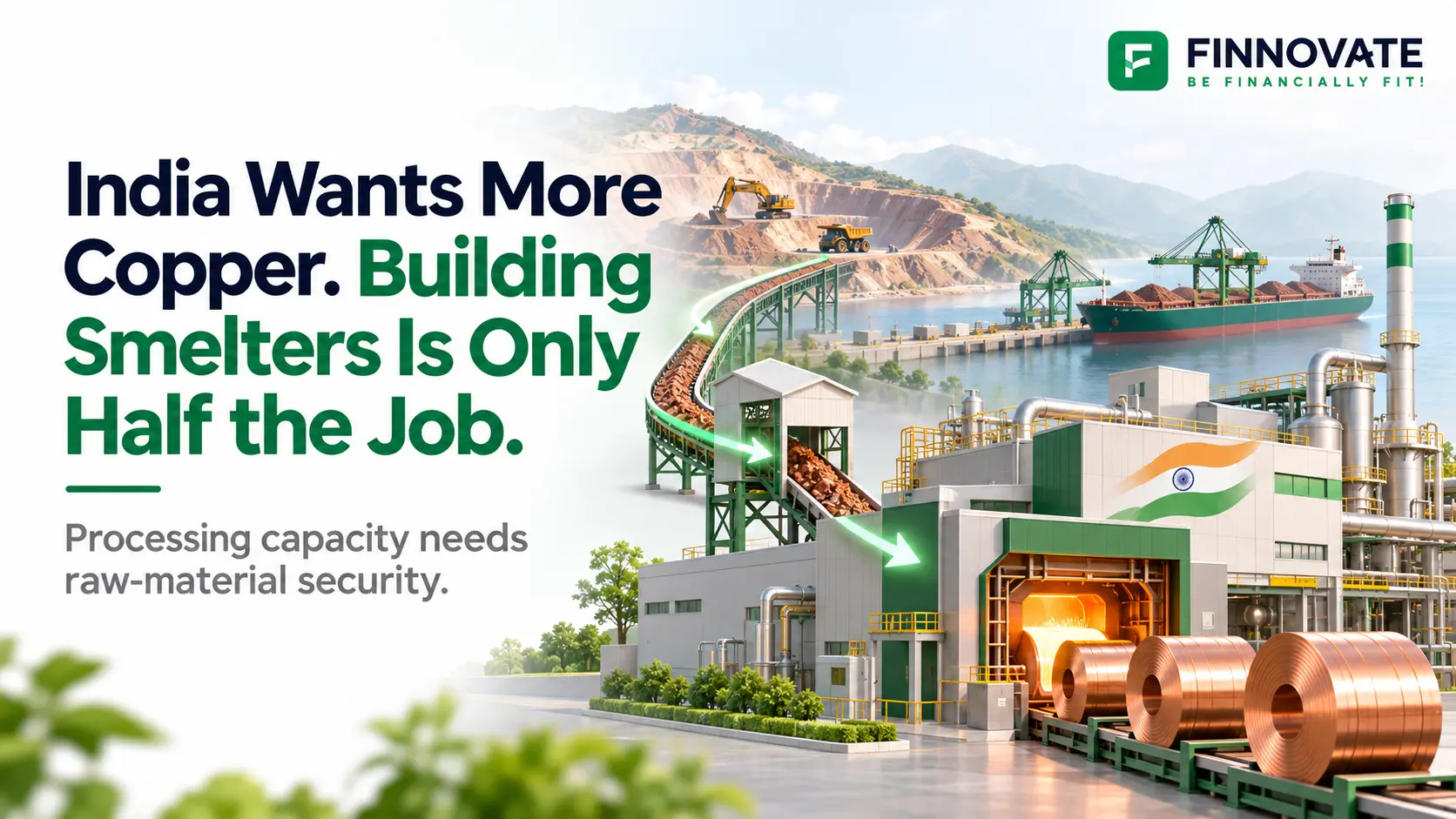
A copper smelter in Gujarat needs machinery, power and a port. But keeping it running also depends on something that may lie thousands of kilometres away: the raw material inside a mine.
That explains why an exploration agreement in northern Chile matters to India’s industrial plans.
In November 2026, Adani’s Kutch Copper and Chile’s state-owned Codelco announced a memorandum of understanding for a potential exploration partnership at the Kaburkaala copper project. The proposed arrangement would connect overseas resource development with Adani’s copper-processing business in Mundra.
It is still an exploration opportunity, with no announced production date or committed annual supply quantity. But the commercial logic reaches well beyond one project.
India wants more electricity networks, electric vehicles, electronics and data centres. All need copper. Building plants to process the metal is one part of the task. Finding enough material to feed those plants, at a cost that leaves room for profit, is another.
And that is where the copper story becomes interesting.
Many Industries, One Shared Requirement
Copper is a good conductor of electricity and heat. It is also workable and resistant to corrosion, making it useful across electrical systems.
Its applications stretch from building wiring and motors to transmission networks, electronics and industrial equipment. As more activities run on electricity, more infrastructure is needed to carry and distribute that power.
An electric vehicle needs electrical connections and motors. Charging it requires another layer of equipment. A data centre needs power distribution inside the building and connections to the wider grid.
The demand therefore extends beyond the product people see.
A new factory, charging network or data centre can require copper at several points between the electricity source and the final machine.
Copper demand is tied to the physical work of electrification. Even a digital service depends on equipment, cables and power systems somewhere.
Why Higher Prices Cannot Quickly Produce More Copper
For many manufactured goods, stronger demand can encourage companies to add shifts, install equipment or expand factories.
Mining takes longer.
A promising geological discovery must pass through drilling, resource assessment, technical studies, financing, permits and construction. Roads, water and power may also need to be developed before production begins.
The average discovery-to-production timeline for a new copper mine is around 17 years. That is an industry average, with individual projects taking different paths.
Existing mines face their own problems. Lower ore grades mean processing more rock to obtain the same amount of copper. That can increase energy use, waste handling and costs.
Production is also concentrated geographically. Chile, the Democratic Republic of Congo and Peru together accounted for approximately 49% of global mined copper production in 2025. Disruptions in major producing regions can therefore affect buyers far beyond their borders.
Higher prices can improve the case for investment. They cannot compress every stage of mine development into a few quarters.
The Long-Term Supply Warning
BloombergNEF’s October 2026 outlook projects that a copper supply gap could reach 20 million tonnes by 2050, equivalent to 44% of projected demand. It estimates that substantial investment in new mines would be needed to address the challenge.
That is a forecast built on assumptions about demand and future supply. New projects, recycling, material substitution and changes in consumption can alter the outcome.
Its significance lies in the planning problem.
A manufacturer can announce a new plant relatively quickly. The mine expected to supply its raw material may need years of work before it produces anything.
Companies making long-term investments must therefore think beyond today’s copper price. They need to consider whether suitable supplies will be available when their own operations expand.
That leads to a less obvious question: who earns more when copper becomes scarce?
A Copper Boom Can Still Be Difficult for a Smelter
Copper moves through several stages before it becomes a cable or an electrical component.
Ore is mined and processed into copper-rich material known as concentrate. Smelters and refineries then turn that material into high-purity metal. Manufacturers use the metal to make rods, wires and other products.
Each stage has a different business model.
A miner benefits from higher selling prices if production and costs remain under control. A processor must first obtain enough feedstock and earn a return from treating it.
When smelting capacity expands faster than concentrate supply, more plants compete for the same raw material. That gives suppliers greater bargaining power and can push processing fees lower.
The IEA documented this pressure in March 2026: high copper prices were accompanied by severe stress on treatment and refining charges. Plants connected to mines and independent processors faced different levels of exposure.
A simple comparison helps explain the investment implications:
| Business | Main commercial exposure | What to examine |
|---|---|---|
| Copper miner | Copper prices, ore quality and production costs | Output, costs, mine life and project execution |
| Smelter or refiner | Feedstock availability and processing economics | Supply contracts, processing fees, energy costs and by-product income |
| Cable or equipment maker | Copper input costs and customer pricing | Ability to pass on costs, demand and working capital |
Scroll horizontally to view the full table.
For a cable maker, higher copper prices can increase the money tied up in inventory and customer payments. Even when contracts allow price increases, the business may need more funding to support the same physical sales volume.
“Copper exposure” can mean very different things for different companies.
India’s Dependence Begins Before the Refinery
India’s Ministry of Mines identifies the raw-material challenge clearly.
Its 2025 Copper Vision Document states that more than 95% of India’s copper concentrate requirement is met through imports. That figure concerns feedstock for processing, rather than every form of copper consumed in the country.
A country can expand domestic refining and reduce its need to import finished metal while continuing to depend heavily on foreign mines.
The investment still creates value. Local plants can support manufacturing, logistics, employment and downstream industries. But the overseas supply relationship remains central to their operation.
That is why processing capacity and raw-material access need to develop together.
A large plant with unreliable feedstock can struggle to maintain output. A plant that obtains material only on unfavourable terms can operate at weak margins.
The task is to keep the facility supplied on terms that make the whole business workable.
Why the Chile Agreement Fits This Strategy
The Kaburkaala proposal gives Kutch Copper a route to participate earlier in the supply chain.
The announced arrangement combines Adani’s proposed capital contribution and project capabilities with Codelco’s geological knowledge. It follows an earlier agreement and an evaluation of potential projects.
For an Indian processor, overseas exploration offers the possibility of a future connection to mined supply. For the resource owner, a partner can help fund exploration and share development risks.
Exploration must establish what is present and whether it can be extracted economically. A commercially viable project would still need further studies, approvals, financing and construction.
The agreement is therefore best understood as an investment in a possible future supply route.
Its broader relevance is that Indian companies are looking beyond buying material after it reaches the market. They are exploring ways to participate in the projects that could produce it.
Why Warehouse Stocks Tell Only Part of the Story
Copper availability also depends on location.
Metal can accumulate in one market while buyers elsewhere face tighter conditions. Expected tariffs, freight costs and price differences between exchanges can encourage traders to move inventory.
The IEA has identified uncertainty over US tariffs as one factor behind the build-up of copper inventories in the United States.
Warehouse holdings should therefore be read alongside their commercial context. Privately owned exchange inventory is different from a government strategic reserve.
For an industrial buyer, the practical questions are straightforward: where is the metal, who can sell it, and what will delivery cost?
Holding extra inventory can protect against disruption. It also ties up cash and creates storage, financing and price risks. A stockpile buys time; a dependable supply network supports continuing operations.
India Needs More Than One Supply Route
Overseas partnerships are part of a wider response.
Long-term purchase agreements can improve supply visibility, while relationships across several producers can reduce dependence on one location.
Domestic mine expansion can add local supply where geology and project economics support it.
Recycling can recover copper from equipment, cables and other scrap. Its contribution depends on collection systems, processing capacity and the availability of material reaching the end of its useful life.
Material efficiency and substitution can reduce the amount of new copper required. Aluminium can replace copper in some applications, although design, space and performance requirements affect where that works.
These measures address different parts of the problem. Recycling cannot immediately recover copper from a grid installed last year. A new exploration project cannot meet next month’s delivery requirement. A purchase contract helps access supply but does not create a new deposit.
A stronger supply strategy combines near-term procurement with longer-term resource development.
The Investment Question Goes Beyond Copper Prices
Copper demand offers a compelling link between electrification and industrial growth. Turning that demand into shareholder returns depends on where a company operates in the supply chain.
For miners, production and costs matter alongside the metal price. For processors, feedstock and processing margins deserve close attention. For manufacturers, pricing power and working capital can determine how much growth reaches profits.
India’s ambitions will require more copper. The companies serving those ambitions need more than capacity announcements.
They need access to raw material, workable contracts and projects that deliver.
The next phase of the copper story may be shaped as much by who can obtain reliable supplies as by where the metal’s price goes next.
Sources
- Codelco: Kaburkaala exploration partnership announcement
- Adani: Kutch Copper and Codelco memorandum of understanding
- Ministry of Mines: Copper Vision Document
- BloombergNEF: Transition Metals Outlook 2026
- S&P Global: Copper supply, demand and mine-development timelines
- USGS: World Minerals Outlook
- IEA: Copper prices and pressures on smelters