

FPI Flows First Half September 2026: $1.47 Billion Net Selling
FPIs net sold $1.47 billion in Indian equities during September 1–15, 2026. Explore sect...
23 September 2026
Trigger: SEBI Chairman's address at ET NOW Market Summit, June 12, 2026
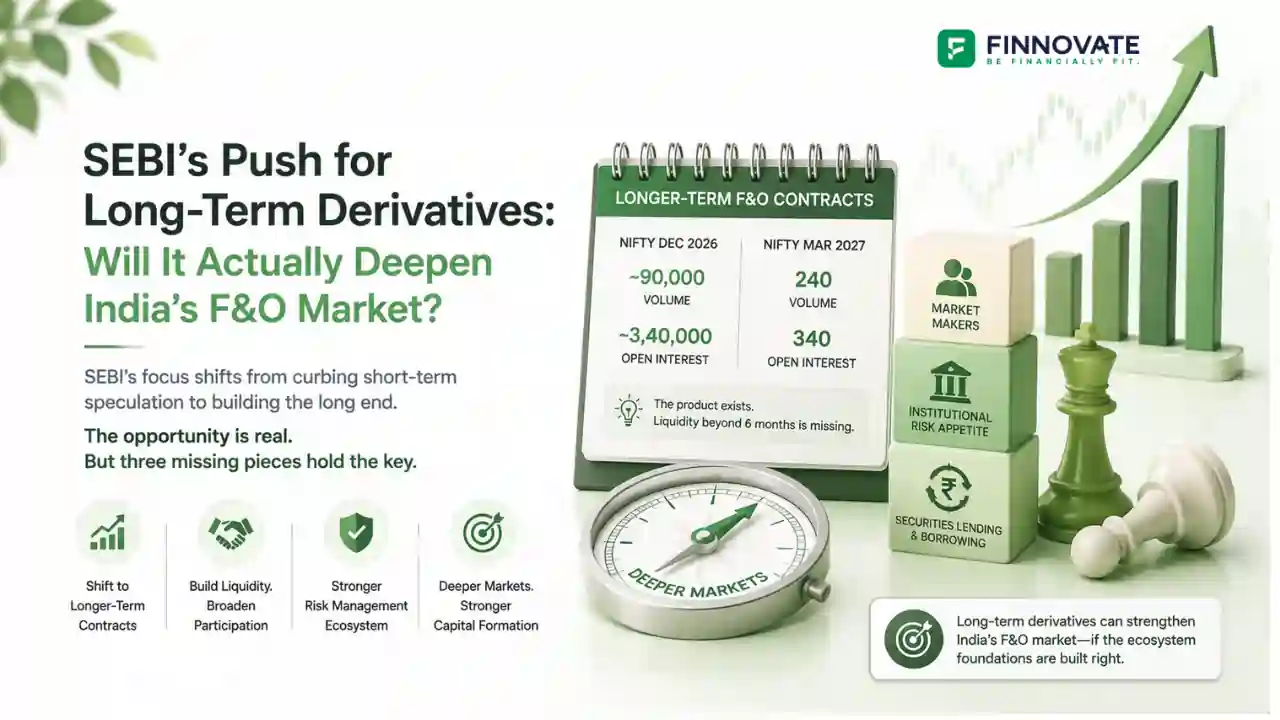
On June 12, 2026, SEBI Chairman Tuhin Kanta Pandey signalled a significant shift in the regulator's direction for India's derivatives market. Speaking at the ET NOW Market Summit in Mumbai, he stated that "development of longer-term futures and options contracts in the equity derivatives market will be an important part of deepening the capital markets." The announcement is notable for what it represents: after years of restricting short-term speculative derivatives activity, SEBI is now looking to build out the long end of the F&O curve.
But long-term derivatives in India are not a new concept. They already exist. The question is why they have not taken off, and whether SEBI's intent, without addressing the structural reasons for their failure so far, will produce a different outcome this time.
Quick read
India became the world's largest derivatives market by volume, with notional turnover of $6.4 trillion per day and annual option premiums of $2.2 trillion in 2024. But SEBI's own study found that 93% of individual F&O traders lost money. The regulator responded from November 2024 with a series of structural restrictions:
Those measures targeted the short end of the F&O curve (weekly expiries that had become instruments of speculative retail participation). The new direction targets the opposite end: extending contracts further out in time to encourage institutional hedging, long-term position-taking, and more structured risk management. The logic is sound. The implementation challenge is significant.
Before evaluating what SEBI is proposing, it is worth understanding the current state of long-term derivatives in India. Nifty, Bank Nifty, and Nifty Next already offer quarterly options contracts extending beyond the standard three near months. On individual stocks, the current structure offers only the near month, mid-month, and far month.
| Nifty Contract Expiry | Combined Call + Put Volume (June 12, 2026) | Total Open Interest | Liquidity Assessment |
|---|---|---|---|
| December 2026 | ~90,000 contracts | ~3,40,000 contracts | Fair: some institutional activity |
| March 2027 | ~240 lots | ~340 lots | Negligible: functionally illiquid |
| Beyond March 2027 | Near zero | Near zero | Non-existent |
The volume cliff between December 2026 and March 2027 is stark. This is not a function of investors being unaware of longer-dated contracts. It is a function of the structural problems that make these contracts unattractive to both buyers and sellers.
Even in the relatively liquid December 2026 Nifty contracts, bid-ask spreads on in-the-money (ITM) calls and puts are materially higher than near-month equivalents. By the time you move to March 2027 contracts, bid-ask spreads on most strikes become so wide as to make the contracts uneconomic for most use cases. A wide bid-ask spread is effectively a transaction tax on every entry and exit: the longer the contract, the more uncertainty in pricing, and the wider the spread. Without market makers obligated to post tight two-sided quotes, this problem does not self-correct.
For option buyers, the risk is capped at the premium paid. But for option sellers, who are essential to any functioning long-dated derivatives market, the daily mark-to-market margin requirement can be severe. Unlike futures, option premiums have no circuit filter limiting how much they can move in a single day. A seller of a long-dated put option on a volatile index can face sudden large margin calls if market conditions shift. This is a meaningful deterrent for the institutional sell-side, which is exactly the counterparty that needs to exist in volume for LEAPS to function.
For long-dated derivatives (known in mature markets like the US as LEAPS, or Long-term Equity AnticiPation Securities) to function in India, three structural elements must be in place before the product can be expected to attract meaningful participation.
| Missing Link | Why It Matters | Current State in India |
|---|---|---|
| Market Makers with Tight Spreads | Without market makers obligated to post continuous two-sided quotes at narrow spreads, long-dated contracts remain illiquid. Wide spreads make entries and exits expensive, deterring both hedgers and speculators. Market making is the first condition, not an afterthought. | Market making exists in India but is not mandatory for long-dated contracts. No exchange currently has a market maker programme specifically for LEAPS-style contracts. |
| Institutional Sell-Side Participation | Long-dated options are bought primarily by large institutions using them to hedge multi-year equity portfolios. For every buyer there must be a seller willing to absorb open-ended risk for months or years. In the US, large banks, insurance companies, and hedge funds play this role. In India, this counterparty base is thin. | India's institutional sell-side in derivatives is dominated by proprietary desks and FPIs. Domestic insurance and pension fund participation in the derivatives sell-side is negligible. Regulatory restrictions limit the universe of eligible sellers. |
| Robust Securities Lending and Borrowing (SLB) | An institution that sells a long-dated call option on a stock needs to be able to borrow that stock and deliver it if the option is exercised. Without SLB, writing covered calls or running stock-replacement strategies is impossible. SLB is the backbone of any healthy long-dated single-stock derivatives market. | India's SLB market is nascent. Volumes are thin, tenures are short, and the universe of lendable securities is narrow. Without reform here, long-term single-stock derivatives (which SEBI explicitly intends to expand) cannot function effectively. |
In the United States, LEAPS (Long-term Equity AnticiPation Securities) are exchange-listed options with expiration dates more than one year away. They were introduced on the CBOE in 1990 and have become a standard institutional tool for multi-year hedging, stock-replacement strategies, and leveraged long-term positions.
The US LEAPS market works because all three structural conditions are present. Market makers are obligated to maintain continuous two-sided quotes. The institutional sell-side (banks, insurance companies, hedge funds) actively writes LEAPS as part of structured product creation and portfolio management. And the US stock lending market is deep and liquid, making stock-covered LEAPS strategies viable at scale.
India is not starting from zero. It has the exchange infrastructure, the legal framework, and a growing institutional investor base. But the cart is not yet in front of the horse; it is simply not there yet. SEBI's intent on June 12 is a necessary first step. The structural work that must precede the product launch is the more important second step.
SEBI's direction on longer-term F&O contracts is the right policy move for a market that has over-indexed on short-dated speculation. Long-dated derivatives can serve genuine economic functions: corporate hedging of equity compensation plans, institutional portfolio protection, and multi-year structured product creation. But the data from existing long-dated Nifty contracts, where March 2027 liquidity is functionally zero, tells a clear story. The problem is not that investors do not want the product. It is that the market structure does not yet support it. Mandatory market making, SLB reform, and expanded institutional sell-side participation are not nice-to-haves that can follow the product launch. They are preconditions. If SEBI launches long-term stock derivatives without building these foundations first, the contracts will sit on the exchange with thin volumes and wide spreads, exactly as the longer Nifty quarterly contracts do today. Intent is the starting line. Infrastructure is the finish line.
Long-term derivatives are futures and options contracts with expiry dates significantly further out than the standard one to three month contracts. In mature markets, these are known as LEAPS (Long-term Equity AnticiPation Securities). SEBI Chairman Tuhin Kanta Pandey signalled on June 12, 2026 that expanding these contracts is a priority for deepening India's equity derivatives market, with a focus on supporting institutional hedging rather than short-term speculation.
Yes. Quarterly option series extending beyond three months already exist on Nifty, Bank Nifty, and Nifty Next indices. However, liquidity falls off sharply beyond the six-month horizon. On June 12, 2026, Nifty March 2027 contracts had total volumes of just 240 lots and open interest of 340 lots, versus approximately 90,000 combined volumes for December 2026 contracts. On individual stocks, F&O is currently available only for the near month, mid-month, and far month.
A market maker is an entity obligated to continuously post both buy and sell quotes for a contract at specified maximum spreads. Without market makers, long-dated contracts suffer from wide bid-ask spreads that make them uneconomic for most users. Market makers are essential infrastructure; without them, the product exists on paper but not in practice. Any LEAPS development plan must address market maker obligations as a first step, not an afterthought.
Securities Lending and Borrowing (SLB) allows investors to temporarily borrow shares they do not own to fulfil delivery obligations, for example, when an institution has sold a call option and needs to deliver shares if it is exercised. Without a deep SLB market, institutions cannot safely write long-dated single-stock options. India's SLB market is currently thin in volume and narrow in security eligibility. Reform of SLB is a precondition for any viable long-term single-stock derivatives market.
SEBI's own study found that 93% of individual F&O traders lost money, while proprietary trading desks and foreign institutions consistently profited. The mismatch reflects a structural information and risk management advantage held by sophisticated participants. Short-dated weekly options with tight expiries amplified this dynamic by encouraging high-frequency retail speculation. SEBI's recent restrictions on weekly expiries and higher contract sizes were designed to reduce retail participation in this losing trade. Long-dated contracts, by design, attract different participants with longer time horizons and more structured hedging objectives.
F&O market structure changes affect equity market volatility, institutional behaviour, and ultimately the returns on long-term equity portfolios. The FinnFit Financial Fitness Test takes 3 minutes and shows you whether your portfolio is structured to withstand market volatility and aligned to your long-term goals.
Take the FinnFit TestDisclaimer: This article is for general information and educational purposes only. It does not constitute investment advice, a recommendation, or an offer to buy or sell any securities or financial instruments. References to SEBI's announced intent are based on publicly reported statements at the ET NOW Market Summit on June 12, 2026 and do not represent a formal regulatory circular or rule. Derivatives trading involves substantial risk of loss and is not suitable for all investors. F&O volume and open interest data cited are from a single trading day and are indicative only. Please consult a SEBI-registered investment adviser before making any investment decision involving derivatives.
No spam. Only new posts, simple explainers, and practical money checklists for busy professionals.
Finnovate is a SEBI-registered financial planning firm that helps professionals bring structure and purpose to their money. Over 3,500+ families have trusted our disciplined process to plan their goals - safely, surely, and swiftly.
Our team constantly tracks market trends, policy changes, and investment opportunities like the ones featured in this Weekly Capsule - to help you make informed, confident financial decisions.
Learn more about our approach and how we work with you:
No comments yet. Start the conversation. What would you add?
No spam. Only new posts, simple explainers, and practical money checklists.
You may also like
FPIs net sold $1.47 billion in Indian equities during September 1–15, 2026. Explore sect...

Nearly 39% of India’s monitored coal power plants were critically low on fuel in Septemb...

Tata Sons faces a major governance dispute over N Chandrasekaran’s reappointment, RBI li...
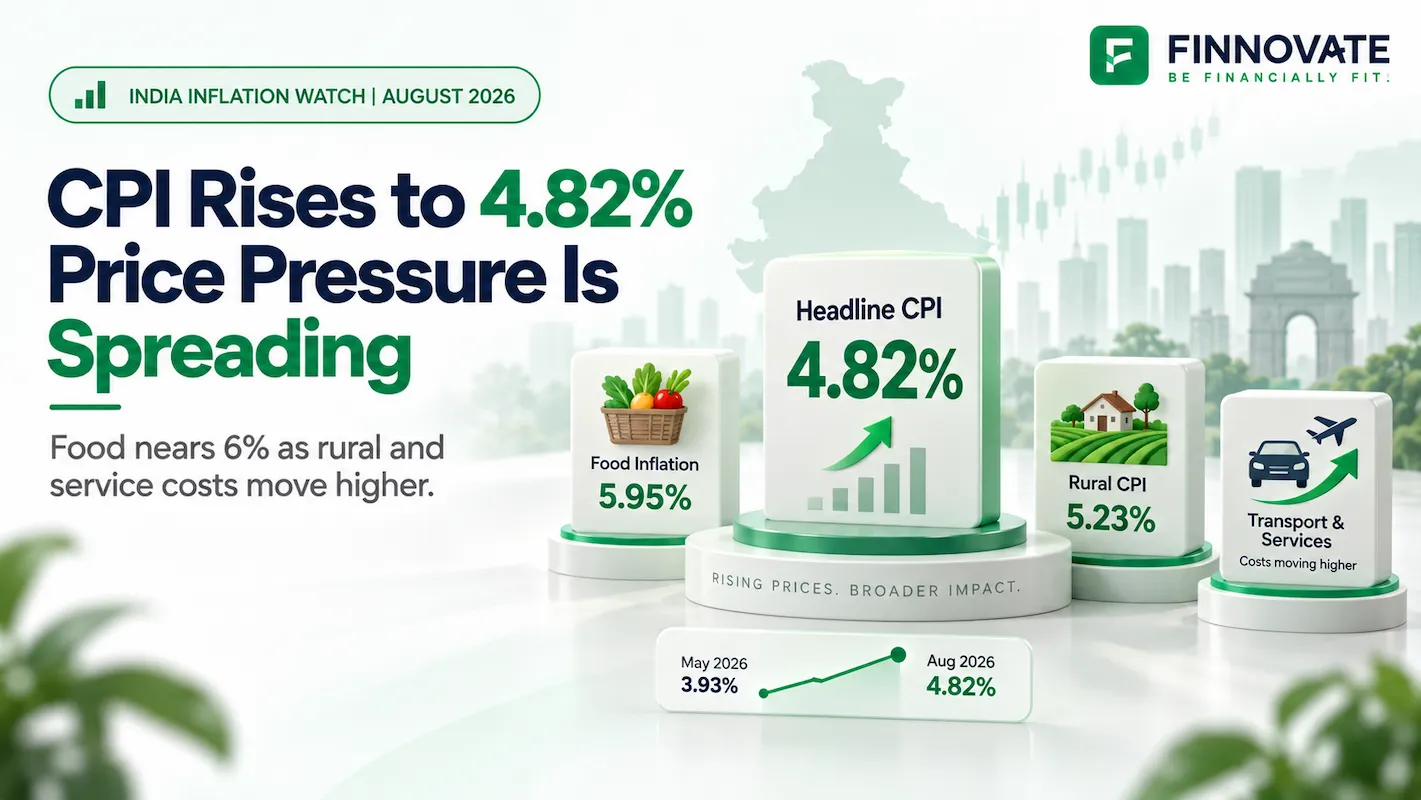
India’s CPI inflation rose to 4.82% in August 2026 as food inflation neared 6% and rural...
Popular now

Learn how to easily download your NSDL CAS Statement in PDF format with our step-by-step g...

Looking for the best financial freedom books? Here’s a handpicked 2026 reading list with...
Learn what SIF investment means in India, SEBI rules, Rs 10 lakh minimum investment, avail...

Clear guide to mutual fund taxation in India for FY 2025–26 after July 2024 changes: equ...