
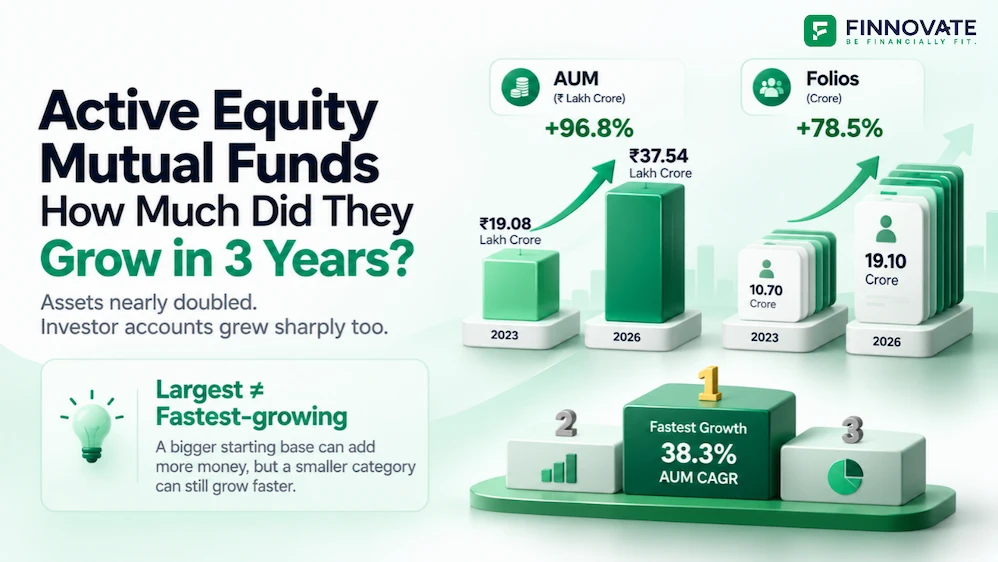
Active Equity Fund Growth 2023–2026: AUM & Folio Rankings
Compare active equity mutual fund growth from September 2023 to September 2026, with categ...
21 October 2026


Finnovate’s editorial team researches and creates financial content using trusted sources, regulatory references and inputs from subject experts.
India’s SIP culture is growing fast. In February 2026, monthly SIP contributions stood at ₹29,845 crore, while the mutual fund industry’s average assets under management for the month stood at ₹83.43 lakh crore. That shows how many investors are choosing the SIP route today. But there is one important distinction many investors miss: starting SIPs is not the same as building wealth.
A lot of investors now have multiple SIPs across multiple funds. On paper, that looks disciplined. In reality, some portfolios are being built with purpose, while others are just growing in count. Funds get added because of recent returns, tax season, app suggestions, or popular categories. Over time, the portfolio starts looking active, but not necessarily structured.
That is the real question behind this article. Are your SIPs helping you build wealth through a proper portfolio, or are they simply increasing the number of mutual funds you own?
Short Answer
If your SIPs are linked to clear goals, matched to your time horizon, and backed by a portfolio where each fund has a defined role, you are more likely building wealth. If you keep adding SIPs without knowing what each fund is supposed to do, you may just be collecting mutual funds. SIP is a useful investing route, but it is not a complete wealth-building plan by itself.
Table of Contents
A SIP helps you invest regularly. It builds discipline. It can reduce the pressure of putting in a large lump sum at one time. That is valuable.
But wealth building needs more than regular investing. It needs a reason behind the investment, a suitable asset mix, the right time horizon, and periodic review. A SIP can support all of that, but it cannot replace it.
This is where many investors get confused. They assume that because they are running multiple SIPs, they must be doing everything right. But the number of SIPs is not the same as portfolio quality. A person with two well-placed SIPs linked to clear goals may be in a better position than someone with seven SIPs added over time without any real structure.
SIP is the mode of contribution. Wealth building is the bigger system around it.
If someone asks why you own a particular fund and your answer is “it was doing well” or “someone suggested it,” that is a weak base. Every fund does not need a long story, but it should have a role.
One year performance often attracts attention. But adding funds because they recently did well can slowly turn your portfolio into a list of past winners rather than a forward-looking plan.
This is where overlap becomes a problem. The portfolio may look diversified because the count is high, but several funds may still be doing very similar jobs.
Retirement, child education, buying a house, and near-term liquidity do not all need the same investment approach. If your SIPs are not mapped to goals, they may be running without direction. Start with the goal-based financial planning framework. Once the target amount and deadline are defined, use the Goal SIP Calculator to check whether your current SIP amount is enough.
If you have reached a point where tracking, reviewing, or understanding your own portfolio feels messy, that is a warning sign. A good portfolio does not need to be complicated to look serious.
This happens because SIP investing has become very easy. Investors can start online in minutes, add a new fund quickly, and respond to every market phase quickly. That ease is good for participation, but it also makes it easy to build a portfolio in fragments.
A common pattern looks like this. One fund is started for tax-saving reasons. Another is added after reading a top-rated list. A third comes from a friend. A fourth is started because a trending category is in focus. A fifth is added because an app suggests diversification. None of these actions may look wrong in isolation. But together, they can create a portfolio with no common logic.
There is also one popular assumption behind many such portfolios: more funds must mean better diversification. That sounds sensible, but it is not always true.
Diversification is about spreading risk thoughtfully. It is meant to improve the portfolio’s overall balance. Duplication is different. Duplication happens when multiple funds are giving you broadly similar exposure without adding much new value.
That is why a portfolio should not be judged by how many funds it has. It should be judged by whether each part adds something meaningful.
For investors, the practical lesson is simple. More funds do not automatically mean better diversification. Sometimes they only mean more repetition.
That is also why simplicity should not be seen as a weakness. A simpler portfolio is often easier to review, easier to understand, and easier to stay disciplined with over the long run.
Real wealth-building usually looks quieter than fund collection.
It starts with goals. What is this money for? When will it be needed? How much fluctuation can you realistically handle before you panic or exit?
Then comes structure. Your investments should reflect time horizon, risk fit, and overall allocation. Only after that should product selection come into the picture.
In a well-built portfolio, each fund has a reason to exist. One may support a long-term growth bucket. Another may fit a different part of the overall plan. The point is not to keep expanding the list. The point is to make sure every investment belongs there for a reason.
That is also where review matters. Wealth building is not just about starting SIPs and forgetting everything else. It is about checking whether the current setup still matches your goals and whether every new addition is solving a real need.
Collecting funds is product-first. Building wealth is plan-first.
Use this quick check on your own portfolio:
| Question | What It May Indicate |
|---|---|
| Do you know why each fund is in your portfolio? | Role clarity |
| Are your SIPs linked to specific goals? | Better planning discipline |
| Do some funds look very similar in category or style? | Possible overlap |
| Have you added funds without reviewing older ones? | Portfolio drift |
| Can you explain your SIP strategy in two minutes? | Simplicity and structure |
If several of these questions make you pause, your issue may not be lack of discipline. Your issue may be portfolio design.
Before adding another SIP, ask these four questions:
A SIP without a purpose can easily become just another line item.
If you cannot answer this clearly, adding it may only increase clutter.
That is the real test. More activity does not always mean better investing.
Sometimes the answer is not a new SIP. Sometimes the answer is to review what is already there.
Not Sure If Your SIPs Are Working Together?
If your SIP portfolio has grown over time and you want to understand whether it is aligned with your goals, risk profile, and overall financial life, a proper financial fitness review can help you look at the full picture before making the next move.
Book a Financial Fitness Review with Finnovate to assess your SIPs, portfolio structure, and how they fit into your wider financial goals.
Starting SIPs is a good financial habit. But habits alone do not build wealth.
Wealth usually gets built when regular investing is backed by planning, allocation, and review. If each SIP in your portfolio has a clear purpose and fits into a wider structure, you are likely moving in the right direction. But if your portfolio keeps growing without a plan, you may be active without being organised.
SIP discipline matters. Portfolio design matters just as much.
No. Diversification is about spreading risk thoughtfully. A higher number of SIPs can still lead to repetition if multiple funds are giving similar exposure.
Yes. A larger number of funds can make review, tracking, and decision-making harder, especially when there is no clear role for each holding.
Investing regularly is the habit. Building wealth is the bigger process that includes goals, allocation, suitability, and review. SIP supports that process, but it does not replace it.
A simple test is whether you can explain what each SIP is for, how it fits your goals, and why it belongs in your overall portfolio.
No. This article is educational in nature and does not recommend any specific mutual fund, portfolio model, or investment product.
Disclaimer: This article is for educational and informational purposes only and should not be treated as investment, tax, legal, or product advice. Mutual fund investing involves market risk. Please read all scheme-related documents carefully before investing and consult a qualified professional or SEBI-registered investment advisor if you need advice specific to your situation.
No spam. Only new posts, simple explainers, and practical money checklists for busy professionals.
Finnovate is a SEBI-registered financial planning firm that helps professionals bring structure and purpose to their money. Over 3,500+ families have trusted our disciplined process to plan their goals - safely, surely, and swiftly.
Our team constantly tracks market trends, policy changes, and investment opportunities like the ones featured in this Weekly Capsule - to help you make informed, confident financial decisions.
Learn more about our approach and how we work with you:
No comments yet. Start the conversation. What would you add?
No spam. Only new posts, simple explainers, and practical money checklists.
You may also like
Compare active equity mutual fund growth from September 2023 to September 2026, with categ...

Explore September 2026 ETF and index fund flows, with category-wise inflows, outflows, AUM...

Equity fund net inflows rose 30.61% to ₹38,306.55 crore in September 2026. Compare 13 ca...

Equity mutual funds received ₹29,329 crore in August 2026. See which categories saw the ...
Popular now

Learn how to easily download your NSDL CAS Statement in PDF format with our step-by-step g...

Looking for the best financial freedom books? Here’s a handpicked 2026 reading list with...

Learn what SIF investment means in India, SEBI rules, Rs 10 lakh minimum investment, avail...

Clear guide to mutual fund taxation in India for FY 2025–26 after July 2024 changes: equ...