

Shiller CAPE Ratio Above 40: Is the US Stock Market Overvalued?
The Shiller CAPE ratio is near its 1999 peak. Explore what it means for US stock valuation...
09 October 2026

Finnovate’s editorial team researches and creates financial content using trusted sources, regulatory references and inputs from subject experts.
India may soon test a new way to issue and settle corporate bonds.
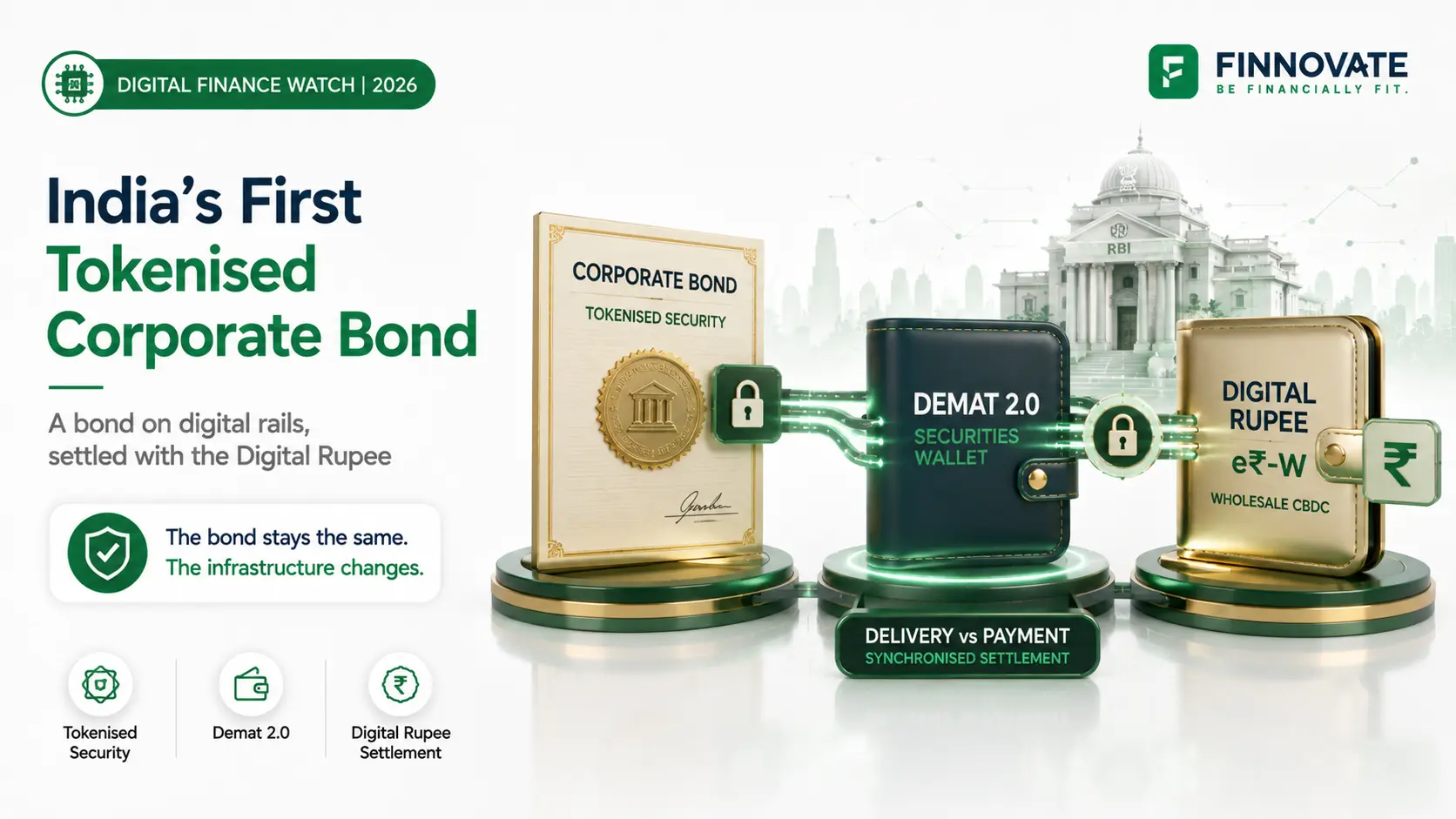
A pilot reported for September 2026 is expected to involve state-owned financier REC issuing India’s first tokenised corporate bond, with an issue size of less than ₹500 crore.
The bond would reportedly use distributed-ledger technology for the securities side and India’s wholesale Digital Rupee, or e₹-W, for payment. Investors in the pilot are also expected to use a new securities wallet being referred to as Demat 2.0.
The bigger story is not the ₹500 crore size. It is whether India can connect a regulated corporate bond, a digital securities ledger and central-bank digital money in one settlement system.
Table of Contents
A corporate bond is debt issued by a company or institution. Investors lend money to the issuer, which promises to pay interest and repay principal according to the terms of the bond.
A tokenised corporate bond is still a bond.
The difference is in the infrastructure used to represent ownership and transfer the security. Instead of relying only on conventional securities records, ownership can be represented digitally on distributed-ledger technology, or DLT.
A tokenised REC bond would not be Bitcoin, Ether or another crypto asset. The digital token would represent a regulated financial security issued by a real-world entity.
Its value and risk would still depend on the issuer, coupon, maturity, prevailing interest rates, credit quality, liquidity and final issue terms.
| Pilot Feature | What Is Currently Reported |
|---|---|
| Expected issuer | REC |
| Expected launch | September 2026 |
| Issue size | Less than ₹500 crore |
| Initial investors | Select participants |
| Securities infrastructure | DLT / blockchain-based |
| Payment | Wholesale Digital Rupee, e₹-W |
| Securities wallet | Reportedly called Demat 2.0 |
| Initial lock-in | Reported three months |
| Secondary market | Reportedly targeted from December |
These are reported pilot details, not final offer terms.
What is officially confirmed is the broader regulatory direction. In May 2026, SEBI said it was examining the potential for tokenisation of bonds to improve accessibility, transparency and efficiency in the corporate bond market.
SEBI also highlighted a larger structural issue: India’s corporate bond market had around ₹59 trillion of outstanding issuance at the end of March 2026, but retail participation remained limited and about 98% of corporate bonds were privately placed.
India already has electronic infrastructure for issuing, holding, trading and settling bonds. Tokenisation is not about making today’s system suddenly digital. It already is.
The experiment is about connecting ownership and payment more directly on programmable infrastructure.
The tokenised bond is recorded in a digital securities wallet using DLT.
The investor uses wholesale Digital Rupee for the money leg of the transaction.
This concept is known as Delivery versus Payment, or DvP.
If both legs are programmed so that one cannot complete without the other, settlement can move closer to atomic settlement: either both sides complete, or neither does.
According to current reporting, Indian depositories are developing a new electronic securities wallet being referred to as Demat 2.0 for the pilot.
It would reportedly hold the tokenised security, while the wholesale CBDC wallet would handle payment.
RBI launched the wholesale Digital Rupee pilot in November 2022, initially for settling secondary-market transactions in government securities.
The logic was straightforward: settlement in central-bank money can reduce the need for some settlement guarantees and collateral used to manage settlement risk.
This is more significant than simply recording a bond on blockchain because every securities transaction requires both the asset and payment to move safely.
Money and securities could potentially move much closer to real time once all conditions are satisfied.
A shared digital ledger can provide a clearer record of transactions and ownership changes.
Participants using synchronised records may reduce some post-trade reconciliation steps.
Some servicing events could eventually be automated through pre-defined rules.
Future systems could potentially automate parts of coupon payments, redemptions or compliance checks.
But faster technology does not mean every surrounding process disappears. KYC, investor eligibility, regulatory reporting, cybersecurity, price discovery and liquidity still matter.
This is the most important investor distinction.
If the issuer cannot repay, blockchain does not solve the repayment problem.
The issuer can still fail to pay interest or principal.
Bond prices can still fall when market interest rates rise.
A tokenised bond may still be difficult to sell at a fair price if there are too few buyers and sellers.
Digital wallets, interoperability, cybersecurity, legal finality and system resilience become important additional considerations.
No such assumption should be made.
REC is a Maharatna Central Public Sector Enterprise, but whether a specific security is secured, unsecured, guaranteed or otherwise supported depends on its final issue documents. Those terms have not yet been publicly released for the proposed pilot.
Based on information currently available, the initial pilot is not being positioned as a general retail offering.
It is reportedly intended for selected participants, and final eligibility conditions have not yet been published.
Wholesale CBDC itself is designed for institutional and large-value financial-market use rather than functioning like the retail e₹ wallet available to individuals.
So investors should not read the pilot as confirmation that blockchain-based corporate bonds will immediately become available to everyone.
Because the amount being raised is not the main experiment.
SEBI says India’s corporate bond market had about ₹59 trillion of outstanding issuance at the end of March 2026, with roughly ₹9.11 lakh crore mobilised through corporate debt markets in FY 2025-26.
Against that scale, a sub-₹500 crore issue is tiny.
If it works, regulators and market institutions can then assess larger questions:
That is why the secondary-market phase may ultimately matter more than the first issuance.
Tokenising one bond proves that a security can be created on the infrastructure. A functioning market would also need to prove that investors can buy, sell, settle, receive payments and handle the full bond lifecycle reliably.
It is a corporate debt security whose ownership and transfers are represented digitally using distributed-ledger technology. It remains a bond and continues to carry credit, interest-rate and liquidity risks.
No. The token represents a regulated financial security issued by a real-world entity. Blockchain or DLT is being used as part of the infrastructure.
REC is reportedly expected to issue the pilot bond in September 2026 for less than ₹500 crore. These details have not yet been formally confirmed in final issue documents.
Demat 2.0 is the name currently being used in reports for a new securities wallet being developed for the pilot. Its final architecture and wider-use rules have not yet been publicly released.
The pilot is expected to use RBI’s wholesale Digital Rupee, e₹-W, for the payment side while the tokenised bond is held on the securities side.
The initial pilot is reportedly for selected participants. Retail participation has not been announced.
No. It may improve settlement and record-keeping, but it does not remove credit risk, interest-rate risk, liquidity risk or the need to evaluate the final issue terms.
Disclaimer: This article is for educational and informational purposes only. It is based on information available as of August 26, 2026. Certain details of the proposed tokenised corporate-bond pilot are based on media reports and have not yet been formally announced in final regulatory or offer documents. Final terms may change. Nothing in this article is an offer, solicitation or investment recommendation. Investors should evaluate the final offer documents, credit risk, liquidity, suitability and their own financial circumstances before investing in any security.
No spam. Only new posts, simple explainers, and practical money checklists for busy professionals.
Finnovate is a SEBI-registered financial planning firm that helps professionals bring structure and purpose to their money. Over 3,500+ families have trusted our disciplined process to plan their goals - safely, surely, and swiftly.
Our team constantly tracks market trends, policy changes, and investment opportunities like the ones featured in this Weekly Capsule - to help you make informed, confident financial decisions.
Learn more about our approach and how we work with you:
No comments yet. Start the conversation. What would you add?
No spam. Only new posts, simple explainers, and practical money checklists.
You may also like
The Shiller CAPE ratio is near its 1999 peak. Explore what it means for US stock valuation...

Can Starlink change internet access in India? Explore why Jio and Airtel signed deals, how...

AI demand is pushing up memory chip prices. Here's why the shortage could make smartphones...

FPIs sold ₹35,861 crore in Indian equities in September 2026. See which sectors saw outf...
Popular now

Learn how to easily download your NSDL CAS Statement in PDF format with our step-by-step g...

Looking for the best financial freedom books? Here’s a handpicked 2026 reading list with...
Learn what SIF investment means in India, SEBI rules, Rs 10 lakh minimum investment, avail...
Clear guide to mutual fund taxation in India for FY 2025–26 after July 2024 changes: equ...