

How India Saves and Invests: Where Household Money Goes
See how Indian households save and invest across deposits, insurance, mutual funds and sto...
07 October 2026
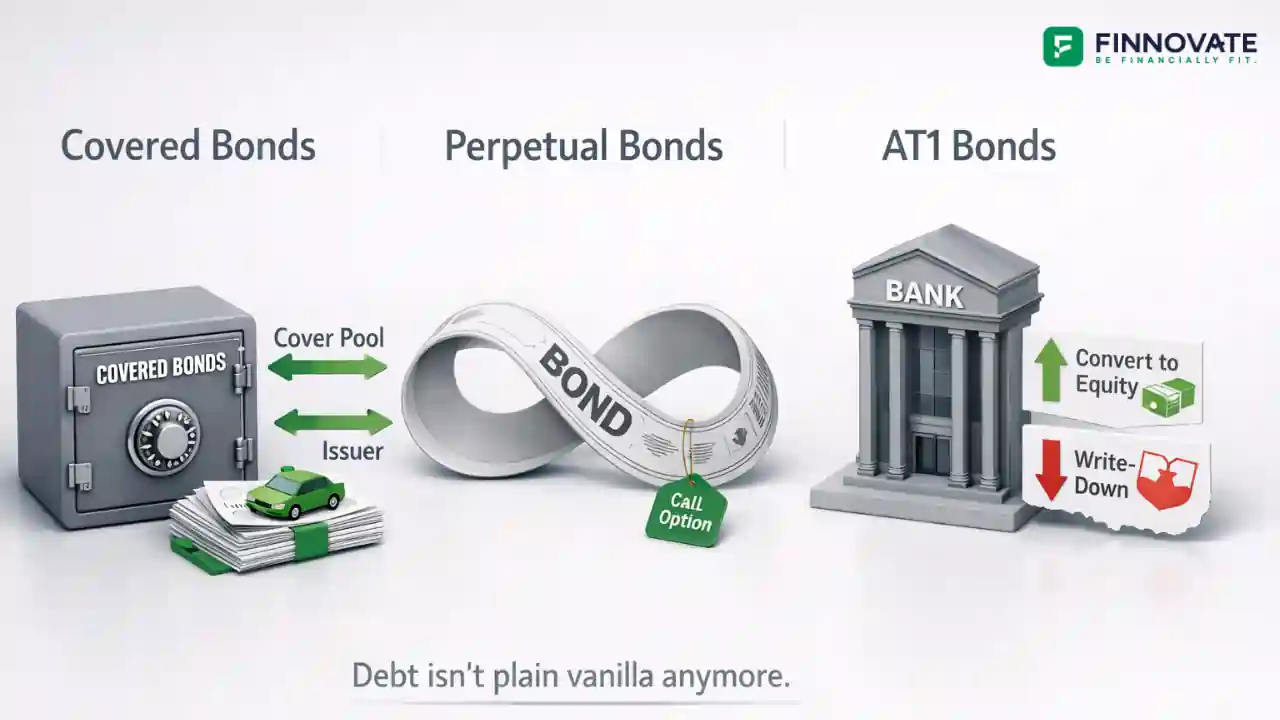
Debt isn’t “boring” anymore. It used to be simple. A company borrows money, you lend it, you get interest, you get principal back on maturity. Done.
But markets hate simplicity. So debt products evolved. Some reduce interim cash outflows for issuers. Some track changing rates. Some stretch duration to ride rate cycles. Some add credit protection. Some can even convert into equity.
In this blog, we’ll focus on three instruments that show how “plain vanilla” debt can quietly turn into something else: Covered Bonds, Perpetual Bonds, and AT1 Bonds, with an Indian context.
Now let’s unpack each.
Even before these three, debt already had “variants”:
Covered bonds, perpetual bonds, and AT1 bonds sit on top of this landscape. They exist because issuers want cheaper or more flexible funding and investors want yield, structure, or both.
A covered bond is a bond where repayments are “covered” by a ring-fenced pool of loans that generate regular cash flows.
Example:
An NBFC has a high-quality car loan pool with strong repayment history. The NBFC itself may be rated AA, but that car loan pool may be even stronger in quality and predictability. So the NBFC issues a bond backed by that pool’s cash flows.
The idea is simple: better collateral and better cash-flow visibility can support better pricing.
Covered bonds are often called dual recourse bonds because investors have two claims:
That dual layer is what makes them feel “safer” than a plain unsecured corporate bond, though “safer” does not mean “risk-free.”
Covered bonds are complex. Key risks include:
Covered bonds are not “magic.” They are just a smarter packaging of risk, with paperwork and rules doing the heavy lifting.

A perpetual bond has no maturity date. Unlike a 5-year bond, there is no fixed promise that the principal will be repaid at a specific time.
So what do you get?
You typically get a coupon payment that can continue indefinitely.
That’s why these instruments are often described as “equity-like,” not because they behave exactly like shares, but because the principal is not scheduled to come back on a defined date.
Most perpetual bonds come with a call option. This means the issuer can choose to redeem the bond after a certain period like 5 years or 10 years.
Why does this matter?
Because the issuer will usually call the bond if it becomes expensive for them.
Example:
- You buy a perpetual bond paying 11%.
- After 5 years, market yields are 7%.
- You, as the holder, love it because you’re earning 4% more than market.
- The issuer hates it because they’re paying above-market costs, so they may call the bond, repay principal, and issue fresh bonds at lower rates.
So while “no maturity” sounds like certainty, the call feature introduces real-world uncertainty.
Normal bonds are often priced using yield-to-maturity (YTM) because maturity exists.
Perpetuals don’t mature. So a common simplified pricing approach is:
Value of a perpetual bond = Annual Rupee Interest / Required Rate of Return
Example from the concept:
- Annual interest (coupon in rupees) = ₹1,000
- Required return = 4% (0.04)
- Value = ₹1,000 / 0.04 = ₹25,000
Now see what rates do:
- If required return falls to 3%, value rises to ₹1,000 / 0.03 = ₹33,333 (approx).
- If required return rises, value falls.
This is why perpetual bond prices can be very sensitive to rate moves.
AT1 bonds (Additional Tier 1) are issued by banks to strengthen their capital base. They became widely discussed after the 2008 global financial crisis, when regulators globally pushed banks to carry more shock-absorbing capital.
Think of AT1 as a tool for banks to meet capital adequacy needs, but the “capital-like” nature comes with tougher terms for investors.
Because they are riskier than traditional bonds.
AT1 bonds are often structured as perpetual instruments, and while issuers may redeem them later (commonly seen around 8–10 years in practice), there is no guarantee.
This is the part many people miss.
In a distress situation, AT1 bonds can:
This is not theoretical. Similar outcomes have occurred in distressed banks in India and globally, depending on the resolution and regulatory triggers.
A typical trigger logic is:
AT1 bonds often attract:
Mostly because yields can look attractive.
But the risks are not just “default risk.” You also face:
AT1 is not “just another high-yield bond.” Its rulebook is different.
| Feature | Covered Bonds | Perpetual Bonds | AT1 Bonds (Additional Tier 1) |
|---|---|---|---|
| Typical issuer | Banks, NBFCs | Established companies, sometimes financial issuers | Banks |
| Maturity | Has a defined structure, generally treated like a bond with expected repayment | No maturity date | No maturity date (perpetual-like) |
| Coupon | Fixed/structured based on issue terms | Fixed coupon | Higher coupon vs plain bonds (risk premium) |
| Call option | Depends on structure | Common (5–10 years) | Common in practice, but not guaranteed |
| Security / recourse | Dual recourse: cover pool + issuer assets | Generally unsecured, depends on issue | Capital-like instrument, not like senior bonds |
| Key risks | Structure complexity, pool performance, liquidity | Interest rate risk, call risk, reinvestment risk | Write-down risk, conversion risk, bank stress triggers |
| Typical buyer | Conservative investors needing structure (often institutional) | Investors seeking long income stream | Sophisticated investors (HNIs, institutions) |
| Why issuers issue | Lower cost funding, better terms via cover pool | Long-term funding without fixed principal repayment date | Strengthen bank capital and meet adequacy norms |
They are often described as securitised-style structures because repayments are linked to a loan pool. But a key idea in covered bonds is dual recourse: you have a claim on the pool and also on the issuer, depending on structure.
Because a high-quality cover pool can make repayment support stronger and more predictable. If investors trust the pool and structure, the issuer may raise funds at better terms than an unsecured borrowing.
Complexity. You need clarity on how the pool is maintained, what happens if the pool quality drops, and what legal protections exist. It’s not just “credit rating,” it’s also “structure rules.”
Usually through secondary market selling, or if the issuer exercises the call option and redeems the bond. Without a call and without a liquid market, exit can be difficult.
Because the cash flows can extend indefinitely. When rates rise, the present value of long cash flows falls more sharply. When rates fall, the present value rises. That sensitivity is the main driver.
If rates fall, the issuer is more likely to call the bond and refinance cheaper. That means holders lose a high coupon stream and must reinvest at lower yields. So the call option shifts upside away from the holder.
Not guaranteed. Even if past behaviour shows many issuers eventually redeem, the instrument is perpetual by design. The decision depends on issuer choice, market conditions, and regulatory considerations.
Write-down means the bond’s principal value can be reduced, potentially even to zero, under stress triggers or resolution actions. This is a built-in loss-absorbing feature to protect the bank’s stability.
Yes. Conversion to equity is a common mechanism in AT1 structures when capital falls below a threshold. That reduces debt and increases equity, helping the bank’s capital position.
Anyone who treats it like a normal bond. AT1 requires understanding of bank capital triggers, resolution mechanics, and loss absorption terms. It suits investors who can evaluate these risks properly.
Disclaimer: This article is for educational information only. It is not a recommendation to buy or sell any security. Terms and risk features vary by issuer and issue documents, so readers should evaluate suitability and read the relevant offer documents carefully.
No spam. Only new posts, simple explainers, and practical money checklists for busy professionals.
Finnovate is a SEBI-registered financial planning firm that helps professionals bring structure and purpose to their money. Over 3,500+ families have trusted our disciplined process to plan their goals - safely, surely, and swiftly.
Our team constantly tracks market trends, policy changes, and investment opportunities like the ones featured in this Weekly Capsule - to help you make informed, confident financial decisions.
Learn more about our approach and how we work with you:
No comments yet. Start the conversation. What would you add?
No spam. Only new posts, simple explainers, and practical money checklists.
You may also like
See how Indian households save and invest across deposits, insurance, mutual funds and sto...

Received a ₹10 lakh bonus? Learn how to decide between spending, debt repayment, near-te...

Should your emergency fund stay in a savings account? Learn how to split it across savings...
FD vs corporate bonds: compare returns, YTM, safety, liquidity, tax and credit risk to und...
Popular now

Learn how to easily download your NSDL CAS Statement in PDF format with our step-by-step g...

Looking for the best financial freedom books? Here’s a handpicked 2026 reading list with...
Learn what SIF investment means in India, SEBI rules, Rs 10 lakh minimum investment, avail...
Clear guide to mutual fund taxation in India for FY 2025–26 after July 2024 changes: equ...