

The Great Economic Decoupling of 2026: Oil, AI & India
Rising oil prices and booming AI investment are shaping an uneven global economy in 2026. ...
24 October 2026
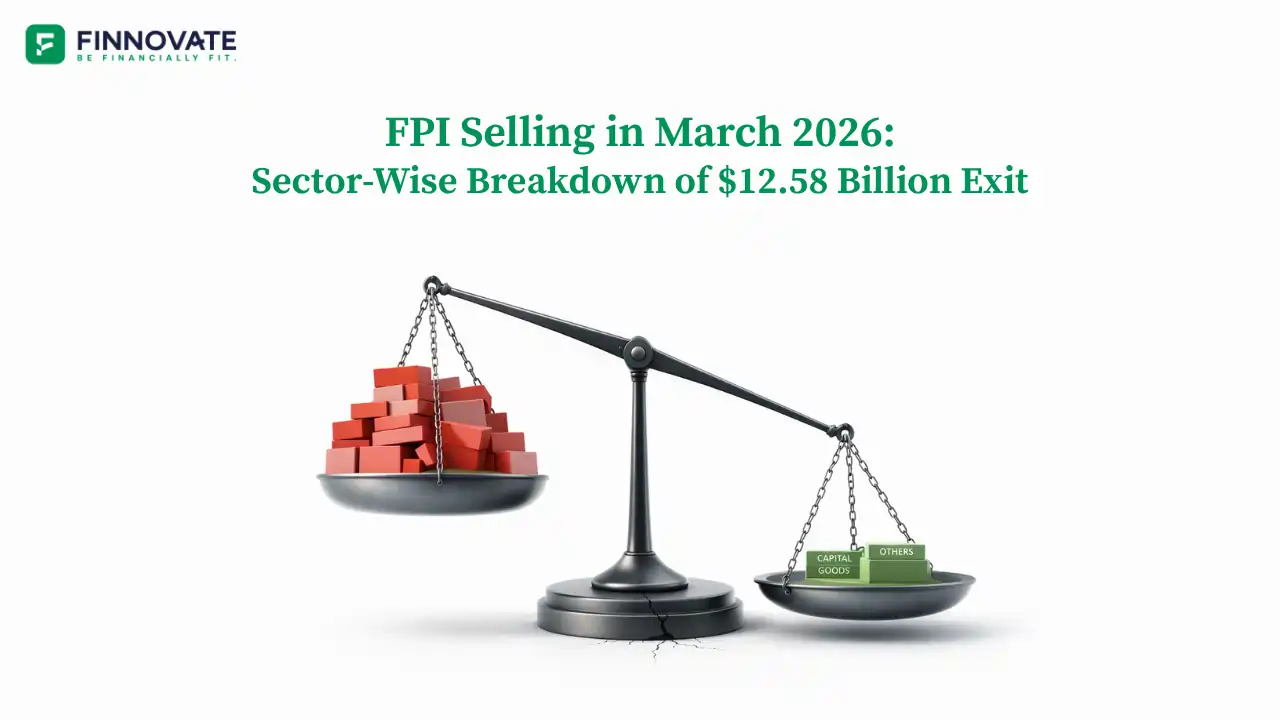
The breadth of FPI selling in March 2026 is what makes it stand apart from previous episodes.
FPIs sold $12.58 billion worth of Indian equities in March, the highest monthly outflow on record. But the number alone does not capture the full picture. Net selling was recorded in 21 of 23 sectors tracked by NSDL. FPIs were net sellers on every single trading day of the month. And FPI equity assets under custody fell by approximately $130 billion in a single month, dropping to $660 billion, nearly 30% below the September 2024 peak of approximately $930 billion.
This article covers the complete sectoral breakdown of March 2026 FPI flows, the three triggers that drove the sell-off, why BFSI absorbed the largest hit, and what the AUC data signals about where FPI positioning stands entering FY27.
| Metric | Figure |
|---|---|
| Total FPI equity selling in March 2026 | $12.58 billion |
| Sectors in net selling | 21 of 23 |
| Sectors in net buying | 2 (Capital Goods, Others) |
| First fortnight selling | $5.70 billion |
| Second fortnight selling | $6.88 billion |
| FPI equity AUC end-March 2026 | ~$660 billion |
| FPI equity AUC September 2024 peak | ~$930 billion |
| Decline from peak | ~29% |
| Overall FPI AUC (all asset classes) | ~$735 billion |
The table below shows the full NSDL sectoral breakdown of FPI equity flows for March 2026.
| Sector | FPI Flows ($M) | Sector | FPI Flows ($M) |
|---|---|---|---|
| Financial Services (BFSI) | -6,488 | Consumer Services | -225 |
| Automobiles & Components | -1,333 | Information Technology | -202 |
| Construction | -975 | Textiles | -34 |
| Telecommunication | -602 | Chemicals | -24 |
| FMCG | -579 | Power | -23 |
| Realty | -501 | Diversified | -2 |
| Healthcare | -497 | Media & Entertainment | -2 |
| Oil & Gas | -443 | Utilities | -2 |
| Construction Materials | -336 | Forest Materials | -1 |
| Metals & Mining | -332 | Others | +267 |
| Consumer Durables | -311 | Capital Goods | +343 |
| Services | -275 | Grand Total | -12,577 |
Two observations stand out immediately. The selling was not concentrated in two or three sectors. It spread across every category from large-cap BFSI to niche segments like Textiles and Chemicals. Capital Goods was the sole meaningful bright spot, attracting $343 million in net FPI buying even as everything else sold off.
The US-Iran conflict, which began on 28 February 2026, triggered a global risk-off move that hit India particularly hard. India depends on the Middle East for the bulk of its crude oil and gas procurement. The conflict forced the government to ration gas allocation to non-priority industries, creating direct economic disruption beyond oil prices. India's structural energy vulnerability made it one of the emerging markets most exposed to a sustained West Asia shock.
As FY27 projections began flowing in during March, the numbers were unfavourable. CPI inflation forecasts moved up sharply, with ICICI Bank projecting 4.5% and Goldman Sachs 4.6%, against just 2.1% in FY26. GDP growth estimates were cut materially, with Goldman Sachs reducing its 2026 calendar year forecast to 5.9%. For FPIs calibrating India exposure to a risk-return model, a simultaneous inflation spike and growth slowdown is a difficult combination to stay invested through.
The rupee weakened from approximately ₹91 per dollar before the conflict to ₹95 by end-March. FPIs invest and exit in dollars, so rupee depreciation erodes returns directly. A Nifty delivering 3% in rupee terms but losing 4% on currency conversion produces a negative dollar return, incentivising further selling that weakens the rupee further. Despite RBI intervention, FPI sentiment on the rupee remained cautious through the month.
At $6.49 billion, BFSI alone accounted for 51.5% of all FPI selling in March 2026. That concentration reflects two separate but compounding dynamics.
The first was macro-driven. BFSI is consistently the most vulnerable sector to any economic shock. Rising rates, a weakening currency, slower growth, and wider credit spreads all affect banks and financial services companies directly. In a month where all three macro variables moved adversely, BFSI was the first exit for any FPI reducing India exposure.
The second was company-specific. HDFC Bank, India's largest private sector bank and one of the highest-weighted stocks in Nifty, experienced a sharp governance shock in March. On 18 March 2026, part-time chairman Atanu Chakraborty resigned citing ethical concerns. Three senior executives were subsequently terminated following an internal probe into alleged AT-1 bond mis-selling in the bank's Gulf operations. We covered the governance implications of this episode in detail here. FPIs reduced their HDFC Bank stake from 47.67% to 44.05% in Q4 FY26, a reduction of approximately ₹35,000 crore. Given HDFC Bank's index weight, that selling had a compounding effect on the entire BFSI flow figure.
Auto sector FPI selling reflected a convergence of concerns. Gas rationing to non-priority industries began directly affecting manufacturing supply chains. Input cost inflation from higher crude derivatives added margin pressure. Weak consumer demand signals for discretionary categories compounded the picture. For a sector that had seen strong FPI interest through much of FY25 and early FY26, March marked a sharp reversal.
Construction saw nearly $1 billion in net selling due to concerns about a slowdown in government capital expenditure as the fiscal year closed. Realty was hit by a combination of demand concerns from rising borrowing costs and the broader risk-off environment. Both sectors are highly sensitive to domestic macro conditions, and the March shock made FPIs reassess near-term earnings visibility in both.
Healthcare, FMCG, and Telecom saw net selling of $497M, $579M, and $602M respectively. These sectors are typically defensive holdings and are usually among the last to be sold. The selling in March appears largely attributable to passive index-level redemptions rather than sector-specific concerns. When large passive funds reduce India exposure, they sell the index, and defensives get sold as part of that basket regardless of their underlying business quality.
Capital Goods attracted $343 million in net FPI buying in March, making it the standout exception in an otherwise uniformly negative month. Companies like L&T are expected to benefit materially from reconstruction activity in the Middle East once the conflict subsides. FPIs are also positioning for a revival of domestic capex in FY27, with both government and private sector investment expected to pick up. Capital Goods sits at the intersection of both themes, which explains why FPIs maintained buying interest even as they exited everything else.
Assets Under Custody is a more complete measure of FPI positioning than monthly flows alone. AUC reflects both net buying/selling and the price movement of existing holdings. A falling AUC means FPIs are losing exposure through a combination of active selling and falling market prices.
In March 2026, FPI equity AUC fell from approximately $790 billion to $660 billion, a decline of roughly $130 billion in a single month. Three numbers contextualise this:
AUC recovery requires not just a return of FPI inflows but also market price recovery and rupee stabilisation. All three factors need to move in the same direction for FPI AUC to regain meaningful ground.
We covered the daily flow dynamics and the rupee-FPI cycle in detail in two earlier pieces: FPI Selling in March 2026: The $12.3 Billion Equity Sell-Off and FPI Selling in Early March 2026.
The breadth of March 2026 FPI selling, specifically 21 of 23 sectors in net selling, raises a question: was the war's impact structural or peripheral? Three observations from the data are relevant.
| Observation | What It Suggests |
|---|---|
| Selling was uniform across both fortnights | This was not a panic spike that moderated. Sustained risk aversion throughout the month points to a broader repositioning rather than short-term volatility. |
| Capital Goods bucked the trend | FPIs did not abandon India entirely. They rotated toward companies with specific FY27 earnings visibility. Selective logic, not a blanket exit. |
| AUC is 29% below peak despite prior partial recovery | FPI positioning in India had already been declining since September 2024. March accelerated a pre-existing trend rather than creating a new one from scratch. |
The honest answer is that the war's impact is both structural and peripheral depending on the sector. For energy-sensitive sectors and macro variables like inflation, rupee, and rates, the impact is structural and will persist beyond a ceasefire. For sectors like Capital Goods and potentially IT on valuation grounds, the impact may be more peripheral and could reverse once geopolitical clarity returns.
FPIs sold $12.58 billion of Indian equities in March 2026, a new monthly record. Net selling was recorded in 21 of 23 NSDL-tracked sectors, reflecting unusually broad risk-off behaviour rather than sector-specific exits.
Two factors combined. BFSI is the most macro-sensitive sector, directly exposed to rising rates, rupee weakness, and slowing growth. The HDFC Bank governance shock in mid-March, triggered by the part-time chairman's resignation citing ethical concerns, further prompted heavy institutional selling in India's most-weighted private bank stock.
AUC is the total market value of equities held by FPIs, reflecting both net flows and price movement of existing holdings. March's $130 billion AUC decline reflects both active selling of $12.58 billion and the sharp rupee and equity market correction that eroded the dollar value of remaining FPI holdings simultaneously.
FPIs are positioning for two specific themes: Middle East reconstruction activity post-conflict, and a domestic capex revival expected in FY27. Companies like L&T sit at the intersection of both, giving this sector specific earnings visibility that justified buying even in a broad risk-off environment.
Past episodes show broad FPI selling is typically followed by sharp recoveries once the external trigger eases. Crude price normalisation, rupee stabilisation, and geopolitical clarity in West Asia are the key variables to watch. Please consult a SEBI-registered investment adviser before making any investment decisions based on FPI flow data.
Disclaimer: This article is for general information and educational purposes only. It does not constitute investment advice, a recommendation, or an offer to buy or sell any securities or financial instruments. FPI flow data, AUC figures, and sectoral breakdown referenced in this article are based on NSDL data and Finnovate Research, and are subject to revision. Past FPI flow patterns are not indicative of future outcomes. Please consult a SEBI-registered investment adviser or qualified financial professional before making any investment decision. Equity investments are subject to market risks.
No spam. Only new posts, simple explainers, and practical money checklists for busy professionals.
Finnovate is a SEBI-registered financial planning firm that helps professionals bring structure and purpose to their money. Over 3,500+ families have trusted our disciplined process to plan their goals - safely, surely, and swiftly.
Our team constantly tracks market trends, policy changes, and investment opportunities like the ones featured in this Weekly Capsule - to help you make informed, confident financial decisions.
Learn more about our approach and how we work with you:
No comments yet. Start the conversation. What would you add?
No spam. Only new posts, simple explainers, and practical money checklists.
You may also like
Rising oil prices and booming AI investment are shaping an uneven global economy in 2026. ...

Explore FPI equity flows for October First Half, 2026: ₹47,955 crore in net outflows, th...

Understand the India–Mauritius tax treaty’s Principal Purpose Test, its August 2026 ef...

Explore India’s AI hardware opportunity through the proposed Adani–Jabil venture, from...
Popular now

Learn how to easily download your NSDL CAS Statement in PDF format with our step-by-step g...

Looking for the best financial freedom books? Here’s a handpicked 2026 reading list with...

Learn what SIF investment means in India, SEBI rules, Rs 10 lakh minimum investment, avail...

Clear guide to mutual fund taxation in India for FY 2025–26 after July 2024 changes: equ...