
Nifty Sector Performance September 2026: IPO, Pharma & Metal Lead
Compare 19 sector and thematic indices with Nifty 50 for September 2026, covering monthly ...
01 October 2026
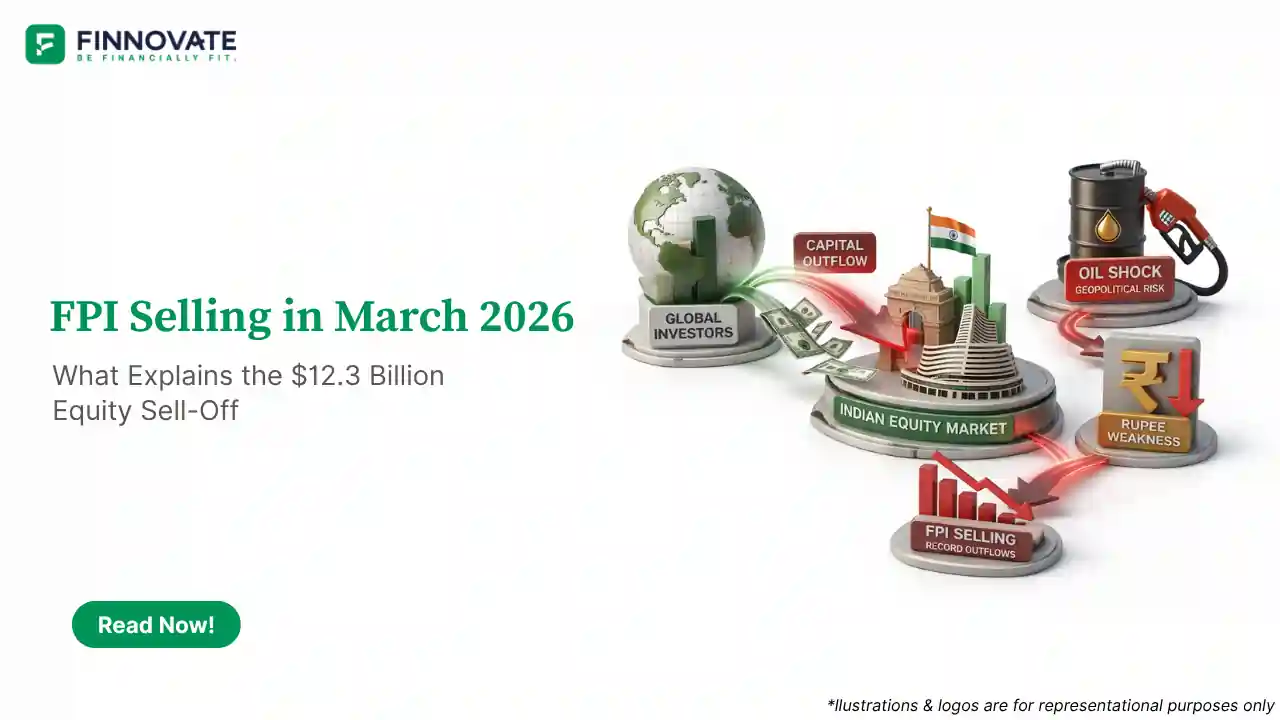
March 2026 will be remembered as the worst month for foreign portfolio investor flows in Indian equity market history.
FPIs sold ₹1,13,810 crore worth of Indian equities in March, equivalent to approximately $12.3 billion. This surpasses the previous record of ₹94,017 crore seen in October 2024. What made this episode particularly striking was not just the size but the consistency. FPIs were net sellers on every single trading day across 17 sessions. That kind of uninterrupted selling is rare and signals something beyond routine profit-booking or portfolio rebalancing.
This article breaks down what drove the sell-off, why the rupee made it worse, what it implies for India's macro outlook, and what investors should be thinking about in this environment.
| Metric | Figure |
|---|---|
| FPI equity outflows in March 2026 | ₹1,13,810 crore (~$12.3 billion) |
| Trading sessions in which FPIs were net sellers | 17 out of 17 |
| IPO inflows offsetting gross selling | ₹4,284 crore |
| FPI debt outflows in March 2026 | ~$1 billion |
| March 2026 share of total 2026 FPI outflows | ~90% |
| Previous monthly outflow record | ₹94,017 crore (October 2024) |
| Rupee level by end of March | ~₹94.60 per US dollar |
The primary trigger was the US-Iran conflict that began on 28 February 2026 and the subsequent disruption to shipping through the Strait of Hormuz.
The Strait of Hormuz is one of the world's most critical energy chokepoints. According to the International Energy Agency and the US Energy Information Administration, approximately 20% of global oil consumption and 20% of global LNG trade passes through this narrow waterway daily. India is among the most exposed countries to any disruption here. India imports approximately 85% of its crude oil requirements, and a significant share of that supply transits the Strait.
The impact of the closure was immediate and severe:
The key concern for India is not just the immediate oil price spike. Even if the conflict de-escalates, the lag effects of higher freight costs and elevated insurance risk pricing may persist for considerably longer. Goldman Sachs scenario analysis projects Brent at $80 in Q4 2026 if Hormuz normalises by mid-April, or $100 to $115 if disruptions persist. That elevated oil baseline has direct implications for inflation, the current account, and India's fiscal position. Gas rationing has begun affecting several industries. These are not short-term ripples. They are structural pressures building.
We covered the detailed daily flow data from the first nine trading days of this sell-off in a separate piece: FPI Selling in Early March 2026.
For FPI flows, the rupee does not act as a passive bystander. It acts as an accelerant.
FPIs bring dollars in and take dollars out. Every investment they make in Indian equities is exposed to currency risk. If the Nifty delivers 3% returns in rupee terms but the rupee weakens by 4% against the dollar, the FPI ends up with a negative dollar return of approximately 1%. The local market gain is entirely erased by currency loss.
This creates a self-reinforcing cycle:
With the rupee already at approximately ₹94.60 per dollar by end of March, and no immediate catalyst for stabilisation, this cycle has been running hard. The rupee has weakened over 4% against the dollar in 2026 so far, following a 4.7% decline in 2025.
It is worth noting that February 2026 had seen a brief reversal of this pattern, with FPIs bringing in ₹22,615 crore in net equity inflows, the highest monthly inflow in 17 months. That reversal evaporated entirely once crude crossed $100 and the rupee came under pressure. We covered what drove that rebound and why it proved short-lived here: FPI Buying in February 2026.
RBI intervention through dollar sales provides some support, but the scale of FPI outflows and broader dollar strength driven by elevated US Treasury yields limits how much the central bank can do without depleting reserves.
The West Asia conflict has forced a rapid rethink on India's FY27 macro assumptions, with revisions moving in the wrong direction across all three key variables.
Goldman Sachs raised its 2026 India inflation forecast to 4.6%, up from 3.9% before the conflict began. The RBI had projected inflation at 4% for Q1 FY27 and 4.2% for Q2 FY27. Those projections were made before crude crossed $100. The pass-through from higher oil and gas prices into headline CPI has historically been significant for India, given the weight of fuel, transport, and food in the consumer price basket.
Goldman Sachs cut its 2026 India GDP forecast to 5.9%, down from a pre-conflict projection of 7%, a reduction of approximately 110 basis points. For FY27, the estimate was trimmed to 6.4% from 6.9%. The concern is not only the direct impact of higher oil import costs. It is the knock-on effect on consumer purchasing power, corporate margins, and investment sentiment if energy costs remain elevated for an extended period.
Goldman Sachs has flagged the possibility of a 50 basis point RBI rate hike in 2026, primarily to defend the rupee and manage inflation pass-through rather than to cool a demand-driven economy. The RBI has held the repo rate at 5.25% as of its last meeting. A 50 bps hike would bring it to 5.75%. Higher rates increase the cost of capital used to discount future corporate earnings, which can compress equity valuations. The RBI's challenge is significant: rate hikes help stabilise the currency but depress equity valuations, while holding rates steady keeps valuations supported but allows rupee weakness to continue.
FPI selling of this magnitude does not mechanically translate into a view on what Indian equities will do next. History shows markets can recover sharply once the external trigger begins to ease. But the current environment carries specific signals worth considering.
Domestic institutional investors have been absorbing.
DIIs purchased approximately ₹1,16,586 crore in the same period that FPIs were selling. Mutual fund SIP flows remain intact. Domestic capital has been a meaningful buffer, but it has not been able to fully offset the FPI exit pressure.
The oil-rupee-rate nexus is the key variable to watch.
The pace at which crude normalises, the rupee stabilises, and the RBI's policy path becomes clearer will determine when and how FPI flows reverse. These three variables are interconnected and largely dependent on the geopolitical situation in West Asia.
Historically, sectors with high FPI ownership have seen more selling pressure during risk-off episodes.
Financial services bore the largest share of FPI selling in March, with outflows of over ₹31,800 crore in that sector alone. Understanding where FPI concentration is highest helps investors contextualise which parts of their portfolios face the most near-term pressure from continued outflows. For context on what the India VIX was signalling through this same period, see our breakdown here: India VIX in March 2026: What the Fear Index Is Telling Investors.
A reversal, when it comes, could be sharp.
Geopolitical shock-driven FPI selling in Indian markets has historically reversed quickly once the trigger begins to ease. The pace of recovery this time will depend on how long the Hormuz disruption persists and whether India's macro assumptions stabilise.
FPIs sold ₹1,13,810 crore (~$12.3 billion) from Indian equities in March 2026, the highest monthly FPI outflow on record, surpassing October 2024's ₹94,017 crore.
Three factors combined: the US-Iran conflict triggered a global risk-off move, crude rising above $100 raised inflation and current account concerns for India, and rupee weakness at ~₹94.60 reduced dollar-denominated returns, incentivising further exits.
FPIs invest and exit in dollars. If Indian equities deliver 3% in rupee terms but the rupee weakens 4% against the dollar, the FPI nets a negative dollar return. That loss incentivises selling, which pressures the rupee further, creating a self-reinforcing cycle.
Past episodes of geopolitical shock-driven FPI selling have reversed once the external trigger eased. The pace of reversal will depend on crude normalisation, rupee stabilisation, and clarity on West Asia. No specific timeline can be stated with certainty.
A 50 bps RBI rate hike would primarily target rupee stability and inflation pass-through, not demand cooling. Higher rates increase the cost of capital used to discount earnings, which can compress equity valuations across rate-sensitive sectors.
DIIs purchased ~₹1,16,586 crore during the same period, providing meaningful support. However, domestic buying has not fully offset FPI selling pressure, and markets have corrected significantly. SIP flows remain robust, providing a continuing base of domestic demand.
Disclaimer: This article is for general information and educational purposes only. It does not constitute investment advice, a recommendation, or an offer to buy or sell any securities or financial instruments. FPI flow data, macro forecasts, and market data referenced in this article are based on publicly available sources including NSDL, Business Standard, Outlook Money, Goldman Sachs research, and internal Finnovate analysis, and are subject to revision. Past market behaviour and FPI flow patterns are not indicative of future outcomes. Please consult a SEBI-registered investment adviser or qualified financial professional before making any investment decision. Equity investments are subject to market risks.
No spam. Only new posts, simple explainers, and practical money checklists for busy professionals.
Finnovate is a SEBI-registered financial planning firm that helps professionals bring structure and purpose to their money. Over 3,500+ families have trusted our disciplined process to plan their goals - safely, surely, and swiftly.
Our team constantly tracks market trends, policy changes, and investment opportunities like the ones featured in this Weekly Capsule - to help you make informed, confident financial decisions.
Learn more about our approach and how we work with you:
No comments yet. Start the conversation. What would you add?
No spam. Only new posts, simple explainers, and practical money checklists.
You may also like
Compare 19 sector and thematic indices with Nifty 50 for September 2026, covering monthly ...

Understand the Growpital case, SEBI’s refund order, the LLP investment structure and wha...
India plans to borrow ₹7.86 lakh crore in the second half of FY2026–27. Learn how the ...

Proposed EU scrap export curbs could affect India’s metal supply and manufacturing costs...
Popular now

Learn how to easily download your NSDL CAS Statement in PDF format with our step-by-step g...

Looking for the best financial freedom books? Here’s a handpicked 2026 reading list with...
Learn what SIF investment means in India, SEBI rules, Rs 10 lakh minimum investment, avail...
Clear guide to mutual fund taxation in India for FY 2025–26 after July 2024 changes: equ...