

Why the AI Boom Could Make Your Next Phone More Expensive
AI demand is pushing up memory chip prices. Here's why the shortage could make smartphones...
08 October 2026
Last reviewed: May 2026
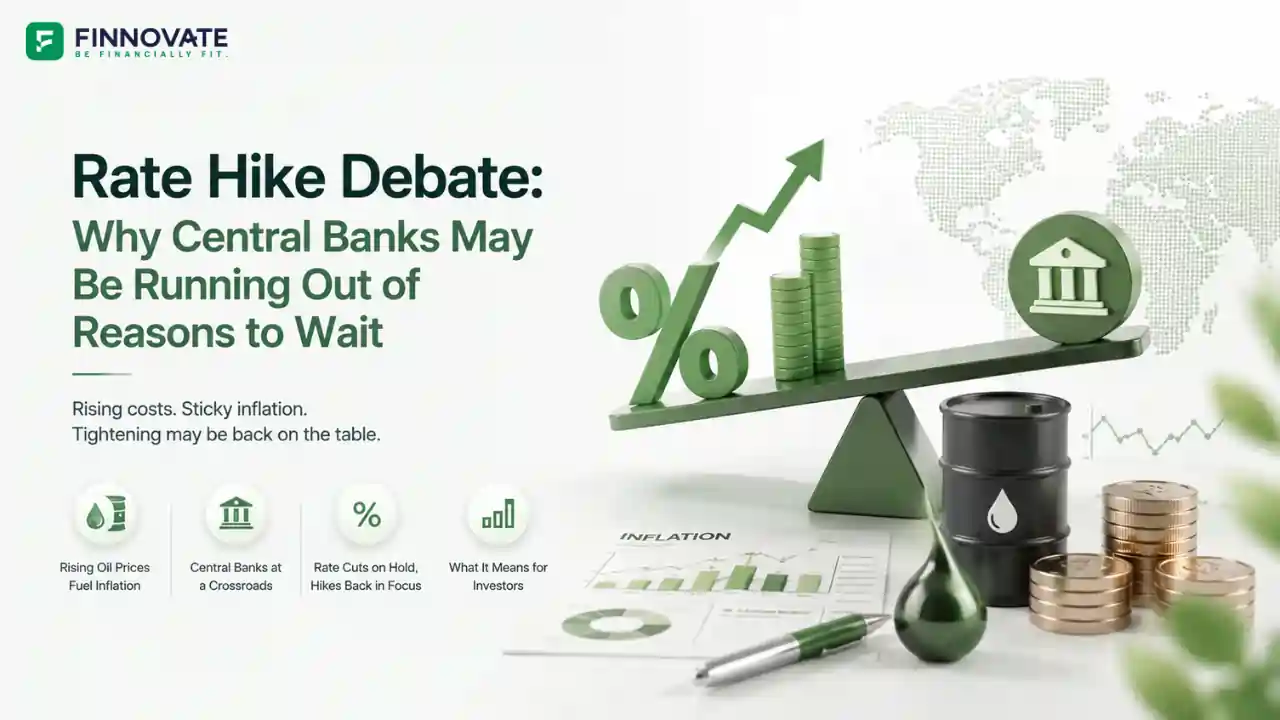
For much of 2025, the debate at the Federal Reserve and the Reserve Bank of India centred on one question: cut now or wait? By May 2026, that debate had become more complicated. Rate cuts are no longer a simple base case, and markets have started assigning a meaningful probability to the possibility of a rate hike.
The trigger is familiar: an energy price shock linked to the West Asia conflict and concerns around the Strait of Hormuz, a chokepoint through which a significant share of global oil shipments pass. India's crude oil basket was reported at approximately $115 per barrel in April 2026 and approximately $106 in May 2026, according to data linked to PPAC under India's Ministry of Petroleum and Natural Gas. Higher crude prices have raised inflation concerns globally.
This article examines what the data actually shows, why the Fed and the RBI are in meaningfully different positions, and what a potential rate hike cycle would mean for Indian investors.
| Metric | Latest Reading | Context |
|---|---|---|
| US CPI inflation (April 2026) | 3.8% YoY | Highest since May 2023; 180 bps above Fed's 2% target; rose from 3.3% in March |
| US core CPI (ex-food and energy) | 2.8% YoY | Above Fed target; accelerated from 2.6% in March |
| US unemployment rate (April 2026) | 4.3% | Unchanged; 115,000 non-farm payrolls added; labour market still resilient |
| US Fed funds rate (current) | 3.5% to 3.75% | Held at current range since December 2025 cut; no changes at January, March, or May 2026 meetings |
| Market probability of US rate hike (2026) | ~37 to 39% | Up sharply from near-zero earlier in 2026; CME FedWatch post-CPI and PPI reports |
| India RBI repo rate (April 8, 2026) | 5.25% | Held; neutral stance; followed 125 bps of cuts in 2025; next MPC June 3-5, 2026 |
| India FY27 CPI projection (RBI) | 4.6% | Within 2-6% tolerance band; upward revision from earlier; rising crude is key risk |
| India crude oil basket | Above $100/barrel | Sharp reversal from ~$60 range in FY26; India imports over 85% of crude requirements |
The April 2026 US CPI report marked a turning point. Headline inflation rose to 3.8% YoY, up from 3.3% in March, the highest reading since May 2023. The energy index rose 3.8% in April, accounting for over forty percent of the monthly all items increase, per the official BLS release. Gasoline rose 28.4% year on year, and the monthly CPI rise of 0.6% reflected clear pressure from energy and shelter.
The core CPI, which excludes food and energy, also accelerated. It rose 0.4% month on month and 2.8% year on year, up from 2.6% in March. Both headline and core measures are above the Fed's 2% inflation objective.
Entering 2026, market expectations were for at least one Fed rate cut during the year. After the April CPI and PPI reports, futures markets are pricing in no cuts at all in 2026. The probability of a rate hike by end-2026 or early 2027 has risen to approximately 37 to 39%, up sharply from near-zero earlier in the year. That is not a majority probability, but the direction of change is significant.
The Federal Reserve's dual mandate requires it to manage both inflation and employment. The April data makes the inflation half significantly more difficult. But the employment side is what makes the Fed's position particularly complex.
US unemployment held at 4.3% in April, with 115,000 non-farm payroll jobs added, per the Bureau of Labor Statistics. The labour market was not flashing distress, which gives the Fed less room to justify early easing.
Having been criticised for acting too slowly in 2022, the Fed may be less willing to wait this time if inflation does not reverse quickly. Energy-driven inflation is typically self-correcting once the geopolitical trigger stabilises. But there are two concerns that complicate this:
Neither concern locks in a hike. But both reduce the Fed's comfort in waiting indefinitely.
The source document makes a distinction worth examining carefully.
Demand-pull inflation responds directly to rate hikes: higher rates make borrowing more expensive, reduce spending, and cool demand. The mechanism is clean.
Cost-push inflation, driven by supply constraints, does not respond the same way. A rate hike does not reduce the price of crude oil. It does not reopen a shipping lane. It does not fix a supply chain.
However, rate hikes serve a second function in any inflationary environment: they anchor inflation expectations. If households and businesses expect inflation to persist, they demand higher wages and set higher prices, creating a self-fulfilling spiral. The central bank's willingness to raise rates signals it will not allow inflation to become entrenched, even if the immediate mechanism is indirect.
What this means: In the 2022 cycle, both the Fed and the RBI used rate hikes to break this expectations dynamic, not just to reduce demand. Acting early preserves credibility and typically requires fewer total hikes. Acting late requires more aggressive action to break the same spiral.
The RBI's situation in May 2026 is materially different from the Fed's, and treating both as equally likely to hike is an oversimplification.
India's inflation risk is linked heavily to imported energy costs. The RBI's April 2026 MPC decision kept the repo rate at 5.25% with a neutral stance, framing the hold as a balancing act between inflation control and growth support. The MPC's position is that monetary policy cannot directly reduce global crude prices, so the response depends on whether the energy shock starts feeding into broader inflation expectations and domestic demand. The RBI has chosen a cautious policy stance while monitoring the pass-through from global energy prices into domestic inflation.
| Factor | US Federal Reserve | India RBI |
|---|---|---|
| Current rate | 3.5% to 3.75% | 5.25% |
| Inflation vs target | 3.8% vs 2% target (+180 bps) | Tracking toward 4.6% FY27 (within 2-6% band) |
| Recent policy direction | On hold since December 2025 | Cut 125 bps in 2025; early easing cycle |
| Labour market / growth | Unemployment 4.3%; GDP 1.8-2.5% | 6.9% projected FY27 (per RBI April 2026 MPC); growth resilient |
| Governor's stated position | Watching inflation carefully; no rate cut planned | MPC held; cautious stance; monitoring energy pass-through to domestic inflation |
| Next decision point | June 2026 FOMC meeting | June 3-5, 2026 MPC meeting |
| Hike probability assessment | ~37-39% (CME FedWatch) | Not base case; possible if CPI materially overshoots 5% |
The RBI's FY27 inflation projection of 4.6% remains within its 2-6% tolerance band. It is not a breach. The pipeline effect of crude above $100 per barrel and a rupee that weakened significantly is expected to push headline CPI progressively higher through Q1 and Q2 of FY27. If India's CPI pushes materially above 5%, the calculation changes. As of May 2026, however, the RBI's stated position is that it has not reached that threshold.
Whether or not a rate hike materialises in 2026, the shift in market expectations from cut to hold to potential hike has real effects on portfolios today.
Rising rate expectations push bond yields up and bond prices down. Long-duration debt mutual funds and long-dated bonds are most sensitive to this dynamic. Short-duration instruments, liquid funds, and floating rate instruments are more resilient in a rising rate environment.
If the RBI does hike in FY27, the full impact on FD rates and bond yields would unfold over months, not overnight. Please consult a SEBI-registered investment adviser before making any changes to debt fund allocation.
Rate hikes typically compress equity valuations, particularly for high-growth and high-PE companies valued on future earnings. Infrastructure and capital goods companies with high borrowing requirements are directly impacted by rising rates.
Conversely, banks and financial institutions can see net interest margins improve in the early phase of a rate hike cycle, as lending rates reprice faster than deposit costs. Past performance is not indicative of future returns.
Any RBI repo rate hike would generally pass through to repo-linked floating rate loans at the next reset date. The RBI's external benchmark framework requires such rates to be reset at least once in three months, though the exact timing and impact depend on the lender and individual loan terms.
Please consult your lender and a SEBI-registered investment adviser for guidance specific to your borrowing situation.
For most of 2025, the policy direction was clearly toward lower rates. Portfolios built on the assumption of continued rate cuts, particularly those with heavy exposure to long-duration debt, may warrant review. The direction has changed from certain to uncertain, and uncertain is a different risk environment.
When inflation is demand-driven, the monetary policy response is predictable and its effects on asset classes are well understood. When inflation is cost-push and supply-driven, rate hikes may come later and be smaller, but the uncertainty period itself carries risk. Positioning for a clarity that does not arrive is its own cost.
Indian investors sometimes assume Indian monetary policy follows the Fed with a lag. The current situation shows that assumption has limits. The RBI cut rates 125 basis points in 2025 while the Fed held. It may stay on hold or act later than the Fed this time. Understanding India's specific monetary policy drivers, not just tracking the Fed, is essential for Indian portfolio decision-making.
Please consult a SEBI-registered investment adviser before adjusting any allocation based on rate expectations.
The shift from a cut cycle to a hold-or-hike environment affects debt funds, fixed deposits, home loans, and equity sector allocation differently. Whether your portfolio is positioned for the current rate environment is worth a 30-minute review.
Book a free callThe energy price surge following the US-Israel-Iran conflict pushed US CPI inflation to 3.8% in April 2026, well above the Fed's 2% target, and raised India's crude oil import costs significantly. When inflation re-accelerates after a cutting cycle, central banks must assess whether it is temporary or risks becoming entrenched through wage-price spirals. The concern about entrenched expectations is what moves rate hike probability from near-zero to significant.
Cost-push inflation occurs when supply constraints, such as an energy price shock, push prices higher regardless of demand levels. A rate hike does not fix a shipping lane or reduce crude oil prices. However, rate hikes serve a credibility function: they signal that the central bank will not allow inflation to persist, reducing the risk of a self-fulfilling wage-price spiral. In a cost-push environment, rate hikes work with a lag and address expectations rather than the underlying supply constraint directly.
The RBI's April 2026 MPC decision held the repo rate at 5.25% with a neutral stance. The MPC's position is that monetary policy cannot directly reduce global crude prices, so the response depends on whether the energy shock starts feeding into broader inflation expectations. The FY27 inflation projection of 4.6% remains within the RBI's 2-6% tolerance band. The June 3-5, 2026 MPC meeting is the next significant decision point. A hike becomes more likely if India's CPI pushes materially above 5% in coming months. As of May 2026, a hike is possible but not the base case. Please consult a SEBI-registered investment adviser for guidance on portfolio positioning.
Rising interest rates cause bond prices to fall and yields to rise. Long-duration debt funds, which hold bonds with longer maturities, are most sensitive to rate changes and experience larger NAV declines when rates rise. Short-duration funds, liquid funds, and floating rate funds are comparatively more resilient. Past performance is not indicative of future outcomes. Please consult a SEBI-registered investment adviser before making any changes to debt fund allocation.
Floating rate home loans linked to the repo rate via the RBI's external benchmark framework (EBLR) will see interest rates reset at the next scheduled reset date, which must occur at least once every three months per RBI guidelines. The exact timing and EMI impact depend on the lender and individual loan terms. Borrowers with fixed-rate loans would not be affected in the near term. Please consult your lender for specific details.
Broad asset allocation decisions should not be based on a single macroeconomic signal. Rate hike environments affect different equity sectors differently: banks may benefit from improving net interest margins in the early phase of a cycle, while highly leveraged companies and high-growth names tend to face valuation pressure. Whether a specific portfolio adjustment is warranted depends on individual goals, time horizon, and current allocation. Please consult a SEBI-registered investment adviser before making any portfolio decisions based on rate expectations.
Disclaimer: This article is for general information and educational purposes only. It does not constitute investment advice, a recommendation, or an offer to buy or sell any securities or financial instruments. Inflation and employment data from the US Bureau of Labor Statistics April 2026 CPI report and Employment Situation Summary. Fed rate data from the Federal Reserve and CME FedWatch. RBI data from the RBI MPC Statement April 8, 2026. Past monetary policy patterns are not indicative of future central bank actions. No investment decision should be made based solely on the contents of this article. Please consult a SEBI-registered investment adviser or qualified financial professional before making any investment decision. Debt and equity investments are subject to market and interest rate risks.
No spam. Only new posts, simple explainers, and practical money checklists for busy professionals.
Finnovate is a SEBI-registered financial planning firm that helps professionals bring structure and purpose to their money. Over 3,500+ families have trusted our disciplined process to plan their goals - safely, surely, and swiftly.
Our team constantly tracks market trends, policy changes, and investment opportunities like the ones featured in this Weekly Capsule - to help you make informed, confident financial decisions.
Learn more about our approach and how we work with you:
No comments yet. Start the conversation. What would you add?
No spam. Only new posts, simple explainers, and practical money checklists.
You may also like
AI demand is pushing up memory chip prices. Here's why the shortage could make smartphones...

FPIs sold ₹35,861 crore in Indian equities in September 2026. See which sectors saw outf...
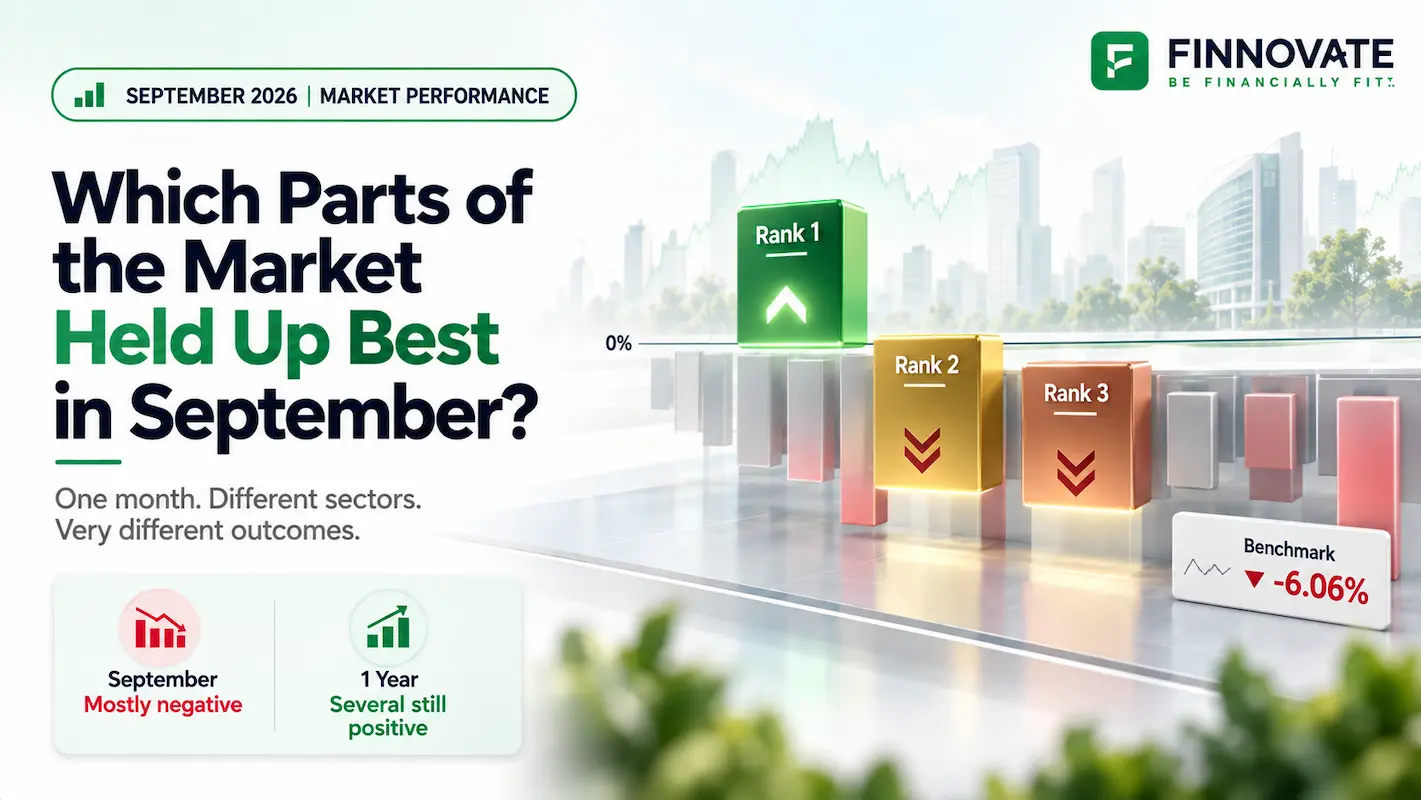
Compare 19 sector and thematic indices with Nifty 50 for September 2026, covering monthly ...

Understand the Growpital case, SEBI’s refund order, the LLP investment structure and wha...
Popular now

Learn how to easily download your NSDL CAS Statement in PDF format with our step-by-step g...

Looking for the best financial freedom books? Here’s a handpicked 2026 reading list with...
Learn what SIF investment means in India, SEBI rules, Rs 10 lakh minimum investment, avail...
Clear guide to mutual fund taxation in India for FY 2025–26 after July 2024 changes: equ...