
Growpital Case: SEBI’s Refund Order Explained
Understand the Growpital case, SEBI’s refund order, the LLP investment structure and wha...
29 September 2026
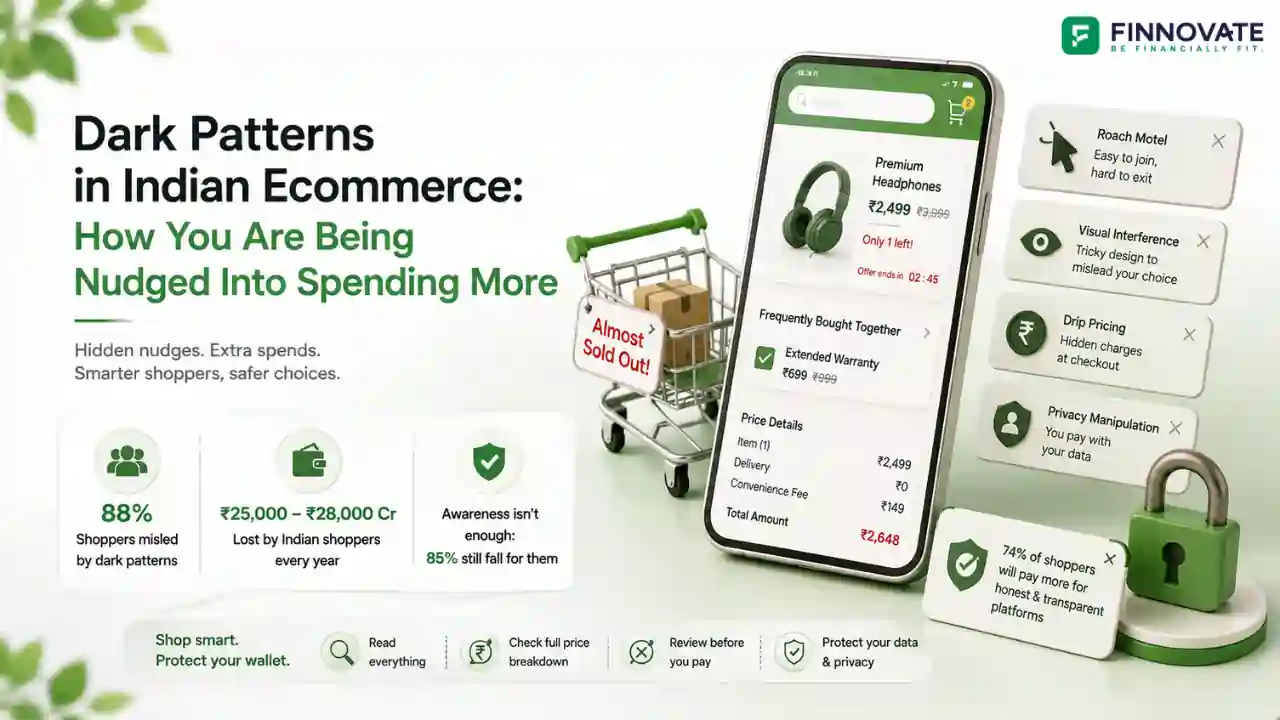
Source: Datum Intelligence, Dark Patterns in India's Online Marketplaces, Q1 2026
The average Indian online shopper loses between ₹78 and ₹87 every month to dark patterns. That is not a large number on its own. Across India's 304 million online buyers, it adds up to between ₹25,000 crore and ₹28,000 crore every year, a drain that flows not from fraud or theft, but from interface design that is deliberately built to make you spend more than you intended.
Dark patterns are not glitches. They are features. They are carefully engineered nudges embedded into the apps and websites you use every day for shopping, booking, and subscribing. A Datum Intelligence study conducted in Q1 2026 across 2,590 consumers in 50 cities and 12 major platforms found that 88% of online shoppers have been misled by these techniques. More striking: 81% of consumers say they are aware of dark patterns, yet 85% still report falling for them. Awareness alone is not protection.
Quick read
Upper estimate of annual consumer losses from dark patterns across India's digital commerce ecosystem
Share of India's 304 million online buyers who have been financially affected by dark patterns
Gross Merchandise Value at risk as consumers reduce spending, compare more aggressively, or switch platforms
The Roach Motel pattern is named after the old insect trap: you can check in but you cannot check out. It works in three steps. First, a limited-time offer creates a sense of urgency: a 72-hour discount window, a "only 2 left" inventory warning, or a promotional price about to expire. Second, to claim that benefit, you sign up for a subscription or a service you did not fully evaluate. Third, and most critically, the exit path is deliberately obscured, buried in menus, requiring multiple confirmation steps, or channelled through a customer service queue rather than a self-service button. You end up paying month after month for something you no longer want, because getting out is harder than staying in.
Visual interference is perhaps the most common dark pattern, and the easiest to overlook because it looks like normal design. The consent button or the upsell option is large, brightly coloured, and prominently placed. The opt-out, the decline, or the "no thanks" option is in small grey text, below the fold, or absent entirely. When you cancel a cab ride and the list of cancellation reasons does not include "the wait was too long," and any reason you do select charges you a small penalty: that is visual interference. The interface is not giving you neutral choices. It is steering you toward the outcome that benefits the platform, not you.
Drip pricing involves displaying a headline price that does not reflect what you will actually pay. The true cost is revealed incrementally: convenience fees, platform fees, packaging charges, handling charges, each added one at a time as you move through the checkout flow. By the time you see the final price, you have already invested time and intent in the purchase, which makes you less likely to abandon it. Datum Intelligence found that 69% of the platforms surveyed use drip pricing tactics, and 63% of online payment users now encounter hidden charges during transactions, up from 52% in 2024. When you book a flight and the final price includes seat selection, insurance, and baggage fees that were not visible in the search result, that is drip pricing.
Data privacy dark patterns work at the level of your information, not just your wallet. The opt-out from data sharing exists, but it is several menus deep. The consent for marketing communications is pre-checked by default. And in many cases, even when you do opt out, data sharing continues; platforms have been found to monetise consumer data regardless of consent settings. The deepest problem is perpetuity: when you close your account or cancel your subscription, the data you submitted (including sensitive identifiers like PAN, Aadhaar, and card details) may remain active in the platform's systems and in third-party data pipelines it has already shared with. This is not just a cost you pay now. It is a liability that persists.
The Central Consumer Protection Authority issued its Guidelines for Prevention and Regulation of Dark Patterns in 2023, formally identifying 13 prohibited practices including drip pricing, false urgency, disguised advertisements, and bait-and-switch tactics. This was a meaningful step: India became one of the few markets with an explicit regulatory framework for dark patterns. The Datum Intelligence Q1 2026 study found, however, that 73% of platforms continue to deploy forced-action mechanisms and 69% still use drip pricing. Regulation has named the problem and created legal recourse, but enforcement has not yet caught up with practice. The definitions remain ambiguous enough that platforms operate in grey zones.
| Dark Pattern Type | What to Watch For | What to Do |
|---|---|---|
| Roach Motel / Subscription Trap | Urgency timers, "limited offer" prompts, automatic renewals buried in terms | Before subscribing, test-search "how to cancel [service name]": if the answer is not simple, that is your signal. Use virtual cards with spending limits for new subscriptions. Set a calendar reminder to review before the trial ends. |
| Visual Interference | Pre-checked add-ons, prominent green "Yes" buttons paired with small grey "No thanks" text, missing cancellation reasons | Slow down at checkout. Uncheck everything by default and only re-check what you actually want. Look actively for the opt-out, not just the opt-in. |
| Drip Pricing | Headline price that grows by 15-30% by the final checkout screen; fees labelled as "convenience," "handling," or "platform" | For travel and high-value purchases, compare the final checkout price, not the search result price. Use price comparison tools that show all-in fares. Abandon carts and return later, as some platforms reduce fees for returning users. |
| Data Privacy | Pre-checked marketing consent, opt-out buried in account settings, continued marketing after unsubscribing | Review account privacy settings immediately after signing up, not at the time of a complaint. Avoid sharing sensitive identifiers on platforms where it is not strictly necessary. Use CCPA's consumer complaint portal for documented violations. |
The Datum Intelligence study found that 74% of online shoppers say they would pay more for platforms that commit to transparent, fair design. This is a striking commercial signal. Dark patterns generate short-term revenue extraction. They also erode the platform trust that sustains long-term consumer engagement. With ₹55,000 crore of GMV at risk from behavioural shifts, including consumers spending less, comparing more aggressively, or migrating away entirely; platforms are beginning to face the financial cost of their own design choices.
For consumers, the takeaway is practical. Dark patterns are not going to disappear because a regulation was passed or because you read an article about them. They are embedded in the interfaces you use every day and they are maintained by large engineering teams whose job is to optimise for platform revenue. The defence is deliberate friction: slow down at checkout, test the exit before you enter, audit your recurring charges quarterly, and treat your data as a currency you are spending, not just a form you are filling out.
Subscription creep, forced add-ons, and drip pricing add up across dozens of digital services. A Finnovate financial review helps you map recurring charges, identify unnecessary subscriptions, and build a cleaner picture of where your money is actually going.
Book a Discovery CallDark patterns are not a niche consumer protection issue. At ₹25,000-28,000 crore a year, they are a material drain on household finances across India's digital economy. The regulatory framework exists but enforcement lags. The awareness exists but is not sufficient to protect against in-the-moment interface manipulation. The practical answer is not to stop using digital commerce; it is to use it with more deliberate attention to the design choices that platforms have made for you. The platform's default is its preference, not yours. Every pre-checked box, every urgency timer, and every buried opt-out is a design decision. So is the choice to uncheck it.
Dark patterns are user interface design techniques that deliberately guide you toward choices that benefit the platform at your expense. They include pre-checked add-ons, subscription traps with difficult exit paths, prices that grow incrementally at checkout, and consent settings designed to be hard to find or change. They are not accidental design flaws; they are intentional features that generate revenue through consumer inattention.
Yes, many are. The Central Consumer Protection Authority issued the Guidelines for Prevention and Regulation of Dark Patterns in 2023, identifying 13 prohibited practices including drip pricing, false urgency, disguised advertisements, bait-and-switch, and forced action. Violations are actionable under the Consumer Protection Act, 2019. Despite the regulation, Datum Intelligence's Q1 2026 study found that 73% of major platforms continue to use forced-action mechanisms and 69% still deploy drip pricing.
The Datum Intelligence study estimates that 88% of Indian online shoppers lose between ₹78 and ₹87 per month, roughly ₹940 to ₹1,044 per year, to dark patterns including hidden charges, subscription traps, forced add-ons, and drip pricing. The figure may seem modest individually, but it scales to ₹25,000-28,000 crore across India's 304 million online buyers each year.
The Roach Motel pattern describes a subscription or service that is easy to sign up for but deliberately hard to exit. It typically combines false urgency (a limited-time offer to pressure fast sign-up), automatic renewal (charges continue without active confirmation), and a deliberately difficult cancellation process (multiple steps, no self-service, or routing through a customer service queue). The name comes from the insect trap: easy to enter, impossible to leave.
Review privacy settings immediately after account creation, not when you first notice a problem. Opt out of all non-essential data sharing by default and take a screenshot of the settings. If you continue to receive marketing communications after opting out, that is a documentable CCPA violation. Avoid sharing sensitive identifiers like PAN or Aadhaar on platforms that do not strictly require them, and understand that data you have submitted may persist in third-party pipelines even after account closure.
Disclaimer: This article is for general information and educational purposes only. It does not constitute legal advice. Statistics and findings referenced are from the Datum Intelligence report "Dark Patterns in India's Online Marketplaces" (Q1 2026) and publicly available news reporting. Regulatory guidelines referenced are from the Central Consumer Protection Authority (CCPA) and are subject to amendment. Consumers seeking legal recourse for dark pattern violations should consult a qualified legal professional or contact the National Consumer Helpline at consumerhelpline.gov.in.
No spam. Only new posts, simple explainers, and practical money checklists for busy professionals.
Finnovate is a SEBI-registered financial planning firm that helps professionals bring structure and purpose to their money. Over 3,500+ families have trusted our disciplined process to plan their goals - safely, surely, and swiftly.
Our team constantly tracks market trends, policy changes, and investment opportunities like the ones featured in this Weekly Capsule - to help you make informed, confident financial decisions.
Learn more about our approach and how we work with you:
No comments yet. Start the conversation. What would you add?
No spam. Only new posts, simple explainers, and practical money checklists.
You may also like
Understand the Growpital case, SEBI’s refund order, the LLP investment structure and wha...
India plans to borrow ₹7.86 lakh crore in the second half of FY2026–27. Learn how the ...

Proposed EU scrap export curbs could affect India’s metal supply and manufacturing costs...
FPIs net sold $1.47 billion in Indian equities during September 1–15, 2026. Explore sect...
Popular now

Learn how to easily download your NSDL CAS Statement in PDF format with our step-by-step g...

Looking for the best financial freedom books? Here’s a handpicked 2026 reading list with...
Learn what SIF investment means in India, SEBI rules, Rs 10 lakh minimum investment, avail...

Clear guide to mutual fund taxation in India for FY 2025–26 after July 2024 changes: equ...