

Tax Planning and Benefits for Married Couples in India: 2026 Guide
Tax planning for married couples in India explained for 2026. Compare tax regimes, deducti...
05 September 2026

Gold is held across a wide range of formats in Indian portfolios: physical jewellery inherited across generations, coins purchased during festivals, ETFs held in demat accounts, sovereign gold bonds, and digital gold on mobile platforms. Each format is taxed differently. Getting the holding period, the applicable rate, and the cost computation right matters when planning a sale or filing returns.
This guide covers the current taxation framework for every major form of gold investment for FY 2025-26 (AY 2026-27), including the Budget 2026 change to SGB taxation that takes effect from FY 2026-27 onwards.
Table of Contents
Gold jewellery is a capital asset under the Income Tax Act. Gains from its sale are subject to capital gains tax. Jewellery is explicitly excluded from the definition of personal effects and is therefore taxable, unlike household furniture or clothing. This is a commonly overlooked point at the time of filing.
For jewellery, the cost of acquisition includes the purchase price plus making charges paid at the time of purchase. When selling old jewellery where the original purchase receipt is unavailable, a registered valuer's certificate can establish the fair market value for cost purposes.
For jewellery acquired before April 1, 2001, the fair market value as on April 1, 2001 may be used as the cost of acquisition instead of the actual historical purchase price. This is particularly relevant for inherited jewellery purchased decades ago.
When old jewellery is exchanged at a jeweller (a common practice in India), this is treated as a sale of the old jewellery and a purchase of new jewellery. The capital gains tax rules apply to the old jewellery at the time of the exchange. The market value of the old jewellery at the point of exchange is the sale consideration for tax purposes.
Physical gold coins and digital gold are taxed under the same capital gains framework as physical gold. The CBDT treats these on par with physical gold for tax purposes.
Gold ETFs are listed on stock exchanges and are treated as listed non-equity capital assets for tax purposes. The Finance (No. 2) Act, 2024 set a shorter holding period for listed assets, which benefits gold ETF investors compared to physical gold.
Gold mutual funds are fund-of-fund schemes that invest in gold ETFs. Unlike the ETFs themselves, these funds are unlisted. The unlisted classification means the longer holding period applies.
Gold mutual funds are not treated as equity-oriented funds for tax purposes and do not benefit from the Section 112A ₹1.25 lakh annual exemption. They are also not covered by Section 50AA (which applies to debt-oriented funds with 35% or less equity exposure), since gold is not equity.
SGBs are government-backed securities issued by the RBI, denominated in grams of gold. No new SGB tranches have been issued since FY 2023-24. Existing bonds continue to be held and traded by investors who subscribed earlier or purchased from the secondary market.
SGBs pay 2.5% annual interest on the issue price, paid semi-annually. This interest is taxable under Income from Other Sources at the investor's applicable slab rate. No TDS is deducted on the interest.
Trading gold via futures or options on MCX or other recognised exchanges is treated as non-speculative business income under the Income Tax Act. Gains are taxed at the investor's applicable slab rate. Business-related expenses such as brokerage, transaction charges, and related costs can be claimed as deductions against this income. Losses can be set off against other business income and carried forward for up to 8 years.
Receiving gold through inheritance is not a taxable event. No capital gains tax applies at the time of receipt. Tax becomes applicable only when the inherited gold is subsequently sold. For computing capital gains on sale, the original owner's purchase price and purchase date are used to determine both the cost of acquisition and the holding period. If the gold was acquired by the original owner before April 1, 2001, the fair market value as on April 1, 2001 may be used as the cost.
Where gold is held for the required period and qualifies as a long-term capital asset, two reinvestment-based exemptions may apply to reduce tax liability.
The entire net sale consideration (not just the gain) from the gold sale must be invested in one residential house in India. Purchase must be made within one year before or two years after the date of sale, or construction must be completed within three years. The exemption is proportionate to the amount reinvested relative to total sale consideration and is capped at ₹10 crore. The new property must not be sold within three years, or the exemption is reversed.
An additional condition: the investor must not own more than one residential house on the date of sale of the gold (excluding the new one being purchased).
The capital gains amount (not the full sale value) may be invested in specified bonds issued by NHAI or REC within six months of the date of sale. The maximum investment qualifying for exemption is ₹50 lakh per financial year. The bonds carry a five-year lock-in period. Redemption before five years reverses the exemption.
| Gold Format | LTCG Holding Period | LTCG Tax Rate | Indexation | STCG Tax |
|---|---|---|---|---|
| Jewellery and physical gold | 24 months | 12.5% | No | Slab rate |
| Gold coins | 24 months | 12.5% | No | Slab rate |
| Digital gold | 24 months | 12.5% | No | Slab rate |
| Gold ETF (listed) | 12 months | 12.5% | No | Slab rate |
| Gold Mutual Fund (FoF, unlisted) | 24 months | 12.5% | No | Slab rate |
| SGB: maturity via RBI (FY 2025-26) | 8 years (all investors) | Exempt | NA | Slab rate |
| SGB: maturity via RBI (from FY 2026-27) | 8 years (original subscribers only) | Exempt for original subscribers; 12.5% for secondary market buyers | No | Slab rate |
| SGB: sold on exchange before maturity | 12 months | 12.5% | No | Slab rate |
| Gold F&O (futures and options) | Not applicable | Not applicable | Not applicable | Business income at slab rate |
Post-tax return on gold varies significantly across formats and holding periods. Our advisory team can help you understand the tax impact before you sell or switch formats.
Book a 30-Minute Clarity CallYes. Gold jewellery is a capital asset under the Income Tax Act. Gains on sale are taxable as capital gains. Held for more than 24 months: LTCG at 12.5% without indexation. Held for 24 months or less: STCG at the applicable slab rate. Jewellery is specifically excluded from the personal effects exemption that covers items like clothing and furniture.
For FY 2025-26, yes, for all investors. Capital gains on SGBs redeemed through the RBI window at maturity (or on premature redemption after 5 years through the RBI window) remain fully exempt for FY 2025-26. From FY 2026-27 onwards, the exemption is restricted to original subscribers who hold the bond continuously until maturity. Secondary market buyers of SGBs will be taxed on maturity gains at 12.5% (LTCG) from FY 2026-27.
Gold ETFs are listed on stock exchanges and classified as listed non-equity capital assets. From July 23, 2024, the LTCG threshold for listed assets is 12 months. Physical gold, gold coins, digital gold, and gold FoFs are unlisted and therefore subject to the 24-month threshold. The exchange listing is the distinguishing factor.
No. Gold mutual funds are fund-of-fund schemes investing in gold ETFs and are not equity-oriented funds. LTCG applies after 24 months at 12.5% without indexation. STCG within 24 months is taxed at slab rate. They do not qualify for the ₹1.25 lakh annual exemption available under Section 112A for equity funds.
Yes, for long-term capital gains. Section 54F allows exemption on reinvestment of the entire sale proceeds into one residential house within specified timelines, capped at ₹10 crore. Section 54EC allows exemption on investment of the capital gains amount (not full sale proceeds) into NHAI or REC bonds within six months, with a ₹50 lakh annual cap and a five-year lock-in. Both exemptions require the gain to be long-term. Please consult a SEBI-registered investment adviser or qualified Chartered Accountant before making reinvestment decisions.
Inheritance itself is not a taxable event. Capital gains apply only when the inherited gold is sold. The original owner's purchase price and purchase date are used to compute the gain and determine whether it is short-term or long-term. For gold acquired before April 1, 2001, the fair market value as on that date may be used as the cost basis.
Digital gold platforms are not regulated by SEBI or RBI. Taxation follows the same capital gains framework as physical gold, with the 24-month LTCG threshold. Investors should review the terms of the specific platform before investing, as the counterparty structure and storage arrangements vary across providers.
Disclaimer: This article is for general information and educational purposes only. It does not constitute investment advice, a recommendation, or an offer to buy or sell any securities or financial instruments. Gold taxation rules, holding periods, SGB exemption conditions, and Budget 2026 changes referenced here are based on publicly available Income Tax Department notifications, the Finance (No. 2) Act, 2024, and the Income Tax Act, 2025, applicable for FY 2025-26 (AY 2026-27) and FY 2026-27 (AY 2027-28) as noted. Rules may change in subsequent budgets. Please consult a SEBI-registered investment adviser or qualified Chartered Accountant before making any investment or tax filing decision. Mutual fund and gold investments are subject to market risks.
No spam. Only new posts, simple explainers, and practical money checklists for busy professionals.
Finnovate is a SEBI-registered financial planning firm that helps professionals bring structure and purpose to their money. Over 3,500+ families have trusted our disciplined process to plan their goals - safely, surely, and swiftly.
Our team constantly tracks market trends, policy changes, and investment opportunities like the ones featured in this Weekly Capsule - to help you make informed, confident financial decisions.
Learn more about our approach and how we work with you:
No comments yet. Start the conversation. What would you add?
No spam. Only new posts, simple explainers, and practical money checklists.
You may also like
Tax planning for married couples in India explained for 2026. Compare tax regimes, deducti...
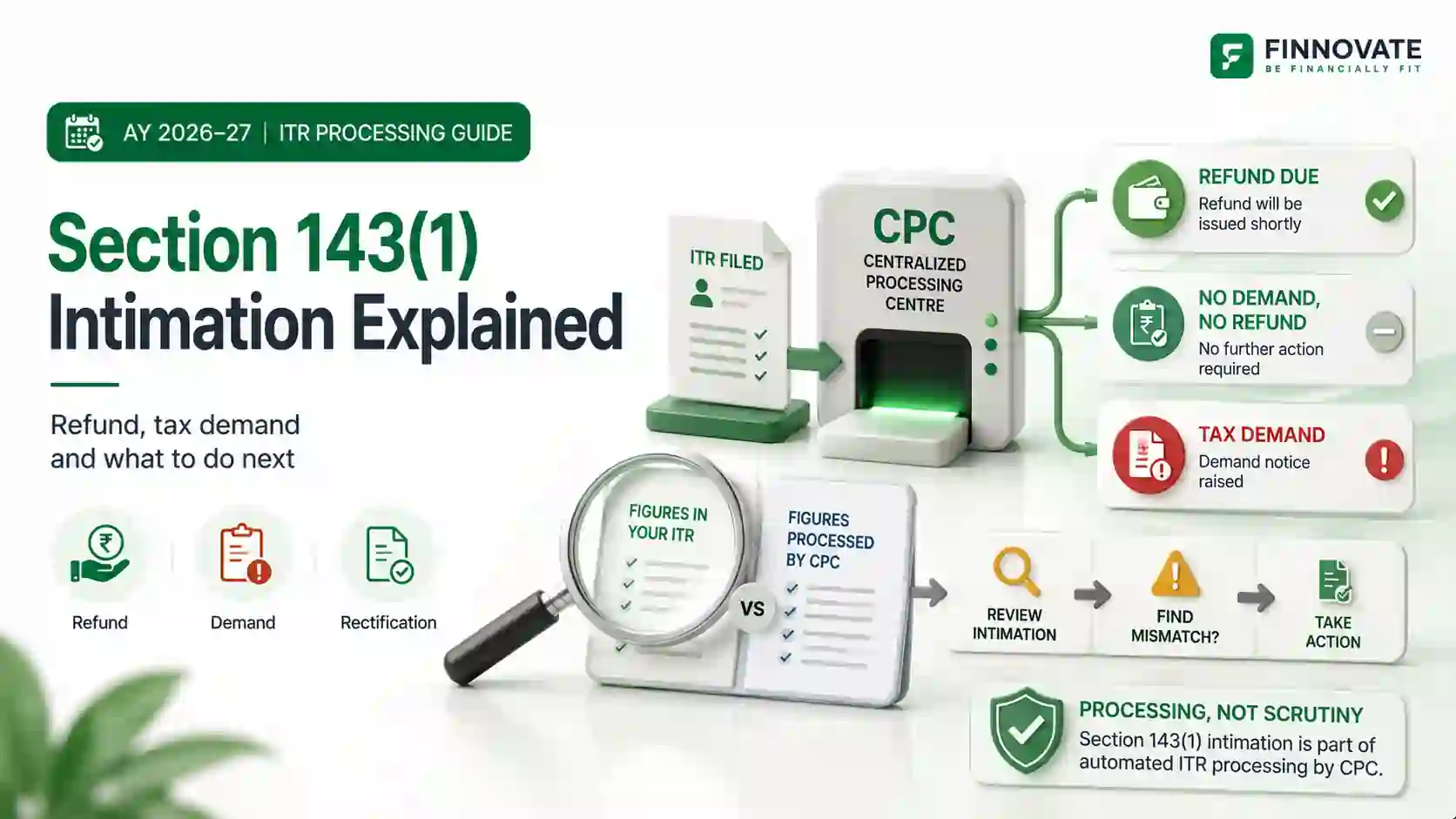
Received a Section 143(1) intimation? Understand CPC adjustments, refunds, tax demands, re...

Zero tax on a ₹14.65 lakh salary is real, but only if your employer contributes EPF on f...

Changed jobs in FY 2025-26? See why combining two Form 16s can create a tax shortfall past...
Popular now

Learn how to easily download your NSDL CAS Statement in PDF format with our step-by-step g...

Looking for the best financial freedom books? Here’s a handpicked 2026 reading list with...
Learn what SIF investment means in India, SEBI rules, Rs 10 lakh minimum investment, avail...

Clear guide to mutual fund taxation in India for FY 2025–26 after July 2024 changes: equ...