
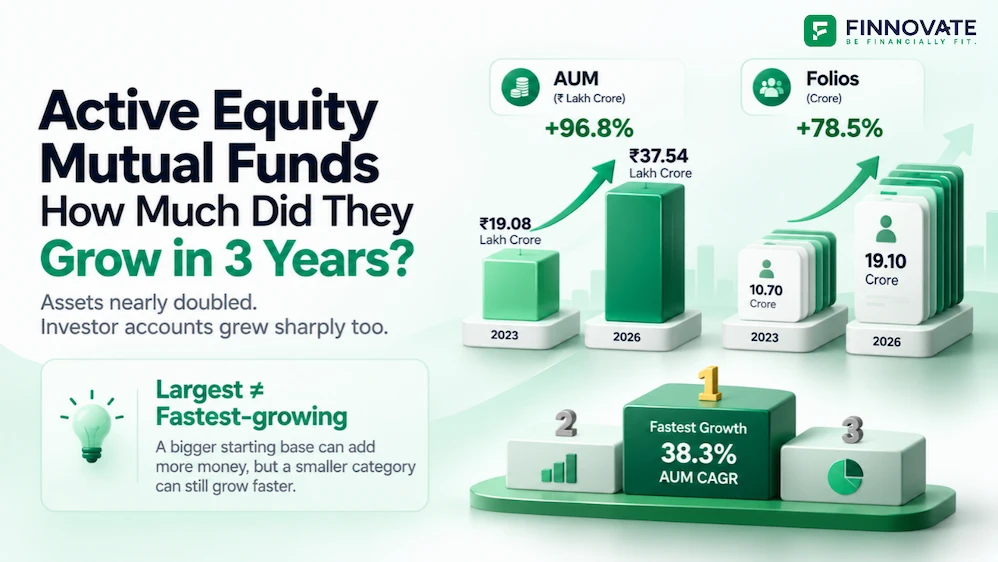
Active Equity Fund Growth 2023–2026: AUM & Folio Rankings
Compare active equity mutual fund growth from September 2023 to September 2026, with categ...
21 October 2026

SEBI has introduced another set of changes to mutual fund classification with a clear objective. Make fund categories easier to understand, make portfolios more “true to label,” and reduce confusion created by overlapping products.
These changes are not cosmetic. They touch three important areas:
One naming choice still raises a question too, which we will come to at the end.
Mutual fund categorisation is not just a filing exercise. It shapes how investors interpret risk, return potential, and the role of a fund in a portfolio.
Over time, categories can become too broad, or too loosely defined. That creates two common problems:
SEBI’s latest changes aim to improve transparency and reduce this confusion. While existing classifications have been fine-tuned, one big structural decision has also been made. The “solutions funds” segment has been entirely dropped.
Under the new rules, the number of schemes available under active equity will expand from 11 to 13.
There are no entirely new schemes being introduced. Instead, two categories have been split into separate buckets to allow clearer positioning and better differentiation.
Earlier, Value and Contra were clubbed together. Now they are split into two distinct categories, which allows an AMC to offer:
This matters because the two approaches are not the same and investors should not be forced to treat them as one blended idea.
SEBI has also increased the minimum equity allocation requirement here from 65% to 80%. That pushes these categories to behave like genuine equity funds, not diluted hybrids in disguise. The two ideas must also be demarcated.
Sector and thematic strategies can look similar in marketing, but they behave differently in practice. SEBI has now demarcated them into two distinct categories.
Under the revised framework, these funds must have at least 80% exposure to the respective sector or theme.
This tightening improves label integrity. If a fund calls itself “sector” or “theme,” it must behave like one.
ELSS will now be called ELSS Tax Saver Fund. The intent is straightforward. The name should underline what the category is for, so investors do not treat it like a regular diversified equity product.
This shift helps both investors and product design.
For investors, it improves clarity:
For AMCs, it creates more room:
SEBI has decided to scrap the “solutions funds” classification, which earlier included retirement funds and children’s funds. These were goal-based funds but had not attracted too much public attention.
SEBI is now replacing this segment with a new classification called Life Cycle Funds.
At a high level, the intent is simple. A life cycle fund will be a multi-asset approach that can allocate across equity, debt, liquid assets, gold, silver, exchange traded commodity derivatives, REITs, and INVITs. The category is meant to align more closely with real financial planning, where goals change as life stages change.
We have already covered the Life Cycle Funds framework in detail including how the structure is designed and what rules matter most for investors, so we are keeping this section short here. For the full deep dive, you can read the dedicated explainer. (Read the Life Cycle Funds explainer)
What matters in this article is the broader point. SEBI is moving goal-based positioning from a narrow “solutions” bucket to a more comprehensive, planning-led category.
One of the most practical changes is SEBI introducing an explicit overlap clause.
SEBI is not putting a hard cap on how many funds an AMC can launch across categories. The framework still works like this:
This “no limit” approach can create a problem. An AMC may launch multiple funds that look different by name, but in reality hold highly similar portfolios.
SEBI is now addressing this through the 50% overlap limit.
If an AMC launches multiple sector funds or multiple thematic funds, the overlap between them should not exceed 50%.
This overlap condition is not restricted only within sector and thematic buckets. It also applies across other equity categories, apart from large cap funds.
This pushes AMCs to ensure each new fund has a genuinely different strategy or positioning.
It also protects investors from:
In a market where NFOs and product launches are frequent, this is a meaningful step toward true-to-label investing.
Taken together, these changes are largely positive.
Here is what improves clearly:
In short, these reforms help categories match what investors think they are buying.
Even after these improvements, one naming issue remains.
Why do we call the fourth category “Other Funds” instead of calling them “Passive Funds”?
Passive funds have a specific role in portfolios. They are not “other” in any vague sense. Naming them as “Passive Funds” could convey their role and purpose more directly, and make it easier for investors to understand what they represent.
This is not a regulatory shortcoming. It is simply a labelling decision that can influence investor understanding.
Disclaimer: This article is for general information and educational purposes only. It does not constitute investment advice, a recommendation, or an offer to buy or sell any securities or mutual fund schemes. Mutual fund investments are subject to market risks. Please read all scheme-related documents carefully and consider consulting a qualified professional before taking any financial decision.
No spam. Only new posts, simple explainers, and practical money checklists for busy professionals.
Finnovate is a SEBI-registered financial planning firm that helps professionals bring structure and purpose to their money. Over 3,500+ families have trusted our disciplined process to plan their goals - safely, surely, and swiftly.
Our team constantly tracks market trends, policy changes, and investment opportunities like the ones featured in this Weekly Capsule - to help you make informed, confident financial decisions.
Learn more about our approach and how we work with you:
No comments yet. Start the conversation. What would you add?
No spam. Only new posts, simple explainers, and practical money checklists.
You may also like
Compare active equity mutual fund growth from September 2023 to September 2026, with categ...

Explore September 2026 ETF and index fund flows, with category-wise inflows, outflows, AUM...

Equity fund net inflows rose 30.61% to ₹38,306.55 crore in September 2026. Compare 13 ca...

Equity mutual funds received ₹29,329 crore in August 2026. See which categories saw the ...
Popular now

Learn how to easily download your NSDL CAS Statement in PDF format with our step-by-step g...

Looking for the best financial freedom books? Here’s a handpicked 2026 reading list with...

Learn what SIF investment means in India, SEBI rules, Rs 10 lakh minimum investment, avail...

Clear guide to mutual fund taxation in India for FY 2025–26 after July 2024 changes: equ...