

India–Mauritius Tax Treaty: Principal Purpose Test Explained
Understand the India–Mauritius tax treaty’s Principal Purpose Test, its August 2026 ef...
22 October 2026
On 2 April 2026, the Indian rupee posted its biggest single-day gain in approximately 12 years. From a record low of ₹95.22 per dollar, it closed at approximately ₹93.10, touching an intraday high of ₹92.68. The move was not driven by a sudden shift in global risk appetite or a ceasefire in West Asia. It was driven by the Reserve Bank of India deploying a sequence of increasingly sharp regulatory tools to dismantle the speculative machinery that had been amplifying the rupee's fall.
This article explains what each RBI measure did, why the first move was partially offset, why the second move hit harder, what it cost the banking system, and whether the defence holds once the structural pressures reassert themselves.
Any central bank defence of a currency has to address two distinct problems simultaneously.
The first is structural. The rupee was under pressure from genuinely difficult macro fundamentals: crude above $100 per barrel, a record FPI equity outflow of $12.58 billion in March 2026, a widening current account deficit, and inflation expectations rising sharply for FY27. These are not problems that any regulatory circular can fix. They require time, oil price normalisation, or a reversal of capital flows.
The second is momentum and speculation. Once a currency starts moving sharply in one direction, speculative positions pile in to amplify the move. This is particularly dangerous for the rupee because of the offshore non-deliverable forward market, where participants can bet on the rupee's direction without holding any actual rupees. When speculative momentum takes over, the currency can overshoot well beyond what fundamentals justify. That is the problem regulatory tools can address. That is where the RBI focused its attention.
On 27 March 2026, the RBI issued a circular directing all authorised dealer banks to cap their Net Open Position in Rupee at $100 million at the end of each business day. Banks were given until 10 April 2026 to comply.
To understand why this matters, it helps to know what the NOP represents. A bank's Net Open Position is the difference between its total foreign currency assets and its total foreign currency liabilities. A large long-dollar NOP means the bank profits if the dollar strengthens against the rupee, which creates an incentive to hold and even build that position during a period of rupee weakness. Multiply that across dozens of banks and the aggregate effect is a significant directional bet against the rupee.
Before the RBI's intervention, banks set their own NOP limits, subject to a ceiling of up to 25% of their Tier-I and Tier-II capital. For large banks with capital bases of several billion dollars, this meant open positions could reach $1 billion or more per institution. The RBI replaced this bank-determined framework with a single hard cap of $100 million for every bank, regardless of size.
The intent was clear: force banks to unwind their dollar-long positions, creating forced dollar selling that would support the rupee.
When banks cut their own positions, the risk did not disappear. It migrated. Traders and corporates identified an arbitrage between the onshore rupee market and the offshore NDF market. When NDF rates implied a weaker rupee than onshore prices, participants could sell dollars in the NDF and buy dollars onshore, pocketing the spread. In aggregate, this added fresh dollar demand to the domestic market and partially offset the RBI's intervention. The 1-month spread between onshore and offshore rates, which normally sits within 1-5 paise, blew out to over one rupee at one point. The RBI had not stopped speculation. It had relocated it.
That relocation forced the RBI's hand. On 1 April 2026, the central bank issued a second circular, effective immediately, barring authorised dealers from offering rupee non-deliverable forward contracts to resident Indians and NRIs. The rebooking of cancelled contracts was also prohibited.
To understand the significance of this, the scale of the offshore NDF market needs context.
| Market | Daily Rupee Derivative Volumes |
|---|---|
| Offshore NDF market (Singapore, US, UK, Hong Kong) | Over $150 billion per day |
| Onshore Indian forex market | Less than $72 billion per day |
The offshore NDF market is more than twice the size of the onshore market by daily volume. It is where global funds, hedge funds, and speculators place directional bets on the rupee without needing to hold or deliver actual rupees. Contracts settle in dollars based on the exchange rate difference. When sentiment turns negative on the rupee, the NDF market can amplify that sentiment at a scale the RBI's own dollar selling cannot easily counter.
By barring resident Indians and NRIs from participating in rupee NDF contracts, the RBI severed one of the key transmission channels through which offshore speculative pressure flowed back into the domestic market. By prohibiting rebooking of cancelled contracts, it prevented traders from rolling speculative positions indefinitely.
The market response was immediate. On 2 April 2026, the rupee surged from its lows with traders reporting that the new rules forced rapid unwinding of arbitrage positions and sharply lifted offshore hedging costs above onshore levels. This was the rupee's biggest single-day gain in over 12 years.
The RBI's intervention worked, but it was not free. The forced unwinding of large bank positions carries a real financial cost, which the banking sector is absorbing.
Banks had built up approximately $30-40 billion in combined rupee positions, a mix of proprietary directional bets and arbitrage trades between the onshore and NDF markets. Mark-to-market losses from forcing these positions to unwind by the April 10 deadline were estimated at approximately ₹4,000-5,000 crore across the banking system.
This matters for two reasons. First, these losses will hit Q4 FY26 treasury income for banks with active forex desks. Second, the NOP cap and NDF ban reduce banks' ability to earn from forex trading going forward, compressing a revenue stream that had become meaningfully sized for several private sector banks.
Banks pushed back on the April 10 compliance deadline, requesting a 2-3 month extension to allow positions to mature naturally rather than be unwound in a stressed market. As of the time of writing, the RBI had not publicly granted that extension.
More than any individual measure, the RBI's sequencing and language carry a message of their own. The central bank has deployed its tools in a deliberate, escalating order.
| Stage | Tool | Date | Objective |
|---|---|---|---|
| Stage 1 | Dollar selling via state-run banks | Through February-March | Direct market support; limited by reserve depletion |
| Stage 2 | Net Open Position cap at $100 million | 27 March 2026 | Reduce structural bank exposure to rupee weakness |
| Stage 3 | NDF ban and rebooking prohibition | 1 April 2026 | Cut speculative offshore-onshore arbitrage channel |
| Stage 4 | Rate hike | Not yet deployed | Last resort; would address rupee via interest rate differential |
Each step has been more structural and more forceful than the last. Dollar selling is the most visible but the most expensive in terms of reserve depletion. Position caps are structural but created an unintended arbitrage. The NDF ban is the sharpest tool yet deployed because it directly attacks the offshore speculation mechanism rather than trying to overwhelm it.
The RBI's communication accompanying both circulars made clear that it would not tolerate speculative positioning against the rupee beyond what legitimate hedging and trade financing require. That clarity of intent has its own restraining effect on markets, independent of the specific measures.
This multi-pronged approach has historically worked. The RBI deployed similar escalating strategies in 2009, 2013, and 2020, each time successfully reducing speculative excess and allowing the currency to find a more fundamentals-based level. Past RBI intervention outcomes are not indicative of future results. The rate hike remains unused, and the RBI deploying it would signal a qualitative shift in the severity of the situation, which is presumably why it is being held in reserve. We covered the case for a rate hike in detail in our earlier piece: RBI Rate Hike in FY27: Why the Narrative Has Flipped.
The honest answer, which the RBI itself would likely not dispute, is that the measures address speculative momentum but not structural pressure.
The rupee's fundamental headwinds remain fully in place. Brent crude is above $100 per barrel, widening India's import bill and current account deficit. FPIs remain net sellers. Goldman Sachs has flagged FY27 inflation at 4.6% and GDP growth at 5.9% for calendar 2026, a combination that does not naturally attract capital inflows. The rupee's depreciation over the full fiscal year FY26 was approximately 10%, making it among Asia's weakest-performing currencies.
What the RBI has achieved with its multi-pronged defence is two things. First, it has removed the speculative amplification of those fundamentals, the overshoot beyond what the macro picture actually justifies. Second, it has bought time for structural factors to potentially improve: a ceasefire in West Asia, crude price normalisation, or a resumption of FPI buying would all change the underlying equation.
Whether the bounce at ₹93.10 holds depends primarily on crude prices and geopolitical developments, not on the regulatory measures. Those measures are the circuit breaker, not the cure. We covered the full picture of FPI selling and rupee dynamics in our detailed article: FPI Selling in March 2026: The $12.3 Billion Equity Sell-Off.
A bank's Net Open Position is the difference between its foreign currency assets and liabilities. A large long-dollar NOP means the bank profits from rupee weakness, creating an incentive to hold that position. By capping all banks at $100 million, the RBI forced dollar selling across the system, directly supporting the rupee.
A Non-Deliverable Forward is a contract that settles in dollars based on the exchange rate difference, with no actual rupees changing hands. The offshore NDF market, spread across Singapore, the US, UK, and Hong Kong, processes over $150 billion in daily rupee volumes, making it more than twice the size of the onshore market. Speculators can use it to bet against the rupee from anywhere in the world, which makes it a major amplifier of currency weakness.
When banks reduced their own positions, the risk migrated to corporates who exploited the gap between onshore and offshore NDF rates. This arbitrage added fresh dollar demand to the domestic market, partially offsetting the rupee support from the NOP cap. The 1-month spread between onshore and offshore rates, normally 1-5 paise, reportedly blew out to over one rupee at one point.
Companies with legitimate foreign currency exposure, such as importers and exporters, typically hedge through onshore deliverable contracts rather than NDFs. The NDF ban primarily affects speculative positioning by residents and NRIs. Companies with genuine hedging needs through onshore instruments are not directly impacted by this measure.
The RBI's measures have removed the speculative amplification of rupee weakness but not the underlying structural pressures. Crude prices above $100, FPI outflows, and a wide current account deficit remain in place, and the rupee's medium-term trajectory will depend primarily on how these factors evolve. Please consult a SEBI-registered investment adviser before making any financial decisions linked to currency movements.
Disclaimer: This article is for general information and educational purposes only. It does not constitute investment advice, a recommendation, or an offer to buy or sell any securities or financial instruments. Exchange rate figures, NDF volume data, and bank loss estimates referenced in this article are based on publicly available sources and Finnovate Research, and are subject to change. Past RBI intervention outcomes are not indicative of future results. Investors should not make any investment decision based solely on this article. Please consult a SEBI-registered investment adviser or qualified financial professional before making any financial or investment decisions. Currency and related investments are subject to market risks.
No spam. Only new posts, simple explainers, and practical money checklists for busy professionals.
Finnovate is a SEBI-registered financial planning firm that helps professionals bring structure and purpose to their money. Over 3,500+ families have trusted our disciplined process to plan their goals - safely, surely, and swiftly.
Our team constantly tracks market trends, policy changes, and investment opportunities like the ones featured in this Weekly Capsule - to help you make informed, confident financial decisions.
Learn more about our approach and how we work with you:
No comments yet. Start the conversation. What would you add?
No spam. Only new posts, simple explainers, and practical money checklists.
You may also like
Understand the India–Mauritius tax treaty’s Principal Purpose Test, its August 2026 ef...

Explore India’s AI hardware opportunity through the proposed Adani–Jabil venture, from...
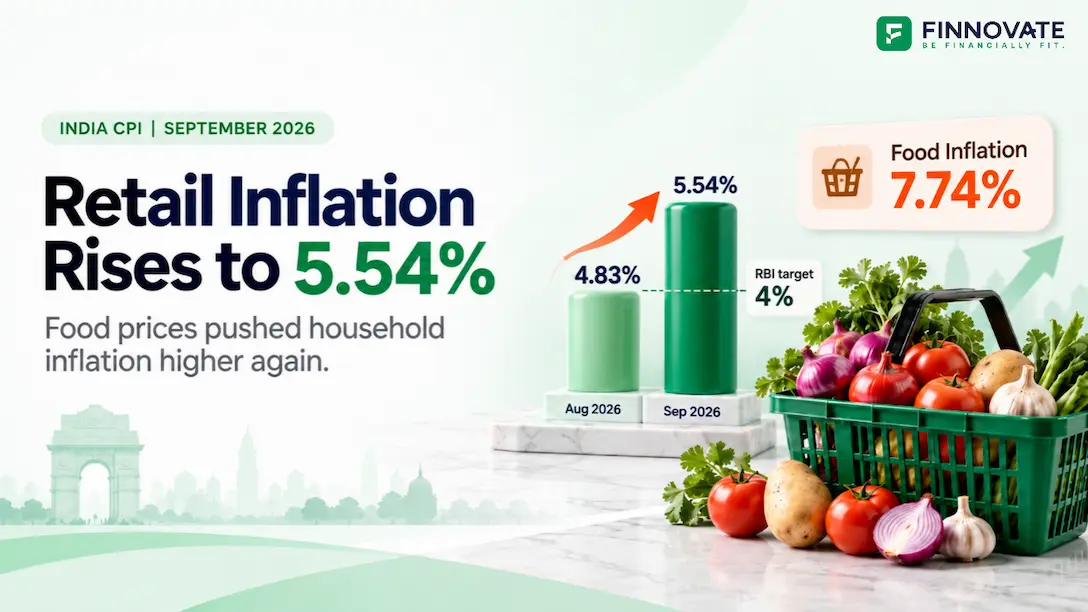
India’s CPI inflation rose to 5.54% in September 2026. Compare monthly trends, food pric...

The Shiller CAPE ratio is near its 1999 peak. Explore what it means for US stock valuation...
Popular now

Learn how to easily download your NSDL CAS Statement in PDF format with our step-by-step g...

Looking for the best financial freedom books? Here’s a handpicked 2026 reading list with...

Learn what SIF investment means in India, SEBI rules, Rs 10 lakh minimum investment, avail...

Clear guide to mutual fund taxation in India for FY 2025–26 after July 2024 changes: equ...