
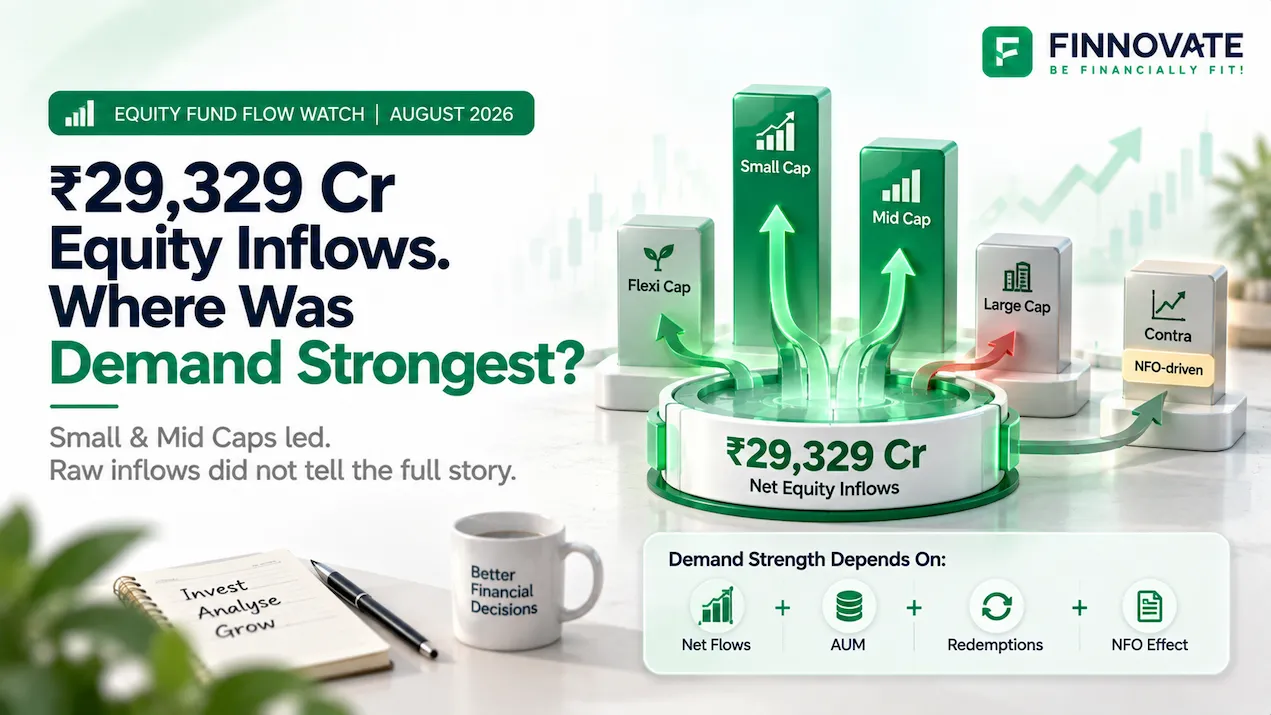
Equity Mutual Fund Inflows August 2026: Which Categories Led?
Equity mutual funds received ₹29,329 crore in August 2026. See which categories saw the ...
15 September 2026
Mutual fund overlap is the percentage of shared stock exposure between two funds. If both hold HDFC Bank, Reliance, and Infosys, those common holdings drive the overlap score. High overlap means paying two expense ratios for largely the same portfolio, without the real diversification benefit of holding two.
Some overlap is normal, particularly across large-cap funds that draw from the same restricted universe. The concern begins when overlap crosses 30 to 40%, at which point two funds start behaving as one and the diversification you paid for begins to disappear.
This calculator uses the minimum-weight method:
For each common stock, we take the lower of the two weights and sum them. If HDFC Bank is 8% in Fund A and 5% in Fund B, only 5% is counted toward overlap.
Using the Finnovate MF Overlap Calculator takes under a minute:
Parag Parikh Flexi Cap's international allocation (Alphabet, Meta) and concentrated domestic book keep its overlap with HDFC Flexi Cap well below what two mainstream large-cap funds would show.
| Common Stock | HDFC Flexi Cap | PPFAS Flexi Cap | Overlap Counted |
|---|---|---|---|
| HDFC Bank | 8.6% | 4.8% | 4.8% |
| ICICI Bank | 6.9% | 3.2% | 3.2% |
| Power Grid Corp | 2.4% | 4.1% | 2.4% |
| Coal India | 2.1% | 3.4% | 2.1% |
| Axis Bank | 4.3% | 1.9% | 1.9% |
| Total (all common stocks) | 22.3% |
Result: Moderate overlap. Holdings are illustrative based on publicly available AMFI quarterly disclosures. Actual figures change each quarter. Use the calculator above for live results.
There is no universal rule, but these ranges serve as a practical guide for Indian equity funds:
| Overlap Range | Zone | Interpretation |
|---|---|---|
| 0 – 15% | Low | Ideal diversification. Funds complement each other well |
| 15 – 30% | Moderate | Standard for same-category funds, generally acceptable |
| 30 – 50% | High | Significant duplication. Consider reviewing your allocation |
| 50%+ | Very High | Near-identical portfolios with little real diversification benefit |
SEBI requires large-cap funds to hold at least 80% in the top-100 companies. Every fund in this category draws from the same narrow universe, making overlap structural rather than a stock-picking failure.
HDFC Bank, Reliance, ICICI Bank, Infosys, and TCS appear in hundreds of schemes by collective professional preference, not mandate. Managers across categories gravitate to the same liquid, well-researched names.
Funds from the same AMC share research teams and house views. A conviction call flows into multiple schemes at once. Spreading across AMCs typically produces lower overlap than diversifying within one fund house.
High overlap has three practical costs:
Four funds at 60% average overlap are functionally one concentrated fund. You pay for the appearance of spread without the risk protection it implies.
A stock at 4% in Fund A and 5% in Fund B creates combined exposure larger than either shows. When it falls, both funds fall together: the risk is hidden inside a seemingly broad portfolio.
Two expense ratios for largely the same exposure: a drag that compounds significantly over 10+ years.
High overlap is a signal to review, not necessarily act. Start here:
Please consult a SEBI-registered investment adviser before making portfolio changes based on overlap data alone.
A few principles help structure a portfolio where funds genuinely complement each other rather than duplicate exposure:
Run through this before every SIP increase or new fund addition:
The Securities and Exchange Board of India introduced landmark overlap disclosure and concentration rules in February 2026:
This tool reflects current publicly available AMFI holdings data. As AMC disclosures evolve under SEBI's new framework, data quality and coverage will improve.

All your investments, one clear view
Track, analyse and manage your portfolio with the Finnovate Wealth App
Download the App


No spam. Only new posts, simple explainers, and practical money checklists for busy professionals.
Finnovate is a SEBI-registered financial planning firm that helps professionals bring structure and purpose to their money. Over 3,500+ families have trusted our disciplined process to plan their goals - safely, surely, and swiftly.
Our team constantly tracks market trends, policy changes, and investment opportunities like the ones featured in this Weekly Capsule - to help you make informed, confident financial decisions.
Learn more about our approach and how we work with you:
No comments yet. Start the conversation. What would you add?
No spam. Only new posts, simple explainers, and practical money checklists.
You may also like
Equity mutual funds received ₹29,329 crore in August 2026. See which categories saw the ...

When should you exit a mutual fund? Learn when to hold, stop a SIP, rebalance or redeem ba...

Mutual fund AUM rose ₹3.54 lakh crore in July 2026. See how much came from fresh inflows...
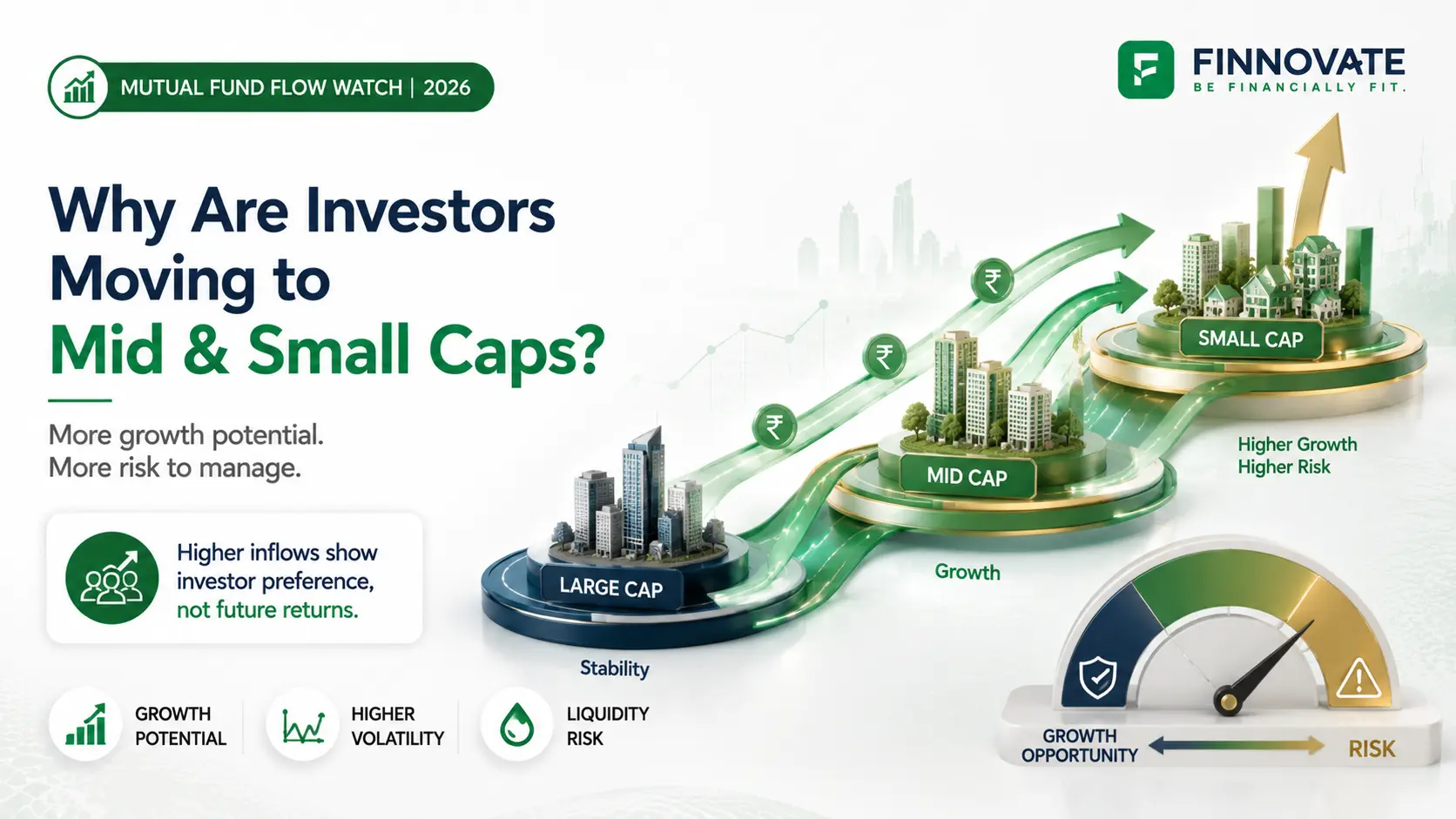
Small- and mid-cap funds drew nearly 7x more inflows than large-cap funds from February to...
Popular now

Learn how to easily download your NSDL CAS Statement in PDF format with our step-by-step g...

Looking for the best financial freedom books? Here’s a handpicked 2026 reading list with...
Learn what SIF investment means in India, SEBI rules, Rs 10 lakh minimum investment, avail...
Clear guide to mutual fund taxation in India for FY 2025–26 after July 2024 changes: equ...