

EU Scrap Export Curbs: India’s Raw-Material Risk Explained
Proposed EU scrap export curbs could affect India’s metal supply and manufacturing costs...
24 September 2026
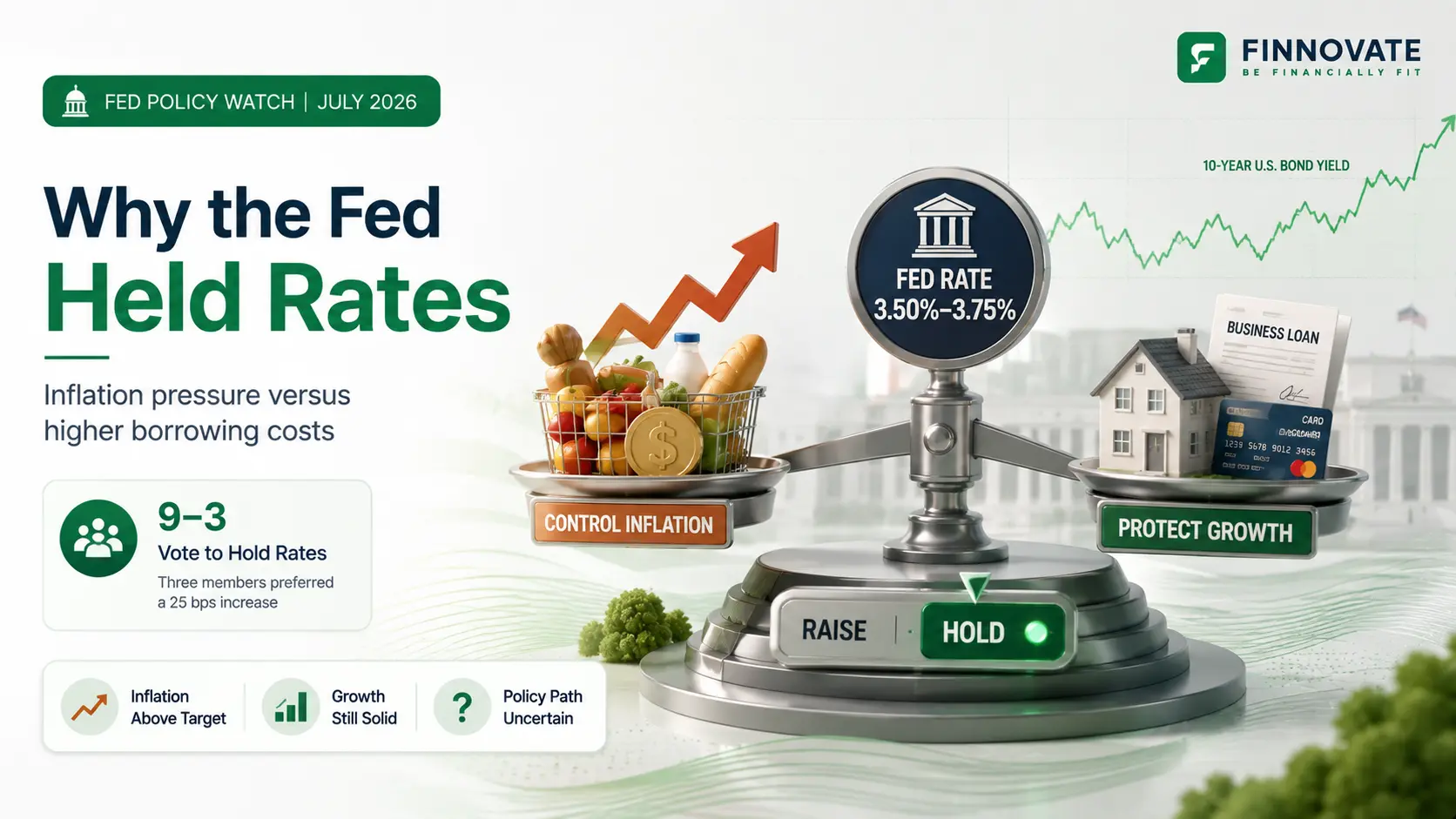
The US Federal Reserve left interest rates unchanged at its meeting on July 28–29, 2026. The Federal Open Market Committee voted 9–3 to retain the federal funds rate target range at 3.50%–3.75%.
The decision, however, was not unanimous.
Beth Hammack, Neel Kashkari and Lorie Logan voted for a 25-basis-point increase. Their dissent indicated that concerns about persistent inflation were gaining support within the committee.
For American households, both available choices carry a cost. Inflation continues to make everyday expenses more expensive. But an increase in interest rates would raise borrowing costs on mortgages, business loans, credit cards and other forms of credit.
Kevin Warsh’s immediate dilemma is therefore difficult: should the Fed increase rates to control inflation, or wait to understand whether the latest price pressures will persist?
Table of Contents
The Federal Reserve maintained the target range for the federal funds rate at 3.50%–3.75%.
The decision can be summarised as follows:
| Policy consideration | Position in July 2026 |
|---|---|
| Federal funds rate | Maintained at 3.50%–3.75% |
| FOMC vote | 9 in favour and 3 against |
| Dissenting position | A 25-basis-point rate increase |
| Economic growth | Expanding at a solid pace |
| Labour market | Broadly stable |
| Inflation | Still above the Fed’s 2% goal |
| Fed’s stated priority | Delivering price stability |
The majority believed that the available economic information did not yet justify an immediate rate increase. The three dissenters believed that inflation risks had already become strong enough to require action.
Warsh’s approach appears to begin with a simple premise: economic projections have limits.
Interest rates influence the cost of money across the US economy. They affect consumption, borrowing, investment, asset prices and the value of the dollar.
But these variables are also influenced by fiscal policy, geopolitical conflicts, energy prices, tariffs, productivity, labour conditions and technological investment.
The interaction between these factors makes the economy difficult to predict with precision.
The challenge is particularly visible in the current environment. The Federal Reserve has noted that inflation remains elevated, partly because of supply shocks and higher prices in sectors such as energy. At the same time, economic activity remains solid, productivity growth is strong and capital investment continues to expand.
These conditions do not provide a simple policy signal.
An increase could help control inflation, but it could also place additional pressure on household consumption and business activity.
Holding rates steady could support growth, but it risks allowing inflationary pressures to become more persistent.
Warsh has therefore placed greater emphasis on responding to economic developments rather than publicly committing the Fed to a fixed future path.
The Federal Reserve has not stopped producing economic projections.
FOMC participants continue to submit projections for economic growth, unemployment, inflation and the federal funds rate through the Summary of Economic Projections.
In June 2026, the median projection placed:
| June 2026 median projection | Projected level for 2026 |
|---|---|
| Real GDP growth | 2.2% |
| The unemployment rate | 4.3% |
| PCE inflation | 3.6% |
| Core PCE inflation | 3.3% |
| The year-end federal funds rate | 3.8% |
These numbers show that policymakers expected inflation to remain considerably above the Fed’s 2% goal during 2026.
Warsh’s change has been more visible in forward guidance: the signals a central bank gives about what it is likely to do at upcoming meetings.
His communication has been less focused on providing a defined interest-rate path. Instead, the emphasis has been on preserving the ability to respond as conditions change.
The July policy statement was brief.
It described economic activity as solid, noted the strength of productivity and capital investment, and stated that inflation remained above the Fed’s 2% goal. But it did not indicate whether the next policy move would be an increase, a reduction or another pause.
Warsh followed a similar approach during his press conference.
He described the current phase as one of “watchful thinking,” rather than passive waiting. He also said that the committee had considered the full range of available policy choices and was not constrained to one predetermined course.
This approach gives the Fed greater flexibility.
It can respond to new inflation, employment or growth data without appearing to abandon an earlier commitment. But flexibility for the central bank can create uncertainty for investors.
Markets use Fed communication to estimate future interest rates. When the central bank provides fewer directional signals, investors must form their own view of how the Fed will react.
Different interpretations can then create larger movements in bond yields, currencies and share prices.
Warsh’s approach has revived a long-running monetary-policy question: should the Federal Reserve guide financial markets towards its expected policy path, or should it allow market prices to independently reflect changing economic conditions?
This is not a choice between communicating and remaining silent.
The real question is how much direction the central bank should provide.
It can help households, businesses and investors plan their decisions. But it can also restrict the Fed if economic conditions change unexpectedly.
It preserves policy flexibility. But it can leave markets uncertain about how the central bank will respond to inflation, employment or growth.
The reaction in the US Treasury market after the July decision showed why this matters.
Long-term Treasury yields moved higher even though the Federal Reserve did not increase its policy rate. Chairman Warsh acknowledged that both nominal and inflation-adjusted market rates had tightened while the Fed itself had made no policy change during the preceding weeks.
The federal funds rate is an overnight policy rate. A 30-year Treasury yield reflects expectations over several decades.
Long-term yields can therefore rise even when the Fed leaves its current rate unchanged.
Investors may demand higher yields when they expect:
This means the bond market does not only respond to what the Federal Reserve did at its latest meeting.
It responds to what investors believe the Fed may eventually have to do.
If markets think the central bank is delaying a necessary rate increase, longer-term yields can rise because investors expect tighter monetary policy later.
Warsh’s most difficult task may not be choosing the correct interest rate at the next FOMC meeting.
It may be maintaining confidence in the Fed’s commitment to price stability.
Inflation expectations matter because they can influence actual behaviour.
When households expect prices to rise quickly, they may bring purchases forward.
Workers may demand higher wages to protect their purchasing power.
Businesses may increase prices in anticipation of rising labour and input costs.
These actions can make inflation more persistent.
Central banks therefore try to keep inflation expectations anchored near their official target. For the Federal Reserve, that target is 2% over the longer run.
For several years, the Fed used policy statements, economic projections, speeches and press conferences to explain how it expected inflation and interest rates to develop.
This made monetary policy easier to interpret, even when investors disagreed with the Fed’s forecast.
Warsh’s less prescriptive approach changes this relationship.
It reduces the risk that the Fed becomes trapped by an inaccurate forecast. But it increases the importance of explaining the conditions that would lead to a policy change.
The Federal Reserve has not provided a mechanical rule for its next decision. However, an increase would become more likely if several developments occur together:
The Fed would also have to assess whether the inflation increase is temporary or likely to continue.
A short-lived increase caused by a specific supply disruption may not require the same response as broad inflation driven by strong demand and rising wages.
The case for maintaining rates would strengthen if:
This last factor is particularly important.
When long-term yields rise, borrowing becomes more expensive for households and businesses. This can slow economic activity even when the Fed does not increase its overnight rate.
The central bank must therefore consider the combined effect of its own policy and the tightening already taking place in financial markets.
The Federal Reserve’s decisions affect markets beyond the United States.
Higher US interest rates and bond yields can make dollar-denominated assets more attractive. This can influence global capital flows, currency values and the cost of borrowing.
For India, the possible effects include:
| Global development | Possible effect on India |
|---|---|
| Higher US Treasury yields | Foreign investors may prefer US fixed-income assets |
| Stronger US dollar | Pressure on the Indian rupee |
| Persistent global inflation | Higher imported commodity and energy costs |
| Tighter global liquidity | More selective foreign portfolio flows |
| Higher international borrowing costs | Increased funding costs for some companies |
| Volatile global equity markets | Short-term fluctuations in Indian equities |
These effects are not automatic. Indian markets are also influenced by domestic growth, inflation, corporate earnings, fiscal policy and the Reserve Bank of India’s decisions.
However, uncertainty around the Fed can increase short-term volatility across global portfolios.
Warsh’s dilemma is larger than the choice between increasing rates and holding them steady.
The Federal Reserve must remain flexible enough to respond to an unpredictable economy. At the same time, it must be predictable enough for households, businesses and investors to trust its commitment to controlling inflation.
It can create false confidence in forecasts that may later prove incorrect.
It can leave markets uncertain about how the Fed will react.
The July meeting showed that the committee itself is divided. Three policymakers believed that inflation risks already justified higher rates, while the majority preferred to wait.
Warsh may be right that economic projections should not be treated as policy promises. But if the Fed reduces its reliance on detailed forward guidance, it must replace it with a well-understood decision-making framework.
Disclaimer: This article is intended for educational purposes and does not constitute investment advice. Economic and market conditions can change, and investors should assess decisions according to their financial goals and risk profile.
No spam. Only new posts, simple explainers, and practical money checklists for busy professionals.
Finnovate is a SEBI-registered financial planning firm that helps professionals bring structure and purpose to their money. Over 3,500+ families have trusted our disciplined process to plan their goals - safely, surely, and swiftly.
Our team constantly tracks market trends, policy changes, and investment opportunities like the ones featured in this Weekly Capsule - to help you make informed, confident financial decisions.
Learn more about our approach and how we work with you:
No comments yet. Start the conversation. What would you add?
No spam. Only new posts, simple explainers, and practical money checklists.
You may also like
Proposed EU scrap export curbs could affect India’s metal supply and manufacturing costs...

FPIs net sold $1.47 billion in Indian equities during September 1–15, 2026. Explore sect...

Nearly 39% of India’s monitored coal power plants were critically low on fuel in Septemb...

Tata Sons faces a major governance dispute over N Chandrasekaran’s reappointment, RBI li...
Popular now

Learn how to easily download your NSDL CAS Statement in PDF format with our step-by-step g...

Looking for the best financial freedom books? Here’s a handpicked 2026 reading list with...
Learn what SIF investment means in India, SEBI rules, Rs 10 lakh minimum investment, avail...

Clear guide to mutual fund taxation in India for FY 2025–26 after July 2024 changes: equ...