

Tax Planning and Benefits for Married Couples in India: 2026 Guide
Tax planning for married couples in India explained for 2026. Compare tax regimes, deducti...
05 September 2026


Finnovate’s editorial team researches and creates financial content using trusted sources, regulatory references and inputs from subject experts.

Buying a home in India is a major financial milestone. Home loans also come with tax benefits, but the real benefit depends on your tax regime, income level, property use, and loan stage.
This guide explains what you can actually claim in FY 2025-26 (AY 2026-27), what does not work for most people anymore, and how to evaluate it realistically.
Quick Answer: Home loan tax benefits in FY 2025-26
Which sections cover home loan tax benefits? Home loan interest falls under Section 24(b); principal repayment falls under Section 80C.
| Benefit | Section | Old Tax Regime | New Tax Regime |
|---|---|---|---|
| Interest (self-occupied) | 24(b) | Up to Rs 2 lakh/year | Not allowed |
| Interest (let-out) | 24(b) | Actual interest paid | Against rental income; no upper cap. Loss cannot be set off against salary or any other income head; only carried forward against future house property income. |
| Principal repayment | 80C | Within Rs 1.5 lakh cap | Not allowed |
| Additional interest (first-time buyer) | 80EE / 80EEA | If conditions met | Not allowed |
For a self-occupied home, all home loan deductions are available only under the old tax regime. The new tax regime does not allow Section 24(b), 80C, 80EE, or 80EEA for self-occupied properties.
Legal context: This article covers FY 2025-26 (AY 2026-27) rules under Section 115BAC and deductions under Section 24(b), Section 80C, Section 80EE, and Section 80EEA of the Income Tax Act, 1961.
For self-occupied property:
For let-out property:
Practical meaning: If your main goal is home loan deductions for a self-occupied home, the new tax regime provides no benefit from the home loan. The entire deduction story for self-occupied homes is an old-regime story.
Not sure whether old or new regime saves you more tax with your specific home loan, income, and deductions? Finnovate's tax planning advisory covers regime comparison and ITR strategy for home loan borrowers.
Book a Tax Planning CallEach EMI has two parts: interest (borrowing cost) and principal (loan repayment). In the initial years of long-tenure loans, the interest component is usually much higher than principal. This matters because:
Section 24(b) allows a deduction for interest paid on a home loan taken for purchase or construction of a residential property.
Maximum deduction: up to Rs 2,00,000 per year, subject to conditions.
Key rules that apply:
Interest paid before possession is not lost. It can be claimed in 5 equal instalments starting from the year possession is obtained, subject to the Section 24(b) limit. The total deduction including the pre-construction instalment cannot exceed Rs 2 lakh in a year for self-occupied property.
Takeaway: If you are in the old tax regime with a self-occupied home, Section 24(b) is almost always the single biggest home loan tax benefit.
Section 80C allows deduction for principal repayment on a home loan and for stamp duty and registration charges (only in the year they are paid). The total Section 80C cap is Rs 1,50,000 per year, shared across all eligible 80C items.
Many salaried employees already exhaust the Rs 1.5 lakh cap through EPF contributions, life insurance premiums, PPF, ELSS, and children's tuition fees. When the cap is already full, home loan principal repayment adds no additional tax saving.
If the property is sold before five years from the end of the financial year in which possession was obtained, all Section 80C deductions claimed on principal repayment are reversed. The full amount previously claimed is added back to taxable income in the year of sale. This is a statutory provision, not a convention. Section 24(b) interest deductions are not reversed on early sale.
Takeaway: Section 80C helps only if there is unused room remaining within the Rs 1.5 lakh cap. For most salaried employees with EPF, the incremental benefit is often zero.
Section 80EE provides an additional interest deduction of Rs 50,000 per year, over and above the Section 24(b) limit.
Conditions (all must be met simultaneously):
Reality: Section 80EE is not a general first-time buyer benefit. The sanction window closed in March 2017. Anyone whose loan was sanctioned after March 2017 is not eligible. For most current borrowers, 80EE is not applicable.
Section 80EEA offers an additional interest deduction of up to Rs 1,50,000 per year, over and above the Section 24(b) limit of Rs 2 lakh (i.e., maximum combined interest claim of Rs 3.5 lakh per year where both apply).
Conditions (all must be met simultaneously):
For loans sanctioned within the window and meeting all conditions, the Rs 1.5 lakh deduction can be claimed each year until the loan is fully repaid.
Reality: Section 80EEA's sanction window closed in March 2022. No new buyer can enter this window. Existing borrowers who met the conditions when sanctioned can continue claiming until repayment. The deduction is condition-heavy and not automatic for any "affordable housing" purchase.
| Feature | Section 80EE | Section 80EEA |
|---|---|---|
| Maximum additional deduction | Rs 50,000 per year | Rs 1,50,000 per year |
| Loan sanction window | 1 Apr 2016 to 31 Mar 2017 | 1 Apr 2019 to 31 Mar 2022 |
| Property value limit | Stamp duty value up to Rs 50 lakh | Stamp duty value up to Rs 45 lakh |
| Loan amount limit | Loan up to Rs 35 lakh | No specific loan amount cap |
| Can both be claimed together? | No. Only one can be claimed. 80EEA is available only to those not eligible for 80EE. | |
| Available to new buyers today? | No. Window closed March 2017. | No. Window closed March 2022. |
| Benefit | Old Tax Regime (OTR) | New Tax Regime (NTR) |
|---|---|---|
| Section 24(b) interest: self-occupied | Up to Rs 2 lakh (conditions apply) | Not allowed |
| Section 24(b) interest: let-out | Full interest; net loss set-off against other income up to Rs 2 lakh; remainder carried forward up to 8 years | Full interest against rental income; net loss cannot be set off against salary or other income in any year; carried forward against future house property income only |
| Section 80C principal repayment | Within Rs 1.5 lakh overall cap | Not allowed |
| Section 80EE (if eligible) | Rs 50,000 extra per year | Not allowed |
| Section 80EEA (if eligible) | Rs 1.5 lakh extra per year | Not allowed |
| Standard deduction (salaried) | Rs 50,000 | Rs 75,000 |
Joint loans can increase deductions, but only if structure and documents are aligned.
Conditions for individual claims by each borrower:
Takeaway: The double benefit works only when ownership, borrowing, and payment records are aligned. Co-borrower status alone, without co-ownership, does not support a clean deduction claim.
Yes. Claiming both HRA and home loan benefits in the same year is possible when the facts support it.
Common genuine scenarios:
The situation must be factually supportable and documented. Refer to the HRA tax benefit guide for common filing mistakes in this area.
If you own more than one property, taxation changes based on which property is treated as self-occupied, whether the second property is actually rented, and whether the law treats it as "deemed let-out."
Under Sections 23(2) and 23(4) of the Income Tax Act, a taxpayer can designate up to two properties as self-occupied, with nil annual value for both. Budget 2025 further simplified this from AY 2025-26: the second property no longer requires a specific reason for non-occupation. All properties beyond two are treated as let-out or deemed let-out. Interest deductions on let-out properties are unlimited in OTR, but the net loss set-off against other income heads is capped at Rs 2 lakh per year; the remainder is carried forward for up to 8 years.
This table shows whether switching to the old tax regime purely for home loan deductions is worthwhile at different income levels. It assumes salaried income, FY 2025-26 slabs, standard deduction of Rs 75,000 in NTR and Rs 50,000 in OTR, and that Section 80C is already exhausted through other investments (EPF, insurance, PPF). All figures are illustrative.
| Gross Annual Salary | NTR Tax (FY 2025-26) | Other deductions needed in OTR to match NTR | Approx home loan interest component needed |
|---|---|---|---|
| Rs 12,75,000 | Rs 0 (87A rebate) | Not applicable | OTR not meaningful at this income |
| Rs 15,00,000 | Rs 97,500 | ~Rs 5.4 lakh | ~Rs 3.9 lakh+ |
| Rs 18,00,000 | Rs 1,50,800 | ~Rs 6.4 lakh | ~Rs 4.9 lakh+ |
| Rs 20,00,000 | Rs 1,92,400 | ~Rs 7.1 lakh | ~Rs 5.6 lakh+ |
| Rs 25,00,000 | Rs 3,19,800 | ~Rs 8.0 lakh | ~Rs 6.5 lakh+ |
| Rs 30,00,000 | Rs 4,75,800 | ~Rs 8.0 lakh | ~Rs 6.5 lakh+ |
At Rs 15 lakh salary, you would need roughly Rs 3.9 lakh in annual home loan interest alone (beyond an already-exhausted 80C) before OTR becomes competitive. At Rs 12.75 lakh, OTR almost never makes sense for tax savings alone.
Figures based on FY 2025-26 new regime slabs (Budget 2025), 4% health and education cess, Rs 75,000 standard deduction in NTR, Rs 50,000 standard deduction in OTR, 87A rebate applied where taxable income does not exceed Rs 12 lakh. OTR old-regime slabs: 0-2.5L at 0%, 2.5L-5L at 5%, 5L-10L at 20%, above 10L at 30%. Illustrative only. Actual tax liability depends on your complete income, deductions, and filing status.
Tax benefits should support the home-buying decision, not drive it.
Many people lose deductions or pick the wrong regime because their situation overlaps: salary plus investments, a second property, HRA, or joint ownership.
In a short consultation, a Finnovate adviser can help you:
Book a 15-Minute Tax Clarity Call
Ideal if you are buying your first home, claiming HRA alongside a home loan, or managing joint ownership.
For cross-checking your AIS data before submitting, refer to: AIS vs TIS vs Form 26AS before filing ITR.
Home loans do offer tax benefits, but only within strict rules and the right regime choice.
Buy a home for affordability and life goals. Tax benefits are a supporting factor, not the justification.
Section 24(b) deductions start only after possession. Interest paid during the construction period (pre-construction interest) can be claimed in 5 equal annual instalments starting from the year possession is obtained, subject to the Section 24(b) annual limit. Section 80C principal deductions also start only after possession.
Yes, in the old tax regime. Section 24(b) covers interest, and Section 80C covers principal repayment. Both can be claimed simultaneously within their respective caps and conditions. They cover different parts of the EMI so there is no overlap.
Yes. Section 80EEA covers additional interest (a separate item from Section 24(b)), and Section 80C covers principal repayment. These three deductions cover different items and can all be claimed together in the old tax regime, provided the eligibility conditions for 80EEA are met.
This situation is not straightforward. Co-borrower status alone is not sufficient for a clean deduction claim. Co-ownership of the property is the more important condition. Without co-ownership, the claim is weaker and may not be accepted. Please consult a qualified tax adviser before filing in this situation.
Yes, in genuine cases. Common valid situations include owning a home in one city but renting in another due to job location, or owning a home that is still under construction while renting elsewhere. The reason for renting must be documentable and consistent.
No. The new tax regime can still be better even with a home loan if your total deductions are not high enough to offset the difference in tax rates. The breakeven table above shows the level of interest needed at different income levels before the old regime becomes advantageous. Please consult a qualified tax adviser before making your regime choice.
If the property is sold before five years from the end of the financial year in which possession was obtained, all Section 80C deductions claimed on principal repayment are reversed and added to your taxable income in the year of sale. Section 24(b) interest deductions are not reversed on early sale.
Tax Planning in India: Definition, Types, Benefits and Common Methods
Tax Planning for Salaried Employees in India (2026 Guide)
Disclaimer: This article is for informational and educational purposes only. It does not constitute tax, legal, or financial advice. Tax rules can change, and the correct treatment depends on your specific facts. Breakeven table figures are illustrative, based on FY 2025-26 slabs, and are not a substitute for a personalised tax computation. Please consult a qualified Chartered Accountant or tax adviser before making any filing or regime decisions.
No spam. Only new posts, simple explainers, and practical money checklists for busy professionals.
Finnovate is a SEBI-registered financial planning firm that helps professionals bring structure and purpose to their money. Over 3,500+ families have trusted our disciplined process to plan their goals - safely, surely, and swiftly.
Our team constantly tracks market trends, policy changes, and investment opportunities like the ones featured in this Weekly Capsule - to help you make informed, confident financial decisions.
Learn more about our approach and how we work with you:
No comments yet. Start the conversation. What would you add?
No spam. Only new posts, simple explainers, and practical money checklists.
You may also like
Tax planning for married couples in India explained for 2026. Compare tax regimes, deducti...
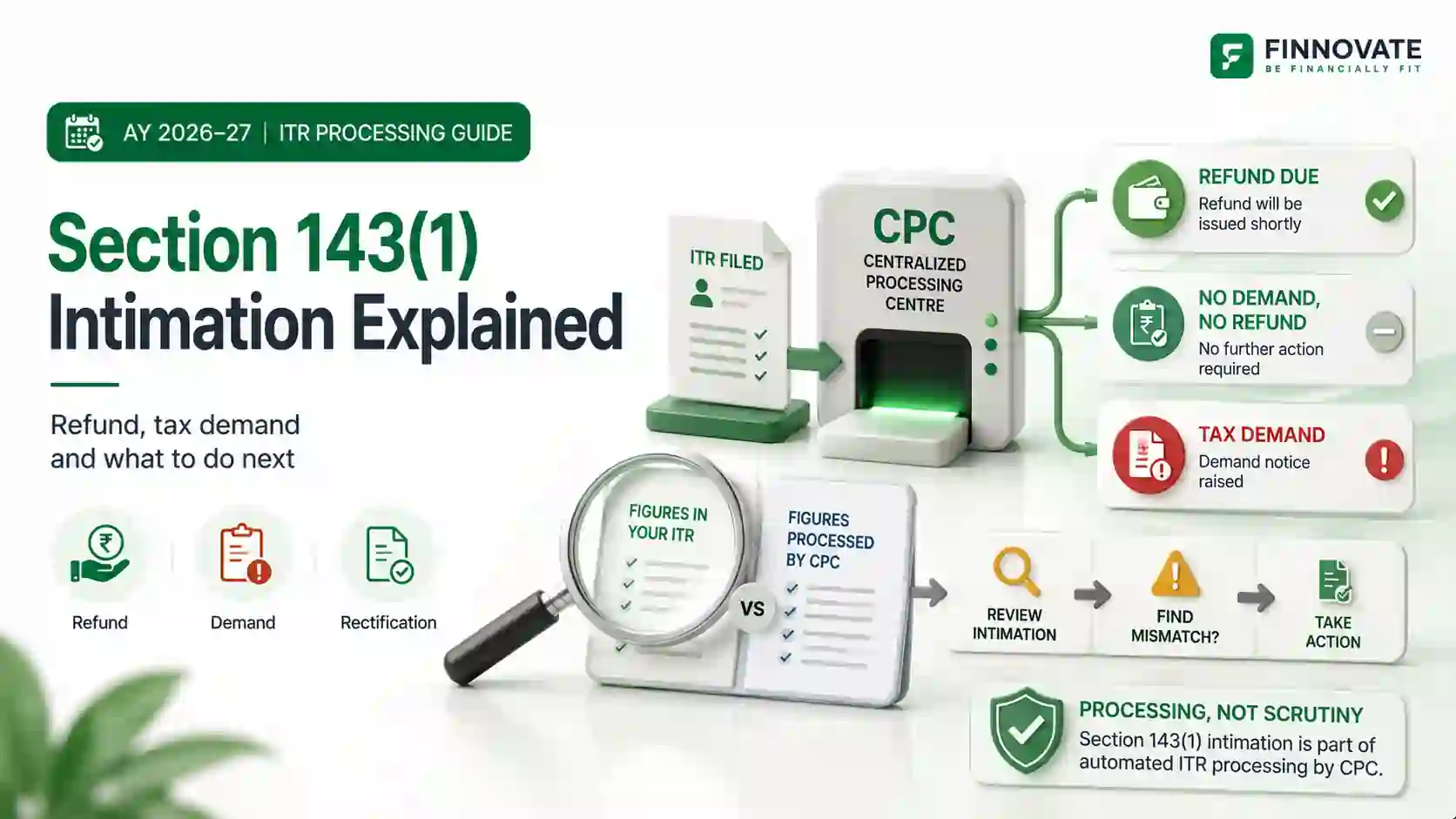
Received a Section 143(1) intimation? Understand CPC adjustments, refunds, tax demands, re...
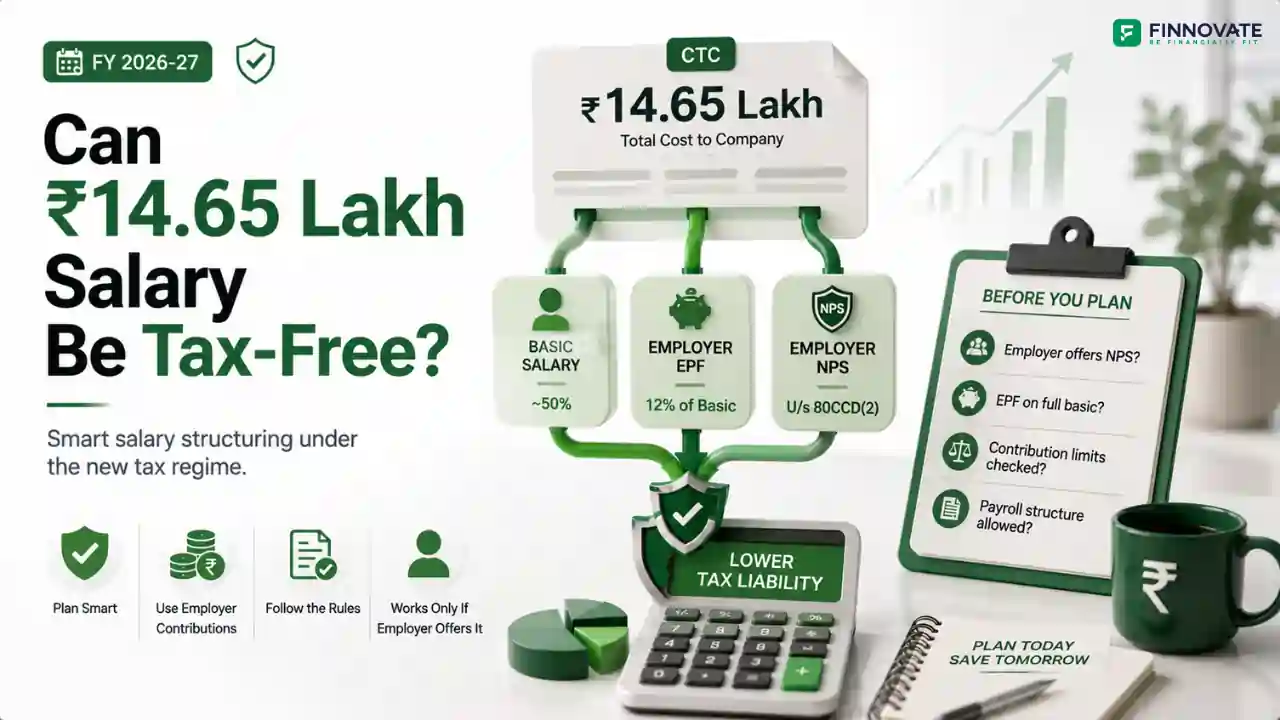
Zero tax on a ₹14.65 lakh salary is real, but only if your employer contributes EPF on f...
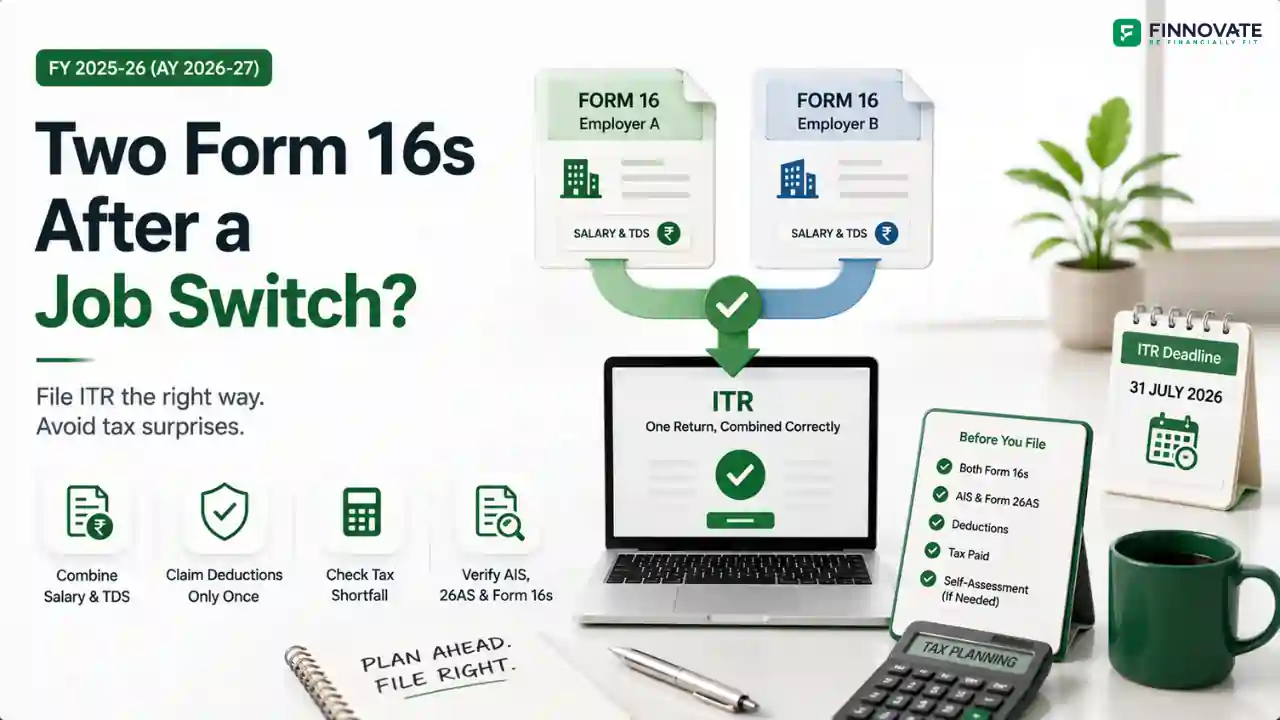
Changed jobs in FY 2025-26? See why combining two Form 16s can create a tax shortfall past...
Popular now

Learn how to easily download your NSDL CAS Statement in PDF format with our step-by-step g...

Looking for the best financial freedom books? Here’s a handpicked 2026 reading list with...
Learn what SIF investment means in India, SEBI rules, Rs 10 lakh minimum investment, avail...
Clear guide to mutual fund taxation in India for FY 2025–26 after July 2024 changes: equ...