

Tax Planning and Benefits for Married Couples in India: 2026 Guide
Tax planning for married couples in India explained for 2026. Compare tax regimes, deducti...
05 September 2026


Finnovate’s editorial team researches and creates financial content using trusted sources, regulatory references and inputs from subject experts.

Debt mutual funds have faced a steady erosion of investor appeal over the past few years. The reasons span the rate cycle, credit events, and most significantly, a series of adverse tax changes. Understanding exactly what changed, what the current rules are, and what the broader implications are for portfolio construction is the starting point for any rational view on debt funds today.
This article covers the current taxation framework for debt funds in FY 2025-26, how it compares to equity funds and direct bond investments, and the structural argument that the current rules create a distortion worth examining.
Quick Answer: How are debt mutual funds taxed in India? (FY 2025-26)
Taxation depends on the fund's equity exposure. The Finance (No. 2) Act 2024 amended the Section 50AA definition from FY 2025-26. The three-bracket framework below applies to the current financial year.
| Fund type | Equity / debt exposure | Holding period for LTCG | Tax treatment (FY 2025-26) |
|---|---|---|---|
| Equity-oriented funds | 65% or more in domestic equity | 12 months | LTCG at 12.5% above Rs 1.25L; STCG at 20% |
| Hybrid funds (mid-range) | More than 35%, less than 65% equity | 24 months | LTCG at 12.5%; STCG at slab rate |
| Debt-oriented / Section 50AA funds | More than 65% in debt and money market instruments | No LTCG treatment | All gains taxed at slab rate regardless of holding period |
Key change for FY 2025-26: The Finance (No. 2) Act 2024 narrowed the Section 50AA definition. For FY 2025-26 onwards, only funds investing more than 65% in debt and money market instruments are covered. Gold ETFs and international funds, previously caught under the old 35% equity rule (FY 2023-24 and FY 2024-25), are no longer subject to Section 50AA.
All rates exclude cess (4%) and surcharge. Please consult a SEBI-registered investment adviser and a qualified Chartered Accountant for guidance specific to your situation.
Table of Contents
For decades, debt mutual funds played a central role in Indian portfolios. They were used by conservative retail investors seeking income and capital stability, by institutions managing liquidity and short-term surplus, and by investors looking to balance equity exposure with a lower-volatility component.
Debt funds offered access to a wide range of instruments: government securities, corporate bonds, and money market instruments, through professionally managed portfolios at low minimum investment sizes. They also provided liquidity that direct bond investments typically do not. This combination made them a structurally important product for household asset allocation.
The taxation of debt mutual funds in FY 2025-26 depends on the fund's equity or debt exposure. Two frameworks apply depending on where the fund sits on the spectrum.
Funds investing more than 65% of total proceeds in debt and money market instruments fall under Section 50AA for FY 2025-26. For these funds, gains are treated as short-term capital gains and taxed at the investor's applicable slab rate, regardless of how long the units are held. There is no long-term classification. There is no indexation benefit. A fund held for ten years produces the same tax outcome as a fund held for ten months.
Funds that invest more than 35% but less than 65% of proceeds in equity shares are not covered by Section 50AA. For these funds, the standard capital gains framework applies. Gains on units held for more than 24 months qualify as long-term capital gains. Gains on units held for 24 months or less are short-term capital gains taxed at slab rate. These funds do not qualify for the 12.5% equity LTCG rate either, since they do not meet the 65% equity threshold for equity fund classification.
Funds with 65% or more in domestic equity qualify as equity-oriented funds and receive the most favourable treatment. LTCG after 12 months is taxed at 12.5% above Rs 1.25 lakh per financial year. STCG within 12 months is taxed at 20%.
| Fund Category | Equity / Debt Exposure | Holding Period for LTCG | Tax Treatment (FY 2025-26) |
|---|---|---|---|
| Equity-oriented funds | 65% or more in domestic equity | 12 months | LTCG at 12.5% above Rs 1.25L; STCG at 20% |
| Hybrid funds (mid-range) | More than 35%, less than 65% equity | 24 months | LTCG at 12.5%; STCG at slab rate |
| Debt-oriented / Section 50AA funds | More than 65% in debt and money market instruments | No LTCG treatment | All gains at slab rate regardless of holding period |
Section 50AA was introduced by the Finance Act, 2023 and applies to acquisitions made on or after April 1, 2023. Its definition has since been amended by Finance (No. 2) Act, 2024, effective from FY 2025-26.
The practical consequence of Section 50AA is that the tax treatment of a debt fund held for three years is identical to that of a bank fixed deposit held for the same period. Both produce income taxed at the investor's slab rate. For investors in the 30% bracket, this eliminates any post-tax advantage debt funds may have offered over deposits.
Under the Finance Act, 2023, a "specified mutual fund" was defined as a fund where not more than 35% of its total proceeds is invested in equity shares of domestic companies. This covered most pure debt funds as well as gold ETFs and international funds (which hold minimal domestic equity).
The Finance (No. 2) Act 2024 narrowed the definition. From FY 2025-26, a "specified mutual fund" means a fund that invests more than 65% of total proceeds in debt and money market instruments, or a fund-of-fund that invests 65% or more in such funds. Gold ETFs and international equity funds, which do not primarily invest in debt and money market instruments, are no longer covered. They revert to the standard capital gains framework applicable to other non-equity mutual funds.
Liquid funds, overnight funds, ultra-short duration funds, low duration funds, money market funds, short duration funds, medium duration funds, long duration funds, gilt funds, corporate bond funds, banking and PSU funds, credit risk funds, and floater funds all fall within Section 50AA from FY 2025-26 because they invest predominantly in debt and money market instruments. Market-linked debentures are also covered.
Arbitrage funds, balanced advantage funds, aggressive hybrid funds, gold ETFs, and international equity funds are not subject to Section 50AA from FY 2025-26. Their gains are taxed under the standard capital gains framework based on holding period and asset class.
The disparity between the tax treatment of debt funds and comparable instruments becomes visible when placed side by side.
| Instrument | Holding Period for LTCG | LTCG Tax Rate | Indexation Available |
|---|---|---|---|
| Listed equity shares | 12 months | 12.5% above Rs 1.25L | No |
| Equity mutual funds | 12 months | 12.5% above Rs 1.25L | No |
| Listed bonds and debentures | 12 months | 12.5% | No |
| Unlisted bonds and unlisted debentures (transferred, redeemed, or matured on or after July 23, 2024) | No LTCG treatment | Slab rate - Section 50AA extended to unlisted bonds by Finance (No. 2) Act 2024 | No |
| Debt mutual funds (Section 50AA) | No LTCG treatment | Slab rate (up to 30%) | No |
| Bank fixed deposits | Not applicable | Slab rate | No |
The comparison that draws the most scrutiny from a policy standpoint is the listed bond versus debt fund row. A listed bond held for 12 months qualifies for 12.5% LTCG. The same bond held inside a debt mutual fund structure is taxed at the investor's slab rate regardless of holding period. Both instruments provide exposure to the same underlying credit risk and interest rate dynamics. For unlisted bonds and unlisted debentures transferred, redeemed, or matured on or after July 23, 2024, Section 50AA now applies: gains are deemed STCG and taxed at slab rate regardless of holding period, placing them in the same bracket as Section 50AA debt funds.
The current framework is the result of two significant changes in the Finance Acts of 2023 and 2024.
From April 1, 2023, mutual funds with 35% or less equity exposure (the Section 50AA definition at that time) lost long-term capital gains treatment. Gains became taxable at slab rate regardless of holding period. Indexation was simultaneously removed. This change applied to new acquisitions from April 1, 2023 onwards. Units purchased before this date retained the old treatment subject to transitional rules.
First, Section 50AA was extended to unlisted bonds and unlisted debentures. Gains from their transfer, redemption, or maturity on or after July 23, 2024 are deemed STCG and taxed at slab rate regardless of holding period, the same treatment as Section 50AA debt funds. Listed bonds and debentures are not affected; they retain the 12-month LTCG treatment at 12.5%.
Second, the Section 50AA definition was narrowed for FY 2025-26 onwards to cover only funds with more than 65% in debt and money market instruments, removing gold ETFs and international funds from scope.
Third, indexation was removed from most other long-term capital assets. For pre-April 2023 debt fund units sold on or after July 23, 2024, the LTCG rate changed to 12.5% without indexation (down from 20% with indexation), and the long-term holding threshold was reduced from 36 months to 24 months.
From a portfolio construction standpoint, the removal of tax efficiency from debt funds has created a structural shift in how advisers and investors approach asset allocation.
The standard allocation framework places equity in the growth bucket and debt in the stability bucket. When the post-tax return from the stability bucket converges with the pre-tax return from a fixed deposit, the case for using a professionally managed debt fund weakens for taxable investors. The differentiation that justified the additional complexity narrows.
This has observable consequences. Investors seeking stable returns with tax efficiency have migrated toward alternatives: arbitrage funds (which are taxed as equity), short-duration hybrid funds, or simply bank deposits. Each of these comes with its own trade-offs in terms of liquidity, credit exposure, or underlying risk.
The concern raised by financial planners and industry bodies is not that any single alternative is wrong, but that the tax-driven migration distorts asset allocation decisions that would otherwise be made on risk and return merit. An investor in the 30% tax bracket holding a debt fund for five years and one holding a fixed deposit for five years now face identical tax treatment, despite the debt fund offering professional management, diversification, and mark-to-market transparency that a deposit does not.
Industry bodies, primarily AMFI, have consistently put forward a set of proposals to restore tax parity for debt funds. These remain requests to the government and have not been adopted as policy.
Our advisory team can help you understand how the current debt fund tax rules affect your specific portfolio and what alternatives may be worth examining for your tax bracket and risk profile.
Book a Free SessionNot all debt funds. Section 50AA, as amended by the Finance (No. 2) Act 2024, applies from FY 2025-26 to funds investing more than 65% of total proceeds in debt and money market instruments. For these funds, gains are taxed at slab rate regardless of holding period. Funds with more than 35% equity exposure retain standard capital gains treatment with the 24-month LTCG threshold at 12.5%.
Before April 1, 2023, debt funds held for more than 36 months qualified for long-term capital gains treatment at 20% with indexation benefit. This allowed the purchase cost to be adjusted for inflation, often significantly reducing the taxable gain. Units held for 36 months or less were taxed at slab rate as short-term capital gains.
For an investor in the 30% tax bracket, the post-tax treatment is now broadly equivalent: both produce income taxed at the applicable slab rate. Debt funds retain advantages in terms of liquidity (no premature withdrawal penalty), professional management, diversification across issuers, and mark-to-market transparency. Whether these non-tax advantages justify the choice depends on the investor's specific needs and risk profile. Consulting a SEBI-registered investment adviser for a comparison specific to your situation is advisable.
A fund with more than 35% equity exposure falls outside Section 50AA and is subject to standard LTCG rules with a 24-month threshold. However, hybrid funds carry equity risk that pure debt funds do not. The tax efficiency comes with higher volatility. Whether the trade-off is appropriate depends on the investor's risk tolerance and investment horizon, not solely on the tax outcome.
No. The DLSS is a proposal from AMFI and has not been introduced in any Union Budget through FY 2026-27. No tax deduction under Section 80C or any other section is available for investments in debt mutual funds as of FY 2025-26.
Pre-April 2023 units retain long-term status if held for the requisite period. The Finance Act 2023 maintained the 36-month threshold for these older units. However, the Finance (No. 2) Act 2024 further amended the treatment for pre-April 2023 units sold on or after July 23, 2024: the LTCG rate changed to 12.5% without indexation (previously 20% with indexation), and the long-term holding threshold for such units was reduced from 36 months to 24 months. For specific guidance on pre-2023 units, consulting a qualified Chartered Accountant is advisable given that the applicable treatment depends on the exact purchase date, sale date, and fund category.
Disclaimer: This article is for general information and educational purposes only. It does not constitute investment advice, a recommendation, or an offer to buy or sell any securities or financial instruments. Tax rules applicable to debt mutual funds, including Section 50AA provisions, are based on the Finance Act, 2023 and Finance (No. 2) Act, 2024, and are subject to change in subsequent budgets. Commentary on tax policy represents an analysis of the current framework and does not constitute advice on any specific investment or tax-related decision. Please consult a SEBI-registered investment adviser or qualified Chartered Accountant before making any investment or tax filing decision. Mutual fund investments are subject to market risks.
No spam. Only new posts, simple explainers, and practical money checklists for busy professionals.
Finnovate is a SEBI-registered financial planning firm that helps professionals bring structure and purpose to their money. Over 3,500+ families have trusted our disciplined process to plan their goals - safely, surely, and swiftly.
Our team constantly tracks market trends, policy changes, and investment opportunities like the ones featured in this Weekly Capsule - to help you make informed, confident financial decisions.
Learn more about our approach and how we work with you:
No comments yet. Start the conversation. What would you add?
No spam. Only new posts, simple explainers, and practical money checklists.
You may also like
Tax planning for married couples in India explained for 2026. Compare tax regimes, deducti...
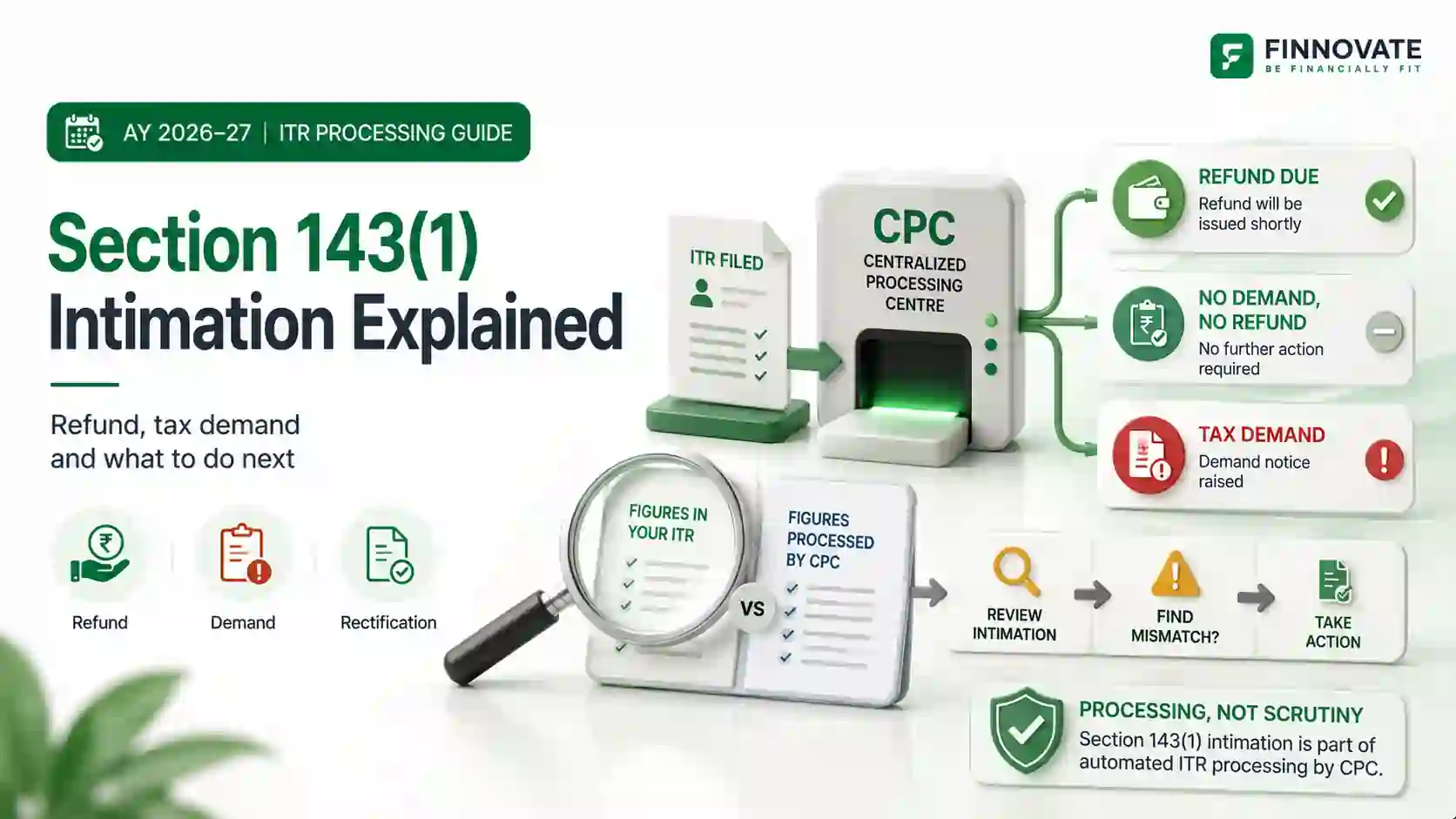
Received a Section 143(1) intimation? Understand CPC adjustments, refunds, tax demands, re...

Zero tax on a ₹14.65 lakh salary is real, but only if your employer contributes EPF on f...

Changed jobs in FY 2025-26? See why combining two Form 16s can create a tax shortfall past...
Popular now

Learn how to easily download your NSDL CAS Statement in PDF format with our step-by-step g...

Looking for the best financial freedom books? Here’s a handpicked 2026 reading list with...

Learn what SIF investment means in India, SEBI rules, Rs 10 lakh minimum investment, avail...

Clear guide to mutual fund taxation in India for FY 2025–26 after July 2024 changes: equ...