

Equity Mutual Fund Inflows August 2026: Which Categories Led?
Equity mutual funds received ₹29,329 crore in August 2026. See which categories saw the ...
15 September 2026

If you use arbitrage mutual funds to park short-term surplus money, Budget 2026 quietly changes the math.
The product is the same. The tax rules are the same. But one cost inside the strategy went up. And arbitrage is a thin-margin strategy, so small cost changes matter.
So the right question is not “Are arbitrage funds bad now?” The right question is “Will they still beat liquid and short-duration debt funds for my holding period, after costs?”
Arbitrage funds try to capture small price gaps between the cash market (spot) and the futures market.
A common setup is simple. The fund buys a stock in the spot market and sells the same stock’s futures contract. The gap between spot and futures, after costs, becomes the return opportunity.
People use arbitrage funds because they usually show low volatility, they get equity-style taxation, and they work as a parking tool when you do not want equity-like ups and downs.
Budget 2026 increased STT on futures from 0.02% to 0.05%.
This matters because arbitrage funds use futures trades heavily. Higher STT means higher transaction costs for the fund manager. Those costs come directly out of the spread the fund is trying to earn.
Nothing breaks in the strategy. But the profit window becomes narrower.
Think of arbitrage returns like this:
Arbitrage return = futures premium (spread) − trading costs − fund expenses
The spread is not big most of the time. That is why arbitrage is usually low risk and modest return.
When a cost like STT rises, net spreads shrink and very short holding periods feel it more because you have less time for returns to build up.
Arbitrage is like a high-volume business with thin margins. Even a small cost hike can reduce the final outcome.
Expectations need a reset.
Earlier, arbitrage funds often delivered returns similar to liquid funds, and sometimes looked better post-tax because of equity taxation.
Now, after the STT hike:
Arbitrage opportunities are typically better when spreads are healthy. In dull market phases, spreads are tighter, and higher costs pinch more.
A simple way to think about these options is to match the product to your bucket and time horizon.
| Option | Best for | What drives returns | Volatility feel | Where it can disappoint |
|---|---|---|---|---|
| Arbitrage fund | Tax-aware parking with low volatility, usually for weeks to a few months | Spot–futures spread minus costs (STT, trading, expenses) | Low, but not fixed | When spreads are tight and costs rise |
| Liquid fund | Very short parking and quick access needs | Short-term money market yields | Very low | Post-tax returns can look weaker in higher tax brackets |
| Ultra-short / money market fund | Parking for a few months with slightly higher yield potential than liquid | Debt portfolio yields and roll-down | Low to mild | Can fluctuate a bit more than liquid and taxation is debt-like |
After the STT hike, the decision is less about labels and more about your holding period and tax bracket. If you park money for very short periods, a liquid fund can still be hard to beat on simplicity. If you park money for longer and you are in a higher tax bracket, arbitrage may still work, but expect modest outcomes.
Arbitrage funds continue to be taxed as equity funds.
This equity-style taxation is a key reason many investors use arbitrage funds instead of debt funds for parking money.
But one point matters most. Tax efficiency helps only if the pre-tax return remains meaningful. If higher costs reduce the return gap too much, the equity tax benefit alone will not make arbitrage the best option for every investor and every time frame.
Quick 4-step check
Arbitrage funds have not stopped working. But they are no longer a no-brainer default for every surplus cash situation.
Not sure where arbitrage fits in your plan?
At Finnovate, we map each rupee to a purpose first. Emergency money, short-term parking, and long-term goals should not sit in the same bucket. If you want, take the FinnFit Test and see how your cash buckets and goal timelines stack up.
Arbitrage funds are not broken. The easy default idea is.
The STT hike reduces the strategy’s net efficiency, so returns can look a bit lower and closer to liquid funds, especially for short holding periods. If you are using arbitrage purely for short-term parking, revisit the comparison and reset expectations.
No. The tax classification remains equity-like. The change is on the cost side, which can reduce pre-tax returns.
The STT hike does not directly increase risk. It mainly reduces net returns because spreads are typically thin.
For very short parking periods, liquid funds can look more attractive because their return drivers are simpler. For longer parking, arbitrage may still be relevant, but the edge may be smaller.
There is no fixed number. In practice, it tends to make more sense when you are parking money for weeks to a few months and you value equity-like taxation.
No. It depends on trading efficiency, expenses, and how actively the fund runs the strategy.
Arbitrage depends more on spreads than volatility. Market phases that widen spot–futures spreads can improve opportunities.
If you need quick access and high predictability, compare liquid and overnight options too. Emergency buckets are about access first, returns second.
Start with your holding period and tax bracket, then compare recent net returns after expenses. If the gap is small, pick the option that matches your need for predictability.
Disclaimer: This article is for information and educational purposes only and should not be treated as investment or tax advice. Mutual fund investments are subject to market risks. Read all scheme related documents carefully before investing.
No spam. Only new posts, simple explainers, and practical money checklists for busy professionals.
Finnovate is a SEBI-registered financial planning firm that helps professionals bring structure and purpose to their money. Over 3,500+ families have trusted our disciplined process to plan their goals - safely, surely, and swiftly.
Our team constantly tracks market trends, policy changes, and investment opportunities like the ones featured in this Weekly Capsule - to help you make informed, confident financial decisions.
Learn more about our approach and how we work with you:
No comments yet. Start the conversation. What would you add?
No spam. Only new posts, simple explainers, and practical money checklists.
You may also like
Equity mutual funds received ₹29,329 crore in August 2026. See which categories saw the ...

When should you exit a mutual fund? Learn when to hold, stop a SIP, rebalance or redeem ba...

Mutual fund AUM rose ₹3.54 lakh crore in July 2026. See how much came from fresh inflows...
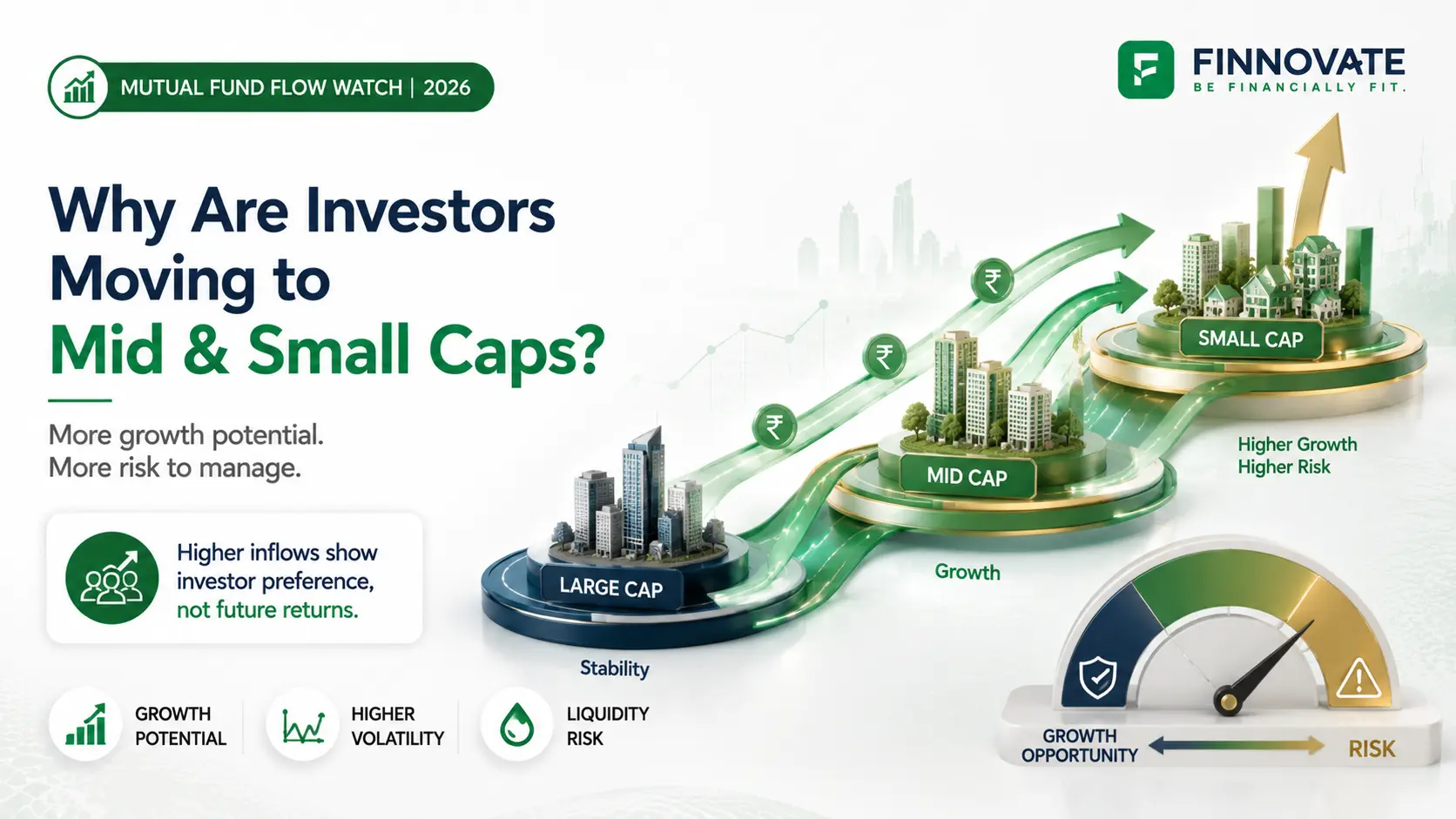
Small- and mid-cap funds drew nearly 7x more inflows than large-cap funds from February to...
Popular now

Learn how to easily download your NSDL CAS Statement in PDF format with our step-by-step g...

Looking for the best financial freedom books? Here’s a handpicked 2026 reading list with...
Learn what SIF investment means in India, SEBI rules, Rs 10 lakh minimum investment, avail...

Clear guide to mutual fund taxation in India for FY 2025–26 after July 2024 changes: equ...