

The Great Economic Decoupling of 2026: Oil, AI & India
Rising oil prices and booming AI investment are shaping an uneven global economy in 2026. ...
24 October 2026
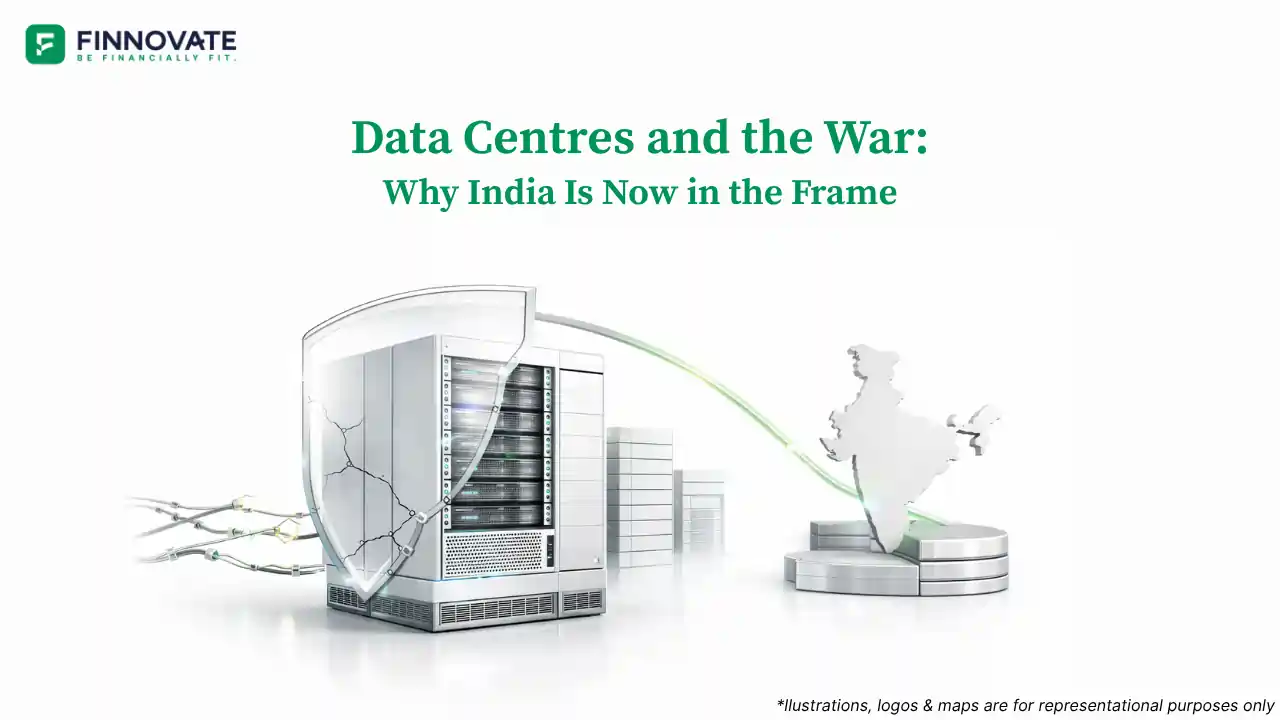
On March 1, 2026, Iranian drones struck two Amazon Web Services data centres in the UAE and damaged a third in Bahrain. It was the first confirmed military attack on hyperscale commercial cloud infrastructure in history. Within days, Oracle's data centre in Dubai was also hit. The conflict had found a new kind of target.
For global technology companies, the strikes exposed a structural vulnerability that had been building for years: concentrating critical AI and cloud infrastructure in a single geopolitical zone. The response that followed is reshaping where data centre capital is headed next, and India is prominently in that conversation.
Iran's strikes on commercial data infrastructure were not incidental. The Islamic Revolutionary Guard Corps (IRGC) stated the AWS facilities were targeted for their suspected role in supporting US military and intelligence operations. The attacks were deliberate and sequenced.
The confirmed sequence of events:
The outages disrupted banking, payments, enterprise software, and delivery platforms across the region. Abu Dhabi Commercial Bank, Emirates NBD, First Abu Dhabi Bank, payments platform Hubpay, data cloud company Snowflake, and ride-hailing platform Careem all reported disruptions. AWS warned that recovery would be prolonged. For context on how this conflict affected FPI flows into Indian equity markets, see the article on FPI outflows in early March 2026.
The Pentagon's Joint Warfighting Cloud Capability and its Joint All-Domain Command and Control networks run on the same commercial cloud infrastructure that serves banks and enterprises. When AWS runs AI models for intelligence analysis alongside retail banking apps on the same physical infrastructure, the boundary between civilian and military target disappears. Iran's IRGC made exactly that argument when it justified the strikes. What changed in March 2026 is not the logic, but the willingness to act on it.
AWS and Microsoft began evaluating rerouting Middle East workloads to India and Singapore within days of the strikes. India's advantages in this context are structural, not coincidental. Three factors define them.
Data centre construction in India costs approximately $6–7 million per MW, according to Vestian and CBRE analyses published in 2026. The equivalent in Singapore runs to approximately $14–18 million per MW, based on APAC data centre cost benchmarks. For hyperscalers deploying hundreds of megawatts of AI infrastructure, the gap is decisive. At roughly half the build cost per megawatt, India delivers approximately twice the capacity for the same capital outlay.
India offers data centre operators 20-year tax exemptions extending to 2047, GST benefits, and single-window clearances, per government policy. The combination of cost advantage and long-dated policy stability creates a framework that is difficult for competing locations to match, particularly for investments that operate on 15 to 20-year time horizons.
India's operational data centre capacity crossed 1,700 MW in 2025, with a record 440 MW added in that year alone. A further 500 MW of new supply is projected for 2026, a 30% year-on-year increase. Cumulative investment commitments reached $126 billion by end-2025 and are projected to exceed $180 billion in 2026, per CBRE's India Alternate Sectors Outlook 2026. The infrastructure base to absorb large workload migrations already exists at meaningful scale.
For decades, the logic of data centre placement was proximity. Companies wanted their data close, for control, latency, and regulatory compliance. The Gulf was attractive precisely because it sat at the geographic intersection of Europe, Asia, and Africa, with 17 submarine cables passing through the Red Sea.
The March 2026 strikes challenged that logic directly. When a single missile can take a hyperscale cloud region offline, the value of proximity is outweighed by the risk of concentration. The new argument gaining traction is distributed remoteness: keep critical operational data on local proximate servers, but shift back-up and archival capacity to geographically remote centres where geopolitical exposure is lower.
India fits that model. It is outside the active conflict zone, has strong submarine cable connectivity, and offers the scale required to absorb workload migration. The SCNX3 submarine cable system, backed by the US Trade and Development Agency, is planned to connect Chennai with Singapore, further strengthening India's data corridor. Data localisation rules in Gulf states restrict the migration of sovereign data, but back-up and secondary capacity migration faces no such constraints.
Global technology majors had already committed large capital to Indian data centre infrastructure before the conflict. The war has added urgency to deployments that were already in motion.
| Company | Commitment | Details |
|---|---|---|
| $15 billion | Data centre project in Andhra Pradesh, confirmed October 2025 | |
| AWS (Mumbai) | $8.3 billion | AWS Asia-Pacific Mumbai region, committed January 2025 |
| AWS (Hyderabad) | $7 billion | Hyderabad region over 14 years, committed March 2026 |
| Microsoft | $17.5 billion | AI infrastructure in India by 2030 |
| Amazon (total) | $35 billion | All India businesses by 2030, including AWS and e-commerce |
India's cumulative data centre investment commitments reached $126 billion by end-2025 and are projected by CBRE to exceed $180 billion in 2026 as global operators accelerate deployment decisions following the Middle East disruptions.
The investment flows into data centre infrastructure are underpinned by a domestic cloud market growing at pace. India's public cloud services market generated $10.9 billion in revenue in 2024 and is projected to reach $30.4 billion by 2029, growing at 22.6% CAGR, per IDC's Worldwide Semi-annual Public Cloud Services Tracker. That trajectory is the organic demand base for data centre capacity in India. War-driven workload migration from the Middle East adds an external demand layer on top.
| Metric | Value | Source |
|---|---|---|
| Operational DC capacity (2025) | 1,700+ MW | CBRE |
| New supply projected (2026) | 500 MW (+30% YOY) | CBRE |
| Build cost per MW (India) | $6–7 million | Vestian / CBRE 2026 |
| Build cost per MW (Singapore) | $14–18 million | APAC cost benchmark, April 2026 |
| Cumulative investment commitments (end-2025) | $126 billion | CBRE |
| Projected commitments (2026) | $180+ billion | CBRE |
| Public cloud market (2024) | $10.9 billion | IDC |
| Public cloud market projected (2029) | $30.4 billion | IDC |
| Public cloud CAGR (2024-2029) | 22.6% | IDC |
The Gulf's role as a global AI infrastructure hub was built over a decade and will not unwind overnight. But the March 2026 strikes introduced physical risk into data centre site-selection models that had previously treated geopolitical exposure as a theoretical concern. Even after the conflict ends, the playbook for data centre resilience has changed. Distributed capacity across geographically separate risk zones will be the standard going forward. India is positioned to absorb a meaningful share of that redistribution. For context on how heightened market uncertainty is being reflected in Indian equity markets, see the article on what the India VIX is telling investors in 2026.
India's major data centre operators, including Yotta, Nxtra, CtrlS, and NTT India, remain largely unlisted. Listed companies with meaningful data centre exposure in India are concentrated in adjacent sectors: power infrastructure, real estate, and telecom. The direct financial opportunity from this structural shift will, for the near term, accrue primarily to private operators and the global hyperscalers already expanding on committed capital. For retail investors, the data centre story in India is a macro tailwind rather than a directly investable theme through listed equity markets at this stage.
Iran struck two AWS data centres in the UAE and one in Bahrain on March 1, 2026, the first confirmed military attack on commercial hyperscale cloud infrastructure. A further strike hit the AWS Bahrain data centre on April 1, and Iran claimed a strike on an Oracle data centre in Dubai on April 2. AWS declared hard-down status across its UAE and Bahrain cloud regions (ME-CENTRAL-1 and ME-SOUTH-1), with prolonged recovery expected.
India offers data centre build costs of approximately $6–7 million per MW, roughly half the cost of Singapore and Japan. Combined with 20-year tax exemptions extending to 2047, strong submarine cable connectivity, and an established hyperscaler presence, India offers both the cost structure and the physical infrastructure to absorb workload migration at scale.
AWS has committed over $15 billion across its Mumbai and Hyderabad regions, Google $15 billion in Andhra Pradesh, and Microsoft $17.5 billion for AI infrastructure in India by 2030. India's total cumulative data centre investment commitments reached $126 billion by end-2025 and are projected to exceed $180 billion in 2026, per CBRE.
India's public cloud services market generated $10.9 billion in revenue in 2024, per IDC. It is projected to reach $30.4 billion by 2029, growing at a CAGR of 22.6%, driven by enterprise cloud adoption, AI workloads, and expanding digital infrastructure.
Most major domestic data centre operators in India, including Yotta, Nxtra, CtrlS, and NTT India, are currently unlisted. Listed companies with indirect data centre exposure exist in adjacent sectors such as power infrastructure, real estate, and telecom. Please consult a SEBI-registered investment adviser before making any investment decision based on sector trends.
Analysts expect existing Gulf infrastructure to remain operational and investment to continue once the conflict de-escalates. However, the March 2026 strikes have altered how companies model geopolitical risk in site selection. Future investment rounds are expected to favour more geographically distributed capacity, with India, Malaysia, and other locations likely to receive a larger share of the next wave of deployments.
Disclaimer: This article is for general information and educational purposes only. It does not constitute investment advice, a recommendation, or an offer to buy or sell any securities or financial instruments. Data on data centre investments, cloud market size, and geopolitical events are sourced from publicly available reports including CBRE India Alternate Sectors Outlook 2026, IDC Worldwide Semi-annual Public Cloud Services Tracker (updated July 2025), Vestian data centre report (April 2026), Data Center Dynamics, Fortune, The Conversation, and media coverage of the March-April 2026 US-Iran conflict. All figures are announced commitments and are subject to revision. Past trends in infrastructure investment and market growth are not indicative of future outcomes. Investors should not make any investment decision based solely on this article. Please consult a SEBI-registered investment adviser or qualified financial professional before making any investment decision.
No spam. Only new posts, simple explainers, and practical money checklists for busy professionals.
Finnovate is a SEBI-registered financial planning firm that helps professionals bring structure and purpose to their money. Over 3,500+ families have trusted our disciplined process to plan their goals - safely, surely, and swiftly.
Our team constantly tracks market trends, policy changes, and investment opportunities like the ones featured in this Weekly Capsule - to help you make informed, confident financial decisions.
Learn more about our approach and how we work with you:
No comments yet. Start the conversation. What would you add?
No spam. Only new posts, simple explainers, and practical money checklists.
You may also like
Rising oil prices and booming AI investment are shaping an uneven global economy in 2026. ...

Explore FPI equity flows for October First Half, 2026: ₹47,955 crore in net outflows, th...

Understand the India–Mauritius tax treaty’s Principal Purpose Test, its August 2026 ef...

Explore India’s AI hardware opportunity through the proposed Adani–Jabil venture, from...
Popular now

Learn how to easily download your NSDL CAS Statement in PDF format with our step-by-step g...

Looking for the best financial freedom books? Here’s a handpicked 2026 reading list with...
Learn what SIF investment means in India, SEBI rules, Rs 10 lakh minimum investment, avail...

Clear guide to mutual fund taxation in India for FY 2025–26 after July 2024 changes: equ...