

The Great Economic Decoupling of 2026: Oil, AI & India
Rising oil prices and booming AI investment are shaping an uneven global economy in 2026. ...
24 October 2026
When a geopolitical shock hits, most investors look at where the Nifty closed. A sharper signal sits elsewhere. The India VIX, the market's own real-time measure of expected volatility, has moved in ways that deserve careful reading since the US-Iran conflict began on 28 February 2026.
This piece breaks down what the VIX data is showing, how to interpret current levels in a historical context, and what it means for portfolio positioning right now.
India VIX was launched by NSE in 2003 on the lines of the CBOE VIX index. It is derived from the bid-ask prices of Nifty options contracts and represents the market's expectation of volatility over the next 30 calendar days. It is commonly called the Fear Index, and the name is apt.
Two things to understand before reading any VIX number:
A high VIX means the market expects large swings. It does not mean the market will necessarily fall.
The table below captures daily India VIX movement from the session before the conflict began through the last available trading date.
| Date | Open | High | Low | Close | % Change |
|---|---|---|---|---|---|
| 27-Feb-26 | 13.06 | 14.04 | 11.20 | 13.70 | +4.88% |
| 02-Mar-26 | 13.70 | 17.81 | 12.83 | 17.13 | +25.01% |
| 04-Mar-26 | 17.13 | 21.37 | 16.97 | 21.14 | +23.41% |
| 05-Mar-26 | 21.14 | 21.14 | 17.30 | 17.86 | -15.52% |
| 06-Mar-26 | 17.86 | 20.14 | 17.20 | 19.88 | +11.33% |
| 09-Mar-26 | 19.88 | 24.49 | 19.22 | 23.36 | +17.51% |
| 10-Mar-26 | 23.36 | 23.36 | 18.78 | 18.91 | -19.06% |
| 11-Mar-26 | 18.91 | 21.39 | 17.24 | 21.06 | +11.40% |
| 12-Mar-26 | 21.06 | 22.36 | 20.82 | 21.52 | +2.17% |
| 13-Mar-26 | 21.52 | 22.88 | 21.25 | 22.65 | +5.26% |
| 16-Mar-26 | 22.65 | 22.88 | 19.82 | 21.60 | -4.61% |
| 17-Mar-26 | 21.60 | 21.60 | 19.63 | 19.79 | -8.39% |
| 18-Mar-26 | 19.79 | 19.79 | 18.59 | 18.72 | -5.41% |
| 19-Mar-26 | 18.72 | 23.20 | 18.72 | 22.80 | +21.78% |
| 20-Mar-26 | 22.80 | 23.14 | 21.69 | 22.81 | +0.03% |
| 23-Mar-26 | 22.81 | 27.17 | 22.81 | 26.73 | +17.17% |
| 24-Mar-26 | 26.73 | 26.73 | 24.63 | 24.74 | -7.44% |
| 25-Mar-26 | 24.74 | 25.23 | 24.14 | 24.64 | -0.40% |
Three patterns stand out immediately from this data:
That pattern of spike, partial relief, and renewed spike is the most important signal in the data. The market has not found resolution. It is in an anxious holding pattern.
VIX readings are best understood in zones rather than precise numbers. Here is how market convention broadly reads them:
| Zone | VIX Level | What It Signals |
|---|---|---|
| Calm and stable | Below 15 | Markets not pricing significant near-term volatility. Levels of 10 to 12 have historically preceded strong market conditions. |
| Elevated caution | 15 to 20 | Investors are paying a premium for protection. Markets still functional but directional moves can be sharp. |
| High volatility zone | 20 to 30 | The most critical zone for portfolio decisions. Large swings in both directions are common. Market direction is undecided. |
| Crisis territory | Above 30 | Deep market stress. India VIX has only crossed 60 twice: the 2008 GFC (intraday peak of 92.5) and the COVID-19 crash of March 2020 (approximately 87). |
The repeated failure to sustain below 20 after brief pullbacks carries a specific message. The market has absorbed the initial shock but has not yet priced in a resolution.
There is also a second signal embedded in this data. Even if the conflict were to end, the oil and gas disruption it has triggered may take longer to unwind.
The practical implication: the VIX could remain elevated above its pre-conflict baseline even after geopolitical headlines improve.
Foreign portfolio investor activity has amplified market pressure significantly through this period. Based on verified NSDL data, FPIs pulled out approximately ₹88,180 crore (around $9.6 billion) from Indian equities between 28 February and 20 March 2026.
FPIs were net sellers on every single trading day during that stretch. For detailed context on what drove this pattern, we covered the full FPI outflow data in a separate piece:
FPI Selling in Early March 2026.
The headline drivers behind the selling were:
Financial services bore the largest share of FPI outflows, with selling of over ₹31,800 crore in the sector. This reverses what was the strongest monthly FPI inflow in 17 months just one month earlier. We covered that February rebound in detail here: FPI Buying in February 2026.
VIX is a market signal, not an investment prescription. But a sustained reading in the 20 to 27 range does provide a useful frame for thinking about positioning.
Portfolios with a heavy tilt toward high-beta stocks or high-beta funds carry greater risk than usual when VIX is in this range. This is not a call to exit equity, but a signal that adding aggressively to volatile positions has less favourable risk-reward than when the VIX was below 15.
Investors with significant large-cap equity exposure may find it worth reviewing whether fully directional positions remain appropriate, given the current VIX environment and the ongoing uncertainty around oil prices and the conflict trajectory.
The sustained period above 20 on VIX is a live prompt to review asset allocation. It does not answer what the right split should be, but investors who have not revisited their equity-to-debt ratio recently may find this a useful moment to do so, particularly if their investment horizon is medium-term.
The brief pullbacks on 5 and 10 March were each followed by renewed spikes. In a geopolitical shock environment, timing equity re-entry based on single-day VIX declines has historically been unreliable. What leads to a durable recovery is resolution of the underlying macro risk, not a one-day move in the fear index.
It means markets are pricing in annualised volatility of approximately 25% in Nifty over the next 30 days. Large moves in both directions become more likely. It does not predict which direction the market will move, only that swings are likely to be larger than normal.
VIX alone is not a sell signal. High VIX reflects elevated uncertainty, not a guaranteed market decline. Some of the strongest single-day recoveries in Indian markets have occurred when VIX was at its highest. Portfolio decisions should be based on personal financial goals, time horizon, and risk tolerance. Please consult a SEBI-registered investment adviser before making investment decisions.
Yes. India VIX crossed 30 during the 2008 Global Financial Crisis, the 2020 COVID crash, and during sharp geopolitical shocks in subsequent years. The two extreme historical peaks were 92.5 intraday in November 2008 and approximately 87 in March 2020.
India imports approximately 85% of its crude oil requirements. When oil prices rise sharply, it raises inflation, widens the current account deficit, pressures the rupee, and compresses corporate margins. Each of these outcomes reduces investor confidence and drives up perceived risk in Indian markets, pushing the VIX higher.
Both measure market expectations of near-term volatility but track different markets. CBOE VIX is derived from S&P 500 options and reflects US market fear. India VIX is derived from Nifty options and reflects Indian market fear. The two often move in the same direction during global events but can diverge significantly based on country-specific factors.
Disclaimer: This article is for general information and educational purposes only. It does not constitute investment advice, a recommendation, or an offer to buy or sell any securities or financial instruments. Market data, VIX levels, and FPI flow figures referenced in this article are based on publicly available sources and are subject to revision. Past market behaviour and VIX patterns are not indicative of future outcomes. Please consult a SEBI-registered investment adviser or qualified financial professional before making any investment decision. Equity and mutual fund investments are subject to market risks.
No spam. Only new posts, simple explainers, and practical money checklists for busy professionals.
Finnovate is a SEBI-registered financial planning firm that helps professionals bring structure and purpose to their money. Over 3,500+ families have trusted our disciplined process to plan their goals - safely, surely, and swiftly.
Our team constantly tracks market trends, policy changes, and investment opportunities like the ones featured in this Weekly Capsule - to help you make informed, confident financial decisions.
Learn more about our approach and how we work with you:
No comments yet. Start the conversation. What would you add?
No spam. Only new posts, simple explainers, and practical money checklists.
You may also like
Rising oil prices and booming AI investment are shaping an uneven global economy in 2026. ...
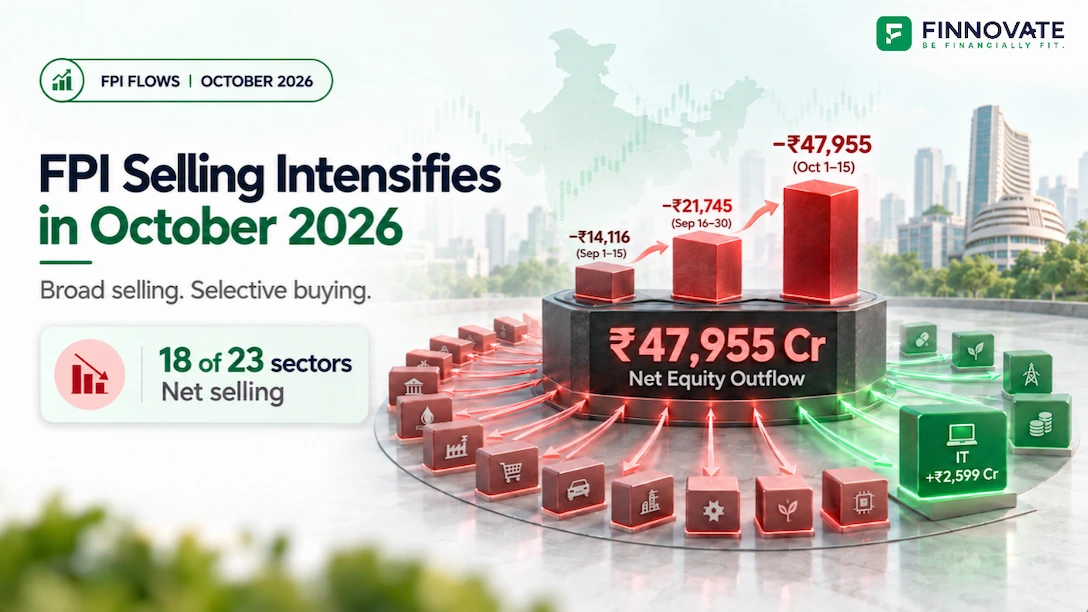
Explore FPI equity flows for October First Half, 2026: ₹47,955 crore in net outflows, th...

Understand the India–Mauritius tax treaty’s Principal Purpose Test, its August 2026 ef...

Explore India’s AI hardware opportunity through the proposed Adani–Jabil venture, from...
Popular now

Learn how to easily download your NSDL CAS Statement in PDF format with our step-by-step g...

Looking for the best financial freedom books? Here’s a handpicked 2026 reading list with...
Learn what SIF investment means in India, SEBI rules, Rs 10 lakh minimum investment, avail...
Clear guide to mutual fund taxation in India for FY 2025–26 after July 2024 changes: equ...