

Received ₹10 Lakh as a Bonus? How Should You Invest It?
Received a ₹10 lakh bonus? Learn how to decide between spending, debt repayment, near-te...
28 September 2026
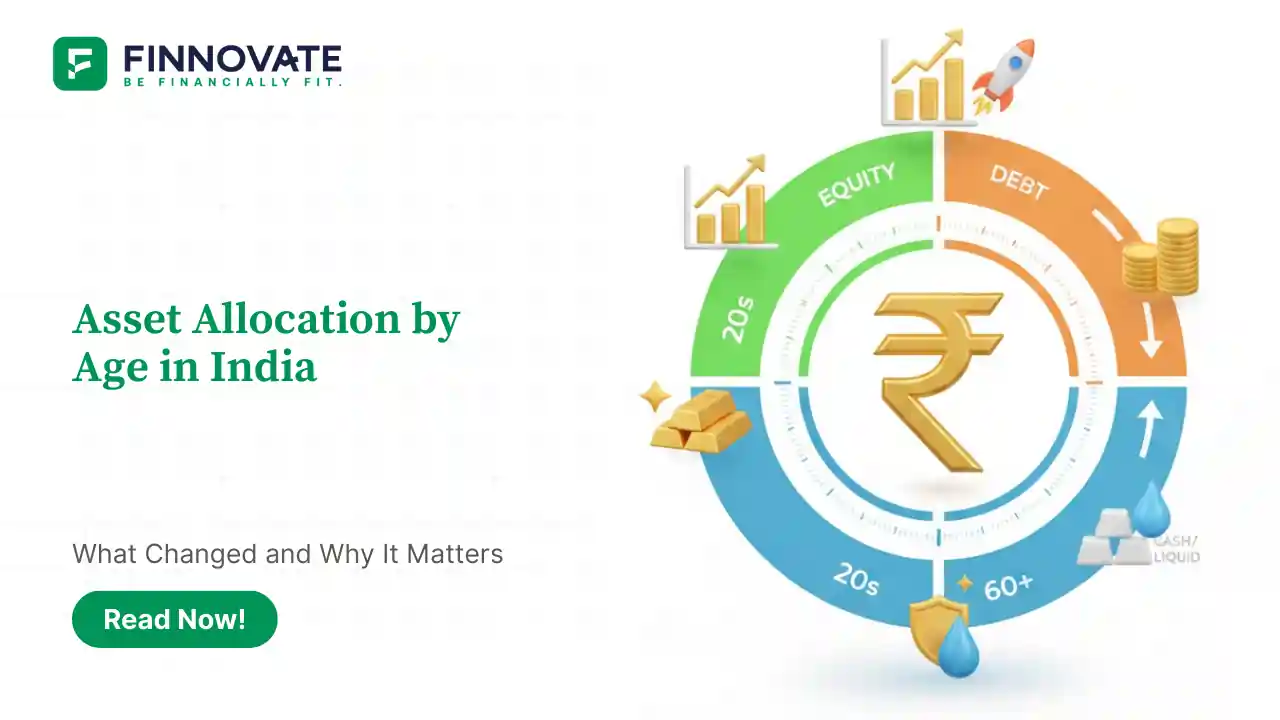
Most people search for "asset allocation by age" because they want a starting point, not a 40-page thesis. The goal is a default setting that fits the current life stage, which can then be adjusted for real-world goals like buying a home, funding a child's education, or retiring comfortably in an inflationary economy.
This guide provides that starting point: an age-based breakdown followed by three rules that explain when to deviate from the defaults based on goals, comfort with volatility, and tax efficiency.
Quick Answer: Asset allocation defaults by age in India
A commonly cited starting point for a 55-year-old in India, approximately 5 to 10 years from retirement, is 35 to 50% equity, 40 to 50% debt, 5 to 10% gold, and 5 to 15% cash or liquid instruments. The focus at this stage shifts toward capital preservation while retaining enough equity to counter 25-plus years of post-retirement inflation.
For other ages, a useful India-adjusted heuristic is 110 minus your age in equity (versus the global "100 minus age" rule, adjusted for India's higher long-term growth potential). For a 35-year-old that gives approximately 75% equity; for a 50-year-old, approximately 60%. This is a rough starting point only. Goals, income stability, and risk tolerance all shift the right number.
The full age-band table is in the section below.
Picking the right stock can produce an outsized gain. Picking the right asset allocation improves the odds of reaching financial goals without taking unnecessary risk.
In India, asset allocation is how an investor splits investable surplus across equity, debt, gold, and cash. Age is the primary driver because it determines the "time to recover" from a significant market drawdown.
A 30% fall is easier to absorb at 25, with decades of future contributions ahead. Near retirement, the same fall can materially disrupt a withdrawal plan. Age-based allocation is not about being conservative for its own sake. It is about ensuring that money is available in the right form when the deadline actually arrives.
Related read: For a deeper framework on the mechanics, see the Wealth Management Principles guide.
The four main asset classes in India behave differently from their equivalents in other markets, particularly because of the country's inflation profile, tax treatment, and cultural relationship with gold.
In an economy with persistent 5 to 6% inflation, equity has historically been one of the most reliable inflation-beating asset classes over long horizons. The trade-off is short-term volatility.
Debt in a portfolio serves a preservation function, not a wealth-creation function. Its role is to reduce drawdown severity during equity market downturns and to fund near-term goals reliably.
Gold has a cultural significance in India, but in a portfolio its role is functional. It has historically provided some protection during periods of currency weakness and geopolitical uncertainty, though its correlation with equities varies and it produces no income or dividends.
This allocation covers immediate liquidity: emergency expenses, short-term goals within 12 months, and the behavioural comfort of having accessible funds during a volatile period.
The table below is a starting point based on age band. If there is no specific near-term goal driving a different approach, this is a reasonable default for most salaried investors in India.
| Age Band | Equity (Growth) | Debt (Stability) | Gold (Hedge) | Cash (Liquidity) |
|---|---|---|---|---|
| 20 to 29 | 75 to 85% | 10 to 15% | 0 to 5% | 5 to 10% |
| 30 to 39 | 65 to 75% | 15 to 20% | 5 to 10% | 5 to 10% |
| 40 to 49 | 50 to 65% | 25 to 35% | 5 to 10% | 5 to 10% |
| 50 to 59 | 35 to 50% | 40 to 50% | 5 to 10% | 5 to 15% |
| 60 and above | 20 to 30% | 50 to 60% | 5 to 10% | 10 to 20% |
Note: The emergency fund is separate from this table. Cash here covers near-term needs and liquidity beyond the emergency fund.
Want to check if your current portfolio split actually matches your age and goals, not just the default table?
Get a free reviewThe age-based table applies to money earmarked for long-term goals. For specific near-term goals, the time horizon of that goal matters more than the investor's age.
Example: A 35-year-old planning a home purchase in 5 years has two separate pools of money to think about. The money set aside for the down payment should be predominantly in debt, regardless of the 65 to 75% equity default in the table. Only the money earmarked for retirement, still 25 or more years away, follows the age-based equity-heavy allocation. Keeping both pools in one equity-heavy portfolio creates a mismatch between money availability and goal deadline.
If a 20% fall in the Nifty 50 triggers an impulse to pause SIPs or exit the market, the equity allocation is likely too high for that investor's comfort level. Behavioural discipline over the full market cycle matters more than mathematical optimality at a single point in time.
For investors who find high equity exposure uncomfortable, picking the lower end of the equity range for their age band in the table is a more sustainable choice than targeting the upper end and abandoning the plan during a drawdown.
In India, selling equity to rebalance carries capital gains tax implications. A tax-efficient alternative in many cases is to direct new monthly investments (SIPs) into the underweight asset class rather than selling the overweight one.
Rebalancing example: A portfolio started at Rs 70 lakh equity and Rs 30 lakh debt (70:30 target ratio). After a bull run, equity grows to Rs 87 lakh and debt to Rs 31 lakh, a total of Rs 118 lakh. Equity is now 73.7% of the portfolio. Directing the next several months of SIP contributions entirely into the debt allocation can restore the 70:30 ratio without triggering a tax event from selling equity.
In the 20s, the largest financial asset is human capital: the ability to earn for the next 30 to 40 years. This long runway makes equity the natural primary holding.
An 80% equity allocation at this stage is not reckless because there are decades available to ride out volatility. The more common mistake in this phase is keeping too much in fixed deposits out of caution. At this horizon, the bigger risk is not market volatility but the risk of a corpus that does not grow enough to beat the long-term rise in living costs.
The 30s is when financial life gets complex. Home loans, marriage costs, and early parenting expenses can arrive simultaneously, creating cash flow pressure at the same time as income is growing.
Maintaining a high equity allocation for the retirement pool while separating goal-specific money into debt-heavy buckets is the practical approach for this decade. A 3-year home down payment pool and a 20-year retirement pool deserve different allocations, even if they sit in the same household balance sheet. The goal-based bucketing framework covers this in depth.
Many 40-year-old investors face simultaneous demands: funding higher education for children, supporting aging parents, and continuing to build their own retirement corpus during peak earning years.
A balanced portfolio in the 50 to 65% equity range helps here. Enough equity to keep the retirement corpus growing; enough debt to ensure school or college fees are protected from a market downturn in the months they are needed. The diversification framework explores this balance in more detail.
Within a decade of retirement, the focus shifts from accumulation to securing what has been built. A systematic reduction in equity exposure, often implemented through a Systematic Transfer Plan (STP) from equity to debt, is a common approach.
The practical target is to have 3 to 5 years of projected post-retirement expenses in safe, liquid instruments by age 60. This protects against having to liquidate equity during a market downturn in the early retirement years. Finnovate's retirement planning advisory covers this transition in detail for investors approaching this stage.
Retirement in urban India no longer means exiting equity entirely. With life expectancy in metros rising, a retirement corpus may need to last 25 to 30 years. A portfolio invested only in fixed income at age 60 carries a meaningful inflation risk over that horizon.
A three-bucket structure is a widely used framework for managing withdrawals without over-concentrating in either risk or safety:
Note on post-retirement equity: Maintaining 15 to 20% equity in retirement, largely in Bucket 3, is a common planning recommendation for investors with a 20-plus year retirement horizon. A portfolio held 100% in debt from age 60 risks gradual erosion of real purchasing power over a long retirement.
Not sure if your allocation is right for your life stage?
Goals, income, EMIs, and family obligations all shift the ideal split beyond what any table can capture. A Finnovate adviser can map your actual allocation against your specific situation.
Book a free reviewMany Indian households hold 80 to 90% of their net worth in property. A portfolio concentrated in one flat is not diversified. For the purpose of this allocation framework, the primary home is best treated as a consumption asset rather than part of the investable portfolio.
EPF and PPF are strong long-term debt instruments, but they are not liquid. Counting them as the only debt allocation can create a situation where an investor is asset-rich but cash-poor during an emergency. A separate liquid fund allocation for immediate access is a practical complement to the locked-in instruments.
Gold has historically lagged equities over long horizons and produces no income or dividends. It plays a useful stabilising role in a portfolio, but at high allocations its drag on long-term return becomes a cost. Keeping gold between 5% and 10% treats it as insurance rather than a primary return driver.
For investors who prefer a structured, adviser-led approach to all four steps above, Finnovate's wealth management advisory covers portfolio construction, annual rebalancing, and goal alignment as an ongoing service.
Asset allocation is not a fixed formula set at one point and left unchanged. It is a framework that evolves as an investor moves from the compounding phase of their 20s through the goal-collision years of the 30s and 40s and into the glide-path and bucket phases of the 50s and 60s.
The goal is not the highest-returning portfolio in any single year. The goal is a resilient portfolio that delivers what is needed, when it is needed, across the full range of life stages.
In most cases, no. Unless a sale and downsizing is planned, the primary home is a consumption asset rather than part of the investable allocation. It is concentrated, illiquid, and does not produce a cash return in the same way as financial assets.
A commonly cited allocation for a 55-year-old approximately 5 years from retirement is 35 to 50% equity, 40 to 50% debt, 5 to 10% gold, and 5 to 15% cash or liquid instruments. The equity component is retained to counter inflation over a potentially 25 to 30-year retirement horizon. Please consult a SEBI-registered investment adviser to determine the right split for your specific income, goals, and risk tolerance.
NPS is best treated as a hybrid instrument within this allocation. The E (equity) tier is counted under equity, and the C (corporate bond) and G (government securities) tiers are counted under debt. The auto-choice option in NPS follows a built-in age-based glide path, reducing equity exposure automatically as the subscriber ages.
The 110-minus-age version is generally considered a better fit for Indian investors, given the country's higher long-term growth potential and relatively high inflation. At 110 minus age, a 30-year-old would hold approximately 80% in equity; a 50-year-old approximately 60%. This remains a rough heuristic and not a precise formula.
For the debt and liquid buckets in retirement, commonly used instruments include debt mutual funds, Senior Citizen Savings Scheme (SCSS), RBI Floating Rate Bonds, and Post Office Monthly Income Scheme (POMIS). Each has different liquidity profiles, rate structures, and tax treatment. A mix across these is common practice to balance stability, liquidity, and return.
Disclaimer: This article is for general information and educational purposes only. It does not constitute investment advice, a recommendation, or an offer to buy or sell any securities or financial instruments. Asset allocation frameworks are illustrative starting points and not tailored advice. Past market behaviour is not indicative of future outcomes. Please consult a SEBI-registered investment adviser before making any investment decision. Investments in securities are subject to market risks.
No spam. Only new posts, simple explainers, and practical money checklists for busy professionals.
Finnovate is a SEBI-registered financial planning firm that helps professionals bring structure and purpose to their money. Over 3,500+ families have trusted our disciplined process to plan their goals - safely, surely, and swiftly.
Our team constantly tracks market trends, policy changes, and investment opportunities like the ones featured in this Weekly Capsule - to help you make informed, confident financial decisions.
Learn more about our approach and how we work with you:
No comments yet. Start the conversation. What would you add?
No spam. Only new posts, simple explainers, and practical money checklists.
You may also like
Received a ₹10 lakh bonus? Learn how to decide between spending, debt repayment, near-te...

Should your emergency fund stay in a savings account? Learn how to split it across savings...

FD vs corporate bonds: compare returns, YTM, safety, liquidity, tax and credit risk to und...

Financial planning for DINK couples in India covering cash flow, emergency funds, investme...
Popular now

Learn how to easily download your NSDL CAS Statement in PDF format with our step-by-step g...

Looking for the best financial freedom books? Here’s a handpicked 2026 reading list with...
Learn what SIF investment means in India, SEBI rules, Rs 10 lakh minimum investment, avail...
Clear guide to mutual fund taxation in India for FY 2025–26 after July 2024 changes: equ...