

How India Saves and Invests: Where Household Money Goes
See how Indian households save and invest across deposits, insurance, mutual funds and sto...
07 October 2026
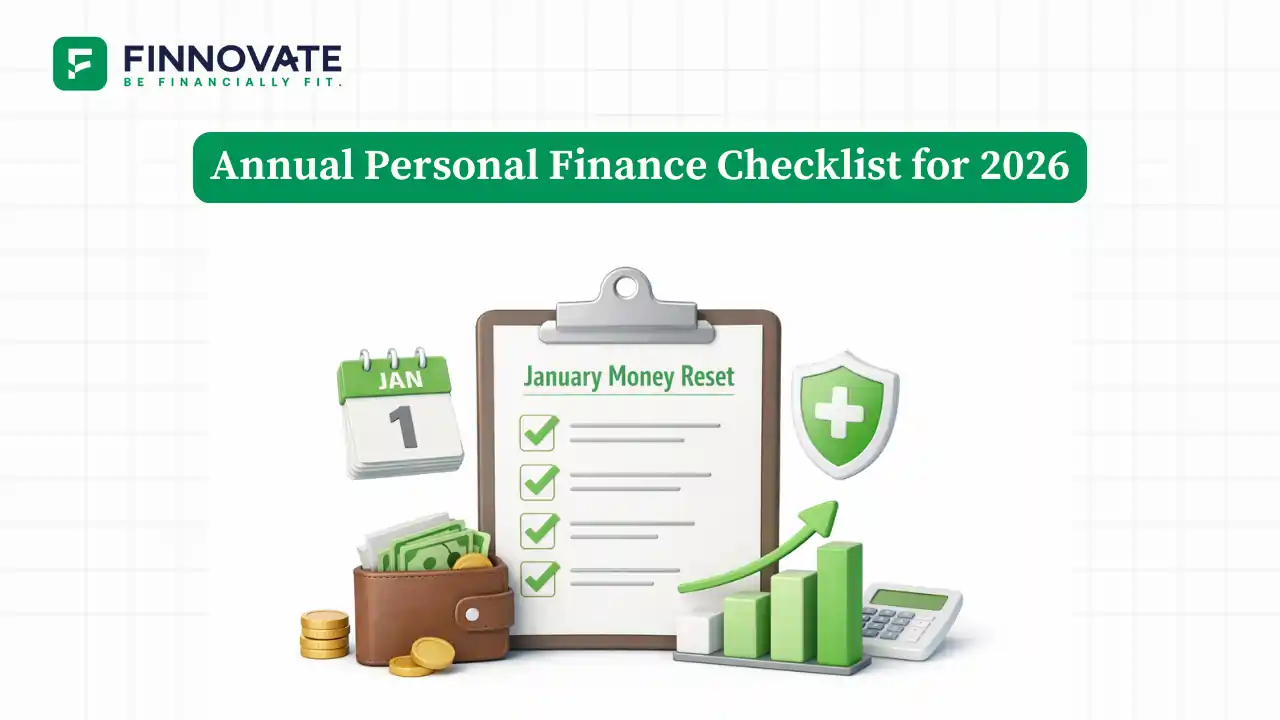

Finnovate’s editorial team researches and creates financial content using trusted sources, regulatory references and inputs from subject experts.
A simple January reset you can actually finish
Every New Year starts with good intentions.
And by February, most money plans quietly fade.
Not because people don’t care.
Because money decisions feel scattered, boring, and easy to postpone.
So instead of resolutions, think of this as a January Money Reset.
A once-a-year review of income, expenses, savings, investments, insurance, loans, and goals done at the start of the year so money decisions don’t depend on motivation later.
One sitting. One clear view. No daily discipline required.
You don’t analyse every detail in a health check-up.
You look at the big markers and fix obvious gaps.
That’s exactly how personal finances should be reviewed. A single annual review, ideally in January, is enough to adjust savings, rebalance investments, review insurance, update nominees, and realign money decisions with changes in income or responsibilities.
Block one focused hour, and use this checklist to:
If you don’t have an hour, jump to the “Do only 3 things” section at the end.

Before goals or planning, pause and take a snapshot.
List what you own and what you owe.
Bank balance, fixed deposits, mutual funds, EPF, PPF, NPS, stocks, gold, property if any.
Then list loans and credit card dues.
Accuracy is not the goal. Awareness is.
Most people make decisions without ever seeing everything in one place. This single snapshot becomes the reference point for every decision you make during the year.
Open your last 30 days of bank and credit card statements.
You’re not judging yourself.
You’re just observing.
This exercise helps you understand your monthly burn rate, your top expense categories, and the quiet subscriptions or habits that add up over time. You don’t need a perfect budget. You need a realistic one that reflects how money actually moves.
Before SIPs, markets, or returns, ask one simple question.
If income stops tomorrow, how many months are you covered?
For most Indians, an emergency fund should cover 3 to 6 months of expenses if income is stable and responsibilities are limited. If income is variable or responsibilities are high, 6 to 12 months offers better safety. This money should stay in safe, liquid options.
Use Finnovate's Emergency Fund Calculator to see how many months your current buffer covers. If you want a deeper explanation, here’s a clear breakdown of the 3–6–12 month emergency fund rule in India.
January is the best time to clean this up.
Check whether your SIPs are aligned to salary dates and linked to goals instead of running randomly. A simple structure works best. One SIP for long-term goals, one for medium-term goals, and optional short-term parking if needed.
If increments are expected during the year, reviewing SIP amounts at the start of the year and adding a small step-up is far more effective than trying to increase contributions later.
If SIPs still feel confusing, this guide explains how SIP calculators actually work for investment planning, and you can also use Finnovate’s SIP calculator to test numbers quickly.
You don’t need constant action.
You need awareness.
Write your intended asset mix in one line. For example, 60% equity, 30% debt, 10% gold. Then compare it with your current allocation.
When markets move, portfolios drift. Rebalancing simply means bringing investments back to the original mix when the drift becomes meaningful, usually beyond 5–10%. This keeps risk under control instead of letting one asset dominate silently.
If asset allocation still feels abstract, this simple explanation of asset allocation and this article on why asset allocation matters more than fund selection will help.
Does your debt make life easier or tighter?
Look at your total monthly EMI and how it feels against income. High-interest loans like credit cards and personal loans should generally be prioritised for repayment. Long-term loans don’t always need rushing if EMIs are manageable and emergency funds are in place.
There is no universal rule. The right decision depends on interest cost, cash-flow comfort, and peace of mind.
This guide on good debt vs bad debt in India explains how to think about loans more clearly.
This takes five minutes and saves money all year.
Ensure full autopay is active, cancel unused cards, and review forgotten subscriptions. Credit cards are useful tools, but interest leakage quietly erodes wealth if left unchecked.
If credit score is a concern, this article on how to improve your CIBIL score in India is worth a read.
Insurance should never be reviewed during a claim.
At the start of the year, check whether your health insurance cover is adequate for your city, understand waiting periods and sub-limits, and confirm hospital network access. Doing this once a year avoids surprises later.
This checklist on key considerations when buying health insurance explains what most people miss.
If income has grown or responsibilities have increased, it’s worth reviewing term insurance coverage.
Focus on adequacy, policy term, and nominee details. Avoid unnecessary complexity. Term insurance is about protection, not optimisation.
If you want a refresher, this guide explains what term insurance actually is and how it works.
January is not about buying tax products.
It’s about choosing direction.
Tax planning works best when it starts at the beginning of the financial year. Early planning helps manage salary TDS smoothly and avoids last-minute decisions made only for tax savings.
This article on tax planning for salaried employees in India explains how to approach it calmly.
This is the most ignored step and the most important one.
Nominee details should be updated across bank accounts, mutual funds, demat accounts, insurance policies, and EPF. Life changes, and records should reflect that.
If you’ve never thought about this properly, this estate planning guide for India is a good starting point.
Not ten. Just three.
Each goal should clearly state what you want, by when, and what runs monthly to support it. If a goal has no monthly action attached, it rarely survives the year.
Check emergency fund adequacy.
Align SIPs and savings to goals.
Update nominees across accounts.
That alone puts you ahead of most people.
Money doesn’t improve because motivation increases.
It improves when systems improve.
This checklist isn’t about doing everything.
It’s about doing the right few things, once, properly, at the start of the year.
Disclaimer: This article is for informational and educational purposes only and does not constitute investment advice.
No spam. Only new posts, simple explainers, and practical money checklists for busy professionals.
Finnovate is a SEBI-registered financial planning firm that helps professionals bring structure and purpose to their money. Over 3,500+ families have trusted our disciplined process to plan their goals - safely, surely, and swiftly.
Our team constantly tracks market trends, policy changes, and investment opportunities like the ones featured in this Weekly Capsule - to help you make informed, confident financial decisions.
Learn more about our approach and how we work with you:
No comments yet. Start the conversation. What would you add?
No spam. Only new posts, simple explainers, and practical money checklists.
You may also like
See how Indian households save and invest across deposits, insurance, mutual funds and sto...

Received a ₹10 lakh bonus? Learn how to decide between spending, debt repayment, near-te...

Should your emergency fund stay in a savings account? Learn how to split it across savings...

FD vs corporate bonds: compare returns, YTM, safety, liquidity, tax and credit risk to und...
Popular now

Learn how to easily download your NSDL CAS Statement in PDF format with our step-by-step g...

Looking for the best financial freedom books? Here’s a handpicked 2026 reading list with...
Learn what SIF investment means in India, SEBI rules, Rs 10 lakh minimum investment, avail...
Clear guide to mutual fund taxation in India for FY 2025–26 after July 2024 changes: equ...