

Received ₹10 Lakh as a Bonus? How Should You Invest It?
Received a ₹10 lakh bonus? Learn how to decide between spending, debt repayment, near-te...
28 September 2026
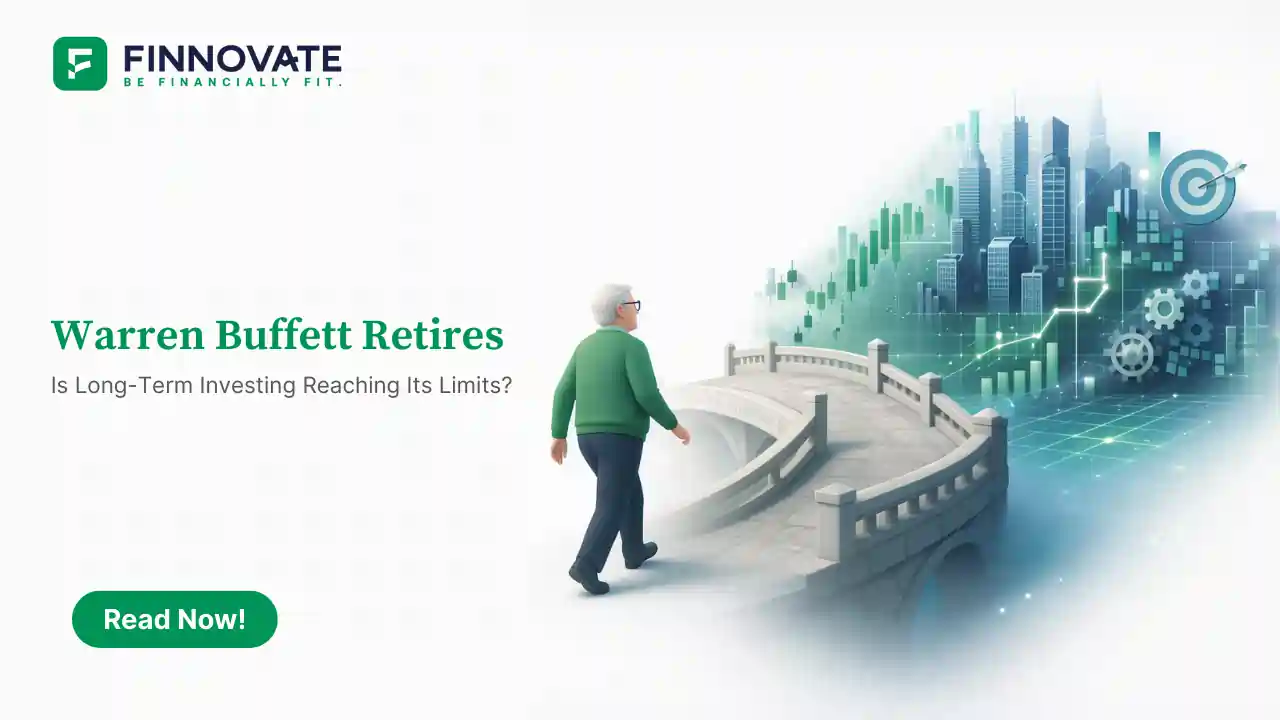
When Warren Buffett finally stepped aside at the age of 95, it was more than the retirement of the world’s most famous investor. It raised a deeper question for markets everywhere.
Is this also the beginning of the end for the idea of “holding forever” in long-term investing?
Buffett’s philosophy shaped generations of investors. But markets today are very different from the world in which that philosophy was built.
Before questioning Buffett’s approach, the data deserves respect.
Since 1960, Berkshire Hathaway has delivered CAGR returns nearly twice that of the S&P 500 over more than six decades. Very few investment records in history come close to this consistency.
It is the investing equivalent of Don Bradman’s batting average - statistically extraordinary and unlikely to be repeated.
Long-term investing, patience, and a focus on business quality clearly worked. The real question now is not whether it worked in the past, but whether it can continue to work the same way in the future.
At the heart of Buffett’s philosophy was the idea of a durable economic moat - businesses so strong that competitors could not easily disrupt them.
In earlier decades, moats lasted generations. Brands, distribution networks, and capital intensity protected companies for decades.
Today, moats can weaken much faster.
Technology, regulation, and shifting consumer behaviour can change industry dynamics within a few years. Valuing a “forever business” becomes harder when the business model itself is constantly evolving.
This does not make Buffett’s thinking wrong - it makes it harder to apply without adjustment.
Buffett’s successful bets are well known. Coca-Cola, American Express, Bank of America, and especially Apple created enormous long-term value for Berkshire Hathaway.
Apple, in particular, became the single most important contributor to Berkshire’s performance over the last decade.
But there were misses too.
Buffett largely avoided many of the defining technology companies of the modern era - Microsoft, Google, Amazon, Meta, Netflix, and NVIDIA. He entered IBM and US airlines only after their peak growth years had passed.
These were not mistakes of judgment alone. They were consequences of an investment framework that was cautious about fast-changing technology.
If you look at the top performing US stocks over the last 10 years, the list is dominated by technology and innovation-led companies.
Semiconductors like NVIDIA, AMD, and Broadcom. Cloud and digital infrastructure players like Arista and Axon. New-age businesses across electric vehicles, defence technology, and biotechnology.
In fact, 8 out of the top 10 long-term performers came from high-technology segments.
An investor who avoided technology entirely could still beat the index but would almost certainly miss the biggest alpha generators of the decade.
This is the trade-off modern investors face.

One of the biggest points of debate in recent years has been Berkshire Hathaway’s growing cash pile.
At its peak, Berkshire was sitting on nearly $380 billion in US Treasuries.
Holding cash provides safety, flexibility, and protection against market crashes. But in a period when US equity markets continued to make new highs, idle cash also carried a heavy opportunity cost.
In strong, momentum-driven markets, waiting for the “perfect price” can be expensive.
The responsibility now shifts to Greg Abel.
Abel inherits not just a balance sheet, but an investing legacy. Repeating an Apple-like success will not be easy. Finding multiple large opportunities at Berkshire’s scale is even harder.
Going forward, Berkshire may need:
This does not mean abandoning Buffett’s principles. It means evolving them for a world where industries change faster and competitive advantages are less permanent.
Buffett’s retirement does not invalidate long-term investing.
But it does highlight an important shift. In modern markets, flexibility matters as much as patience. Understanding technology, innovation cycles, and structural change is now part of long-term investing - not separate from it.
The idea of “holding forever” may still work in select businesses. But applying it blindly, without adapting to changing realities, carries risk.
The Buffett era showed what discipline and patience can achieve. The next era will test how well those principles can evolve.
Disclaimer: This article is for informational and educational purposes only and does not constitute investment advice.
No spam. Only new posts, simple explainers, and practical money checklists for busy professionals.
Finnovate is a SEBI-registered financial planning firm that helps professionals bring structure and purpose to their money. Over 3,500+ families have trusted our disciplined process to plan their goals - safely, surely, and swiftly.
Our team constantly tracks market trends, policy changes, and investment opportunities like the ones featured in this Weekly Capsule - to help you make informed, confident financial decisions.
Learn more about our approach and how we work with you:
No comments yet. Start the conversation. What would you add?
No spam. Only new posts, simple explainers, and practical money checklists.
You may also like
Received a ₹10 lakh bonus? Learn how to decide between spending, debt repayment, near-te...

Should your emergency fund stay in a savings account? Learn how to split it across savings...
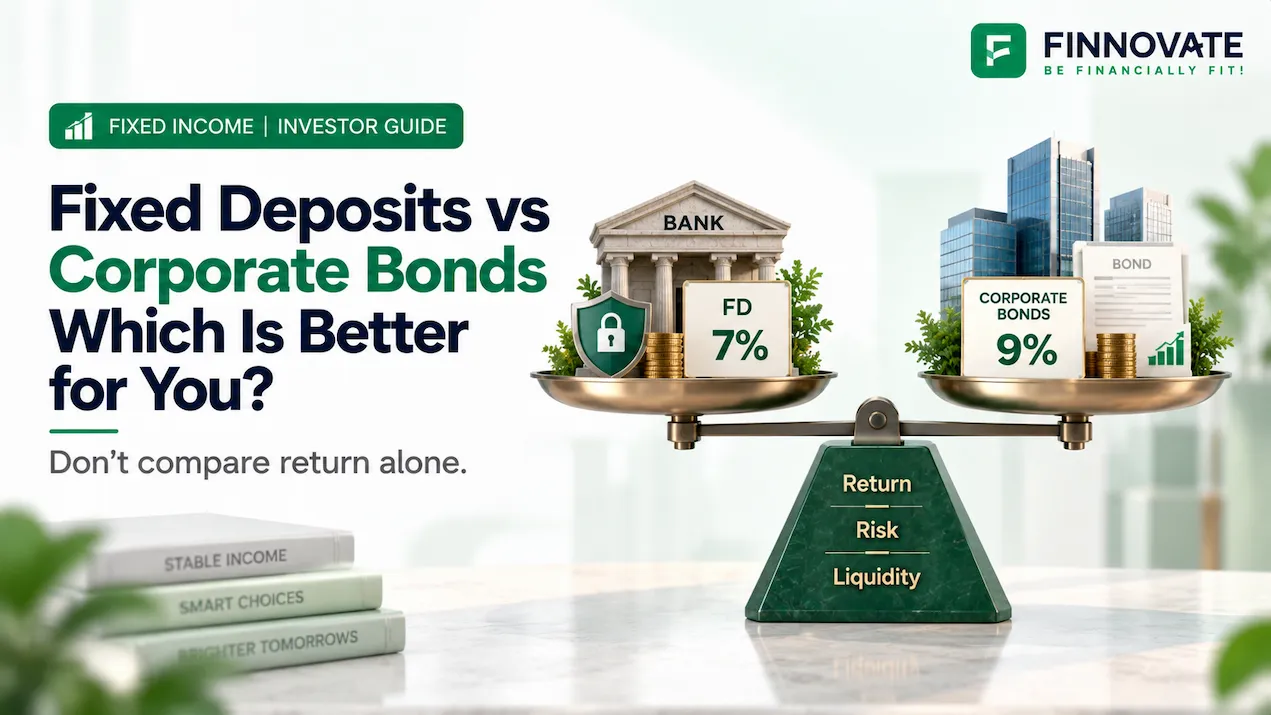
FD vs corporate bonds: compare returns, YTM, safety, liquidity, tax and credit risk to und...

Financial planning for DINK couples in India covering cash flow, emergency funds, investme...
Popular now

Learn how to easily download your NSDL CAS Statement in PDF format with our step-by-step g...

Looking for the best financial freedom books? Here’s a handpicked 2026 reading list with...
Learn what SIF investment means in India, SEBI rules, Rs 10 lakh minimum investment, avail...
Clear guide to mutual fund taxation in India for FY 2025–26 after July 2024 changes: equ...