

How Much Corpus for ₹2 Lakh/Month Retirement in India?
Want ₹2 lakh per month after retirement? See the corpus needed today and after 10, 20 or...
16 September 2026

Building a retirement corpus is a big goal for most Indians. Two of the most used long-term, government-backed saving options are EPF (Employees’ Provident Fund) and PPF (Public Provident Fund). Both are designed to reward patience, both have rule-based withdrawals, and both can be tax-efficient as per prevailing rules.
But they are not the same tool. EPF is usually employer-linked and runs on autopilot through salary. PPF is voluntary and gives you more control, but it comes with a long-term structure. This guide explains the difference between EPF and PPF, how each works in real life, and how to decide what fits your retirement plan in 2026.
EPF is a retirement savings scheme for eligible salaried employees in the organised sector, regulated by EPFO.
Typically, employees in establishments covered under EPF rules contribute via payroll.
EPF interest is declared by EPFO for a financial year. For instance, EPFO has communicated 8.25% for FY 2024–25. Future rates can change because they are declared periodically. So treat EPF returns as “declared rate”, not something you can lock in forever.
EPF is meant for long-term retirement savings, but it typically allows withdrawals under specific conditions such as certain life events or unemployment, as per EPFO rules. The key point is this: EPF is not fully liquid like a bank account.
PPF is a voluntary long-term savings scheme backed by the Government, commonly used by both salaried and self-employed individuals.
Eligible resident individuals can open it voluntarily (NRIs typically cannot open new PPF accounts under prevailing rules).
PPF interest rate is notified by the Government and reviewed periodically. In recent quarters, it has been around 7.1%, but it can change as per notifications. So again, think “declared rate”.
PPF is designed as a long-tenure product (commonly known for its 15-year structure). Partial withdrawals and loan facility may be available after certain years, subject to rules. Practically, PPF should be treated as long-term money.
What this means for you: If you are salaried and have EPF, it becomes your default base. If you are not, PPF becomes a strong stable option.
What this means for you: PPF is easier if income is irregular. EPF is easier if you want forced discipline.
What this means for you: Historically EPF has often been higher, but both are “declared rate” products. Don’t build your plan assuming today’s number will remain forever.
What this means for you: EPF can be more usable during certain emergencies, but neither is meant to replace an emergency fund.
Both EPF and PPF are considered tax-efficient instruments under Indian tax provisions, as per prevailing rules. But avoid thinking of them as “tax-free forever” in all situations.
Important EPF note for higher earners:
Interest on employee contributions above certain thresholds (commonly referenced as ₹2.5 lakh/year, and ₹5 lakh/year in cases without employer contribution) is taxable as per the framework introduced in recent years. If your EPF contribution is high, this matters.
What this means for you: Tax benefit is real, but it is rule-driven. Always check your contribution levels and how they are treated.
| Feature | EPF | PPF |
|---|---|---|
| Who can invest | Eligible salaried employees | Eligible resident individuals |
| Contribution | Payroll-based, structured | Voluntary, flexible within limits |
| Return style | Declared by EPFO | Declared by Govt, reviewed periodically |
| Risk level | Low to moderate | Low |
| Liquidity | Rules-based withdrawals | Long tenure, limited access rules |
| Lock-in behaviour | Retirement-focused | Long tenure by design |
| Employer contribution | Yes (with EPF/EPS split nuance) | No |
| Best role | Retirement base for salaried | Stability bucket for long-term goals |
Instead of a blanket “EPF is better” or “PPF is better”, use this logic.
Think of retirement as needing three things:
EPF and PPF do a good job for the stable base. But retirement planning also needs emergency funds and goal-based buckets outside locked instruments. The mistake is to assume EPF/PPF alone can solve every need, especially if retirement is decades away and inflation is a real factor.
If your goal is to retire early, it helps to know your FIRE number and the monthly investment needed to get there.
Book a FIRE planning call with Finnovate, and map EPF/PPF into a clear retirement plan..
EPF vs PPF is not a competition. It is a role decision. EPF works best as a retirement base for eligible salaried people because it is automatic and employer-linked. PPF works best as a voluntary long-term stability bucket that suits both salaried and self-employed individuals. In 2026, the sensible approach for many is: keep EPF as the base if you have it, use PPF if you need an additional stable bucket, and keep separate liquidity for emergencies.
If you are salaried and covered under EPF, EPF usually becomes the base because it is payroll-driven and employer-linked. If you are not salaried, PPF is a strong voluntary long-term option. For many, the best approach is using both.
EPF is typically employer-linked and structured through salary. PPF is voluntary and flexible. Both are long-term declared-rate instruments with rules-based withdrawals.
Yes. Many salaried people use EPF as the base and PPF as an additional stable long-term bucket.
EPF tax treatment depends on conditions such as tenure and contribution levels, as per prevailing rules. Also, interest on employee contributions above specified thresholds can be taxable.
PPF is designed as a long-tenure product (commonly 15 years), and withdrawals are rules-based. Partial withdrawal rules apply after a certain number of years, subject to prevailing rules.
EPF withdrawals are allowed under specific conditions and timelines defined by EPFO rules. It is best treated as retirement money with conditional access, not anytime money.
Both are stability-oriented instruments. “Safety” also depends on liquidity planning and whether your retirement plan includes buffers for emergencies.
No. They are different schemes. You can contribute to both, but you cannot directly convert one into the other.
Disclaimer: This article is for general educational information only. Interest rates, tax provisions, and withdrawal rules are subject to change as per notifications and applicable rules. Registration granted by SEBI, membership of BASL (in case of IAs) and certification from NISM in no way guarantee performance of the intermediary or provide any assurance of returns to investors.
No spam. Only new posts, simple explainers, and practical money checklists for busy professionals.
Finnovate is a SEBI-registered financial planning firm that helps professionals bring structure and purpose to their money. Over 3,500+ families have trusted our disciplined process to plan their goals - safely, surely, and swiftly.
Our team constantly tracks market trends, policy changes, and investment opportunities like the ones featured in this Weekly Capsule - to help you make informed, confident financial decisions.
Learn more about our approach and how we work with you:
No comments yet. Start the conversation. What would you add?
No spam. Only new posts, simple explainers, and practical money checklists.
You may also like
Want ₹2 lakh per month after retirement? See the corpus needed today and after 10, 20 or...

SWP vs FD for retirement: compare income, risk, inflation, tax, liquidity and corpus susta...

NPS vs mutual funds for retirement: compare liquidity, tax, lock-in, asset allocation, ann...
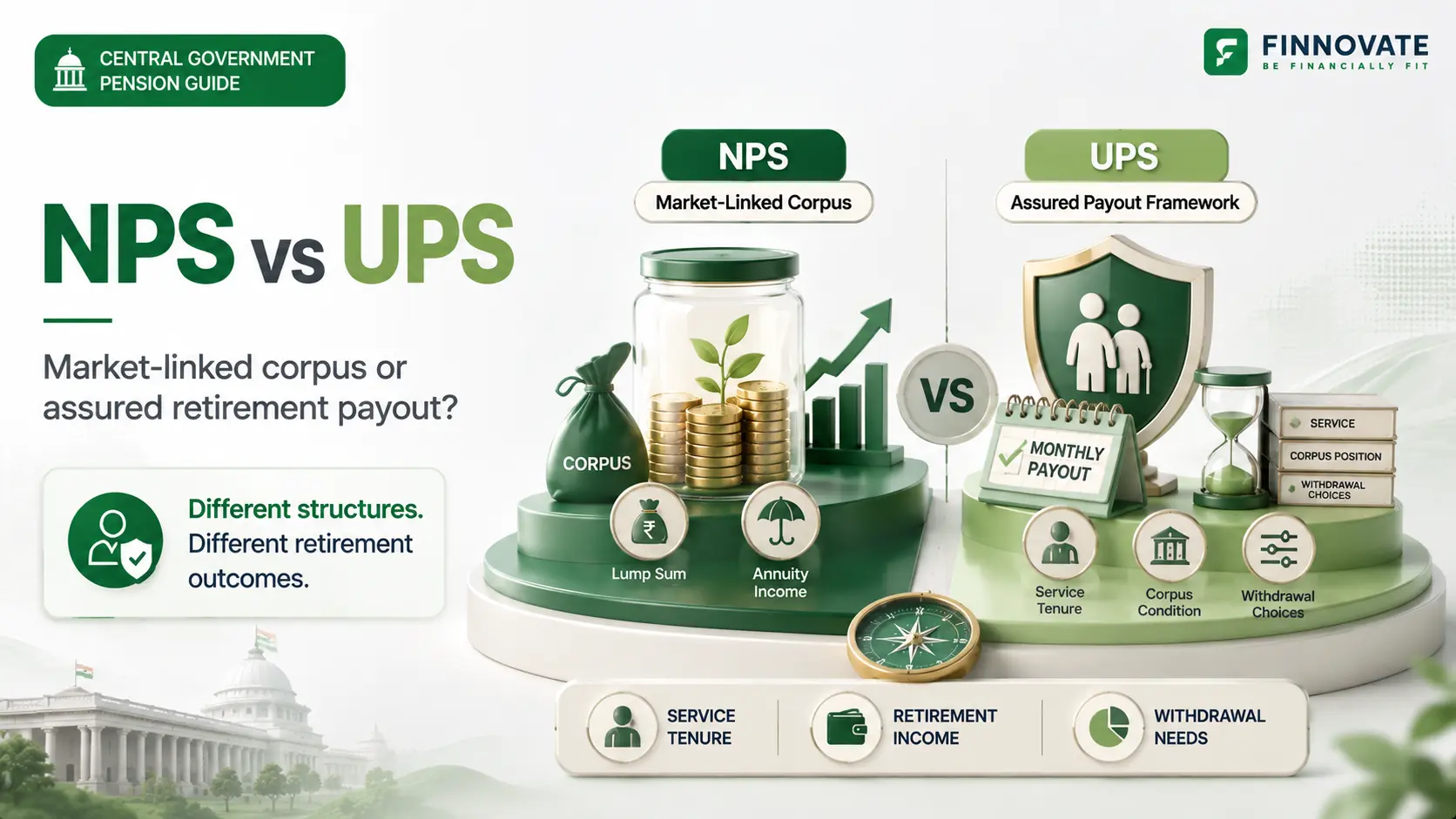
Compare NPS and UPS for Central Government employees, including contributions, pension cal...
Popular now

Learn how to easily download your NSDL CAS Statement in PDF format with our step-by-step g...

Looking for the best financial freedom books? Here’s a handpicked 2026 reading list with...
Learn what SIF investment means in India, SEBI rules, Rs 10 lakh minimum investment, avail...
Clear guide to mutual fund taxation in India for FY 2025–26 after July 2024 changes: equ...