

How India Saves and Invests: Where Household Money Goes
See how Indian households save and invest across deposits, insurance, mutual funds and sto...
07 October 2026
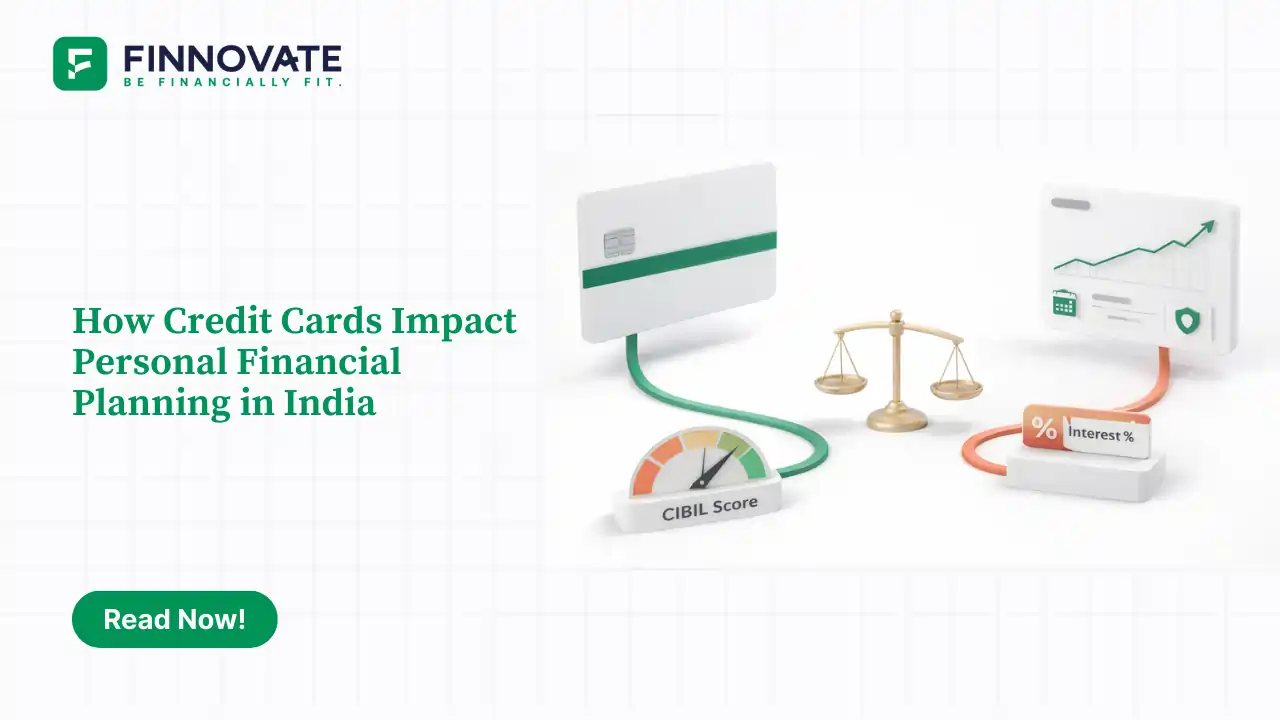
Most people think credit cards are about rewards. In reality, how credit cards impact personal financial planning comes down to two things: cashflow behaviour and cost of debt. Used well, a credit card helps you pay smoothly, build a healthy credit profile, and avoid short-term cash crunch decisions. Used poorly, it becomes one of the most expensive liabilities in your plan.
Rule: If you can’t pay the Total Amount Due every month, a credit card stops being a convenience tool and becomes debt.
One of the biggest ways credit cards impact personal financial planning is through your credit profile (commonly referred to as your CIBIL score). Lenders care about repayment history and credit utilisation. If your credit profile is stronger, you may get better loan terms and smoother approvals. If it’s weak due to missed payments or high utilisation, borrowing can become costlier or harder.
Credit cards can offer an interest-free period up to ~45–50 days, depending on billing cycle, when you spend, and whether you pay in full. This can help cashflow management because money stays in your account for a few extra weeks.
But this benefit is small compared to the risk. If you revolve dues, interest cost usually outweighs any cashflow advantage.
Credit cards are designed to be cleared each month. If you carry dues forward, interest kicks in and it is typically high compared to most other consumer borrowing. In India, revolving credit card APRs often fall in a wide range (commonly around 30%–45%+ p.a. depending on issuer and card).
Minimum due is not a repayment plan. It prevents missed-payment status, but it usually keeps most of the balance running, so interest keeps accumulating. This is how small dues become long-running debt.
In a real emergency, immediate payments may be needed while mutual fund redemptions or transfers take time. A credit card can act as a short bridge.
But don’t confuse this with an emergency fund. Card limits can change, and emergencies funded by long-term revolving dues become expensive quickly.
Credit cards reduce the “pain of paying” because you don’t see money leaving your account instantly. That makes it easier to overspend without noticing. Even a 5–10% monthly overshoot can reduce SIP capacity, delay goal savings, or push you into revolving dues.
Rewards can be useful when they come from spending you would have done anyway. The trap is spending extra to unlock a milestone reward, fee waiver, or lounge access.
If you like frameworks that keep money decisions steady across life stages, you may also find this useful: Asset Allocation: the most important principle for wealth management.
Take the FinnFit Test to see how you’re doing across budgeting, debt, insurance, investing, and retirement planning. It takes a few minutes and gives you a clear starting point.
Take the FinnFit TestNo spam. Just a practical score and next steps.
They can help if you pay on time and keep utilisation low. Missed payments and high utilisation can hurt.
Lower is generally better. Many planners use <30% of total limit as a practical thumb rule.
Minimum due avoids missed-payment status, but it usually keeps debt running and interest accumulating. It’s not a repayment plan.
Interest typically starts applying on the unpaid portion, and costs can rise quickly. Repeating this creates a debt cycle.
They can be a short bridge for immediate payments, but they are not a replacement for an emergency fund.
If you can’t pay Total Amount Due every month, reduce card usage and move to a payoff plan. Treat credit cards as a payments tool, not borrowing.
Disclaimer: This article is for general educational information only. It does not constitute investment advice or a recommendation .
No spam. Only new posts, simple explainers, and practical money checklists for busy professionals.
Finnovate is a SEBI-registered financial planning firm that helps professionals bring structure and purpose to their money. Over 3,500+ families have trusted our disciplined process to plan their goals - safely, surely, and swiftly.
Our team constantly tracks market trends, policy changes, and investment opportunities like the ones featured in this Weekly Capsule - to help you make informed, confident financial decisions.
Learn more about our approach and how we work with you:
Finnovate is a SEBI-registered financial planning firm that helps professionals bring structure and purpose to their money. Over 3,500+ families have trusted our disciplined process to plan their goals - safely, surely, and swiftly.
Our team constantly tracks market trends, policy changes, and investment opportunities like the ones featured in this Weekly Capsule - to help you make informed, confident financial decisions.
Learn more about our approach and how we work with you:
No comments yet. Start the conversation. What would you add?
No spam. Only new posts, simple explainers, and practical money checklists.
You may also like
See how Indian households save and invest across deposits, insurance, mutual funds and sto...

Received a ₹10 lakh bonus? Learn how to decide between spending, debt repayment, near-te...

Should your emergency fund stay in a savings account? Learn how to split it across savings...

FD vs corporate bonds: compare returns, YTM, safety, liquidity, tax and credit risk to und...
Popular now

Learn how to easily download your NSDL CAS Statement in PDF format with our step-by-step g...
Looking for the best financial freedom books? Here’s a handpicked 2026 reading list with...
Learn what SIF investment means in India, SEBI rules, Rs 10 lakh minimum investment, avail...
Clear guide to mutual fund taxation in India for FY 2025–26 after July 2024 changes: equ...