

HDFC Bank: What Must Change to Win Back Investors?
Can HDFC Bank win back investors? Explore how deposit costs, profit margins, loan quality ...
12 October 2026

Since the start of February 2025, Indian IT stocks have seen a sharp correction. The cumulative erosion in market value has been to the tune of $50 billion, with the decline most pronounced in large-cap IT companies that continue to derive a major share of revenues from legacy services.
The correction has raised an important question. Are markets pricing in a genuine structural disruption, or are they reacting disproportionately to uncertainty around AI-driven automation, particularly after the announcement from Anthropic?
To answer that, it is necessary to separate price action from long-term fundamentals.
The divergence between broader markets and IT stocks in 2025 has been stark.
This is not just short-term volatility. It represents a sustained shift in investor sentiment toward the sector.
Foreign portfolio investor behaviour reinforces this trend.
Nearly half of the foreign selling in Indian equities has been concentrated in IT. Markets are often described as behaving like a slot machine in the short term but like a weighing machine over the long term. The current price action suggests that investors are weighing in a structural risk rather than reacting to a one-off headline.
Anthropic, currently valued at approximately $380 billion, has introduced an automation platform positioned as a SaaS-style product. The concern is straightforward.
If enterprises adopt advanced AI automation tools, the need for large-scale IT outsourcing for application development, maintenance, and infrastructure management could reduce.
Indian IT companies such as TCS, Infosys, Wipro, and HCL Tech have traditionally dominated the global outsourcing landscape. A significant portion of their revenues comes from managing legacy systems and enterprise applications for global clients.
Anthropic’s platform represents:
This comes at a time when global corporates are already cautious about IT spending. Budget rationalisation over the past year has already slowed growth in Indian IT.
The fear, therefore, is not isolated to Anthropic alone. It is about the broader acceleration of AI automation in enterprise technology.
To assess the scale of the risk, it is important to look at revenue composition.
Major Indian IT companies derive roughly 70% to 80% of revenues from application services and infrastructure services. These are precisely the areas most susceptible to automation.
Brokerage estimates offer a range of views:
The more conservative view is rooted in enterprise behaviour. Mission-critical enterprise software systems are not replaced overnight. Large corporations tend to move cautiously, especially when dealing with core systems that underpin operations.
While the direction of change is clear, the pace and magnitude remain uncertain.

The current correction appears to reflect concerns around business model evolution rather than immediate earnings collapse.
There are two distinct risks:
Indian IT has successfully navigated multiple transitions over the past three decades.
In each phase, Indian IT firms retooled their capabilities and moved up the value chain. The current disruption is not about extinction. It is about speed of adaptation.
Over the last 30 years, Indian IT has built a global reputation for:
Even today, IT remains a major contributor to corporate ROE in India’s macro earnings profile.
Anthropic's platform is a signal that enterprise technology is evolving faster. It is not, at this stage, proof of permanent revenue destruction.
The risk is more about whether Indian IT companies can reposition themselves quickly toward:
If automation reduces repetitive work, demand may shift toward higher-value advisory and integration roles.
The market’s reaction reflects uncertainty rather than definitive structural collapse.
The $50 billion erosion in market capitalisation suggests that investors are pricing in a scenario of meaningful revenue disruption.
However:
Markets tend to front-load uncertainty. When the narrative shifts toward structural disruption, valuations adjust quickly.
Whether this adjustment proves excessive will depend on execution over the next two to three years.
Disclaimer: This article is for informational and educational purposes only and does not constitute investment advice, a recommendation, or an offer to buy or sell any securities. Market investments are subject to risks. Investors should evaluate their financial situation carefully and consult a qualified financial professional before making investment decisions.
No spam. Only new posts, simple explainers, and practical money checklists for busy professionals.
Finnovate is a SEBI-registered financial planning firm that helps professionals bring structure and purpose to their money. Over 3,500+ families have trusted our disciplined process to plan their goals - safely, surely, and swiftly.
Our team constantly tracks market trends, policy changes, and investment opportunities like the ones featured in this Weekly Capsule - to help you make informed, confident financial decisions.
Learn more about our approach and how we work with you:
No comments yet. Start the conversation. What would you add?
No spam. Only new posts, simple explainers, and practical money checklists.
You may also like
Can HDFC Bank win back investors? Explore how deposit costs, profit margins, loan quality ...
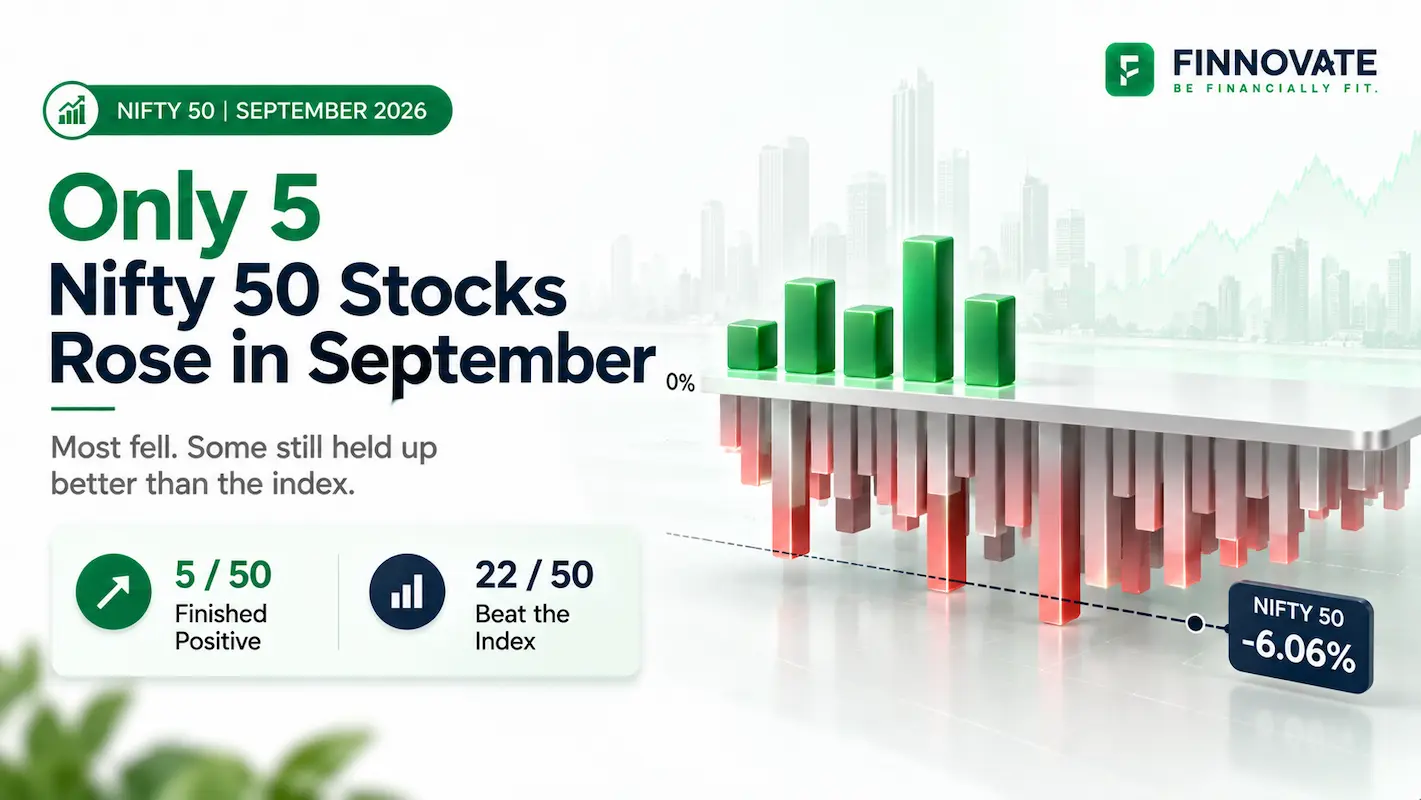
Only five Nifty 50 stocks rose in September 2026 as the index fell 6.06%. Compare monthly ...

Why did hospital stocks fall after Supreme Court scrutiny of medicine prices? Understand d...

Nifty Smallcap 100 rose 3.16% in August 2026. See which small-cap stocks led, what drove t...
Popular now

Learn how to easily download your NSDL CAS Statement in PDF format with our step-by-step g...

Looking for the best financial freedom books? Here’s a handpicked 2026 reading list with...
Learn what SIF investment means in India, SEBI rules, Rs 10 lakh minimum investment, avail...

Clear guide to mutual fund taxation in India for FY 2025–26 after July 2024 changes: equ...