Why the FMCG Index in India Is Struggling Now

The FMCG index in India has slipped from its 2024 peak. See what changed in volumes, pricing, competition and quick commerce, and what it means for investors.
December 04, 2025
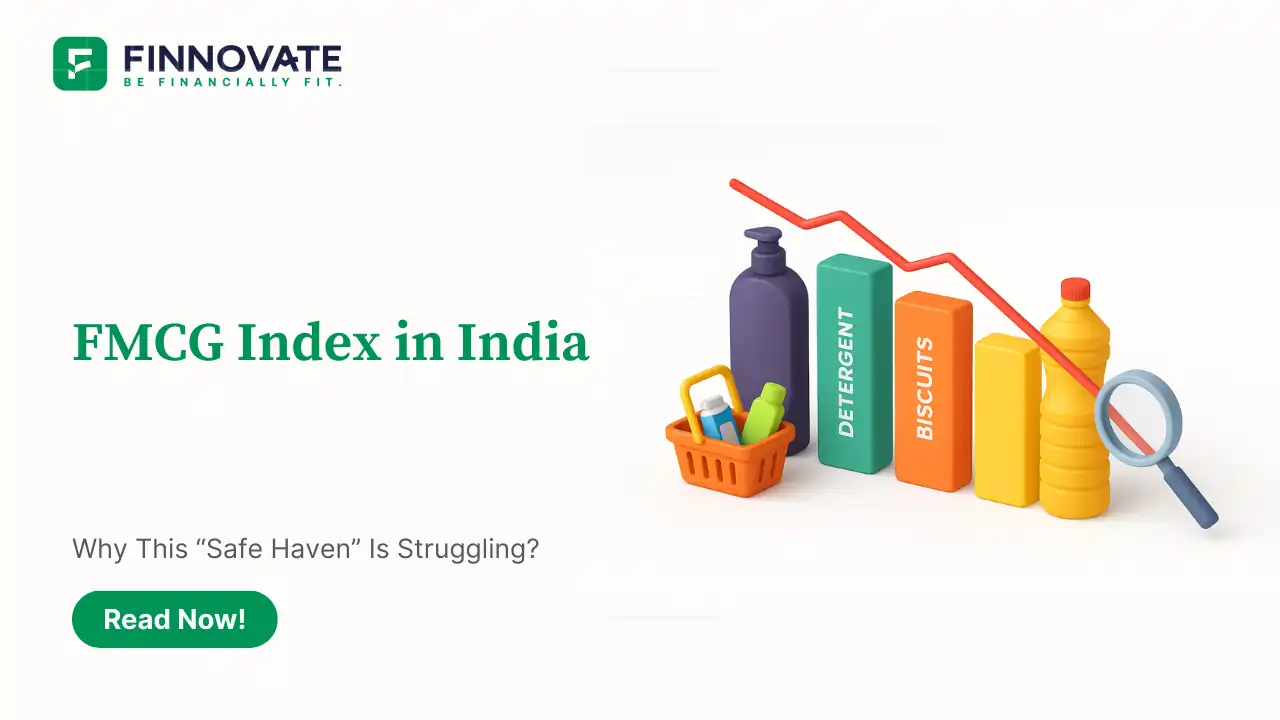
3D illustration of FMCG products as a falling bar chart with a red trend line showing the FMCG index struggling in India

FMCG Index in India: Why This “Safe Haven” Is Struggling

For years, FMCG stocks in India were seen as the “cannot go wrong” part of a portfolio. Steady demand, strong brands, and defensive behaviour in bad markets made them a go-to sector for cautious investors.

But in the last one year, the FMCG index in India has told a very different story. While the 5-year returns are still healthy at around 75%, the index is now well below its 2024 peak and has gone through a sharp correction.

So, what changed? And should investors still treat FMCG as a safe corner of the market?


How has the FMCG index in India performed recently?

Over the last five years, the FMCG index has done reasonably well, delivering around 75% returns. But the recent journey has been bumpy.

  • On 27 September 2024, the FMCG index hit a peak of 65,845.
  • Between September 2024 and February 2025, it corrected by about 23.1%, falling to around 50,689.
  • Since then, the index has recovered from the February lows, but it is still down roughly 15.4% from the peak.

So while long-term numbers look fine on paper, the recent experience for investors has been painful, especially for those who entered near the top.


Why is the FMCG index falling despite being a “safe haven”?

The FMCG index is under pressure because the usual engines that support this sector are not firing properly. Demand growth is weak, volume growth is muted or negative, competition is rising, and the entire distribution model is under stress due to quick commerce platforms.

In simple:

  • Growth is not driven by more units sold, but mainly by higher prices.
  • Consumers are feeling the pinch and are cutting back or down-trading.
  • The unorganized / informal FMCG sector is getting smarter.
  • Quick commerce platforms have changed how people buy daily essentials and how brands reach them.

Let’s break this down.


What has changed in the FMCG story in the last one year?

One year back, many investors still believed FMCG would quietly keep compounding. But several trends have started to hurt that comfort.

1. Price-led growth, not volume-led growth

For most FMCG companies, revenue growth in recent quarters has come mainly from price hikes, not from selling more units.

  • Input costs (like raw materials, packaging, logistics) went up.
  • FMCG companies responded by raising prices sharply.
  • In many staple products, prices are estimated to have gone up by 50–60% in just one year.

This has created a clear problem:

  • Consumers, especially in rural and semi-urban areas, are very price-sensitive.
  • When prices rise too fast, people buy less, buy smaller packs, or switch to cheaper alternatives.
  • As a result, volume growth has turned flat or negative for many consumer staples.

So while the top line may look okay because of higher prices, the underlying demand is weak, and that worries the market.


How do 50–60% price hikes impact FMCG demand?

Such sharp price hikes in a short time do three things:

  1. Shrink the basket
    Households start cutting non-essential items, buying fewer units, or stretching usage.
  2. Push down-trading
    Consumers move from premium to mid-range, and from branded to local or unbranded products.
  3. Delay purchases
    Instead of stocking up, people buy only what is necessary, reducing volumes further.

This is why, even in the latest reported quarters, volume growth for many FMCG categories remains flat or negative, despite higher revenue. Markets don’t like this pattern because price-led growth without volume support is not sustainable in the long run.


How is the informal FMCG sector changing the game?

Another big factor behind the FMCG index’s struggle is the rise of the informal / unorganized sector, which still holds around 25–30% market share in FMCG.

This segment is getting much smarter.

What is the informal sector doing differently?

  • Cost-focused: They run very lean operations with lower overheads and often cheaper inputs.
  • Miniaturisation: They actively push small-size packs that are affordable for rural and semi-urban consumers.
  • Niche targeting: Instead of taking on big brands everywhere, many informal players focus on specific niches or local tastes where competition is limited.

For a consumer who is under pressure:

  • A smaller, cheaper local product can feel like a better deal than a bigger branded pack.
  • Over time, this quietly eats into the volumes of large listed FMCG companies.

Investors are starting to price in this structural competition instead of assuming that branded FMCG will always dominate without a fight.


How is quick commerce hurting traditional FMCG companies?

In the last couple of years, quick commerce platforms like Instamart, Blinkit and others have become a major disruptor.

Most FMCG companies agree that this has been one of the biggest “show spoilers” for their traditional business model.

What has quick commerce changed?

  1. Where customers buy
    Earlier: Kirana stores, supermarkets, and traditional retail networks.
    Now: A large share of urban and young customers prefer quick commerce apps for convenience, choice, and discounts.
  2. How brands are discovered
    On a shelf, brands fight for shelf space.
    On an app, they fight for top search results, banners, and discount slots.
  3. Pricing power and margins
    Quick commerce platforms often run aggressive promotions and discounts.
    This can hurt the pricing power of established brands and pressurise margins.
  4. Distributor relationships
    Traditional distributors and retailers feel threatened when brands support or depend too much on digital platforms.
    This has created friction between FMCG companies and their long-standing distribution partners.

Many FMCG companies are trying to build their own digital marketplaces, but so far, these have limited appeal. Most buyers still prefer agnostic platforms where they can compare multiple brands, get quick delivery, and enjoy better offers.


Is the FMCG index still a safe place for long-term investors?

The FMCG index may still be relatively defensive compared to very cyclical sectors, but the idea that it is always safe and always a winner is being challenged.

Here is the balanced view:

Why it is not as “safe” as before

  • Slower volume growth: Long-term value creation needs consistent volume growth, not just higher prices.
  • Intense competition: From both informal players and private labels / smaller brands on quick commerce.
  • Margin pressure: Higher input costs plus heavy promotion and discounting can squeeze profitability.
  • Changing consumer behaviour: Urban digital buyers and rural price-sensitive buyers are pulling the sector in two very different directions.

Why it is still relevant in a portfolio

  • People will continue to buy essentials like food, personal care and home care products.
  • Strong brands with deep distribution, innovation and cost discipline can adapt and come out stronger over time.
  • FMCG can still act as a stability anchor in a diversified equity portfolio, especially for conservative investors.

The key message:
FMCG can be a part of the portfolio, but treating it as a “buy at any price, always safe” sector is risky.


What should investors keep in mind about FMCG stocks?

Rather than seeing FMCG as a magic shield, investors may want to think in terms of:

  1. Asset allocation first, sectors later
    Decide your equity–debt mix and risk level before deciding sector weights.
  2. Valuation discipline
    Even good businesses can deliver poor returns if bought at expensive valuations, especially when growth slows.
  3. Focus on fundamentals
    Look beyond brand names. Watch for:
    • Volume growth trends
    • Rural vs urban demand
    • Margin resilience
    • How the company is responding to quick commerce and informal competition
  4. Avoid overconcentration
    Don’t overload your portfolio with one “defensive” theme. Spreading exposure across sectors can reduce shocks like the recent FMCG correction.


Key risks and opportunities in the FMCG sector

Main risks

  • Weak rural demand if income growth doesn’t keep pace with inflation.
  • Persistent flat or negative volume growth despite price actions.
  • Share loss to unorganized players and smaller regional brands.
  • Pressure from digital platforms on pricing and promotions.

Possible opportunities

  • Rural recovery or government support that boosts rural incomes.
  • Premiumisation in urban segments where consumers trade up to better quality or healthier options.
  • Better execution by leading FMCG companies in innovation, cost control and digital distribution.

Investors will likely reward companies that adapt quickly and punish those that carry on as if nothing has changed.


FAQs

1. Why has the FMCG index underperformed recently?

The FMCG index has underperformed because volumes are weak even though companies raised prices sharply. Higher prices, rising competition from local players, and pressure from quick commerce have all hurt growth and sentiment.

2. Are FMCG stocks still safe for long-term investors?

FMCG stocks are still relatively defensive, but not risk-free. If you buy them at very high valuations when growth is slowing, returns can disappoint. They work better as part of a diversified portfolio, not as the only “safe” bet.

3. How is quick commerce affecting FMCG companies?

Quick commerce apps like Instamart and Blinkit have changed how people buy essentials, offering more choice and heavy discounts. This can pressure margins, weaken brand pricing power, and create friction with traditional distributors.

4. What is the role of the informal FMCG sector in this story?

The informal FMCG sector, with about 25–30% market share, uses lower costs, small packs and local flavours to win price-sensitive buyers. This quietly takes away volumes and market share from large branded players.

5. What should small investors track in the FMCG sector?

Focus on a few basics:

  • Volume growth rather than just sales growth
  • Rural vs urban demand trends
  • Company commentary on competition and quick commerce
  • Valuation versus realistic growth potential

Treat FMCG as one component of your overall asset allocation, not the only safe sector.


Disclaimer: This article is for information and education only. It is not a recommendation or research report. Please consult a qualified financial professional before making any investment or portfolio decisions.


About Finnovate

Finnovate is a SEBI-registered financial planning firm that helps professionals bring structure and purpose to their money. Over 3,500+ families have trusted our disciplined process to plan their goals - safely, surely, and swiftly.

Our team constantly tracks market trends, policy changes, and investment opportunities like the ones featured in this Weekly Capsule - to help you make informed, confident financial decisions.

Learn more about our approach and how we work with you:


Published At: Dec 04, 2025 12:28 pm
76
NSDL CAS Statement
Jun 27, 2024
How to download NSDL CAS Statement

Learn how to easily download your NSDL CAS Statement in PDF format with our step-by-step guide. Follow our instructions to log in to NSDL e-Services, download your account statement, and subscribe for

Read Full
SEBI’s Specialized Investment Fund Meaning, Benefits, Taxation & How to Invest with latest news
May 26, 2025
SIFs in India - Meaning, Benefits, Taxation & How to Invest (Latest Updates Covered)

Explore what Specialised Investment Funds (SIFs) are, their benefits, taxation, minimum investment, how to invest, how they compare with mutual funds and PMS and latest developments in SIF space

Read Full
Step-by-Step Guide to CDSL CAS Statement
Jun 27, 2024
How to Download Your CDSL CAS Statement

Learn How to Download Your CDSL CAS Statement with our step-by-step guide. Easy instructions for accessing your investment details online.

Read Full
Economic analysis of the 2025 India-Pakistan conflict and its implications on India's economy.
May 12, 2025
War Zone: Assessing the Economic Impact of the 2025 India-Pakistan Conflict

Analyzing the potential economic impact of the 2025 India-Pakistan conflict on India's GDP growth, manufacturing sector, and foreign investment.

Read Full
top financial freedom books in 2025
May 28, 2025
10 Best Financial Freedom Books to Read in 2025

Looking for the best financial freedom books? Here’s a handpicked 2025 reading list with summaries, why to read, and who it's best for.

Read Full
3D vector blog banner showing mutual fund taxation in India with documents, calculator, rupee coins, and tax symbol
Sep 11, 2025
Mutual Fund Taxation in India (FY 2025–26): Updated After July 2024

Clear guide to mutual fund taxation in India for FY 2025–26 after July 2024 changes: equity STCG 20%, LTCG 12.5% with ₹1.25L exemption, debt/hybrid rules, dividends, examples, tables, and FAQs.

Read Full
Demat Depositary (DP), CDSL OR NSDL
Jun 27, 2024
Identifying Your Demat Depositary: NSDL or CDSL

Determine if your Demat Depositary (DP) is NSDL or CDSL easily. Follow our guide to check using broking platforms or Demat account number formats

Read Full
RBI Monetary Policy Changes June 2025 – Repo Rate, CRR, Inflation, GDP, Forex and Bond Yield
Jun 06, 2025
RBI Repo Rate and CRR Cut June 2025: Impact on Economy, Borrowing & Sectors

RBI cuts repo rate by 50 bps and CRR by 100 bps in June 2025 to boost growth. Learn how it impacts inflation, borrowing, sectors, and market trends.

Read Full