
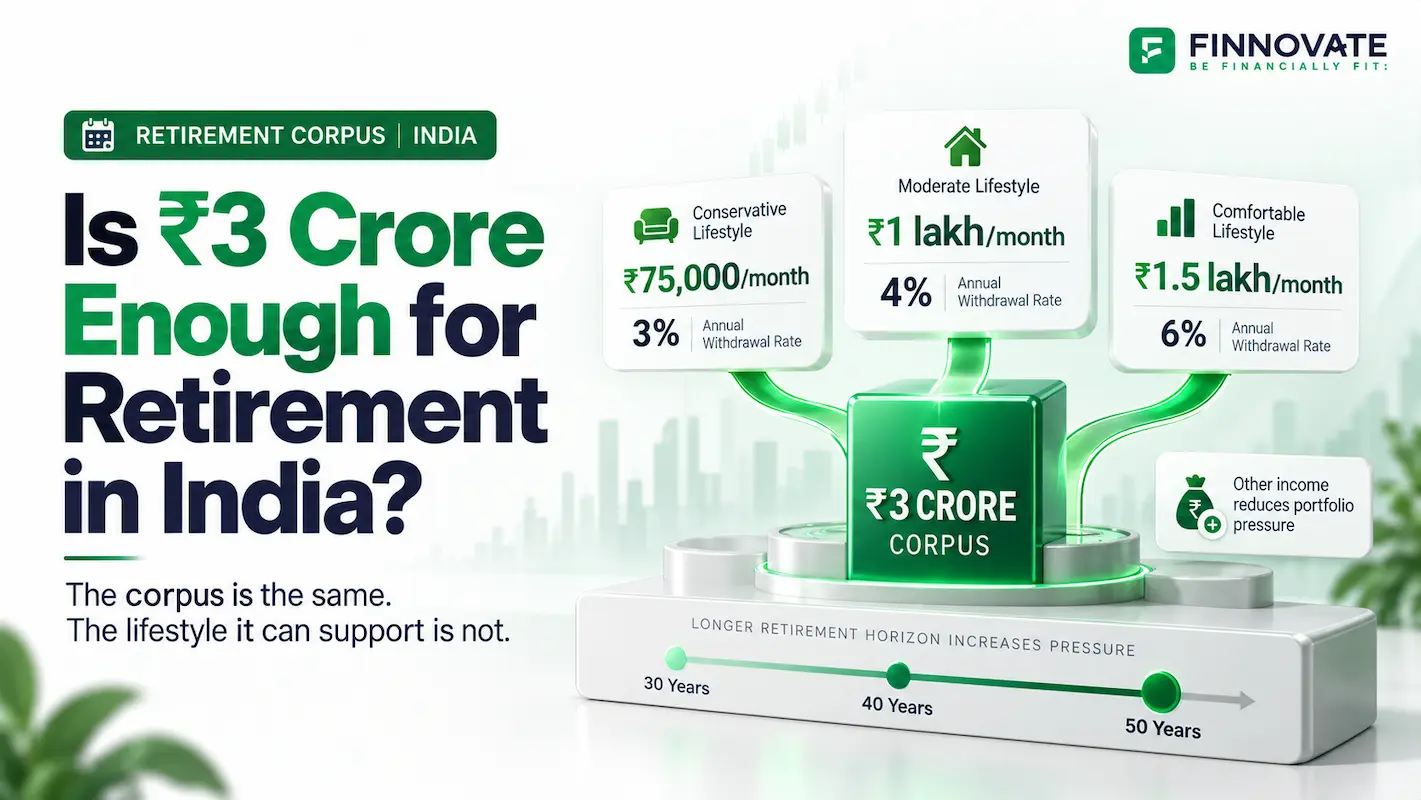
Is ₹3 Crore Enough for Retirement in India?
Is ₹3 crore enough for retirement in India? See what monthly lifestyle it may support, h...
01 October 2026

Early retirement has become a serious financial goal for many professionals in India. With higher incomes, access to equity markets, and growing awareness around financial independence, retiring at 50 - or even earlier - is no longer unrealistic.
However, the real question is not simply whether you can accumulate a sufficient corpus. The more important question is whether your financial structure is strong enough to sustain retirement for 30 to 35 years in Indian conditions.
This article provides a practical framework to help you evaluate whether you are truly ready for early retirement in India.
You are ready for early retirement if your financial plan can:
A large corpus alone does not guarantee sustainability. Retirement planning is not just about accumulation. It is about designing a stable income system that can last for decades.
Let us begin with a simplified example.
Assume:
At 6% inflation, your ₹2 lakh monthly expense today will increase significantly over time.
For example, in 10 years:
₹2,00,000 × (1.06)^10 ≈ ₹3.58 lakh per month
In 20 years, the number becomes substantially higher.
This demonstrates why inflation plays a central role in retirement planning. Even moderate inflation compounds meaningfully over long time horizons.
If you want a deeper mathematical breakdown of corpus requirements at age 50, you can refer to our detailed guide:
Can You Retire at 50 in India? A Practical Guide
However, retirement math alone does not determine readiness. That is where structural evaluation becomes important.
Below is an 8-factor framework that goes beyond corpus size and helps assess retirement sustainability.
Retirement planning begins with accurate expense estimation. Many individuals underestimate discretionary and lifestyle expenses.
Before retiring, you should have clarity on:
A reliable approach is to track actual expenses for at least 12 months before retirement.
The commonly cited 4% rule suggests withdrawing 4% of your corpus annually, adjusted for inflation.
However, this rule was developed based on US historical data and assumes specific asset allocation and market behaviour.
In India, factors such as:
must be incorporated into withdrawal planning.
A structured retirement income model often involves:
You may also explore how systematic withdrawal strategies work through tools such as an SWP calculator, which can help model income scenarios during retirement.
India’s long-term inflation has averaged around 5–6%. Even small deviations in assumed inflation rates can materially impact long-term retirement sustainability.
For example:
₹24 lakh annual expense today
At 6% inflation for 20 years becomes approximately ₹77 lakh annually.
Inflation does not create pressure in the first few years of retirement, but its cumulative effect is significant over 25–30 years.
Retirement income is not automatically tax-neutral.
Depending on asset allocation, you may face:
Over long time horizons, even small tax inefficiencies can reduce corpus longevity.
It is important to estimate net withdrawal income rather than relying solely on gross return assumptions.
At this stage, you may want to evaluate your financial structure more objectively.
You can check your Financial Fitness Score through our free Financial Fitness Test. It helps assess retirement readiness across multiple financial pillars.
Are you financially fit enough to retire? A structured assessment can provide clarity.
Healthcare inflation in India typically exceeds general inflation.
Early retirees must ensure:
Healthcare costs are one of the largest uncertainties in retirement planning.
Market downturns are inevitable.
A practical retirement structure often includes a 2–3 year expense buffer in low-risk instruments. This reduces the need to liquidate equity during market corrections.
The bucket approach to retirement income, where assets are segmented by time horizon, is one way to manage this risk. Our article on the Bucket Retirement Strategy in India explains this approach in detail.
Bucket Retirement Strategy in India
Carrying debt into retirement increases fixed financial obligations and reduces flexibility.
Ideally, early retirement should begin with:
This reduces withdrawal pressure and improves long-term stability.
One of the most overlooked factors in retirement planning is behavioural discipline.
If markets decline by 20–30%, can you continue your withdrawal plan without panic?
Many retirement plans fail not due to insufficient corpus but due to emotional reactions during volatility.
Even professionals with substantial portfolios may feel unsure about early retirement.
Common reasons include:
Retirement confidence comes from clarity of structure, not just wealth accumulation.
Before deciding to retire early, consider the following:
If multiple answers are uncertain, your structure may need refinement.
You can take the free Financial Fitness Test to receive a structured score across six core financial areas. This can help you identify gaps before making long-term decisions.
Retirement readiness is not just about corpus size. It is about structure, sustainability, and long-term resilience.
The Financial Fitness Test evaluates your readiness across six core pillars - goals, budgeting, loans, insurance, investments, and estate planning.
In just 5 minutes, you receive a structured score with PDF that helps you identify gaps before making a long-term decision.
Check Your Financial Fitness ScoreAre you financially fit enough to retire?
Early retirement in India is achievable for many professionals. However, readiness depends on more than corpus size.
It requires:
Before making a retirement decision, it is worth assessing your financial structure objectively.
You can check your Financial Fitness Score through the free Financial Fitness Test and evaluate whether your retirement foundation is strong enough to support long-term independence.
You can retire early if your corpus supports inflation-adjusted withdrawals for 30–35 years while remaining tax-efficient and resilient to market volatility.
The 4% rule suggests withdrawing 4% of your retirement corpus annually, adjusted for inflation. While it can serve as a reference point, it should not be applied without considering Indian economic conditions.
The 70% rule suggests retirees require approximately 70% of their pre-retirement income to maintain lifestyle. However, this varies based on debt, dependents, and lifestyle expectations.
It depends on your expense level, corpus size, inflation assumption, and withdrawal structure. Tools such as a FIRE calculator can help you model financial independence timelines.
Disclaimer: This article is for informational and educational purposes only. It does not constitute tax, legal, or financial advice.
No spam. Only new posts, simple explainers, and practical money checklists for busy professionals.
Finnovate is a SEBI-registered financial planning firm that helps professionals bring structure and purpose to their money. Over 3,500+ families have trusted our disciplined process to plan their goals - safely, surely, and swiftly.
Our team constantly tracks market trends, policy changes, and investment opportunities like the ones featured in this Weekly Capsule - to help you make informed, confident financial decisions.
Learn more about our approach and how we work with you:
No comments yet. Start the conversation. What would you add?
No spam. Only new posts, simple explainers, and practical money checklists.
You may also like
Is ₹3 crore enough for retirement in India? See what monthly lifestyle it may support, h...

Can you retire in your 30s in India? See the FIRE math, withdrawal rates, corpus examples,...

Is ₹1 crore enough for retirement in India? See how much monthly income it can support, ...

Is ₹2 crore enough for retirement in India? See how expenses, inflation, retirement age,...
Popular now

Learn how to easily download your NSDL CAS Statement in PDF format with our step-by-step g...

Looking for the best financial freedom books? Here’s a handpicked 2026 reading list with...
Learn what SIF investment means in India, SEBI rules, Rs 10 lakh minimum investment, avail...
Clear guide to mutual fund taxation in India for FY 2025–26 after July 2024 changes: equ...