
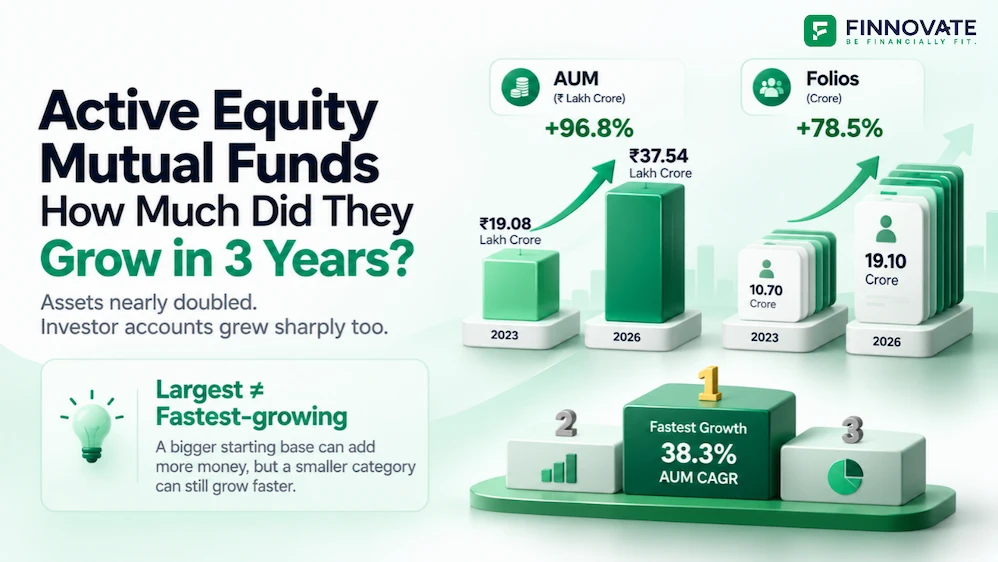
Active Equity Fund Growth 2023–2026: AUM & Folio Rankings
Compare active equity mutual fund growth from September 2023 to September 2026, with categ...
21 October 2026
When most new mutual fund launches come out, the pitch is familiar.
A new strategy. A new theme. Or a promise to beat the market.
This one is positioned differently.
The Parag Parikh Large Cap Fund, as described in its scheme documents, is not positioned as an outperformance-oriented fund. Instead, it is presented as a fund focused on efficiently tracking the large-cap segment of the market.
The core idea, as outlined by the AMC, is to
track the Nifty 100 closely, while attempting to manage implementation-related frictions that can arise in index-style investing.
Let’s break this down.
If you’re new to the concept, here’s what an NFO means.
In theory, index investing appears straightforward.
Buy the index. Hold it over the long term. Earn market-linked returns.
In practice, however, index-style investing can involve certain frictions:
Over longer periods, these factors can contribute to a gap between index returns and investor experience.
As per the scheme’s stated approach, this fund seeks to address these aspects not through stock selection,
but through how index exposure is implemented and managed.
At a structural level, this is a Nifty 100–oriented large cap fund.
This implies that:
The scheme documents do not indicate the use of valuation filters, quality screens, or discretionary sector calls.
This distinction matters.
The fund does not position itself as identifying the “best” large cap stocks.
Instead, it seeks to represent the large-cap segment of the market and manage exposure in a structured manner.
The stated difference lies in how exposure is implemented, rather than in what exposure is taken.
Rather than mechanically executing all trades on index rebalance dates, the fund is structured to allow some flexibility, as permitted by regulations. This includes:
The stated intent here is to reduce execution-related inefficiencies that can arise during index changes.
The scheme documents allow the fund to use instruments such as:
This is disclosed as part of the execution framework.
Importantly, derivatives are not presented as tools for return enhancement.
Their stated role is to assist with:
This use remains subject to SEBI-prescribed limits and disclosures.
Events such as mergers, demergers, and index reconstitutions can lead to temporary distortions in prices.
A purely mechanical index strategy typically reflects such changes immediately, regardless of market conditions.
The fund’s approach, as outlined in its documentation, allows limited flexibility in managing these transitions, while aiming to keep the portfolio closely aligned with the benchmark.
The Nifty 100 provides:
In simple:
The fund is positioned as a core large-cap allocation, rather than a tactical or thematic strategy.
Investors are expected to refer to the AMC’s latest disclosures for current expense ratios.
This fund may suit investors who are looking for broad Nifty 100–style large-cap exposure, have a long-term investment horizon, and prefer structured, index-aligned portfolios over discretionary stock selection. It is positioned for investors who are comfortable with returns that remain close to the benchmark and who value process discipline over outperformance narratives.
It may be less suitable for investors seeking clear alpha, concentrated portfolios, or valuation-driven strategies. For those who already hold a low-cost Nifty 100 index fund and prioritise simplicity, the incremental difference may be limited. There is also no necessity to invest during the NFO period itself; observing how the fund behaves post-launch is a reasonable alternative.
Not exactly. While the portfolio is benchmark-aligned, the scheme is structured as an actively managed fund with flexibility around execution.
Derivatives are disclosed as part of execution management and are subject to regulatory limits. Their use does not imply speculative positioning.
It offers broader large-cap exposure, not necessarily higher returns. The choice depends on diversification preferences.
No. The scheme reopens shortly after the NFO. There is no inherent pricing advantage in investing during the offer period.
Disclaimer: This article is for general information and educational purposes only and should not be treated as investment advice or a recommendation. Mutual fund investments are subject to market risks. Please read all scheme-related documents carefully before investing.
No spam. Only new posts, simple explainers, and practical money checklists for busy professionals.
Finnovate is a SEBI-registered financial planning firm that helps professionals bring structure and purpose to their money. Over 3,500+ families have trusted our disciplined process to plan their goals - safely, surely, and swiftly.
Our team constantly tracks market trends, policy changes, and investment opportunities like the ones featured in this Weekly Capsule - to help you make informed, confident financial decisions.
Learn more about our approach and how we work with you:
No comments yet. Start the conversation. What would you add?
No spam. Only new posts, simple explainers, and practical money checklists.
You may also like
Compare active equity mutual fund growth from September 2023 to September 2026, with categ...
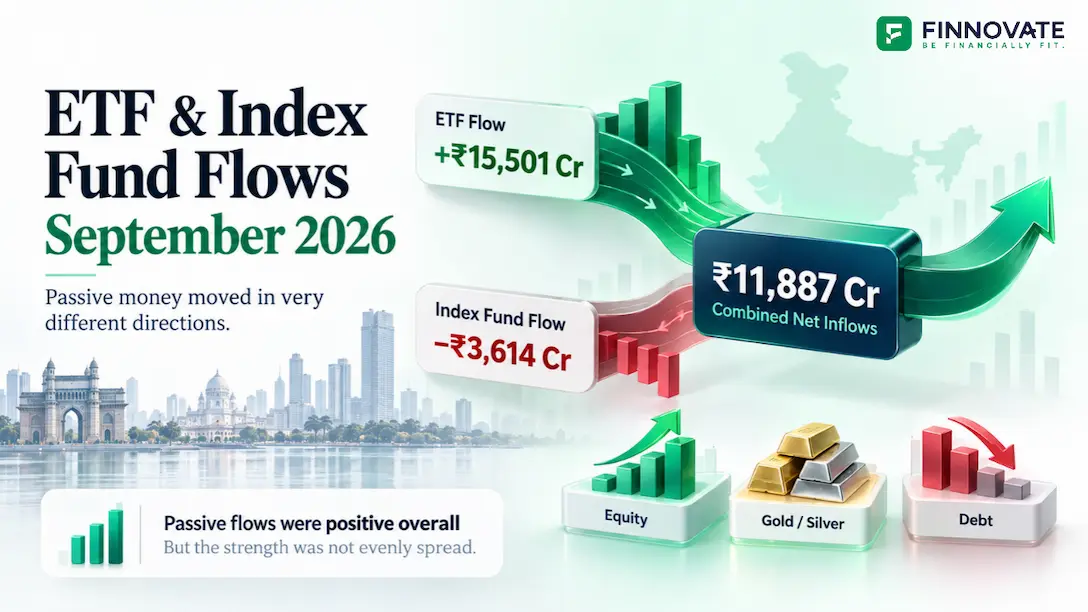
Explore September 2026 ETF and index fund flows, with category-wise inflows, outflows, AUM...

Equity fund net inflows rose 30.61% to ₹38,306.55 crore in September 2026. Compare 13 ca...

Equity mutual funds received ₹29,329 crore in August 2026. See which categories saw the ...
Popular now

Learn how to easily download your NSDL CAS Statement in PDF format with our step-by-step g...

Looking for the best financial freedom books? Here’s a handpicked 2026 reading list with...
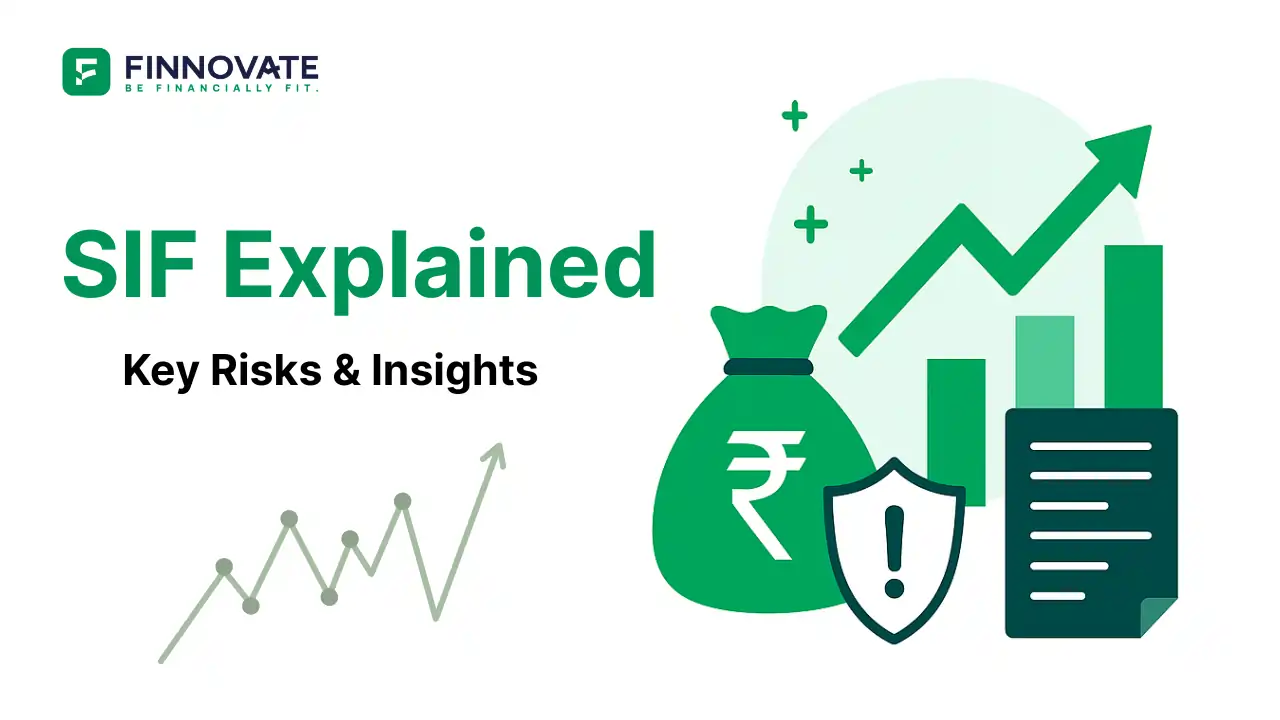
Learn what SIF investment means in India, SEBI rules, Rs 10 lakh minimum investment, avail...

Clear guide to mutual fund taxation in India for FY 2025–26 after July 2024 changes: equ...