
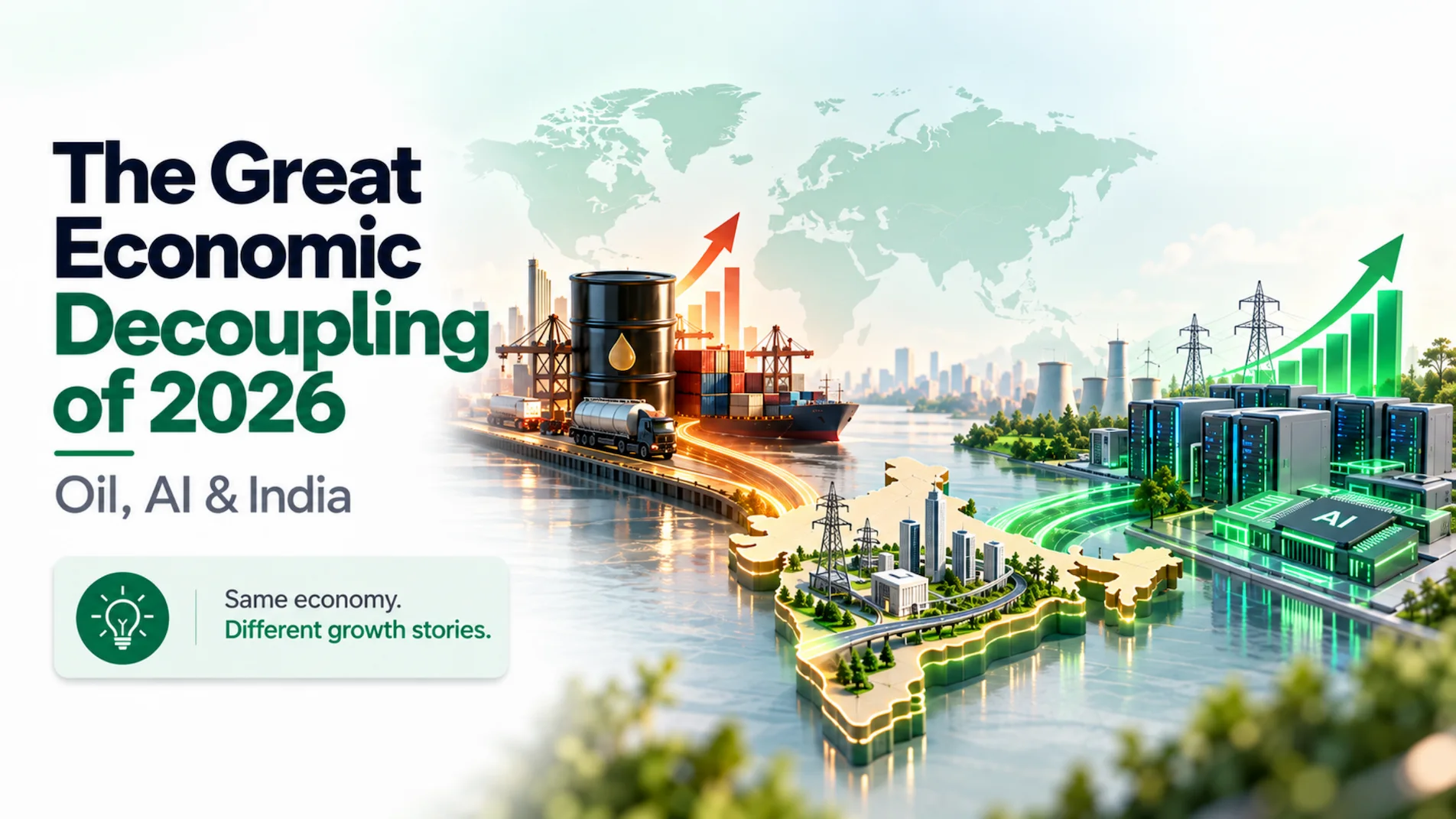
The Great Economic Decoupling of 2026: Oil, AI & India
Rising oil prices and booming AI investment are shaping an uneven global economy in 2026. ...
24 October 2026
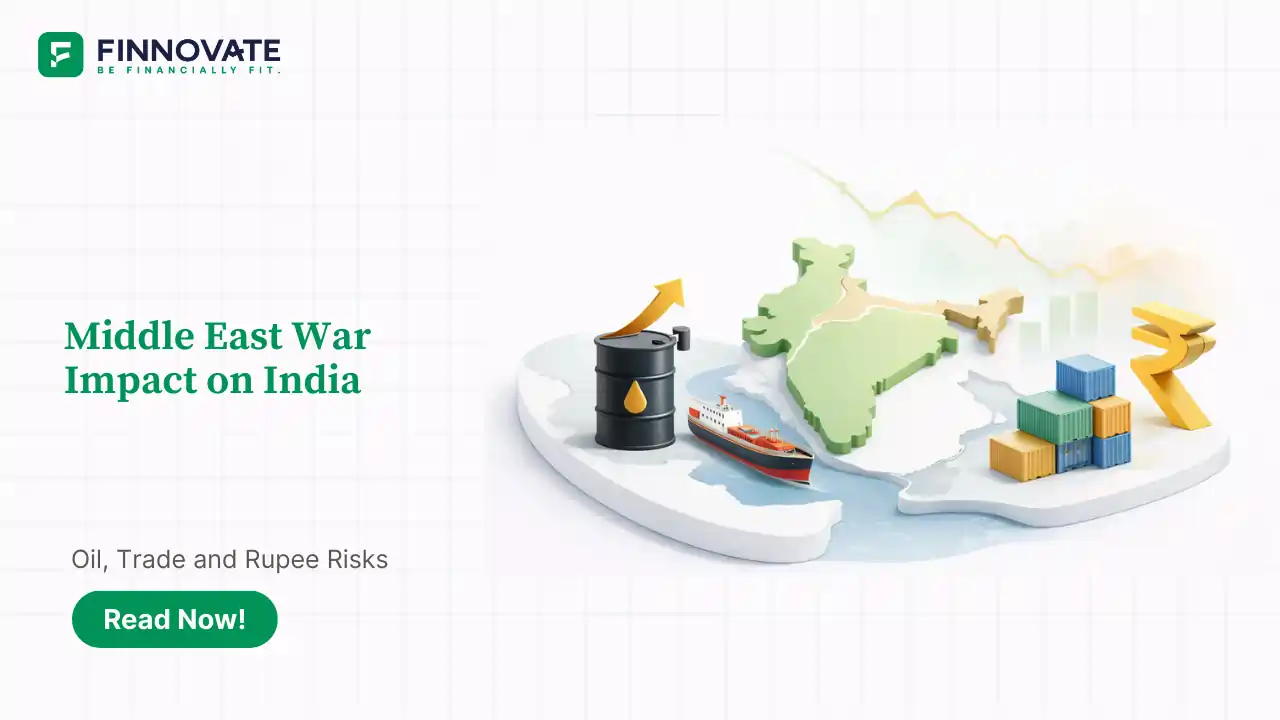
The ongoing conflict in the Middle East is no longer a distant geopolitical event for India. It is now feeding directly into India’s energy costs, trade routes, financial markets, and diplomatic calculations. For a country that depends heavily on imported crude and gas, any disruption around the Gulf quickly turns into an economic problem. That pressure is already visible in oil prices, the rupee, shipping costs, and foreign investor behaviour.
India’s exposure is especially high because the Strait of Hormuz remains one of the most important energy chokepoints in the world. A large share of India’s crude and gas flows is linked, directly or indirectly, to this corridor. When conflict disrupts shipping, production, or insurance in this belt, India does not just face higher fuel prices. It also faces supply uncertainty, costlier imports, and pressure on industrial demand.
India’s dependence on the Middle East is structural, not temporary. The region is central to India’s crude oil imports, LNG supplies, and export linkages with Gulf economies. So when war spreads across the energy corridor, India faces a double hit.
The first hit is on energy security.
The second hit is on trade and macro stability.
This is what makes the present conflict especially costly. It is affecting both the supply side and the financial side of the economy at the same time. Higher crude raises India’s import bill. LNG disruption affects industrial activity. Shipping delays raise freight costs. Risk aversion weakens the rupee and pushes foreign investors to cut exposure.
The most immediate pressure point is energy. India had already begun shifting some oil procurement from Russia toward the Middle East under its evolving trade framework. That made Gulf stability even more important. But with conflict intensifying, energy shipments have become vulnerable.
The LNG side looks even more sensitive than crude. Qatar halted LNG production earlier this month after attacks and wider disruption in the region. That has already forced supply rationing in India and affected industrial buyers and city gas distribution networks. In energy markets, oil can often be sourced from alternative producers, though at a higher price. Gas is harder to replace quickly because infrastructure and contracts matter much more.
One of the clearest examples is Morbi in Gujarat. The ceramics and tiles cluster there, valued at around $7 billion, depends on propane to run kilns. The industry is facing the risk of shutdown if fuel availability does not improve. This shows how a geopolitical shock in the Gulf quickly becomes a manufacturing risk inside India.
This disruption is not limited to one industry. Any prolonged supply shock can hurt:
That is why the present conflict is not just an oil story. It is an economy-wide energy story.
The war is also hitting India’s trade links with the Gulf. Indian exports to GCC countries are meaningful across categories such as engineering goods, food products, building materials, and manufactured items. If shipping risk stays high, the impact will not just come from delays. It will come from economics.
Freight costs are rising. Insurance premia are rising. Security surcharges are making shipments more expensive. In some cases, exporters are already arguing that the extra charges make consignments commercially unviable. Around $15 billion of India’s merchandise exports to GCC markets could be affected if the disruption persists.
This matters because exporters operate on thin margins. A large rise in freight and war-risk insurance can quickly wipe out competitiveness. In a weak global growth environment, even a moderate logistics shock can lead to cancelled orders, delayed cargo movement, and lower export realisations. For India, that creates another drag beyond the oil bill.
Beyond the economic cost, this conflict raises difficult diplomatic questions for India. India had reduced some dependence on Russian oil while deepening engagement under the Indo-US trade framework. If major powers were already aware that the regional situation was fragile, India’s exposure to a renewed Middle East energy shock becomes a serious strategic issue.
The Iran angle is also important. The conflict may complicate India’s regional balancing in multiple ways:
The concern is not only about one disrupted shipment or one month of high oil. The larger issue is whether India’s room for manoeuvre in West Asia narrows at a time when energy security still depends heavily on the region. That makes this both a macro issue and a foreign policy issue.
The macro stress is already visible in market indicators.
The rupee fell to a record low near ₹92 per dollar, with levels around 92.30–92.33 on March 9, 2026, as crude prices surged and geopolitical risk intensified.
Foreign portfolio investors have also turned risk-averse. FPIs withdrew about ₹218.32 billion, roughly $2.4 billion, from Indian stocks amid the latest escalation. Other reporting on the first week of March also points to roughly $2.3 billion of equity outflows.
Oil is the biggest macro transmission channel. The brief mentions Brent around $90 per barrel, but recent reporting suggests the situation moved much further, with Brent briefly surging above $117 on March 9 as the conflict worsened. That change matters because every sustained rise in crude increases India’s import bill and puts pressure on the current account.
These moves matter because they feed into three macro variables very quickly:
That is why this war is not only a geopolitical headline. It is already a macroeconomic event for India.
If the conflict continues, India’s immediate policy priority has to be energy security. Oil sourcing can be diversified to some extent, though usually at a higher cost. Gas is more difficult. India’s LNG exposure to the Gulf means prolonged disruption can create both pricing stress and physical supply stress.
At the same time, Indian exporters are already feeling the pressure from freight and insurance costs. Even if the physical flow of trade resumes, the economics of trade can remain damaged for longer. That means India may have to think about this crisis in layers:
The key point is simple. India needs stability in energy corridors. Instead, it is facing rising uncertainty in exactly the region that matters most for its fuel security.
The full cost of this conflict to India will not be known in one day or one week. It will become clearer over the next few weeks as more data comes in on imports, exports, fuel costs, inflation, and capital flows.
But even at this stage, the broad direction is clear:
For India, this is the price of instability in a region it cannot economically ignore. The longer the disruption lasts, the more visible the impact will become in trade data, inflation prints, corporate margins, and macro balances.
Disclaimer: This article is for general information and educational purposes only. It should not be treated as investment, legal, policy, or financial advice. Market levels, commodity prices, and macro indicators can change quickly during geopolitical events.
No spam. Only new posts, simple explainers, and practical money checklists for busy professionals.
Finnovate is a SEBI-registered financial planning firm that helps professionals bring structure and purpose to their money. Over 3,500+ families have trusted our disciplined process to plan their goals - safely, surely, and swiftly.
Our team constantly tracks market trends, policy changes, and investment opportunities like the ones featured in this Weekly Capsule - to help you make informed, confident financial decisions.
Learn more about our approach and how we work with you:
No comments yet. Start the conversation. What would you add?
No spam. Only new posts, simple explainers, and practical money checklists.
You may also like
Rising oil prices and booming AI investment are shaping an uneven global economy in 2026. ...
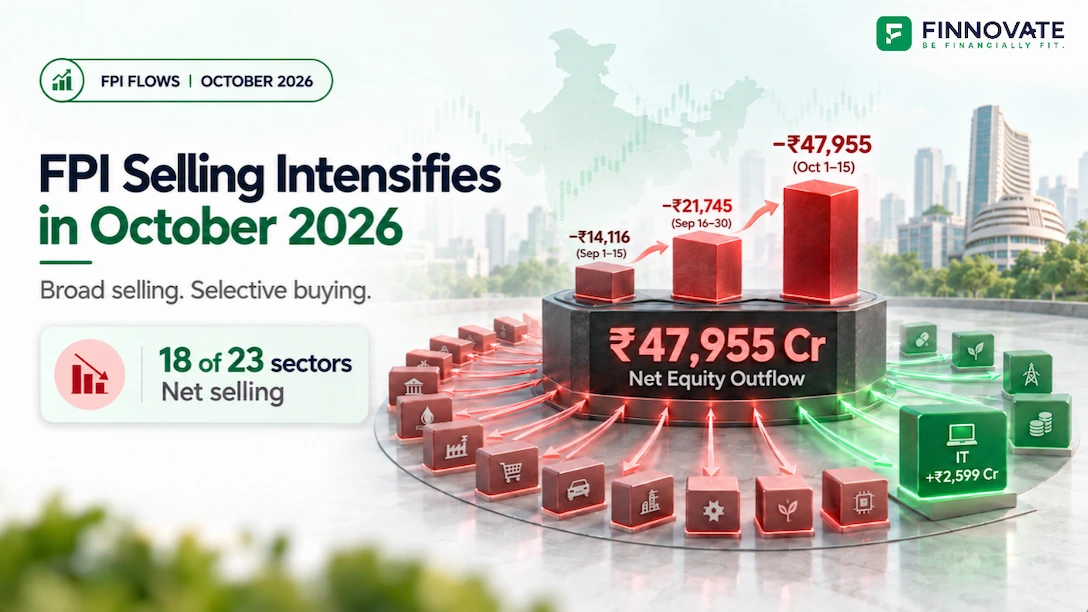
Explore FPI equity flows for October First Half, 2026: ₹47,955 crore in net outflows, th...
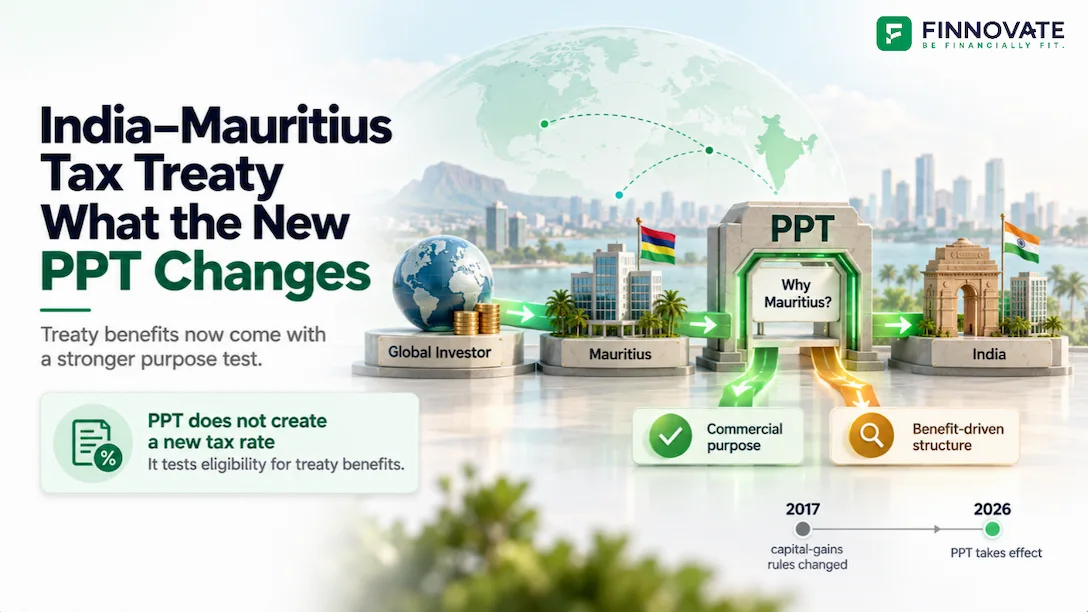
Understand the India–Mauritius tax treaty’s Principal Purpose Test, its August 2026 ef...

Explore India’s AI hardware opportunity through the proposed Adani–Jabil venture, from...
Popular now

Learn how to easily download your NSDL CAS Statement in PDF format with our step-by-step g...

Looking for the best financial freedom books? Here’s a handpicked 2026 reading list with...
Learn what SIF investment means in India, SEBI rules, Rs 10 lakh minimum investment, avail...

Clear guide to mutual fund taxation in India for FY 2025–26 after July 2024 changes: equ...