

The Great Economic Decoupling of 2026: Oil, AI & India
Rising oil prices and booming AI investment are shaping an uneven global economy in 2026. ...
24 October 2026

Published: April 2026
In April 2026, Zerodha CEO Nithin Kamath shared data showing that the firm's zero-brokerage model on equity delivery trades had saved users approximately ₹25,620 crore since 2016, measured against a traditional 0.3% brokerage benchmark. That is approximately $3 billion.
It is a striking number. But does saving on brokerage automatically translate into investors being better off? The answer is more complicated than the headline suggests, and understanding why requires separating what zero brokerage actually saves from what it quietly costs.
Nithin Kamath's statement was specific. The ₹25,620 crore saving was calculated by comparing what investors would have paid at a standard 0.3% delivery brokerage rate against the zero they paid at Zerodha, over 2016 to 2026. Against a lower 0.1% benchmark, the saving was ₹8,540 crore. The claim is technically correct on its own terms.
But the calculation has a structural assumption embedded in it: that the number and type of trades placed would have been exactly the same at a higher-cost broker. That assumption does not hold, and that gap is where the real analysis begins.
In his 2016 Berkshire Hathaway Annual Shareholder Letter, Warren Buffett paid an extraordinary tribute to Jack Bogle, the founder of Vanguard. Buffett wrote that Bogle had "helped millions of investors realize far better returns on their savings than they otherwise would have earned" by advocating for ultra-low-cost index funds for decades. Vanguard's passive funds had, by that point, added approximately $1 trillion to unit holder wealth in the form of lower costs compounded over time.
The praise was about a specific and directional outcome. Lower costs on long-term, passively managed index funds translated directly into better compounded returns for investors. The mechanism was linear: lower expense ratio, same market exposure, higher net return. Vanguard's investors held the same assets as everyone else. They just paid less to hold them.
Vanguard reduced the cost of holding a long-term market position. Zerodha reduced the cost of transacting. These are fundamentally different interventions. A lower expense ratio on a fund held for 20 years compounds into a significant saving regardless of investor behaviour. A zero delivery brokerage changes the economics of every individual trade decision the investor makes. One lowers the cost of staying in the market. The other lowers the cost of moving in and out of it. The investor response to each is very different.
Yes and no. The ₹25,620 crore is a real cash saving on brokerage paid. That money stayed in investors' accounts rather than going to a broker. To that extent, Kamath's claim is valid.
But zero delivery brokerage at Zerodha does not mean zero cost. The statutory charges remain: Securities Transaction Tax (STT), stamp duty, exchange transaction charges, SEBI turnover fees, and GST. These apply regardless of brokerage rate. Depository participant (DP) charges also apply when shares are debited from the demat account on a sell transaction.
For a retail investor executing a ₹1 lakh delivery trade, the statutory and DP charges on a round-trip transaction still amount to several hundred rupees. The saving from zero brokerage is real but partial. More importantly, when brokerage was visible and percentage-based, investors were more likely to factor it into their trade decision. When brokerage disappears from the screen, the remaining statutory charges become less visible, and the psychological sense of trading for free is stronger than the economic reality.
Zero delivery brokerage is not altruism. It is a deliberate business model choice with a corresponding revenue mechanism that every investor using a discount broker should understand.
When delivery brokerage falls to zero, investors are encouraged to keep larger idle balances in their trading accounts. They are less likely to withdraw funds between trades because there is no per-trade cost friction encouraging careful cash management. This increases float: the uninvested cash sitting in trading accounts at any given time.
Zerodha invests this float in money market mutual funds, generating interest income on the balances its users keep parked in their accounts. This is a well-established and significant revenue stream in the brokerage model. Additionally, when shares are held in the DP account and can be pledged as margin, zero brokerage increases the incentive for investors to maintain demat positions and use them as collateral for further trading, increasing platform activity and transaction volume.
For Zerodha, zero delivery brokerage is a customer acquisition and retention strategy that generates float income, increases demat account activity, and builds a user base that then generates revenue through intraday, F&O, and commodity trades at a flat ₹20 per executed order. In FY24, Zerodha reported revenue of ₹8,320 crore and a net profit of ₹4,700 crore. Zero brokerage is not a cost sacrifice. It is a structural advantage.
The most important critique of zero brokerage is not about what it explicitly charges. It is about what it changes in investor behaviour.
In classical finance, transaction costs act as a natural brake on trading frequency. If every trade costs money, investors calibrate decisions more carefully. They consider not just whether a position makes sense, but whether it makes sense given the cost of entry and exit. This friction is not purely negative. It filters out low-conviction trades.
When delivery brokerage falls to zero, that friction disappears. The break-even point on a trade moves lower. A position that looked marginal at 0.3% brokerage now appears clearly worthwhile, but only because the cost signal has been removed, not because the underlying risk-reward has improved.
The probability that a short-duration delivery trade goes against the investor does not change when brokerage falls to zero. What changes is the investor's perception of that trade. When the visible cost of entering a position is zero, the cognitive barrier to risk-taking is lower. Investors tend to trade more frequently, hold for shorter durations, and take on more risk per unit of expected return. This is a well-documented pattern in behavioural finance research: reducing transaction costs in isolation tends to increase trading frequency without a corresponding improvement in returns.
A common objection is that Zerodha charges ₹20 per order for intraday and F&O trades, so the zero-cost nudge only applies to genuine long-term delivery investors. This is not entirely accurate. Aggressive trading also happens in delivery-based equities, with positions held for days to weeks. Zero delivery brokerage makes this approach costless to execute at the transaction level, regardless of whether the underlying strategy is sound. The low cost and the lower break-even point together induce higher position sizing and more frequent rotation, which increases risk of losses for the trader over time.
Zero brokerage is genuinely beneficial for one specific type of investor: the patient, long-term, buy-and-hold equity investor who places few trades, holds for years, and uses the delivery route as an investor rather than a trader. For this person, the brokerage saving compounds meaningfully over time because the explicit transaction cost was a real drag on a low-turnover strategy.
For the active trader using delivery as a shorter-term vehicle, or for anyone whose behaviour changes in response to the zero-cost environment, the picture is different. The saving on explicit brokerage may be more than offset by the implicit cost of lower-conviction trades, higher portfolio churn, and the risk of losses on positions that would not have been taken if transaction friction had been present.
The Vanguard parallel is instructive precisely because it shows the difference. Vanguard did not just lower costs. It channelled investors towards long-term, diversified, low-turnover index funds. The cost saving and the behavioural direction were aligned. Zerodha's zero brokerage saves on transaction costs without changing the behavioural direction of the trade. Whether that saving translates into investor wealth depends entirely on what the investor does with zero-cost access.
Please consult a SEBI-registered investment adviser before making any changes to your brokerage, trading strategy, or investment approach based on cost comparisons alone.
Zero brokerage means the broker charges no commission on certain trade types. Zerodha offers zero brokerage on equity delivery trades, meaning buying or selling shares held for delivery settlement. Intraday, F&O, and commodity trades are charged at a flat ₹20 per executed order. Statutory charges including STT, stamp duty, exchange fees, SEBI turnover fees, and GST apply on all delivery trades regardless of brokerage rate. DP charges apply on delivery sell transactions.
Zerodha CEO Nithin Kamath stated in April 2026 that users had saved approximately ₹25,620 crore against a 0.3% brokerage benchmark between 2016 and 2026. Against a 0.1% benchmark, the saving was ₹8,540 crore. The saving represents the explicit brokerage that would have been paid at higher-rate brokers but was not charged at Zerodha. Statutory charges and DP charges are not included in this saving figure.
No. Zero delivery brokerage eliminates only the brokerage commission. Statutory charges still apply on every delivery trade: Securities Transaction Tax, stamp duty, exchange transaction charges, SEBI fees, and GST. DP charges apply when shares are sold from the demat account. The overall cost of a round-trip delivery trade is lower than at a traditional broker, but it is not zero.
Zerodha earns revenue from flat ₹20 per order on intraday, F&O, and commodity trades; float income from investing idle client balances in money market mutual funds; DP charges on delivery sell transactions; and ancillary platform charges. In FY24, Zerodha reported revenue of ₹8,320 crore and a net profit of ₹4,700 crore. Zero delivery brokerage is a business model strategy, not a cost sacrifice.
This is the central concern. When transaction costs fall to zero, the natural friction that discourages low-conviction trades is reduced. Investors are more likely to enter positions they would have avoided if each trade carried an explicit cost. Research in behavioural finance suggests that lower transaction costs tend to increase trading frequency without a corresponding improvement in returns. The effect is most pronounced for short-duration delivery traders rather than genuine long-term investors.
Zero brokerage is most beneficial for a patient, long-term, low-turnover investor who holds equity positions for years and places relatively few trades. For this investor, the brokerage saving compounds meaningfully without any change in behaviour. For active traders who churn positions frequently or use delivery for short-duration trades, the behavioural impact of cost removal may partially or fully offset the explicit saving. Please consult a SEBI-registered investment adviser to understand how brokerage costs fit within your specific financial goals and investment approach.
Disclaimer: This article is for general information and educational purposes only. It does not constitute investment advice, a recommendation, or an offer to buy or sell any securities or financial instruments. References to Zerodha, Vanguard, and Berkshire Hathaway are for illustrative and educational purposes only and do not constitute an endorsement of or recommendation to use any specific broker, fund, or financial product. Brokerage charges and statutory levies are subject to change; verify current rates directly with your broker before making any decisions. Warren Buffett's quotes are sourced from the 2016 Berkshire Hathaway Annual Shareholder Letter. Zerodha savings data is from Nithin Kamath's public statement, April 2026, as reported by News Sources. Zerodha financial figures (FY24 revenue and profit) are from publicly available sources. Past investor behaviour patterns and market performance are not indicative of future outcomes. Please consult a SEBI-registered investment adviser or qualified financial professional before making any investment or brokerage-related decision.
No spam. Only new posts, simple explainers, and practical money checklists for busy professionals.
Finnovate is a SEBI-registered financial planning firm that helps professionals bring structure and purpose to their money. Over 3,500+ families have trusted our disciplined process to plan their goals - safely, surely, and swiftly.
Our team constantly tracks market trends, policy changes, and investment opportunities like the ones featured in this Weekly Capsule - to help you make informed, confident financial decisions.
Learn more about our approach and how we work with you:
No comments yet. Start the conversation. What would you add?
No spam. Only new posts, simple explainers, and practical money checklists.
You may also like
Rising oil prices and booming AI investment are shaping an uneven global economy in 2026. ...
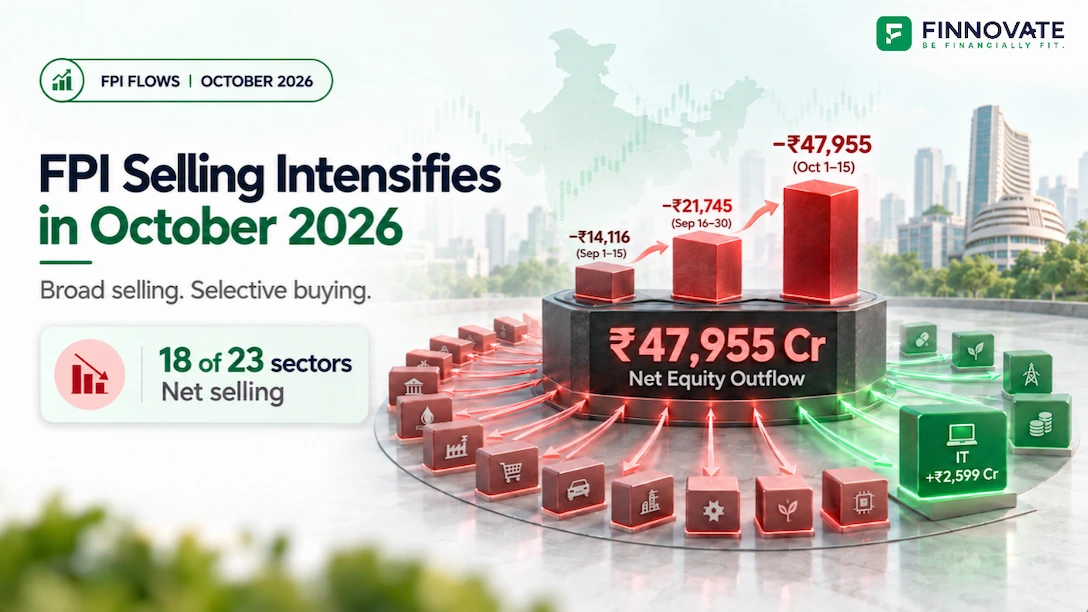
Explore FPI equity flows for October First Half, 2026: ₹47,955 crore in net outflows, th...
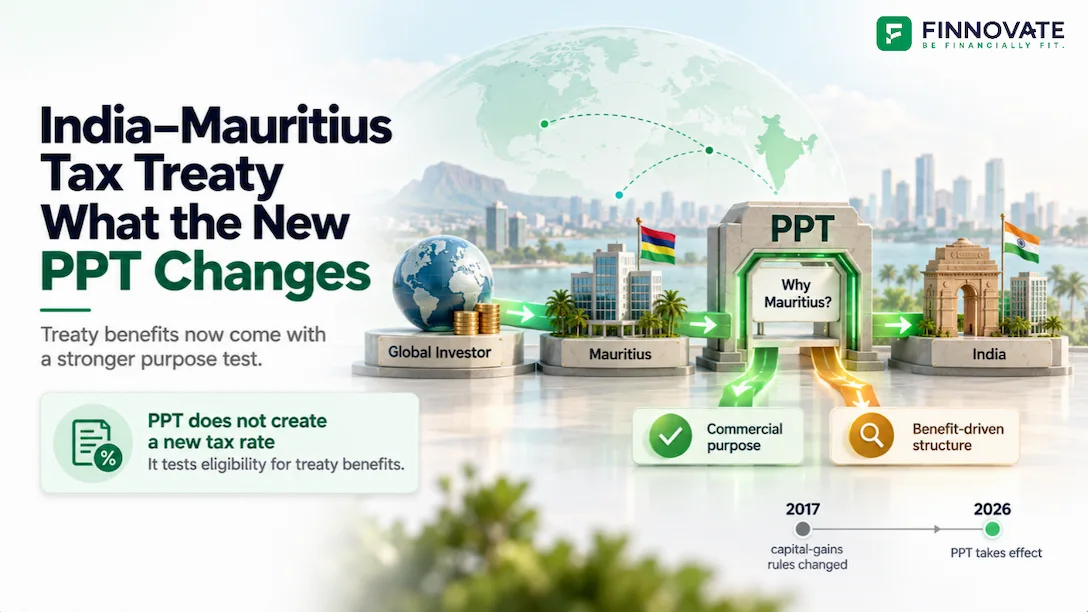
Understand the India–Mauritius tax treaty’s Principal Purpose Test, its August 2026 ef...

Explore India’s AI hardware opportunity through the proposed Adani–Jabil venture, from...
Popular now

Learn how to easily download your NSDL CAS Statement in PDF format with our step-by-step g...

Looking for the best financial freedom books? Here’s a handpicked 2026 reading list with...
Learn what SIF investment means in India, SEBI rules, Rs 10 lakh minimum investment, avail...
Clear guide to mutual fund taxation in India for FY 2025–26 after July 2024 changes: equ...