

FPI Flows First Half October 2026: ₹47,955 Crore Outflow
Explore FPI equity flows for October First Half, 2026: ₹47,955 crore in net outflows, th...
23 October 2026
Published: April 2026 | Data: NSDL Fortnightly Sectoral FPI Data, H1 April 2026
March 2026 was supposed to be the anomaly. Foreign portfolio investors sold $5.70 billion in the first half of the month and another $7.00 billion in the second, as the West Asia conflict escalated and crude crossed $100 per barrel. The scale of selling was attributed to a single macro shock. April, many expected, would bring some respite.
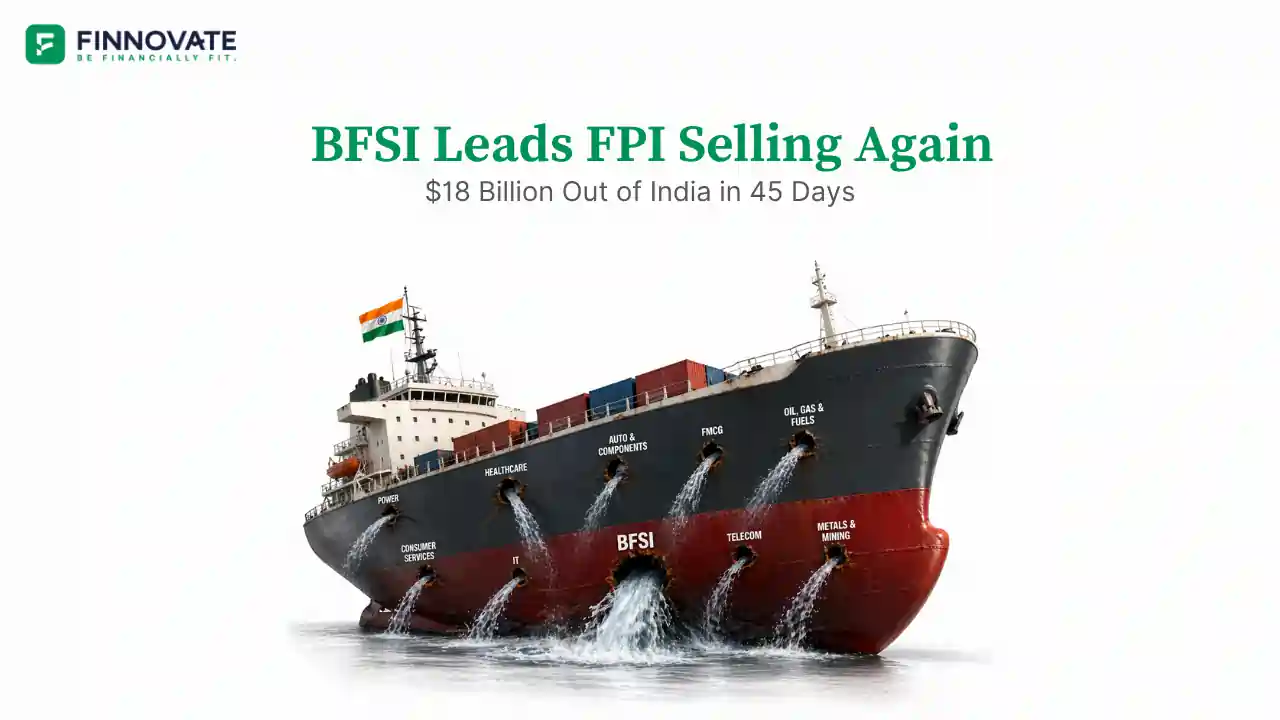
It has not. In the first fortnight of April 2026, FPIs sold another $5.15 billion from Indian equities. The selling is concentrated, the reasoning is consistent, and the sector being targeted is the same one that bore the brunt in March: Financial Services.
In 45 days across the second half of March and the first half of April, FPIs have pulled approximately $18 billion from Indian equities. Understanding who is selling, what they are selling, and why tells a more complete story than the headline number alone.
NSDL's fortnightly sectoral data for the first half of April 2026 shows the full picture of where FPI equity flows went. The grand total was net selling of $5,154 million. Three sectors saw net buying. Fifteen saw net outflows.
| Sector | Net Flow ($mn) | Sector | Net Flow ($mn) |
|---|---|---|---|
| Others | +78 | Metals and Mining | −128 |
| Power | +64 | Construction | −136 |
| Diversified | +1 | Information Technology | −142 |
| Utilities | 0 | Realty | −205 |
| Forest Materials | −2 | Telecommunication | −267 |
| Textiles | −5 | FMCG | −319 |
| Media and Entertainment | −6 | Oil, Gas and Fuels | −359 |
| Chemicals | −28 | Automobile and Components | −397 |
| Capital Goods | −35 | Healthcare | −480 |
| Consumer Durables | −39 | Consumer Services | −571 |
| Services | −63 | Financial Services | −2,051 |
| Construction Materials | −64 | Grand Total | −5,154 |
Financial Services at −$2,051 million represented 39.8% of total net selling in the fortnight. No other sector came close. Consumer Services (−$571 million) and FMCG (−$319 million) combined for $890 million. Healthcare (−$480 million) and Automobiles (−$397 million) combined for $877 million. IT (−$142 million) and Telecom (−$267 million) combined for $409 million.
The only sectors with net inflows were Power (+$64 million) and Others (+$78 million), marginal and without strategic conviction.
Financial Services has been the dominant selling target in every major FPI outflow episode in India over the past year. The pattern is not coincidental.
BFSI is the sector with the largest FPI ownership in Indian equities. It carries the highest weight in major Indian benchmark indices. It is the most liquid large-cap sector and therefore the easiest to exit quickly at scale. When FPIs need to reduce India exposure rapidly, BFSI is where they go first.
A $2 billion exit from Indian BFSI in a fortnight is operationally achievable because the sector has the depth, the daily trading volume, and the free-float to absorb that scale without catastrophic slippage. The same exit from mid-cap industrials or capital goods would take months and move prices significantly more. When FPIs need speed, they use the sector that offers it. BFSI being the largest seller does not mean FPIs have turned structurally negative on Indian banking. It means they needed liquidity and BFSI provided it.
The secondary concern is more specific. FPIs are also worried that the combination of higher energy costs, a weaker rupee, and potential demand compression could squeeze net interest margins and credit quality at Indian banks in FY27. Higher input costs for corporate borrowers, rising fuel bills for consumers, and slower discretionary spending could all translate into stress in the retail lending book, particularly in unsecured consumer credit, which had grown rapidly through FY25 and FY26.
Behind the sectoral table, four distinct investment concerns are driving the FPI sell-off.
Oil, Gas and Fuels (−$359 million), Chemicals (−$28 million), and broader manufacturing sectors all saw selling driven by the same concern. The West Asia conflict has disrupted supply chains for energy-intensive industries. Higher crude, higher freight, and higher insurance costs all compress margins and create earnings downside risk that was not priced into Indian equities before March 2026.
Consumer Services (−$571 million) and FMCG (−$319 million) together saw nearly $900 million in selling. FPIs are positioning for a demand slowdown. When fuel prices eventually pass through to consumers, whether through petrol price revisions or through higher freight costs embedded in goods prices, household disposable income will come under pressure. Consumer-facing sectors are the first to re-rate when that expectation firms.
Automobiles (−$397 million) and Healthcare (−$480 million) represent a different risk: supply chain input cost vulnerability. Auto manufacturers face higher steel, aluminium, and semiconductor input costs with global supply chains disrupted. Pharma exports face US tariff exposure and API import cost increases. Both sectors have earnings risk that is more specific and measurable than the broad macro concern.
IT (−$142 million) and Telecom (−$267 million) combined for $409 million in selling. This is the most structurally significant trend: FPIs are shifting capital toward AI and semiconductor-driven hardware technology companies in Taiwan, Korea, and China. India does not have sufficient representation in the AI supply chain, in chip design, advanced manufacturing, or AI platform companies. The reallocation reflects a global portfolio shift toward the next technology cycle, in which India's listed technology sector has limited direct exposure.
The FPI selling is occurring against a backdrop of a declining MSCI EM weight for India that provides important structural context for the flow picture.
India's weight in the MSCI Emerging Markets Index peaked at approximately 21% in September 2024, when the country had briefly emerged as the second-largest constituent in the benchmark. By the MSCI February 2026 review (effective February 27, 2026), India's weight stood at approximately 14.1%, and India had slipped to fourth position behind China (26.58%), Taiwan (21.04%), and South Korea (15.65%).
The MSCI EM Index is the primary benchmark for passive and active emerging market funds globally. A 1 percentage point decline in India's weight can translate into estimated passive outflows of $1.5 to $2 billion from ETFs and index-tracking funds benchmarked to the index. India's weight declining from 21% to 14% generates structural passive outflows independent of any active selling decision. Active FPI managers have compounded this with discretionary selling driven by macro and geopolitical concerns. The two channels are reinforcing each other.
India's weight decline reflects three factors: profit-booking in large-cap BFSI and IT during the FY25-FY26 run-up; slower relative earnings upgrades versus North Asian technology exporters; and the re-rating of China, Taiwan, and Korea as markets benefiting from the AI hardware investment cycle. India was at 9% weight in 2020. The current adjustment reflects relative market performance, not a structural exit from India as an investment destination.
Despite $5.15 billion in net selling during H1-April 2026, FPI assets under custody in Indian equities bounced to approximately $730 billion during the period, with overall FPI AUC including debt and hybrid instruments reaching approximately $805 billion. This reflects a rally in Indian equity markets during April 2026, which pushed up the market value of FPI holdings even as net selling reduced the unit count.
AUC rising during a period of net selling tells a specific story. FPIs still hold enormous wealth in Indian equities. An AUC of $730 billion means even sustained selling at current rates would take many months to materially reduce India exposure. The selling pressure in H2-April and Q1 FY27 will be shaped more by macro signal changes than by a structural decision to exit India.
Three factors have the clearest potential to reverse or slow FPI selling from current levels.
The rupee strengthened from a peak of approximately ₹95.22 per dollar to approximately ₹92.60 as of mid-April 2026, supported by RBI intervention, falling crude on ceasefire signals, and normalization of importer hedging. A stable or appreciating rupee reduces the FX-adjusted return drag that amplifies FPI selling. A credible Strait of Hormuz reopening would materially accelerate this recovery.
The Q4 FY26 earnings season is beginning in April 2026. If results from BFSI and IT confirm that the fundamental damage from macro headwinds is limited, that credit quality has held and IT deal wins have continued, it removes the earnings risk justification for selling. A positive surprise from the two most-sold sectors would be the clearest near-term catalyst for a flow reversal.
FPI flows into India are partly a function of where India sits in the global capital allocation hierarchy at any given time. A credible resolution of the West Asia conflict, crude falling and staying below $90 per barrel, and a softer US dollar index would all rotate capital back toward growth markets. The second half of April 2026 may begin to show whether these conditions are forming.
For context on the March 2026 FPI outflow episode that preceded this data, see the article on FPI outflows in early March 2026.
FPIs sold approximately $5.15 billion from Indian equities in the first fortnight of April 2026, according to NSDL sectoral data. Combined with $12.70 billion in net selling across March 2026, total FPI equity outflows over the 45-day period from mid-March to mid-April reached approximately $18 billion.
Financial Services (BFSI) saw the largest net selling at $2,051 million in H1-April 2026, representing approximately 40% of total outflows. Consumer Services ($571 million), Healthcare ($480 million), Automobiles ($397 million), Oil and Gas ($359 million), FMCG ($319 million), Telecom ($267 million), and Realty ($205 million) were the other significant outflow sectors. Only Power (+$64 million) and Others (+$78 million) saw meaningful net buying.
Four reasons are driving the current sell-off: geopolitical risk from the West Asia conflict and its impact on crude prices and supply chains; concern that higher inflation and potential demand compression could limit earnings upside; India's declining MSCI EM weight generating passive benchmark-linked outflows; and a global portfolio shift toward AI and semiconductor-led technology companies in Taiwan, Korea, and China where India's listed market has limited direct exposure.
India's weight in the MSCI Emerging Markets Index stood at approximately 14.1% as of the MSCI February 2026 review (effective February 27, 2026), placing India fourth behind China (26.58%), Taiwan (21.04%), and South Korea (15.65%). India's weight had peaked at approximately 21% in September 2024.
Yes. FPI equity AUC rose to approximately $730 billion in H1-April 2026 despite $5.15 billion in net selling, because the market rallied during the period. AUC rising while FPIs sell means market appreciation is larger than the outflow and that FPIs still hold substantial wealth in India. It suggests the selling is tactical and liquidity-driven rather than a structural decision to exit. This pattern typically precedes flow stabilisation once the macro catalyst fades.
Three factors have the clearest reversal potential: stabilisation or further appreciation of the rupee, which reduces the FX-adjusted return drag on India holdings; a credible reopening of the Strait of Hormuz and crude price moderation below $90 per barrel; and a positive Q4 FY26 earnings season from BFSI and IT that limits earnings downgrade risk in the two most-sold sectors. Please consult a SEBI-registered investment adviser before making any investment decisions based on FPI flow data.
Disclaimer: This article is for general information and educational purposes only. It does not constitute investment advice, a recommendation, or an offer to buy or sell any securities or financial instruments. FPI sectoral flow data is from NSDL's fortnightly sectoral FPI investment data for H1 April 2026. FPI equity AUC figures are from NSDL data as cited in the source document and are mid-April 2026 estimates subject to revision. MSCI EM weight data is from the MSCI February 2026 Index Review and publicly available secondary sources. Rupee levels are from Trading Economics and publicly available intraday data as of mid-April 2026. All figures are provisional and subject to revision. Past FPI flow patterns are not indicative of future flows or market performance. Please consult a SEBI-registered investment adviser or qualified financial professional before making any investment decision.
No spam. Only new posts, simple explainers, and practical money checklists for busy professionals.
Finnovate is a SEBI-registered financial planning firm that helps professionals bring structure and purpose to their money. Over 3,500+ families have trusted our disciplined process to plan their goals - safely, surely, and swiftly.
Our team constantly tracks market trends, policy changes, and investment opportunities like the ones featured in this Weekly Capsule - to help you make informed, confident financial decisions.
Learn more about our approach and how we work with you:
No comments yet. Start the conversation. What would you add?
No spam. Only new posts, simple explainers, and practical money checklists.
You may also like
Explore FPI equity flows for October First Half, 2026: ₹47,955 crore in net outflows, th...
Understand the India–Mauritius tax treaty’s Principal Purpose Test, its August 2026 ef...

Explore India’s AI hardware opportunity through the proposed Adani–Jabil venture, from...
India’s CPI inflation rose to 5.54% in September 2026. Compare monthly trends, food pric...
Popular now

Learn how to easily download your NSDL CAS Statement in PDF format with our step-by-step g...

Looking for the best financial freedom books? Here’s a handpicked 2026 reading list with...

Learn what SIF investment means in India, SEBI rules, Rs 10 lakh minimum investment, avail...

Clear guide to mutual fund taxation in India for FY 2025–26 after July 2024 changes: equ...