

The Great Economic Decoupling of 2026: Oil, AI & India
Rising oil prices and booming AI investment are shaping an uneven global economy in 2026. ...
24 October 2026
Published: April 2026
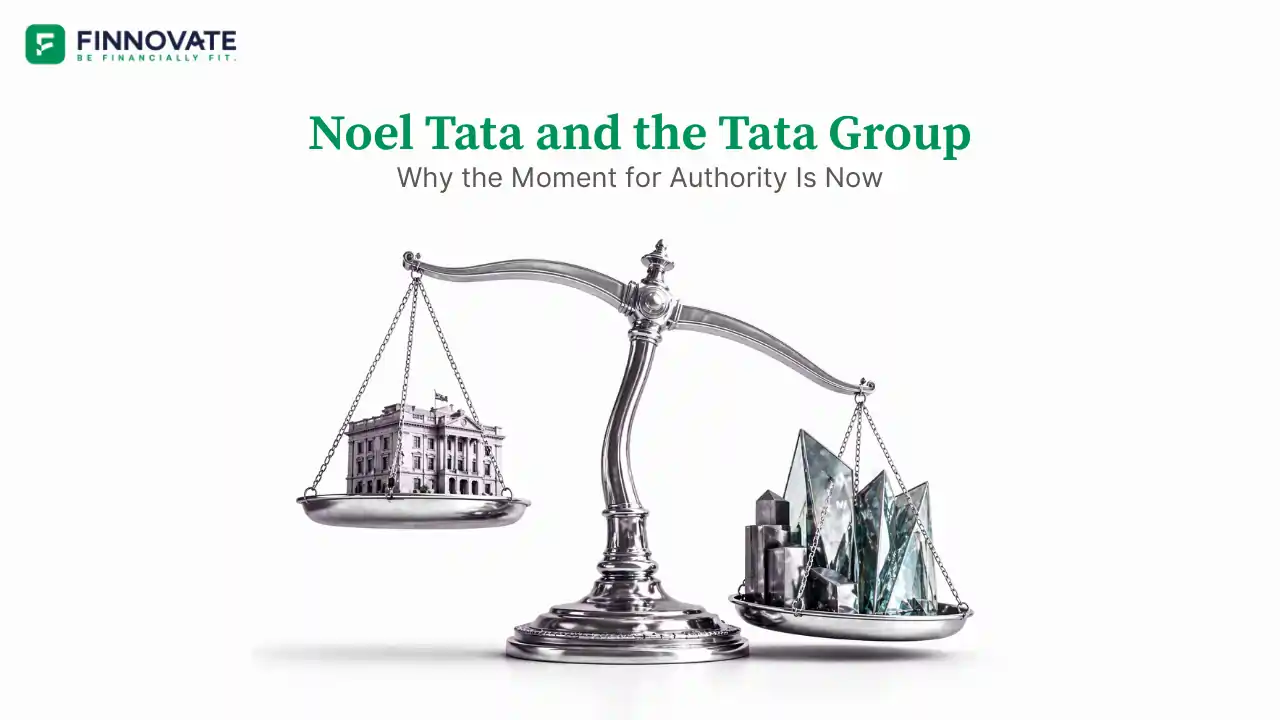
What is unfolding in the boardrooms of Bombay House, the Mumbai headquarters from which the Tata Group has been governed for over a century, is being watched not just by institutional investors and market participants, but reportedly by the Indian government itself. The Tata Group is not merely a large conglomerate. It employs close to a million people, operates in over 100 countries, and holds symbolic weight in India's corporate identity that no other private enterprise quite matches.
The man at the centre is Noel Tata, who became Chairman of Tata Trusts in October 2024 following the death of his half-brother Ratan Tata. He inherited an institution that had always functioned by consensus and quiet authority. He is now presiding over a body that is publicly divided, legally challenged, and facing a convergence of pressures that would test any leader. The question that experienced India watchers are asking is whether Noel Tata will do what Ratan Tata did in 1991: decisively stamp his authority, or allow the divisions to deepen.
The Tata Group is facing several significant challenges simultaneously. Individually, each would be manageable. Together, they are creating a governance overhang that is beginning to affect how institutional investors view Tata group listed companies.
Air India was reacquired by the Tata Group in 2022 after 69 years of government ownership. The revival was expected to be the defining acquisition of the Chandrasekaran era. Fleet renewal has happened, partnerships have been announced, and the brand has been repositioned. But Air India continues to generate losses and absorb capital at a rate that has become a point of tension within the board. Noel Tata has publicly linked his assessment of Chandrasekaran's tenure renewal to the pace of turnaround in loss-making businesses, of which Air India is the most visible.
On February 24, 2026, the Tata Sons board deferred a decision on whether to grant Natarajan Chandrasekaran a third five-year term as Chairman, just four days before his current term was due to expire. Noel Tata had sought a detailed roadmap for reviving loss-making group businesses before committing to a renewal. Whether reasonable or not, this represented an unprecedented public challenge to a sitting Tata Sons chairman. All eyes are now on the June 2026 Tata Sons board meeting as the focal point for resolving this question alongside the listing decision.
Three specific disputes have broken the surface in April 2026 and are no longer matters of internal deliberation alone.
The RBI had mandated Tata Sons to list on Indian exchanges by September 30, 2025. That deadline was missed. Tata Sons' application to de-register as an upper-layer NBFC remains undecided as of April 2026. A new RBI draft framework released on April 10, 2026 would keep Tata Sons in the upper layer on asset-size grounds alone, regardless of the deregistration application. Within the Trust, Noel Tata asked Chandrasekaran in February 2026 for an assurance that Tata Sons would remain a private, unlisted company. By April 2026, Vice-Chairmen Venu Srinivasan and Vijay Singh had publicly endorsed listing as inevitable given the RBI's position. For Noel Tata, the concern is structural: a listed Tata Sons would change the governance architecture in ways that reduce the Trusts' current reserved-matter veto rights and bring the holding company under quarterly public scrutiny.
In October 2025, Noel Tata and other trustees voted out Mehli Mistry as trustee of both Sir Ratan Tata Trust and Sir Dorabji Tata Trust, the first time a trustee had been removed in the institutions' history. Mistry was a close associate of Ratan Tata and had been at the heart of several disagreements over Trust governance. Rather than accepting his removal, Mistry filed an affidavit before the Maharashtra Charity Commissioner challenging his ouster, questioning the validity of Noel Tata's reappointment as life trustee on grounds of an alleged procedural lapse, and requesting the appointment of an independent administrator to oversee the running of both Trusts. He also challenged the appointment of Venu Srinivasan and Vijay Singh as vice-chairmen on the grounds that, as non-Parsis, they are ineligible under the trust's governing rules and the provisions of the Maharashtra Public Trusts Act, 1950. The Charity Commissioner is now expected to examine whether these appointments complied with the trust deed and applicable regulations.
What makes the current moment qualitatively different from earlier Tata disagreements is the collapse of the tradition of consensus decision-making. Under JRD Tata and Ratan Tata, major decisions reflected a unified position; disagreements were managed internally. The current divisions are open, documented in legal filings, reported in the business press, and being adjudicated before a government commissioner. The institutional investors who hold significant positions in TCS, Tata Motors, Tata Steel, and Tata Power are watching closely. Internal rifts at the holding company and Trust level create uncertainty about strategic direction, capital allocation, and leadership continuity, precisely the variables that institutional investors price into their holdings.
There is a historical parallel that is directly instructive for understanding what the current moment demands.
When Ratan Tata succeeded JRD Tata as Chairman of Tata Sons in 1991, he inherited a group structured as a loose federation of powerful business heads. Under JRD's long tenure, Russi Mody of Tata Steel, Ajit Kerkar of Indian Hotels, and Darbari Seth of Tata Chemicals had each built their businesses into significant enterprises, and in doing so had also built personal power centres that operated with substantial independence from Tata Sons.
When Ratan Tata proposed a more centralised system of control, one in which Tata Sons would hold meaningful stakes in group companies and the Tata brand would be managed centrally, it was met with open defiance. Mody was particularly outspoken. Rather than absorbing the challenge or deferring to seniority, Ratan Tata moved decisively. Mody was removed in April 1993, a month before his planned retirement. Kerkar and Seth followed. The message was unambiguous: the group would operate with a coherent centre, and those who could not accept that would not remain in positions of authority.
The parallel is not perfect. Noel Tata faces a governance challenge at the Trust level, not at the operating company level. The disputes are about the Trust's legal standing and the strategic direction of the holding company, not about individual business heads defying central authority. But the essential leadership challenge is the same. A new chairman taking over from a larger-than-life predecessor must establish unambiguous authority. Incremental management of disputes, avoiding confrontation, seeking accommodation with all parties, risks being read as weakness. The institution's credibility depends on its ability to make binding decisions. That requires a leader who is seen to be clearly in command.
Leadership, at its core, cannot be delegated. The ability to take hard decisions, decisions that may be uncomfortable in the short term but serve the long-term interests of the institution, is the task that cannot be assigned to committees or advisers.
Noel Tata has significant structural advantages. He carries the Tata name. He has spent decades in the group, running Trent, Tata International, and Voltas before assuming the Trust chairmanship. He has the institutional credibility and the family lineage to act decisively without being seen as an outsider imposing his will on the organisation.
The June 2026 Tata Sons board meeting is the near-term focal point. Three questions are expected to crystallise around it: whether to renew Chandrasekaran's chairmanship, what position the board formally takes on the listing question given the RBI's new draft framework, and how the Trust responds to the Charity Commissioner's examination of Mistry's affidavit.
How Noel Tata handles these three questions will define the character of his chairmanship. The institutional investors who hold Tata stocks have watched the current uncertainty with concern. They understand that Tata companies have always commanded a governance premium precisely because of the stability and long-term orientation of the Trust structure. That premium is not unconditional. It depends on the group's ability to make clear-eyed decisions, absorb difficult challenges, and emerge with coherent leadership. The moment to demonstrate that capacity is now.
Please consult a SEBI-registered investment adviser before making any investment decision related to Tata group listed companies or any corporate development discussed in this article.
Noel Tata is the Chairman of Tata Trusts, the philanthropic entities that collectively hold approximately 66% of Tata Sons, the holding company of the Tata Group. He was appointed Chairman in October 2024 following the death of his half-brother Ratan Tata. Before taking on the Trust chairmanship, Noel Tata had led Trent, Tata International, and Voltas within the Tata Group.
Multiple disputes have surfaced simultaneously. Mehli Mistry, who was voted out as trustee in October 2025, has filed an affidavit before the Maharashtra Charity Commissioner challenging his removal, questioning Noel Tata's reappointment as life trustee on procedural grounds, and seeking the appointment of an independent administrator. He has also challenged the appointment of Venu Srinivasan and Vijay Singh as non-Parsis on the Trust board. Separately, there is a public division within the Trust over whether Tata Sons should be listed.
The RBI had mandated Tata Sons to list on Indian exchanges by September 30, 2025. That deadline was missed. A new RBI draft framework released April 10, 2026 would classify Tata Sons as upper-layer on asset-size grounds regardless of its deregistration application. Within Tata Trusts, Noel Tata wants to keep Tata Sons private while Vice-Chairmen Venu Srinivasan and Vijay Singh have publicly endorsed listing. For more detail on the listing case, see the article on Tata Sons listing: why the case is getting harder to ignore.
The Tata Sons board deferred a decision on Natarajan Chandrasekaran's reappointment as Chairman for a third five-year term on February 24, 2026, just four days before his current term was due to expire. Noel Tata had sought a detailed roadmap for reviving loss-making group businesses before committing to renewal. The June 2026 Tata Sons board meeting is expected to be the decision point.
When Ratan Tata became Chairman of Tata Sons in 1991, he faced open defiance from powerful company heads including Russi Mody of Tata Steel, Ajit Kerkar of Indian Hotels, and Darbari Seth of Tata Chemicals, who had built independent power centres under JRD Tata's federal management style. Ratan Tata responded decisively, removing each of them and centralising authority under Tata Sons. The current challenge facing Noel Tata, establishing authority over a divided Trust and group structure, is structurally analogous, though the specific context and parties are different.
The key near-term signal points are the June 2026 Tata Sons board meeting (Chandrasekaran reappointment and listing position), the Maharashtra Charity Commissioner's examination of Mehli Mistry's affidavit (which could affect the current Trust board composition), and the RBI's final decision on its draft NBFC framework (open for public comment until May 4, 2026). Internal governance stability at the Trust and holding company level has historically been a component of the premium that Tata group listed stocks command. Please consult a SEBI-registered investment adviser before making any investment decision.
Disclaimer: This article is for general information and educational purposes only. It does not constitute investment advice, a recommendation, or an offer to buy or sell any securities or financial instruments. Information about Tata Trusts governance, the Mehli Mistry affidavit, and the Chandrasekaran reappointment deferral is sourced from external sources, all dated March-April 2026. Shareholding figures are from FY24 filings and court records as reported by these publications; Tata Sons is a private limited company and does not publish exchange filings. The RBI NBFC framework reference is from the RBI draft directions released April 10, 2026. Historical information about the 1991 Tata group transition is from external sources. All information reflects publicly available data as of April 2026 and is subject to change. Past corporate governance outcomes are not indicative of future developments. Please consult a SEBI-registered investment adviser or qualified financial professional before making any investment or financial planning decision.
No spam. Only new posts, simple explainers, and practical money checklists for busy professionals.
Finnovate is a SEBI-registered financial planning firm that helps professionals bring structure and purpose to their money. Over 3,500+ families have trusted our disciplined process to plan their goals - safely, surely, and swiftly.
Our team constantly tracks market trends, policy changes, and investment opportunities like the ones featured in this Weekly Capsule - to help you make informed, confident financial decisions.
Learn more about our approach and how we work with you:
No comments yet. Start the conversation. What would you add?
No spam. Only new posts, simple explainers, and practical money checklists.
You may also like
Rising oil prices and booming AI investment are shaping an uneven global economy in 2026. ...

Explore FPI equity flows for October First Half, 2026: ₹47,955 crore in net outflows, th...
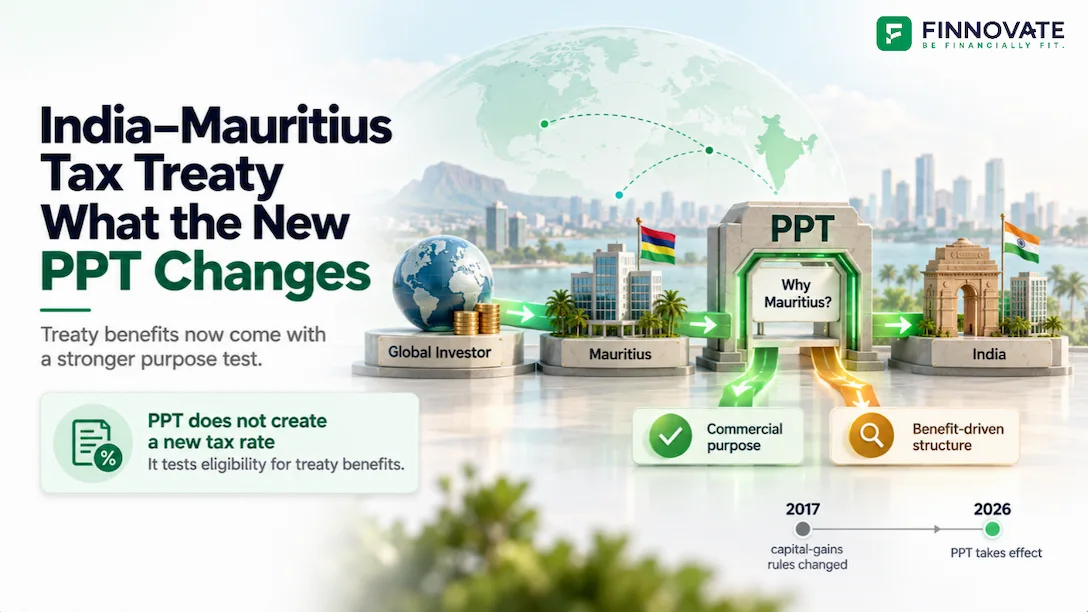
Understand the India–Mauritius tax treaty’s Principal Purpose Test, its August 2026 ef...

Explore India’s AI hardware opportunity through the proposed Adani–Jabil venture, from...
Popular now
Learn how to easily download your NSDL CAS Statement in PDF format with our step-by-step g...

Looking for the best financial freedom books? Here’s a handpicked 2026 reading list with...
Learn what SIF investment means in India, SEBI rules, Rs 10 lakh minimum investment, avail...
Clear guide to mutual fund taxation in India for FY 2025–26 after July 2024 changes: equ...