
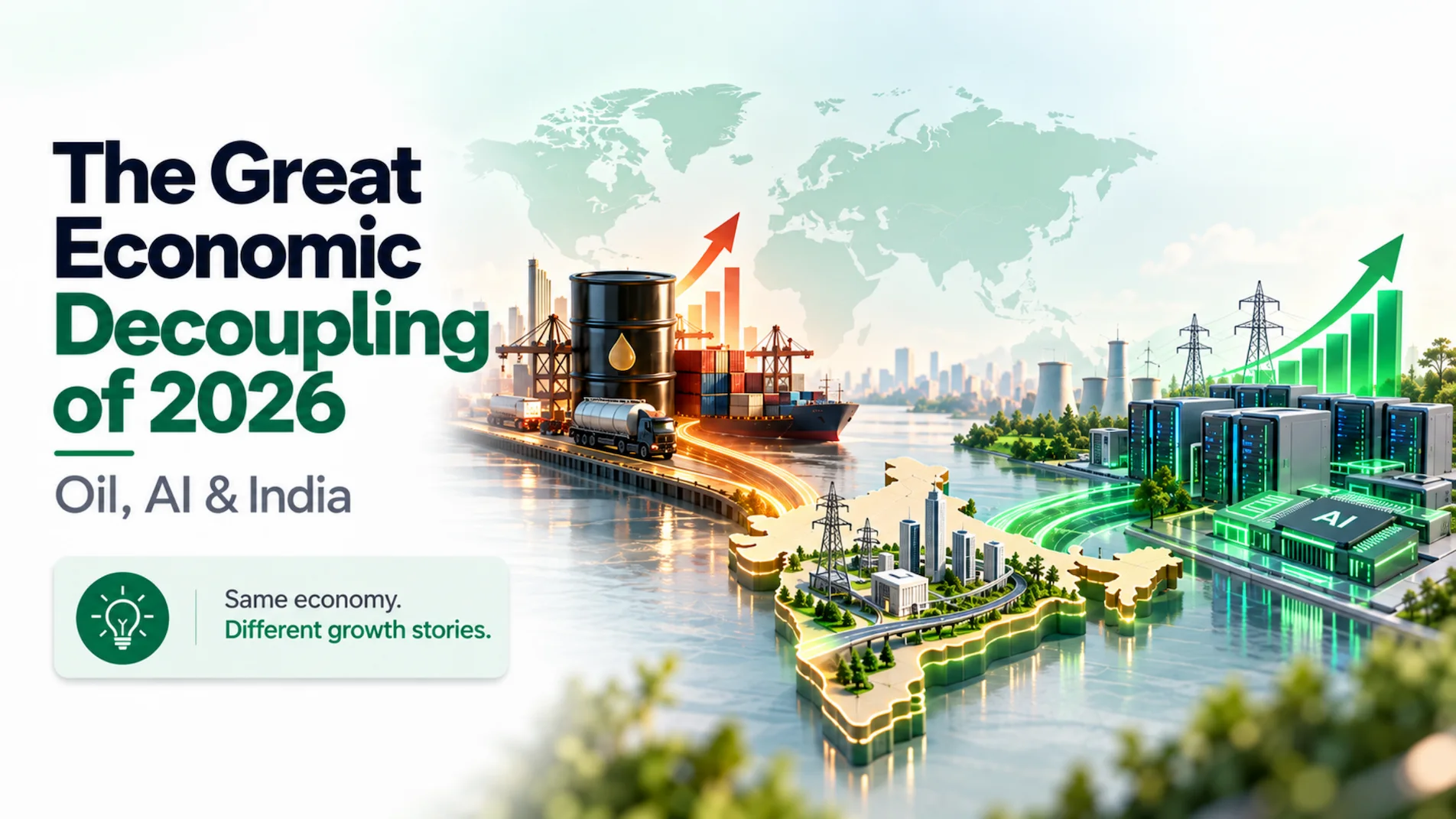
The Great Economic Decoupling of 2026: Oil, AI & India
Rising oil prices and booming AI investment are shaping an uneven global economy in 2026. ...
24 October 2026
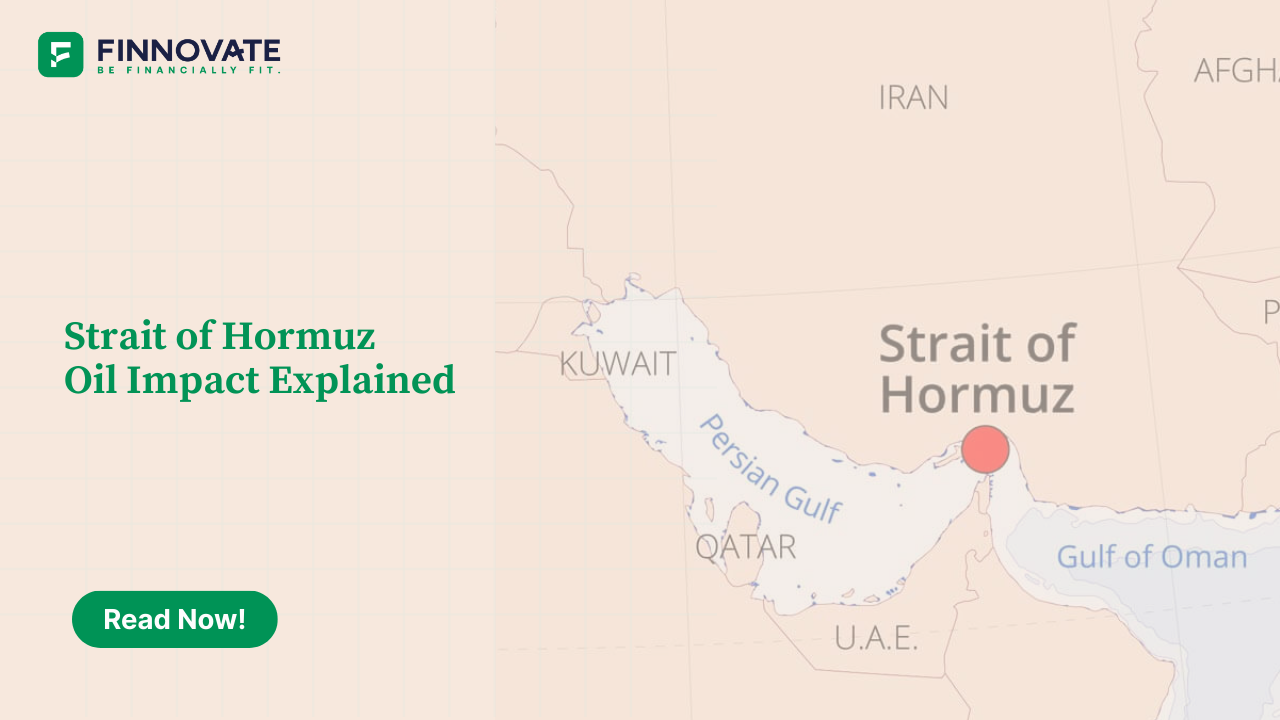
The Strait of Hormuz is one of the most important shipping routes in the world because a huge share of global oil and gas moves through it. When tensions rise in this narrow waterway, oil prices usually react fast, shipping risk goes up, and countries that depend on imported energy, including India, start feeling the pressure. In early March 2026, that risk returned to the spotlight as conflict in the region disrupted tanker movement and pushed crude prices sharply higher.
The Strait of Hormuz is a narrow sea passage between Iran and Oman. It connects the Persian Gulf to the Gulf of Oman and the Arabian Sea. That makes it the main exit route for oil and gas exports from major Gulf producers such as Saudi Arabia, Iraq, the UAE, Kuwait, Qatar, Bahrain, and Iran.
This is not just another shipping lane. It is one of the world’s biggest energy chokepoints. The US Energy Information Administration says around 20 million barrels per day moved through the Strait in 2024, equal to roughly 20% of global petroleum liquids consumption. The IEA’s 2025 view also shows nearly 20 million barrels per day of oil exports through the route.
Strait of Hormuz in 3 numbers
Because there is no easy replacement for it.
The IEA says nearly 15 million barrels per day of crude oil moved through the Strait in 2025, which was about 34% of global crude oil trade. On top of that, just over 112 bcm of LNG also passed through it in 2025, equal to nearly 20% of global LNG trade.
That means any disruption here is not a local issue. It becomes a global energy issue very quickly.
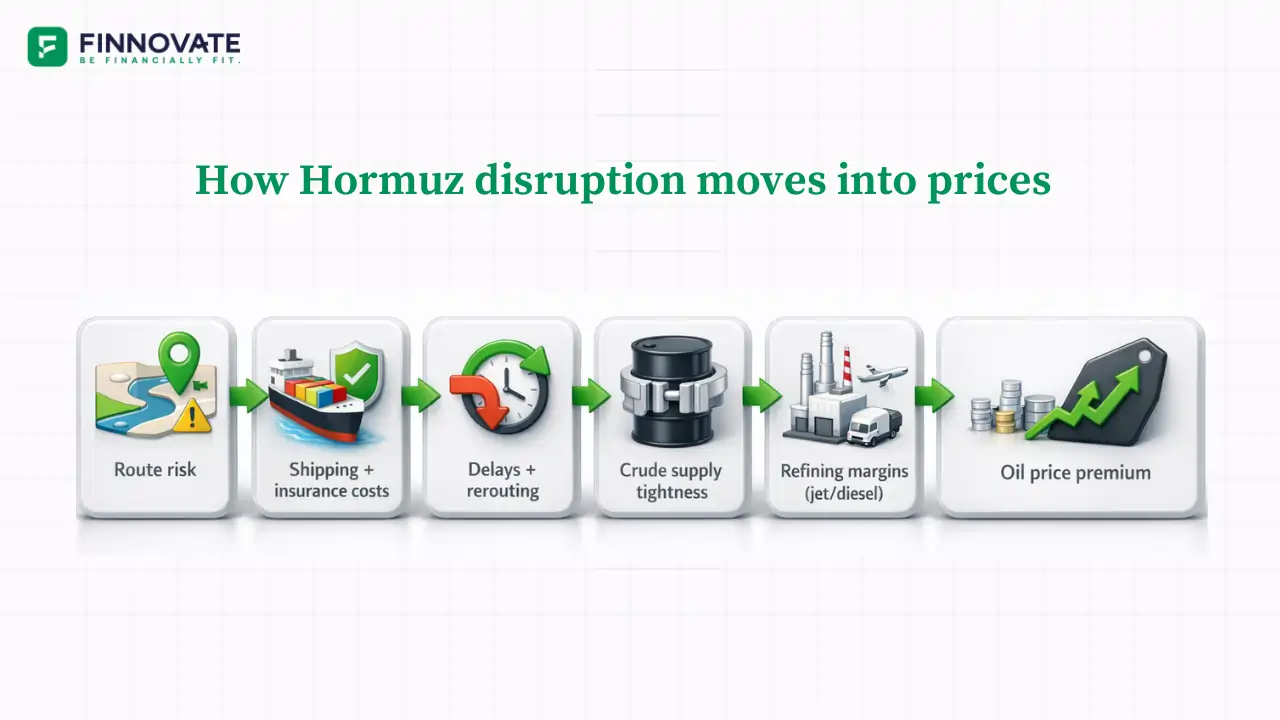
The impact usually spreads through four channels:
First, oil supply risk. Even if actual flows are not fully blocked, markets start pricing in the chance of lower supply.
Second, shipping and insurance costs. Tankers moving through a conflict zone face higher risk premiums, and those costs can feed into delivered energy prices.
Third, gas market stress. Qatar is one of the world’s largest LNG exporters, and its LNG exports depend heavily on this route. If LNG flows are hit, gas prices can jump too.
Fourth, market psychology. Oil does not wait for a full shutdown to move. It reacts to fear, expectations, and possible shortages.
That is exactly what recent price action showed. Reuters reported that by March 6, 2026, Brent had jumped 16.4% for the week and WTI had risen 19.2%, driven by conflict-linked supply fears and disruption to tanker movement through Hormuz.
Oil prices move on expected supply, not just current supply.
If traders believe fewer barrels may reach the market in the coming days or weeks, prices rise immediately. A disruption in Hormuz matters because the route carries such a large share of globally traded oil, and because spare export capacity outside the Strait is limited.
The IEA estimates only around 3.5 to 5.5 million barrels per day can be moved through alternative routes such as Saudi Arabia’s pipeline to the Red Sea and the UAE’s pipeline to Fujairah. That is far below the normal oil volumes that pass through the Strait.
So even partial disruption can create a strong price reaction.
Then comes the second-round effect. Higher crude prices can push up refining costs, transport fuel prices, airline costs, shipping rates, and eventually inflation. For countries that import a lot of energy, that can widen trade deficits and put pressure on currencies too.
India is one of the countries most exposed to what happens in the Strait of Hormuz.
The IEA says China and India together received 44% of the crude oil exports passing through the Strait in 2025. It also says India, Bangladesh, and Pakistan imported almost two-thirds of their LNG supplies via this route in 2025.
That matters for three reasons.
One, import costs. If crude rises, India’s oil import bill rises.
Two, inflation risk. Costlier crude can show up in fuel, transport, logistics, and other parts of the economy.
Three, market sentiment. Indian equities may react differently sector by sector. Upstream energy names may benefit from higher oil prices, while sectors sensitive to fuel and input costs may come under pressure.
For households, the immediate question is usually petrol and diesel. The link is not always one-to-one because retail fuel pricing depends on taxes, marketing margins, and policy action. But sustained higher crude generally raises pressure across the system.
Not fully.
That is the core problem.
Some oil can be rerouted through pipelines outside the Strait, but the available capacity is limited relative to the normal volume moving through Hormuz. On gas, the problem is even harder. The IEA says there are no real alternative routes to bring Qatari and Emirati LNG to the global market at the same scale and speed. It also notes that replacing those lost volumes quickly would be almost impossible because other LNG export facilities are already running close to capacity.
So when people ask, “Can the world manage without the Strait of Hormuz?” the practical answer is this: not smoothly, and not in the short term.
Watch five things.
First, whether tanker traffic is actually restored or remains disrupted.
Second, Brent crude and LNG price movement over the next few sessions.
Third, signals from major governments about emergency supply measures.
Fourth, how India’s currency, inflation outlook, and oil marketing sentiment react.
Fifth, whether the issue remains a short shock or turns into a prolonged supply problem.
The Strait of Hormuz matters because it sits at the center of global energy trade. Around one-fifth of the world’s oil and LNG moves through this narrow route, and there are only limited alternatives if it gets disrupted. That is why even the threat of trouble here can lift oil prices fast, unsettle markets, and create pressure for large importers such as India.
It is a narrow shipping lane between the Persian Gulf and the Arabian Sea. It is one of the world’s most important energy routes because a large share of seaborne oil exports from the Gulf pass through it.
The IEA estimates that in 2025, nearly 15 million barrels a day of crude moved through Hormuz, which was about 34% of global crude oil trade. The US EIA also tracks Hormuz as a key chokepoint for petroleum liquids flows.
Markets price risk early. Even partial disruption can raise costs through insurance, rerouting, and delays. Those frictions tighten delivered supply and can lift the risk premium in crude and fuels.
They are often early stress signals. When crude supply chains tighten or refiners cut runs, the availability of finished fuels can tighten quickly. That pushes up fuel margins and can keep the disruption “visible” even if crude prices cool briefly.
A large share of Gulf oil exports moving through Hormuz goes to Asia. The IEA notes China and India together received 44% of those exports in 2025, which is why Hormuz shocks tend to transmit strongly into Asian crude and fuel markets.
Disclaimer: This article is meant for educational purposes only and should not be treated as investment, financial, or geopolitical advice. Market reactions to global events can change quickly, and readers should review current developments before making any financial decisions.
No spam. Only new posts, simple explainers, and practical money checklists for busy professionals.
Finnovate is a SEBI-registered financial planning firm that helps professionals bring structure and purpose to their money. Over 3,500+ families have trusted our disciplined process to plan their goals - safely, surely, and swiftly.
Our team constantly tracks market trends, policy changes, and investment opportunities like the ones featured in this Weekly Capsule - to help you make informed, confident financial decisions.
Learn more about our approach and how we work with you:
No comments yet. Start the conversation. What would you add?
No spam. Only new posts, simple explainers, and practical money checklists.
You may also like
Rising oil prices and booming AI investment are shaping an uneven global economy in 2026. ...

Explore FPI equity flows for October First Half, 2026: ₹47,955 crore in net outflows, th...
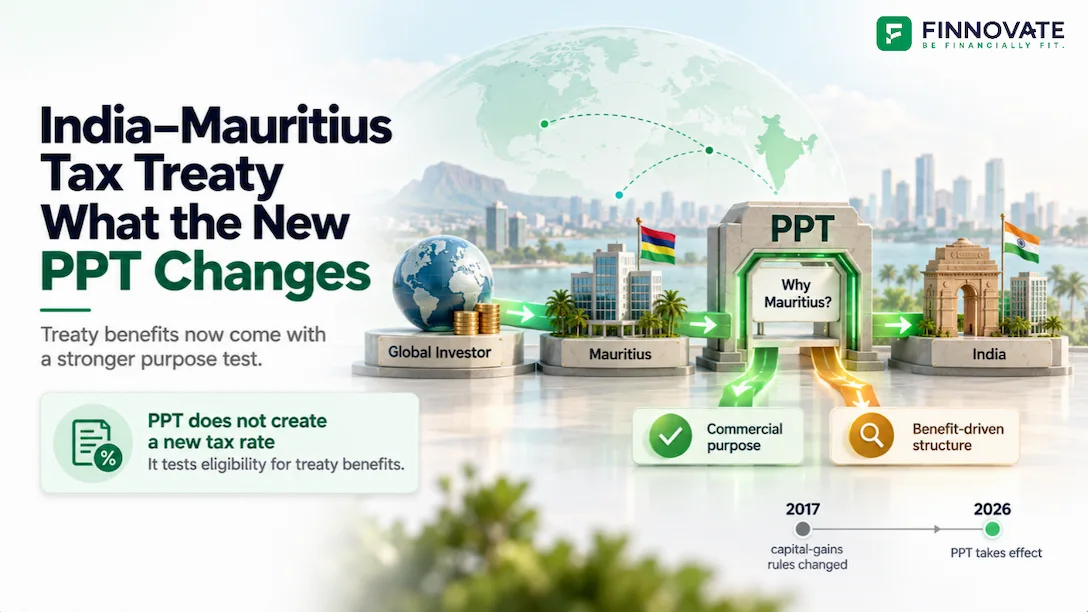
Understand the India–Mauritius tax treaty’s Principal Purpose Test, its August 2026 ef...

Explore India’s AI hardware opportunity through the proposed Adani–Jabil venture, from...
Popular now

Learn how to easily download your NSDL CAS Statement in PDF format with our step-by-step g...

Looking for the best financial freedom books? Here’s a handpicked 2026 reading list with...
Learn what SIF investment means in India, SEBI rules, Rs 10 lakh minimum investment, avail...

Clear guide to mutual fund taxation in India for FY 2025–26 after July 2024 changes: equ...