

The Great Economic Decoupling of 2026: Oil, AI & India
Rising oil prices and booming AI investment are shaping an uneven global economy in 2026. ...
24 October 2026
Published: April 2026 | Data: MoSPI (April 13, 2026), DPIIT (April 14, 2026), RBI MPC (April 8, 2026)
India ended FY26 with average CPI inflation of approximately 2.1%, the lowest full-year reading since the current CPI series began. It was an extraordinary outcome, driven by bumper harvests, the GST 2.0 rate rationalisation in September 2025, and a year of largely contained global commodity prices until the final quarter.
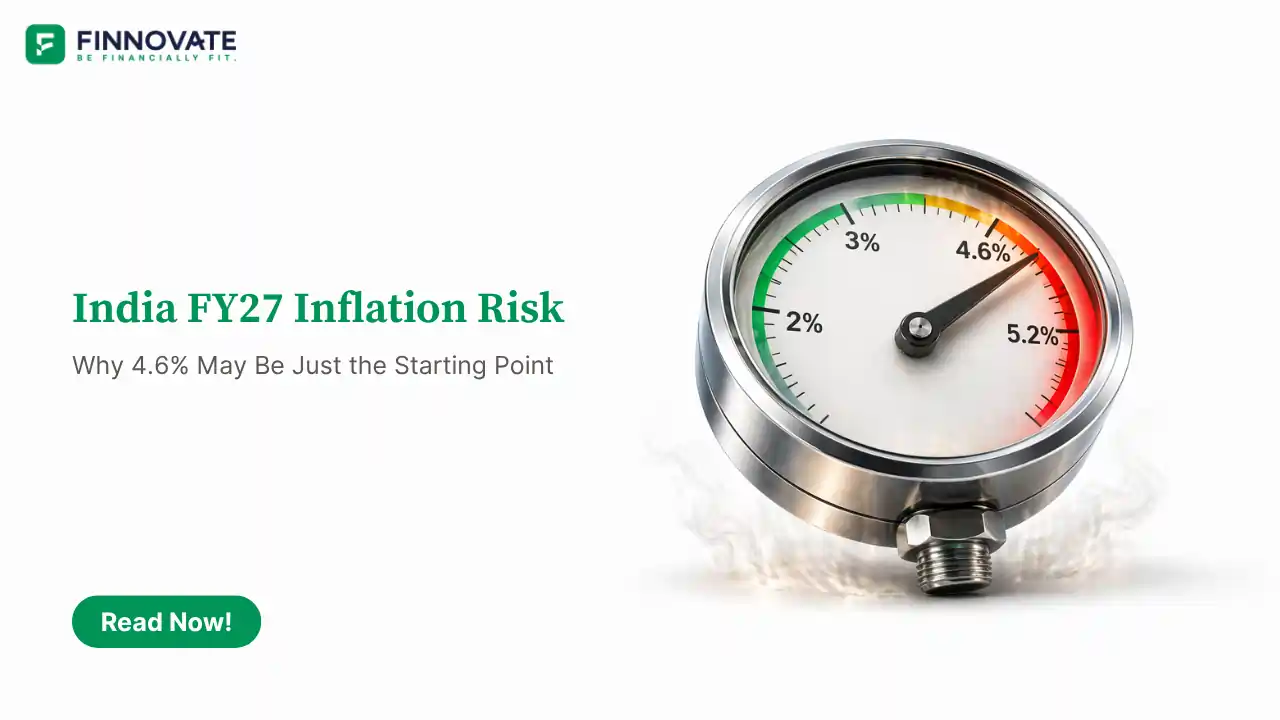
FY27 will be different. The RBI's April 2026 MPC projection puts FY27 headline CPI at 4.6%, more than double the FY26 average. But that projection already carries explicit upside risk flags from the RBI itself: crude above $100 per barrel, a weakened rupee, and the possibility of El Nino conditions affecting the 2026 southwest monsoon. The 4.6% figure may be the floor rather than the central estimate.
March 2026 CPI came in at 3.40%, up from 3.21% in February and 2.75% in January. The direction is clear. Food inflation accelerated to 3.87% in March. This is the first sustained upward move in CPI after nine months of disinflation through most of FY26.
The WPI data released on April 14, 2026 delivered a sharper signal. Wholesale price inflation jumped to 3.88% in March from 2.13% in February, a move of 175 basis points in a single month.
| Indicator | March 2026 | February 2026 | Change |
|---|---|---|---|
| CPI Headline | 3.40% | 3.21% | +19 bps |
| CPI Food (CFPI) | 3.87% | 3.47% | +40 bps |
| WPI Headline | 3.88% | 2.13% | +175 bps |
| WPI Manufacturing | 3.39% | 2.92% | +47 bps |
| WPI Fuel and Power | +1.05% | −3.78% | First positive print in a year |
The West Asia conflict escalated in late February 2026, pushing India's crude oil basket above $100 per barrel. Since then, the government has partially passed on higher energy costs to consumers. Aviation turbine fuel prices have risen. LPG prices have been revised upward. Premium fuel prices have moved.
What has not happened yet is the revision of petrol and diesel retail prices. These two fuels account for the bulk of transport fuel consumption in India and directly feed into freight costs, agricultural input costs, and the price of virtually every good that needs to be moved. RBI Governor Sanjay Malhotra noted explicitly in the April 8 MPC statement that retail prices of petrol and diesel have remained unchanged despite crude significantly above $100 per barrel.
When petrol and diesel prices are revised, the impact is not contained to the fuel line in the CPI basket. It propagates through freight costs to virtually every category of goods. Farm produce, manufactured goods, and consumer staples all become more expensive to move. A single petrol price revision of ₹5–8 per litre typically adds 20–40 basis points to headline CPI within two to three months through direct and indirect channels. The longer the government defers the revision, the sharper the eventual pass-through when it comes.
The secondary inflation wave from crude is already visible in the WPI data. The DPIIT press release for March 2026 identifies crude petroleum and natural gas, other manufacturing, non-food articles, and basic metals as the primary drivers of the WPI spike. Sectors including paints, chemicals, petrochemicals, plastics, and pharma use petroleum derivatives as key inputs. As these sectors absorb sustained higher input costs, they begin passing them through to buyers, a process that typically shows up in CPI with a lag of two to four months from the initial crude price movement.
WPI measures prices at the wholesale stage, before goods reach retailers or consumers. Historically in India, a sustained WPI spike precedes a CPI spike by two to four months as the cost pressure moves through the supply chain.
March 2026's WPI reading of 3.88% is the headline. The composition is more informative. Manufacturing WPI at 3.39% is the fastest since November 2022. Fuel and power WPI turned positive at 1.05% after being in deflation at -3.78% in February, the first positive fuel WPI print in a year. Primary articles WPI accelerated to 6.36%, driven by non-food articles rising 11.50%.
Manufactured products account for 64.2% of the WPI basket. When manufacturing WPI accelerates to a multi-year high, it signals that input cost pressure is broad-based and not confined to a single commodity. Companies facing higher input costs have two options: absorb into margins, or pass through to customers. In the current environment, with firms already managing currency depreciation-led cost increases on imported inputs, the capacity to absorb is lower than in FY26. The pass-through to consumer prices is therefore likely to be faster and larger than the historical average would suggest.
Even if the West Asia conflict were to end tomorrow, the inflation impact would not disappear with the ceasefire. Two structural factors will sustain upward pressure on prices through FY27.
The war has caused substantial physical damage to trade infrastructure in the region. Port operations have been disrupted, shipping routes rerouted, and insurance costs for vessels transiting the region have risen sharply. Rebuilding supply chain capacity takes months, not days. Oil-producing countries in the region are also likely to operate below their pre-conflict production levels for a sustained period after hostilities end. The market for energy and related commodities is therefore likely to remain undersupplied into FY27 and potentially beyond, keeping a floor under commodity prices independent of the conflict's outcome.
The IMD released its official 2026 long-range monsoon forecast on April 13, projecting southwest monsoon rainfall at 92% of the Long Period Average (LPA). Under IMD's own classification, 96–104% of LPA is "normal" and below 90% is "deficient." At 92%, the forecast is "below normal." This is not a drought year by IMD's technical definition, but it is a year in which agricultural output, particularly for kharif crops, will face pressure. The IMD forecast also flags the likely emergence of El Nino conditions during the monsoon season. Food accounts for approximately 46% of India's CPI basket. With the RBI's Q3 FY27 projection already at 5.2%, a below-normal monsoon makes that peak a floor rather than a ceiling.
The government demonstrated in FY26 that fiscal tools can have a rapid and meaningful impact on inflation. GST 2.0, effective September 22, 2025, rationalised the rate structure from four slabs to two (5% and 18%), cutting rates across a wide range of consumer goods. Citi Research estimated the full pass-through could reduce CPI inflation by up to 1.1 percentage points. The October 2025 CPI print of 0.25%, the lowest in over eight years, reflected the immediate impact of those cuts.
That lever has largely been spent. The GST structure has been simplified and rates have been cut. Significantly extending those cuts further is not straightforward, and the fiscal cost of deeper reductions would be material. Income tax cuts delivered in FY26 also limit further room on the direct tax side.
The government retains some options. It can reduce excise duty on petrol and diesel, absorbing part of the crude price increase at the centre rather than passing it to consumers. It can release buffer stocks of food grains to stabilise supply if monsoon disruptions cause shortfalls. It can increase procurement support for specific agricultural commodities. But each option carries a fiscal cost, and the government enters FY27 with less room on both the revenue and expenditure sides than it had entering FY26.
At the April 8, 2026 MPC meeting, the RBI held the repo rate at 5.25% and retained the neutral stance. Governor Malhotra was explicit: rate hikes are not the right tool for supply-driven inflation. The inflation India faces in FY27 is not being caused by excess demand or loose monetary policy. It is being caused by crude oil prices, currency depreciation, and supply chain disruptions. Tightening monetary policy into a supply shock risks compressing demand and growth without addressing the underlying cost-push driver.
That said, the rate hike risk is not off the table. Markets are already pricing in the possibility of up to 50 basis points in rate hikes in FY27, according to the Edelweiss Monetary Policy Update. The trigger would be a durable and broad-based CPI move above 5%, sustained over two or more MPC meetings, taking the situation beyond a supply shock framing into a broader inflationary pressures scenario.
The RBI's own quarterly projection path already peaks at 5.2% in Q3 FY27. If that peak is breached and holds, the conversation around rate hikes will become more concrete. The next key signal point is the June 3-5 MPC meeting, at which the RBI will review the CPI trajectory from April and May 2026, the first months to fully capture the post-war energy pass-through in the consumer basket.
For context on the RBI's April 2026 rate decision and what it means for loans and deposits, see the article on the RBI repo rate unchanged in April 2026. For the March 2026 CPI data in detail, see India CPI inflation March 2026.
The RBI's April 2026 MPC projects FY27 headline CPI inflation at 4.6%, more than double the FY26 average of approximately 2.1%. The quarterly path shows Q1 at 4.0%, Q2 at 4.4%, Q3 at 5.2% (the peak), and Q4 at 4.7%. The RBI has flagged upside risks from energy prices, rupee weakness, and potential El Nino conditions affecting the monsoon.
WPI inflation jumped from 2.13% in February to 3.88% in March 2026, a 175 basis point increase in a single month, driven primarily by crude petroleum and natural gas, non-food articles, other manufacturing, and basic metals. The West Asia conflict that escalated in late February pushed crude above $100 per barrel, driving up input costs across the supply chain. Manufacturing WPI at 3.39% is the fastest since November 2022.
The RBI held the repo rate at 5.25% in its April 2026 MPC meeting and explicitly stated that rate hikes are not the appropriate tool for supply-driven, cost-push inflation. However, markets are pricing the possibility of up to 50 basis points in rate hikes if CPI moves durably above 5% and stays elevated across multiple MPC meetings. The RBI has not signalled any rate hike at this stage. The June 2026 MPC meeting will be an important signal point.
The war has pushed crude above $100 per barrel, raising energy input costs across the economy. ATF, LPG, and premium fuel prices have already risen. Petrol and diesel retail prices remain unchanged, representing the largest pending pass-through to consumers. Secondary effects are appearing in WPI for chemicals, petrochemicals, paints, plastics, and pharma. Supply chain disruptions and higher shipping insurance costs are also raising input costs independent of crude prices.
The IMD's April 2026 long-range forecast projects southwest monsoon rainfall at 92% of the Long Period Average, classified as below normal. El Nino conditions are likely to develop during the monsoon season. A below-normal monsoon creates risk for kharif crop yields, which could push food inflation higher in Q3 and Q4 FY27. Food accounts for approximately 46% of India's CPI basket, making any monsoon shortfall a significant inflationary risk for the second half of FY27.
The GST 2.0 rate cuts deployed in September 2025 have largely been spent as a lever. Remaining fiscal options include reducing excise duty on petrol and diesel to absorb crude price increases at the centre, releasing food grain buffer stocks to stabilise supply, and targeted agricultural procurement support. Each option carries a fiscal cost, and the government has less room entering FY27 than it did in FY26. Please consult a SEBI-registered investment adviser to understand how the inflation outlook may affect your portfolio and financial planning.
Disclaimer: This article is for general information and educational purposes only. It does not constitute investment advice, a recommendation, or an offer to buy or sell any securities or financial instruments. CPI data is sourced from MoSPI's press release dated April 13, 2026. WPI data is sourced from DPIIT's press release dated April 14, 2026; March 2026 WPI figures are provisional and subject to revision. RBI inflation projections are from the RBI Monetary Policy Statement, April 8, 2026. IMD monsoon forecast is from IMD's official April 2026 long-range forecast. GST 2.0 details are from PIB notifications, September 2025. Citi Research GST inflation impact estimate is from publicly available research dated September 2025. Market pricing of rate hike expectations is from the Edelweiss Monetary Policy Update, April 2026, as reported by BusinessToday. All data is as of April 2026 and may be subject to revision. Past inflation trends are not indicative of future outcomes. Please consult a SEBI-registered investment adviser or qualified financial professional before making any investment or financial planning decision.
No spam. Only new posts, simple explainers, and practical money checklists for busy professionals.
Finnovate is a SEBI-registered financial planning firm that helps professionals bring structure and purpose to their money. Over 3,500+ families have trusted our disciplined process to plan their goals - safely, surely, and swiftly.
Our team constantly tracks market trends, policy changes, and investment opportunities like the ones featured in this Weekly Capsule - to help you make informed, confident financial decisions.
Learn more about our approach and how we work with you:
No comments yet. Start the conversation. What would you add?
No spam. Only new posts, simple explainers, and practical money checklists.
You may also like
Rising oil prices and booming AI investment are shaping an uneven global economy in 2026. ...
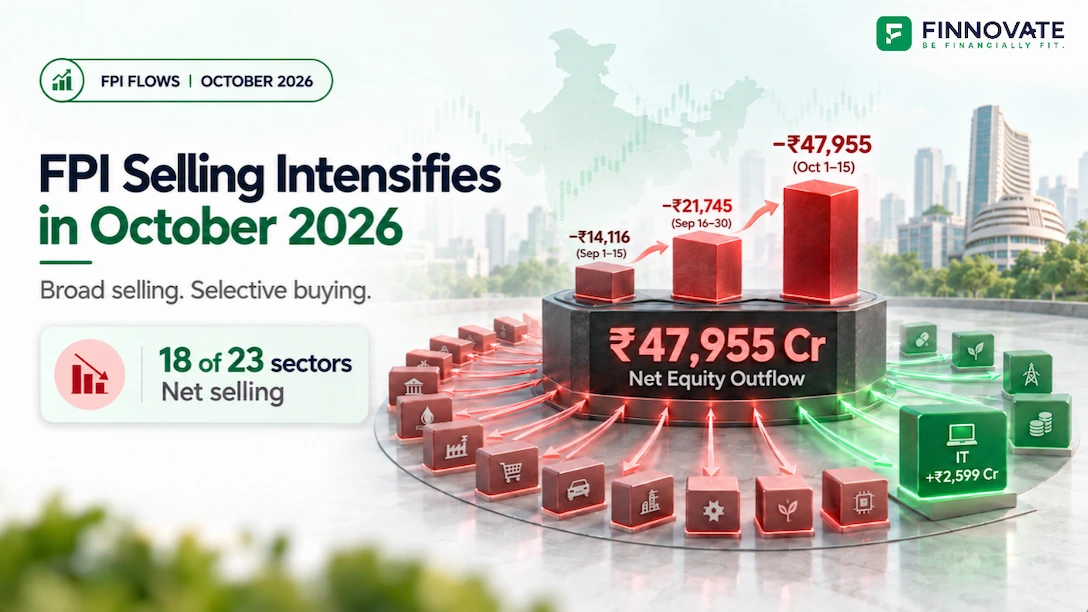
Explore FPI equity flows for October First Half, 2026: ₹47,955 crore in net outflows, th...
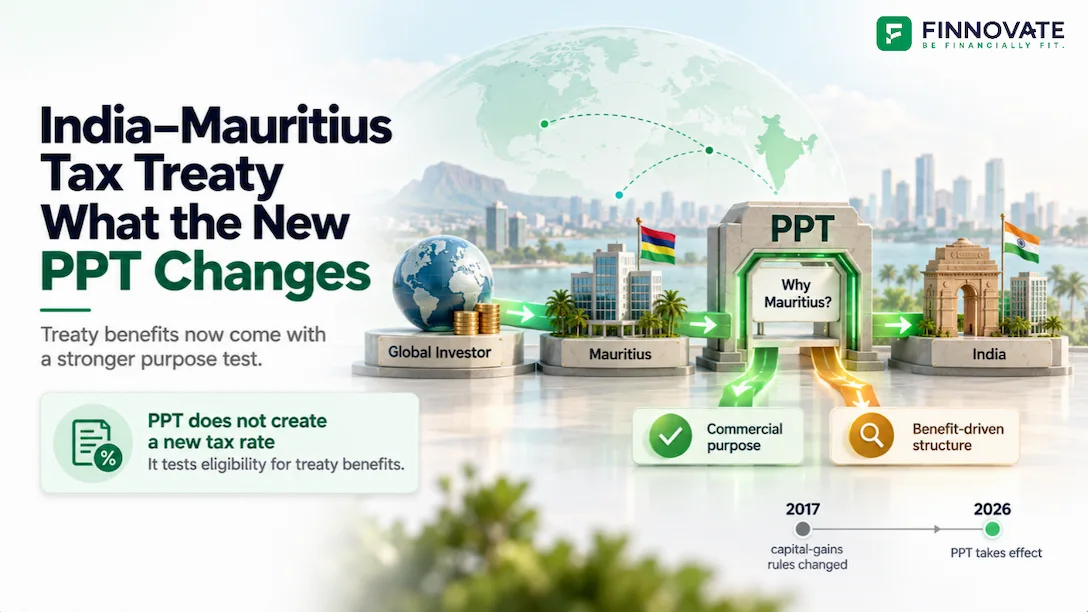
Understand the India–Mauritius tax treaty’s Principal Purpose Test, its August 2026 ef...

Explore India’s AI hardware opportunity through the proposed Adani–Jabil venture, from...
Popular now

Learn how to easily download your NSDL CAS Statement in PDF format with our step-by-step g...

Looking for the best financial freedom books? Here’s a handpicked 2026 reading list with...
Learn what SIF investment means in India, SEBI rules, Rs 10 lakh minimum investment, avail...
Clear guide to mutual fund taxation in India for FY 2025–26 after July 2024 changes: equ...