

EU Scrap Export Curbs: India’s Raw-Material Risk Explained
Proposed EU scrap export curbs could affect India’s metal supply and manufacturing costs...
24 September 2026
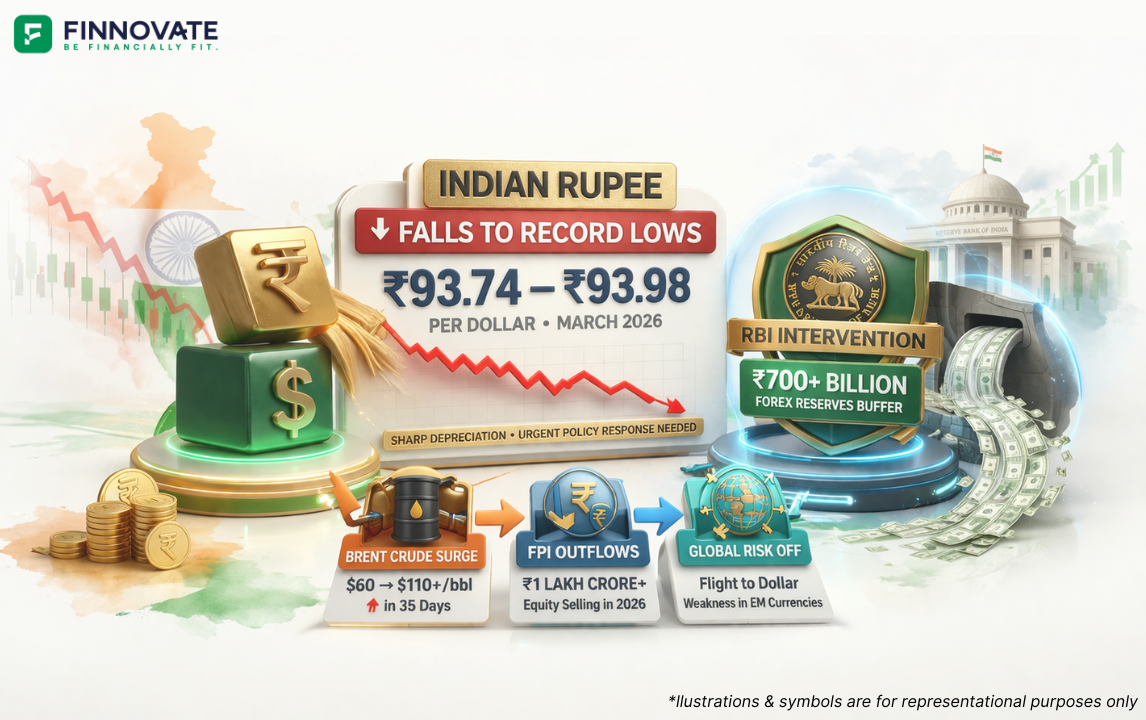
The Indian rupee fell to record lows near 93.74 per dollar on March 20 and weakened further to around 93.98 by March 23. At that point, the issue was no longer just that the rupee was weak. The bigger issue was the speed of the fall and what it was signalling about oil shock, foreign outflows, and pressure on India’s external balance.
Rupee weakness had already been building earlier in 2026, but the latest West Asia disruption made the move much sharper. A currency move becomes more serious when it turns disorderly, spills into bonds and equities, and forces repeated central bank intervention without delivering lasting stability. That is the stage India now appears to be testing.
| Factor | What is happening | Why it matters |
|---|---|---|
| Rupee level | Fell to record lows near 93.74 to 93.98 per dollar | Signals sharp external stress and weak sentiment |
| Oil | Brent moved from around $60 to above $100 and near $120 at peak stress | Raises import bill, inflation risk, and current account pressure |
| FPI flows | 2026 equity outflows crossed ₹1 lakh crore | Adds direct dollar demand and weakens market confidence |
| Forex reserves | About $709.76 billion as of March 13 | Provides a buffer, but not unlimited defence |
| RBI action | Active in spot and forward markets with liquidity side effects | Shows defence effort, but also policy cost |
Three forces are hitting the rupee at the same time.
The first is oil. Brent crude moved from around $60 per barrel in mid-February to above $100, and at one point close to $120, as Middle East tensions escalated. For a large oil importer like India, that quickly raises concern around the import bill, inflation, and the current account.
The second is foreign portfolio outflows. Equity outflows for 2026 have already crossed ₹1 lakh crore, and that selling creates direct dollar demand because foreign investors are pulling money out of rupee assets.
The third is broad risk aversion. In a geopolitical shock, capital usually moves first toward the dollar and away from emerging-market currencies. The rupee is not moving in isolation, but India’s energy dependence makes it more exposed than some peers when oil is the centre of the stress.
The level matters, but the speed matters more.
The rupee was at 91.9875 on January 30, then slid into the 92.6 to 93.7 range in March before touching 93.98. That means it fell nearly 4% in 2026 over a short period, and the move was steep enough to change behaviour across the market.
A slow currency decline can often be absorbed. A sharp and fast move is different. Importers hedge more aggressively, bond yields react, foreign investors get more defensive, and the central bank has to spend more effort containing disorder. Once that begins, confidence itself becomes part of the problem.
That is why this is now a policy story. It is not just about whether the rupee is weak. It is about whether the market believes the pressure is being managed with enough credibility.
India still has a large reserve base, but reserves are not a permanent shield.
Foreign exchange reserves stood at about $709.76 billion for the week ended March 13. The RBI’s own March assessment said that level was enough to cover 11.2 months of goods imports and about 95% of outstanding external debt. By any historical standard, that is a strong reserve position.
But reserve strength does not mean the rupee can be held at any chosen level indefinitely. If pressure is coming from oil, capital outflows, and a stronger dollar at the same time, reserves can smooth volatility, not fully reverse direction on their own. Repeated intervention can slow the fall, but it cannot erase a persistent external shock unless the broader macro pressure also eases.
That is the real challenge. Defending a currency is not only about the headline reserve number. It is about whether the market believes the country’s external position will remain manageable if pressure lasts.
The RBI has clearly not been passive.
Its monthly bulletin showed the central bank was a net buyer of $2.52 billion in January, even while intervening in both spot and forward markets. At the same time, RBI’s net outstanding forward dollar sales had risen to $67.37 billion by end-December, up from $62.35 billion in November. That tells you the RBI has been using more than one lever to manage rupee volatility.
Market estimates also suggest the RBI sold around $20 billion during the latest stress phase, and that intervention has had spillover effects on domestic liquidity. That is an important signal. The RBI is acting. The issue is that intervention becomes less effective when the macro pressure is being reinforced every day by oil, outflows, and uncertainty.
Oil hurts the rupee through the external account.
India imports most of its crude requirements, so a sharp rise in oil prices means more dollars have to leave the system to pay for the same energy demand. That increases pressure on the trade deficit and, if it lasts, can feed into inflation and current account stress.
FPI outflows hurt through the capital account.
When foreign investors sell Indian equities and debt, they eventually convert rupees into dollars to move money out. That adds to dollar demand exactly when oil importers are also demanding more dollars. When both happen together, the rupee usually comes under much heavier pressure. That is what March 2026 has looked like so far.
India has seen currency stress before, but each episode has had a different trigger.
In 2013, the rupee came under pressure during the taper tantrum, and the response was not limited to intervention alone. Policymakers used a broader mix that included tighter liquidity, import-side measures, and stronger signalling to restore confidence. The lesson from that episode is simple: a currency is rarely stabilised by one tool alone.
The 1997 Asian crisis also showed that countries responded very differently. South Korea went through an IMF-backed programme. Malaysia used capital controls. Hong Kong defended its system aggressively through market operations. Taiwan allowed greater exchange-rate flexibility. The takeaway is not that India should copy any one model. The takeaway is that successful currency defence usually comes with a clear framework, not only reactive intervention.
The most important need is clearer policy coordination. Markets need to understand whether the goal is simply to reduce volatility or to defend the rupee more aggressively with multiple tools.
The next priority is external-balance management. If oil stays high, the rupee debate quickly becomes a broader macro debate involving inflation, bond yields, and the current account.
The third priority is confidence restoration. Disorderly currency moves are partly about economics and partly about behaviour. Once importers, investors, and traders all start acting defensively, intervention becomes more expensive and less effective. That is why the response has to be broader than reserve use alone.
This does not automatically justify extreme steps such as banning offshore rupee trading or forcing a pure free float. Those remain debate points, not settled policy choices. But it does justify saying that the rupee needs a more credible and clearly communicated Plan B if the current external shock continues.
A weaker rupee does not stay confined to the currency screen.
It raises imported cost pressure, keeps inflation risk alive, adds pressure on bond yields, and can hurt equity sentiment, especially when it comes alongside oil stress. That is exactly what India has been seeing, with bond yields rising and equities correcting as the rupee weakened.
The most useful way to read the situation is through the broader macro mix, not only the exchange-rate headline. Focus on:
When all of them deteriorate together, the rupee stops being just a currency story. It becomes a broader market-stress story.
Because oil prices have surged, foreign investors have pulled money out, and geopolitical stress has increased dollar demand at the same time.
It is clearly a serious stress phase. Whether it becomes a full currency crisis depends on how long oil, outflows, and confidence pressure last.
RBI can reduce volatility and slow disorderly moves, but reserves alone cannot permanently reverse the trend if the external shock remains intense.
Because India imports most of its crude. Higher oil means more dollar demand, a bigger import bill, and more pressure on the trade and current account.
Watch Brent crude, FPI flows, RBI intervention, reserve levels, bond yields, and whether the rupee stabilises or continues to weaken rapidly.
Disclaimer: This article is for general information and educational purposes only. It does not constitute investment, legal, tax, or financial advice. Currency markets, oil prices, policy responses, and capital flows can change quickly during external shocks.
No spam. Only new posts, simple explainers, and practical money checklists for busy professionals.
Finnovate is a SEBI-registered financial planning firm that helps professionals bring structure and purpose to their money. Over 3,500+ families have trusted our disciplined process to plan their goals - safely, surely, and swiftly.
Our team constantly tracks market trends, policy changes, and investment opportunities like the ones featured in this Weekly Capsule - to help you make informed, confident financial decisions.
Learn more about our approach and how we work with you:
No comments yet. Start the conversation. What would you add?
No spam. Only new posts, simple explainers, and practical money checklists.
You may also like
Proposed EU scrap export curbs could affect India’s metal supply and manufacturing costs...

FPIs net sold $1.47 billion in Indian equities during September 1–15, 2026. Explore sect...

Nearly 39% of India’s monitored coal power plants were critically low on fuel in Septemb...

Tata Sons faces a major governance dispute over N Chandrasekaran’s reappointment, RBI li...
Popular now

Learn how to easily download your NSDL CAS Statement in PDF format with our step-by-step g...

Looking for the best financial freedom books? Here’s a handpicked 2026 reading list with...

Learn what SIF investment means in India, SEBI rules, Rs 10 lakh minimum investment, avail...

Clear guide to mutual fund taxation in India for FY 2025–26 after July 2024 changes: equ...