
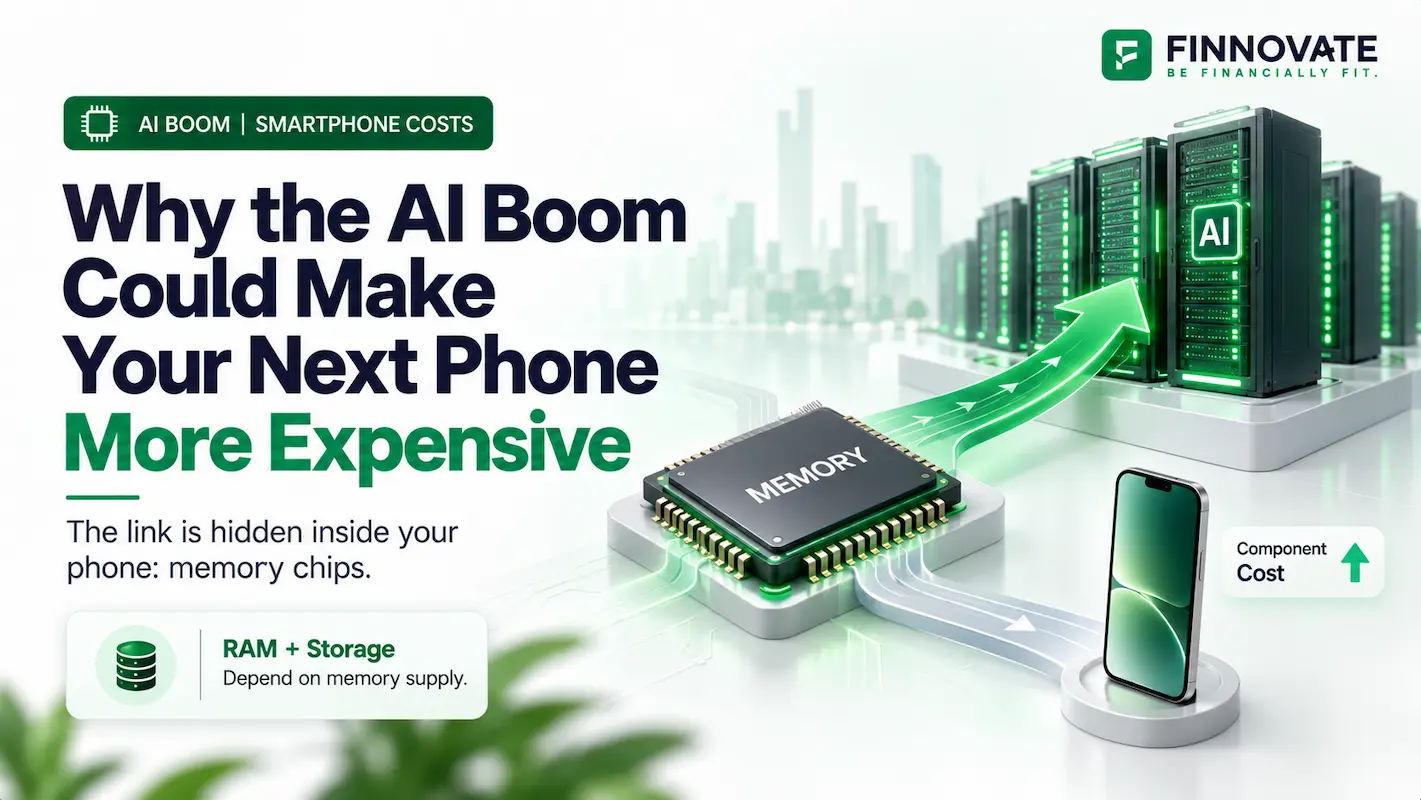
Why the AI Boom Could Make Your Next Phone More Expensive
AI demand is pushing up memory chip prices. Here's why the shortage could make smartphones...
08 October 2026
Published: May 2026
Ruchir Sharma's assessment at the Indian Express Adda on 2 May 2026 has been widely circulated: most foreign investors view India as a loser in the AI race. He described India as an "anti-AI play" in the eyes of global capital: a market that sat out the defining technological shift of this decade while the US, Korea, and Taiwan built their positions. The FPI data lends weight to the concern. Foreign investors have withdrawn more than Rs 1.8 lakh crore from Indian equities in 2026, already exceeding the record annual outflow of 2025.
The verdict of "absent," however, deserves closer examination. India is not building foundational AI models or designing chips. What it is doing is structurally different, and more consistent with how India has always entered technology cycles than most coverage of this debate acknowledges.
| Metric | Figure |
|---|---|
| TCS annualised AI revenue (Q4 FY26) | $2.3 billion |
| TCS AI-led patent filings (cumulative) | 1,833 filed; 573 granted |
| India GCC count (late 2025) | 1,800-plus centres |
| GCC workforce in India | Approx. 2 million professionals |
| New GCCs prioritising AI/ML | 80% |
| Microsoft India cloud and AI investment | $17.5 billion over CY2026-2029, building on an earlier $3 billion commitment |
| Google AI hub investment in Visakhapatnam | Around $15 billion over 2026-2030 |
| Amazon planned India investment by 2030 | Over $35 billion across cloud, AI, logistics, exports, and jobs |
| Combined announced India commitments by Microsoft, Google, and Amazon (since Oct-Dec 2025) | Around $67.5 billion (note: Amazon's portion covers broader India business expansion, not purely data centre investment) |
| Reliance Industries data centre investment | $11 billion, 1 GW over 5 years |
The foreign investor case is not without foundation, and it is worth stating clearly before addressing the counter-argument.
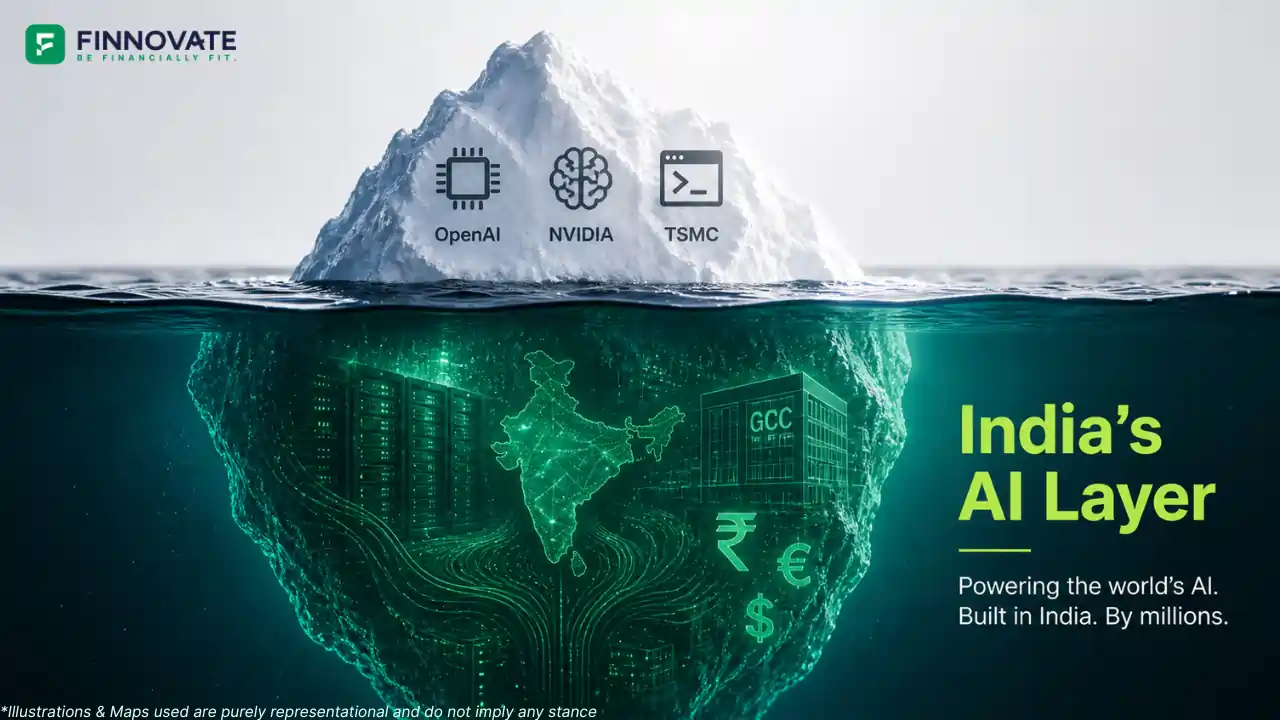
India has no counterpart to OpenAI, Anthropic, or Google DeepMind in the foundational model layer. It has no AI chip designer comparable to NVIDIA, and no advanced semiconductor foundry comparable to TSMC. The two roles are distinct: NVIDIA designs chips, TSMC manufactures them for the world. India is absent from both. It has no agentic coding platforms in the league of Cursor, Windsurf, or Cognition. These are the layers where global AI valuation is currently concentrated. India is absent from all of them.
India's R&D spending as a percentage of GDP also remains well below the US, China, Korea, and Taiwan. Without sustained public and private investment in foundational research, India's position in the AI stack will remain downstream of where the highest-value work happens.
India's AI participation is not at the foundational layer. It is at three other layers that are essential to making global AI work in practice, and each is growing at measurable scale.
India's major IT companies are not passive observers of the AI transition. TCS reported annualised AI revenue of $2.3 billion in Q4 FY26, per its own investor results, up from $1.5 billion at Analyst Day 2025. TCS has also filed 1,833 patents for AI-led inventions, of which 573 have been granted. Infosys, Wipro, and HCL Tech have each announced AI service platforms and are reporting early-stage revenue from enterprise AI deployment, integration, and management. The argument that Indian IT companies are "missing AI" conflates the services layer with the foundational layer. These are different businesses with different entry points.
India hosts over 1,800 Global Capability Centres as of 2025, employing approximately 2 million professionals. According to Nasscom's GCC Quarterly Landscape Report, 80% of new GCCs now prioritise AI and machine learning capabilities as their primary mandate. Bengaluru alone hosts 880-plus centres, with Hyderabad adding 355-plus and Pune and NCR running hundreds more. The work inside these centres is not low-end processing. When global Fortune 500 companies need to fine-tune large language models on proprietary data, build domain-specific AI applications, or validate AI systems before enterprise deployment, a significant and growing share of that work is being executed from India.
India is now one of the largest recipients of AI data centre investment in the world. Microsoft has committed $17.5 billion over CY2026-2029, building on an earlier $3 billion commitment, focused on cloud and AI infrastructure, skilling, and operations. Google has pledged around $15 billion over 2026-2030 for its first AI hub in India at Visakhapatnam, including gigawatt-scale compute, a data centre campus, and subsea connectivity. Amazon has announced over $35 billion in India by 2030 across cloud, AI-driven digitisation, logistics, exports, and jobs. The AI and cloud infrastructure component is significant, though the total figure covers broader India business expansion. Reliance Industries has announced an $11 billion, 1 GW data centre investment through its JV with Brookfield and Digital Realty in Andhra Pradesh. These are formal corporate investment commitments, though execution timelines depend on regulatory approvals, power availability, and capex conditions.
India did not build the hardware, chips, or operating systems of the 1990s technology cycle. It arrived after those foundational layers were established and dominated the services layer, combining skilled manpower with cost efficiency to become the world's largest IT services hub. That transition took a decade to become visible and two decades to become undeniable.
The AI cycle is following a structurally similar pattern. The foundational model and chip layers are being built in the US, with contributions from Korea and Taiwan. India is not in those layers. But the services layer (enterprise AI deployment, domain-specific model fine-tuning, AI systems integration, and data centre operations) is the next phase of the AI value chain. That is where India is positioning, and the data suggests the positioning is already underway at scale.
The difference this cycle is that India is not starting from near-zero infrastructure. The GCC ecosystem, the talent base, the data centre investment, and the IT services AI pivot are all happening simultaneously. That convergence is what most FPI sentiment analysis is not fully capturing.
The FPI narrative around India and AI is partially valid and partially incomplete. The valid part: India has no foundational AI champions, R&D investment is insufficient, and Indian IT companies face genuine disruption risk to legacy services revenue from AI automation.
The incomplete part: the services and infrastructure layers that India is building are not peripheral to the global AI economy. They are where the majority of AI implementation will happen as enterprises move from experimentation to deployment at scale. The companies best positioned to capture this opportunity are the same ones that captured the 1990s enterprise IT services wave.
For context on the FPI selling pattern that has accompanied this debate, see Finnovate's detailed analysis: FPI Outflows: What the Data Shows and the cross-asset return context in Passive Fund Flows and India's Equity Positioning.
India is absent from foundational AI layers (large language model development, chip design, and advanced semiconductor foundries) where current AI valuations are concentrated. However, India is building positions in enterprise AI services (TCS: $2.3 billion annualised AI revenue in Q4 FY26), AI fine-tuning through 1,800-plus Global Capability Centres, and AI data centre infrastructure, where Microsoft, Google, Amazon, and Reliance have each announced major India investment commitments. Whether that constitutes losing depends on which layer of the AI economy generates the most durable long-term value.
Foreign investors have withdrawn more than Rs 1.8 lakh crore from Indian equities in 2026. The AI connection is twofold: India's absence from foundational AI layers makes it a less compelling AI-era investment story versus the US, Korea, and Taiwan; and India's IT sector faces genuine disruption risk from AI automation reducing demand for traditional software services. For detailed FPI flow analysis, see FPI Outflows: What the Data Shows.
A Global Capability Centre (GCC) is a wholly-owned offshore unit set up by a multinational company in India to run strategic business functions globally. India hosts over 1,800 GCCs employing approximately 2 million professionals. These have evolved from cost-arbitrage centres into AI implementation hubs. Now 80% of new GCCs now prioritise AI and machine learning, handling enterprise-level model fine-tuning, domain-specific AI application development, and AI validation work for Fortune 500 companies.
Indian IT companies face real disruption risk to legacy services revenue from AI automation. This is a genuine structural concern, not a temporary headwind. At the same time, TCS's $2.3 billion in annualised AI revenue signals the pivot toward enterprise AI services is underway. The medium-term uncertainty is genuine, and the transition timeline remains unclear. Please consult a SEBI-registered investment adviser before making any decisions related to IT sector investments.
Microsoft has committed $17.5 billion over CY2026-2029 for cloud and AI infrastructure in India, building on an earlier $3 billion commitment. Google has pledged around $15 billion over 2026-2030 for its Visakhapatnam AI hub. Amazon has announced over $35 billion across India businesses by 2030, with AI-driven digitisation and cloud as primary stated goals alongside logistics, exports, and jobs. India offers lower data centre construction and operating costs versus comparable locations, high-quality bandwidth, geopolitical stability, and a large domestic AI consumption market that is growing rapidly.
Disclaimer: This article is for general information and educational purposes only. It does not constitute investment advice, a recommendation, or an offer to buy or sell any securities or financial instruments. Company-level data (TCS AI revenue, patent filings) is sourced from TCS's own investor communications. GCC data is sourced from Zinnov, Nasscom, and Flexiple industry reports. FPI data is sourced from NSDL and media reports. Investment commitment data for AI data centres is sourced from company announcements and Bloomberg. Past performance and historical analogies are not indicative of future outcomes. Please consult a SEBI-registered investment adviser before making any investment decisions.
No spam. Only new posts, simple explainers, and practical money checklists for busy professionals.
Finnovate is a SEBI-registered financial planning firm that helps professionals bring structure and purpose to their money. Over 3,500+ families have trusted our disciplined process to plan their goals - safely, surely, and swiftly.
Our team constantly tracks market trends, policy changes, and investment opportunities like the ones featured in this Weekly Capsule - to help you make informed, confident financial decisions.
Learn more about our approach and how we work with you:
No comments yet. Start the conversation. What would you add?
No spam. Only new posts, simple explainers, and practical money checklists.
You may also like
AI demand is pushing up memory chip prices. Here's why the shortage could make smartphones...

FPIs sold ₹35,861 crore in Indian equities in September 2026. See which sectors saw outf...

Compare 19 sector and thematic indices with Nifty 50 for September 2026, covering monthly ...

Understand the Growpital case, SEBI’s refund order, the LLP investment structure and wha...
Popular now

Learn how to easily download your NSDL CAS Statement in PDF format with our step-by-step g...

Looking for the best financial freedom books? Here’s a handpicked 2026 reading list with...
Learn what SIF investment means in India, SEBI rules, Rs 10 lakh minimum investment, avail...

Clear guide to mutual fund taxation in India for FY 2025–26 after July 2024 changes: equ...