
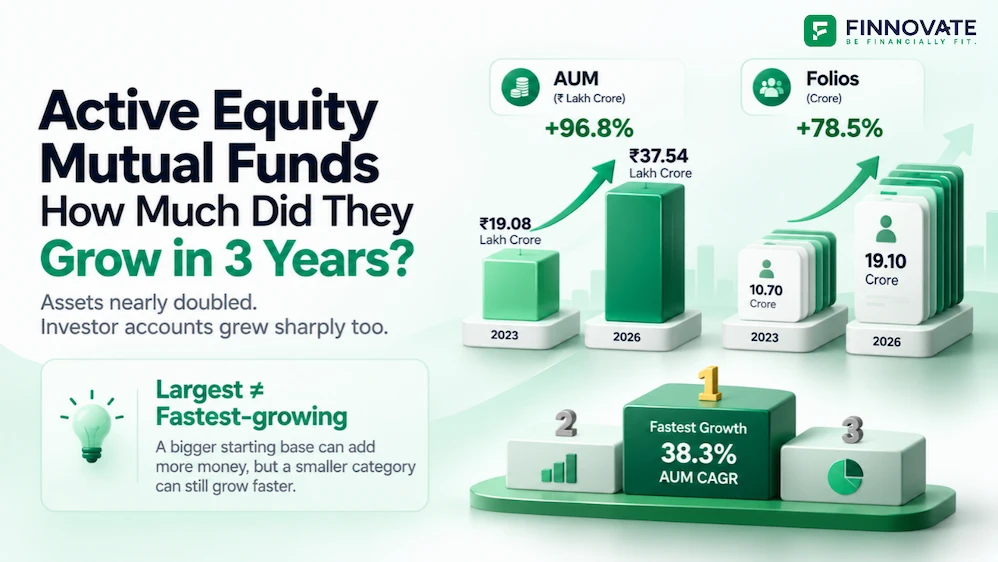
Active Equity Fund Growth 2023–2026: AUM & Folio Rankings
Compare active equity mutual fund growth from September 2023 to September 2026, with categ...
21 October 2026

On April 2, 2026, Prudential Financial announced it had signed definitive agreements to sell its entire 100% stake in PGIM India Asset Management to TVS Venu Group, the Chennai-based conglomerate led by Venu Srinivasan. The transaction is subject to SEBI and regulatory approvals. When it closes, it will mark the end of a nearly two-decade presence for Prudential Financial in India's mutual fund industry. It will also extend a pattern that has quietly repeated itself across the Indian AMC landscape for the past 15 years: a global name enters, struggles to scale, and sells to a domestic buyer.
This fund house has had a complicated life. Prudential Financial first entered India in 2007 through a joint venture with DLF, operating as Pramerica Mutual Fund. DLF ran into financial trouble by 2013-14 and exited. DHFL stepped in as the new partner, and in October 2015 the fund became DHFL Pramerica Mutual Fund.
In a move that briefly gave the fund meaningful scale, DHFL Pramerica acquired Deutsche Bank's Indian mutual fund business for approximately ₹400 crore in late 2015, inheriting roughly ₹25,000 crore in AUM, almost entirely debt-oriented. For a brief moment, the fund had something to build on.
Then came IL&FS. The September 2018 collapse triggered a liquidity crisis across the NBFC sector. DHFL was caught in the fallout, compounded by allegations of fund diversion that eventually destroyed the company. Investors ran. The fund's AUM fell sharply. Prudential Financial moved fast: in December 2018 it announced a buyout of DHFL's 50% stake, and by July 2019 the fund had been renamed PGIM India Mutual Fund.
Over the next seven years, PGIM built the AUM back to over ₹27,000 crore in mutual fund assets. But the fund ranked around 25th in the industry and posted an after-tax loss of approximately ₹23.5 crore in FY25. For a parent managing $1.47 trillion globally, a loss-making mid-table AMC was not worth holding.
PGIM is not the first global name to exit India's mutual fund industry. It is the latest in a pattern stretching back nearly two decades.
| Fund House | Global Parent | Acquired By | Year |
|---|---|---|---|
| Standard Chartered MF | Standard Chartered | IDFC MF | 2008 |
| Fidelity MF | Fidelity Investments (US) | L&T Finance | 2012 |
| Morgan Stanley MF | Morgan Stanley | HDFC MF | 2014 |
| Deutsche Bank MF | Deutsche Bank | DHFL Pramerica | 2015 |
| Goldman Sachs MF | Goldman Sachs | Reliance Capital AMC | 2015 |
| JP Morgan MF | JP Morgan | Edelweiss MF | 2016 |
| Invesco MF | Invesco (US) | Groww | 2024 |
| PGIM India MF | Prudential Financial (US) | TVS Venu Group | 2026 (pending) |
In almost every case, the departing fund house had an AUM base that was disproportionately institutional and debt-oriented. In almost every case, it sold to either a bank-backed fund house or a domestic player with distribution reach it did not have.
The exits are not coincidence. Three structural factors explain the pattern, and they apply to PGIM as they applied to every name in the table above.
India's mutual fund industry runs on distribution. Bank branches, relationship managers, and IFAs are the channels through which retail investors start SIPs and choose funds. The fund that reaches the investor first, and most consistently, wins the AUM. Global AMCs arrive without an existing distribution network. Building one from scratch takes years and significant capital. Most do not have the patience or willingness to absorb those losses long enough to see results.
Global AMCs tend to attract institutional and corporate clients first. These clients park large sums in debt and liquid funds: high AUM, thin margins, low stickiness. The profitable, durable AUM in India is retail equity: SIPs, long-term equity funds, goal-based investing. PGIM India is a direct illustration. Even after equity AUM grew to over ₹23,000 crore by April 2026, the business still could not turn profitable. Institutional debt AUM looks impressive on paper but does not sustain an AMC.
Breaking even as an AMC in India requires a minimum of approximately ₹1 lakh crore in AUM by most industry estimates. PGIM India at ₹27,000 crore in MF assets was less than a third of that threshold. A fund house at this size cannot afford the marketing spend, fund manager talent, or technology investment needed to compete against players running ₹5 to 12 lakh crore. The gap widens every year as the leaders compound their scale advantages.
The dominance of bank-backed fund houses in India is structural, not coincidental.
The six bank-backed leaders are SBI MF (over ₹12 lakh crore), ICICI Prudential MF, HDFC MF, Kotak MF, Axis MF, and Bandhan MF. Deep-distribution houses like UTI, Nippon India, and Aditya Birla Sun Life complete the dominance picture.
Banks have three advantages that standalone global AMCs cannot replicate:
The parallel to banking itself is exact. Citi and Standard Chartered once dominated retail banking and credit cards in India. HDFC Bank, ICICI Bank, and SBI took those businesses back. The same script is playing out in mutual funds, driven by the same structural forces.
For existing PGIM India investors, the immediate position is straightforward: nothing changes yet.
Until SEBI approves the transaction, PGIM India operates exactly as before. Units, NAV, folio numbers, and SIP mandates all stay as they are. No action is required at this stage.
Once approved and TVS Venu Group takes over as sponsor, the fund house will be renamed. This has happened three times before with this AMC. Each time, existing investors were protected and investments continued uninterrupted through the name and sponsor change.
For the first time in this fund house's history, the new owner is a permanent, well-capitalised Indian conglomerate with existing financial services ambitions. What TVS Venu Group builds over the next three to five years is the question that actually matters for investors in these schemes.
Please consult a SEBI-registered investment adviser before making any changes to your existing mutual fund investments based on this development.
Prudential Financial has agreed to sell its 100% stake in PGIM India to TVS Venu Group, subject to SEBI and regulatory approvals. Until the deal closes, PGIM India operates as usual. Once approved, TVS Venu Group will become the new sponsor and the fund house is expected to be renamed.
No investment decision is required at this stage. Your units and SIP mandates continue unaffected through any change in fund sponsor, and a change in AMC ownership does not automatically alter the investment mandate or fund management of existing schemes. Please consult a SEBI-registered investment adviser before making any changes based on this development.
The core challenge is distribution. India's top AMCs are bank-backed and benefit from captive retail reach through branch networks. Global AMCs struggle to build that from scratch, tend to accumulate low-margin institutional debt AUM, and cannot achieve the minimum scale needed to break even. The pattern has repeated across Fidelity, JP Morgan, Goldman Sachs, Invesco, and now PGIM.
TVS Venu Group is a Chennai-based conglomerate led by Venu Srinivasan, who also serves on the board of Tata Sons. The group has interests in automotive, financial services through TVS Credit Services, and real estate. This acquisition marks its entry into asset management.
Scheme mandates and fund manager continuity are typically preserved through AMC ownership changes, as SEBI guidelines protect investor interests during such transitions. Longer-term decisions on team composition and strategy are at the discretion of the new owner and are answered over years, not at deal announcement.
Disclaimer: This article is for general information and educational purposes only. It does not constitute investment advice, a recommendation, or an offer to buy or sell any securities or financial instruments. AUM figures, deal details, and financial data referenced in this article are based on publicly available sources including Business Standard, Value Research, AMFI, and Finnovate Research, and are subject to change. Past performance of any fund house or scheme is not indicative of future results. Investors should not make any investment decision based solely on this article. Please consult a SEBI-registered investment adviser or qualified financial professional before making any changes to your mutual fund investments. Mutual fund investments are subject to market risks. Please read all scheme-related documents carefully before investing.
No spam. Only new posts, simple explainers, and practical money checklists for busy professionals.
Finnovate is a SEBI-registered financial planning firm that helps professionals bring structure and purpose to their money. Over 3,500+ families have trusted our disciplined process to plan their goals - safely, surely, and swiftly.
Our team constantly tracks market trends, policy changes, and investment opportunities like the ones featured in this Weekly Capsule - to help you make informed, confident financial decisions.
Learn more about our approach and how we work with you:
No comments yet. Start the conversation. What would you add?
No spam. Only new posts, simple explainers, and practical money checklists.
You may also like
Compare active equity mutual fund growth from September 2023 to September 2026, with categ...

Explore September 2026 ETF and index fund flows, with category-wise inflows, outflows, AUM...

Equity fund net inflows rose 30.61% to ₹38,306.55 crore in September 2026. Compare 13 ca...

Equity mutual funds received ₹29,329 crore in August 2026. See which categories saw the ...
Popular now

Learn how to easily download your NSDL CAS Statement in PDF format with our step-by-step g...

Looking for the best financial freedom books? Here’s a handpicked 2026 reading list with...

Learn what SIF investment means in India, SEBI rules, Rs 10 lakh minimum investment, avail...

Clear guide to mutual fund taxation in India for FY 2025–26 after July 2024 changes: equ...