

The Great Economic Decoupling of 2026: Oil, AI & India
Rising oil prices and booming AI investment are shaping an uneven global economy in 2026. ...
24 October 2026

If you only look at the headline number, the last four years look pretty good for India.
Total FPI inflows over the last 4 years add up to ₹1,75,042 crore. Sounds like strong foreign interest, right?
But zoom in and the picture flips. FPIs have actually been heavy sellers in secondary market equities. The overall inflow number stayed positive mainly because of debt inflows and IPO participation.
Over the last four years combined:
So where did the “positive overall” come from?
Because the equity number itself hides a sharp divide between primary markets (IPOs) and secondary markets (listed stocks).
That net equity selling of ₹(1,08,313) crore includes two opposite flows:
In plain terms: FPIs didn’t “exit India”. They reduced exposure to listed equities, but still participated in IPOs where they felt pricing and allocations worked better.
So the caution wasn’t about India as a destination. It was about where value existed and how risky the listed market looked at those valuations.
Data Source: NSDL (# data up to December 26, 2025). Absolute numbers are ₹ crore.
| Calendar Month | FPI Flows Secondary | FPI Flows Primary | FPI Flows Equity | FPI Flows Debt/Hybrid | Overall FPI Flows |
|---|---|---|---|---|---|
| Calendar 2022 (₹ Crore) | (146,048.38) | 24,608.94 | (121,439.44) | (11,375.78) | (132,815.22) |
| Calendar 2023 (₹ Crore) | 1,27,759.75 | 43,347.14 | 1,71,106.89 | 65,954.38 | 2,37,061.27 |
| Calendar 2024 (₹ Crore) | (1,21,210.21) | 1,21,637.15 | 426.94 | 1,65,342.98 | 1,65,769.92 |
| Jan-2025 (₹ Crore) | (81,903.72) | 3,876.78 | (78,026.94) | 815.91 | (77,211.03) |
| Feb-2025 (₹ Crore) | (41,748.97) | 7,174.62 | (34,574.35) | 10,273.72 | (24,300.63) |
| Mar-2025 (₹ Crore) | (6,027.77) | 2,055.16 | (3,972.61) | 36,953.97 | 32,981.36 |
| Apr-2025 (₹ Crore) | 3,243.03 | 980.28 | 4,223.31 | (24,413.24) | (20,189.93) |
| May-2025 (₹ Crore) | 18,082.82 | 1,777.41 | 19,860.23 | 11,089.48 | 30,949.71 |
| Jun-2025 (₹ Crore) | 8,466.77 | 6,123.51 | 14,590.28 | (22,153.36) | (7,563.08) |
| Jul-2025 (₹ Crore) | (31,988.32) | 14,247.74 | (17,740.58) | 12,202.89 | (5,537.69) |
| Aug-2025 (₹ Crore) | (39,063.85) | 4,070.42 | (34,993.43) | 14,488.43 | (20,505.00) |
| Sep-2025 (₹ Crore) | (27,163.33) | 3,278.61 | (23,884.72) | 11,345.99 | (12,538.73) |
| Oct-2025 (₹ Crore) | 3,902.34 | 10,707.97 | 14,610.31 | 20,987.58 | 35,597.89 |
| Nov-2025 (₹ Crore) | (15,659.31) | 11,894.69 | (3,764.62) | 6,601.09 | 2,836.47 |
| Dec-2025 (₹ Crore) # | (22,130.28) | 7,395.90 | (14,735.38) | (14,758.36) | (29,493.74) |
| Total for 2025 (₹ Crore) | (2,31,990.59) | 73,583.09 | (1,58,407.50) | 63,433.10 | (94,974.40) |

Debt flows became meaningfully positive from 2023. A big trigger was the inclusion of Indian government bonds in global bond indices, which brought in index-linked passive flows. Add rate-cut expectations and debt started looking like a cleaner, lower-volatility bet.
In 2024, IPO participation was strong. In 2025, IPO inflows were about 40% lower than 2024 even though total IPO collections were similar. The gap suggests something important: domestic institutions like mutual funds and AIFs became more prominent as anchor investors, while FPIs became more selective.
The harshest message is in secondary equities. Over four years, FPIs have net sold roughly $45 billion in listed equities (as per the source note). The pressure wasn’t one-off. It kept showing up whenever valuations looked stretched or risk perception rose.
Over the last four years, FPI behaviour has looked less like a steady “India allocation” and more like a sequence of reactions to specific triggers.
Many FPIs were uncomfortable with India’s Buffett ratio staying above 120 for most of 2025. When valuations feel expensive, the easiest action is to trim secondary equities, especially in large index names.
Over the last ~18 months after the coalition NDA government returned for a third term, FPIs have been more cautious about the pace and continuity of reforms. Whether that concern is fully justified or not, it influenced risk appetite.
In 2024, IPOs drew strong interest. But as IPO valuations got richer, FPIs reduced exposure even there. When the upside looks limited, primary market appetite cools.
Bond index inclusion plus expectations of rate cuts created a supportive setup for debt inflows. This is the part of the FPI story that looks the most structural, not tactical.
For an FPI, returns are measured in dollars. A volatile rupee can wipe out equity gains even if the market performs in INR. Concerns around carry trade, INR vulnerability, and currency swings made India allocations less comfortable.
US sanctions, delays in the Indo–US trade deal, and discomfort around India buying Russian oil amid Western sanctions created a layer of uncertainty. For large global funds, uncertainty often equals lower position sizes.
Three simple conclusions:
In short: the last four years weren’t a clean “FPI love story” for Indian equities. It was a story of debt turning supportive, IPOs offering windows of interest, and secondary equities facing repeated valuation-led selling.
Disclaimer: This article is for informational and educational purposes only and does not constitute investment advice.
No spam. Only new posts, simple explainers, and practical money checklists for busy professionals.
Finnovate is a SEBI-registered financial planning firm that helps professionals bring structure and purpose to their money. Over 3,500+ families have trusted our disciplined process to plan their goals - safely, surely, and swiftly.
Our team constantly tracks market trends, policy changes, and investment opportunities like the ones featured in this Weekly Capsule - to help you make informed, confident financial decisions.
Learn more about our approach and how we work with you:
No comments yet. Start the conversation. What would you add?
No spam. Only new posts, simple explainers, and practical money checklists.
You may also like
Rising oil prices and booming AI investment are shaping an uneven global economy in 2026. ...

Explore FPI equity flows for October First Half, 2026: ₹47,955 crore in net outflows, th...
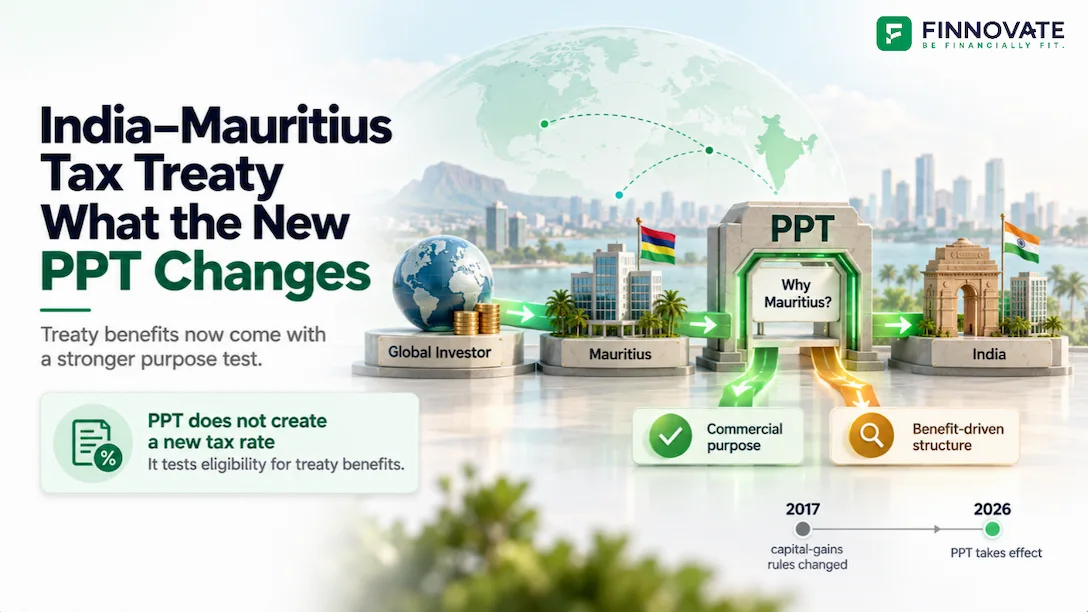
Understand the India–Mauritius tax treaty’s Principal Purpose Test, its August 2026 ef...

Explore India’s AI hardware opportunity through the proposed Adani–Jabil venture, from...
Popular now

Learn how to easily download your NSDL CAS Statement in PDF format with our step-by-step g...

Looking for the best financial freedom books? Here’s a handpicked 2026 reading list with...
Learn what SIF investment means in India, SEBI rules, Rs 10 lakh minimum investment, avail...

Clear guide to mutual fund taxation in India for FY 2025–26 after July 2024 changes: equ...