

The Great Economic Decoupling of 2026: Oil, AI & India
Rising oil prices and booming AI investment are shaping an uneven global economy in 2026. ...
24 October 2026
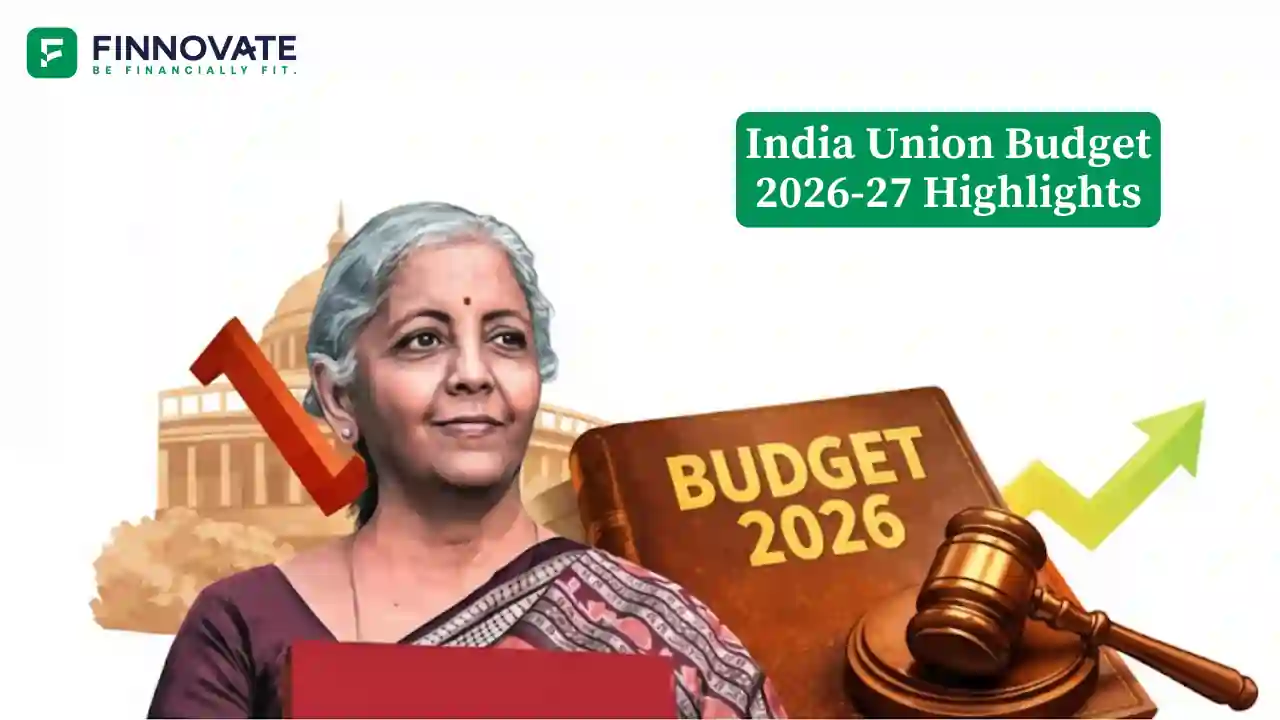
On February 1, 2026, Finance Minister Nirmala Sitharaman presented the Union Budget for the fiscal year 2026-27, centered on the foundational theme of "Yuva Shakti" (Power of Youth). This budget is not merely an annual accounting exercise but a strategic roadmap designed to transition India from a post-pandemic recovery phase into a high-speed, structural growth trajectory.
Guided by the three "Kartavyas" (Duties) - sustaining economic growth, fulfilling people's aspirations, and ensuring inclusive participation (Sabka Sath, Sabka Vikas) - the 2026 budget balances aggressive public investment with strict fiscal discipline. With a total expenditure estimated at ₹53.47 trillion, the government is doubling down on infrastructure, high-tech manufacturing, and human capital to secure India's position as a global economic powerhouse by 2030.
| Budget Overview (2026-27) | Value |
|---|---|
| Total Expenditure | ₹53,47,315 crore |
| Total Receipts (excluding borrowings) | ₹36,51,547 crore |
| Fiscal Deficit | 4.3% of GDP (down from 4.4% in 2025-26) |
| Debt-to-GDP Ratio | 55.6% (target: 50%±1 by 2030-31) |
| Spending and Funding Mix | Value |
|---|---|
| Capital Expenditure | ₹12,21,821 crore (22.9% of total expenditure) |
| Revenue Expenditure | ₹41,25,494 crore (77.1% of total expenditure) |
| Net Tax Receipts | ₹28,70,000 crore |
| Gross Market Borrowings | ₹17,20,000 crore |
| Indicator | Projection |
|---|---|
| GDP Growth Rate (FY 2026-27) | 6.8% to 7.2% |
| Inflation Rate (Apr–Dec 2025 average) | 1.7% |
| Nominal GDP Growth | 10% projected |
| Revenue Deficit | 1.5% of GDP |
Take the 3-minute FinnFit Test and get a quick score on your savings, protection, loans, and investments. Then we’ll show the top 2–3 action steps for your goals.
The Budget 2026-27 is framed within a resilient macroeconomic environment. India remains the fastest-growing major economy globally, with the nominal GDP growth for FY27 projected at a robust 10%.
While the government maintains an optimistic outlook, international agencies suggest a natural "cooling" toward a sustainable high-growth steady state.
| Agency/Source | Real GDP Growth Projection (FY27) |
|---|---|
| Union Budget 2026-27 | ~7.0% - 7.5% (Implied) |
| Economic Survey 2026 | 6.8% - 7.2% |
| RBI (MPC Feb 2026) | 6.7% - 7.0% |
| IMF | 6.4% |
| World Bank | 6.5% |
The variance in these figures reflects a global cautiousness, yet the consensus remains that India will continue to outperform its peers. This growth is powered by strong domestic demand and a strategic shift toward becoming a global manufacturing hub.
Inflation management has been a hallmark of the previous fiscal year, with FY26 seeing retail inflation fall to historic lows of approximately 2.1%. For FY27, analysts project a slight uptick to the 4.0% - 5.0% range as base effects wane. The Reserve Bank of India (RBI) is expected to maintain a neutral-to-easing stance, with the Repo Rate likely holding at 5.25% to provide the necessary liquidity for private investment.
One of the most significant pillars of the 2026 budget is the government's unwavering commitment to fiscal consolidation. By adhering to a transparent glide path, India aims to build global investor confidence and ensure long-term debt sustainability.
The government successfully met its FY26 revised estimate of 4.4%. For FY27, the target is set at 4.3% of GDP.
Beyond the annual deficit, the budget introduces a broader focus on the debt-to-GDP ratio, targeting 50±1% by 2030. This shift indicates a move away from "deficit-only" metrics toward a more comprehensive view of fiscal health, encompassing revenue deficit targets (1.5% for FY27) and outstanding liabilities (estimated at 55.6% of GDP).
Continuing the successful strategy of "investment-led growth," the 2026 budget proposes a record capital expenditure (Capex) outlay of ₹12.22 trillion (US$ 133 billion). This represents an 11.5% increase over the previous year, focusing on critical bottlenecks that hinder economic efficiency.
The lion's share of the budget is directed toward ministries that drive physical and strategic connectivity.
| Ministry | Allocation (₹ Crore) |
|---|---|
| Defence | 7,84,678 |
| Road Transport & Highways | 3,10,000 |
| Railways | 2,81,252 |
| Rural Development | 1,97,023 |
| Agriculture & Allied Activities | 1,40,529 |
-Table.webp)
India is aggressively pursuing "Mineral Security" and industrial decarbonization to power its green transition and meet Net Zero commitments.
Budget 2026-27 signals a paradigm shift for the Micro, Small, and Medium Enterprises (MSME) sector - from survival through subsidies to growth through scaling.
A new ₹10,000 crore SME Growth Fund has been introduced. Unlike traditional credit schemes, this fund is designed to address the equity gap for scalable firms, effectively birthing "Champion MSMEs" that can compete on a global stage.
India is aggressively pursuing "Mineral Security" to power its green transition.
The healthcare sector sees a strategic pivot toward biotechnology and immediate relief for chronic patients.
The focus remains on "Modernizing Rurality."
-Table.webp)
While the tax slabs remain unchanged, Budget 2026 introduces a significant compliance overhaul through the New Income Tax Act, 2025, effective from April 1, 2026. This is paired with a move toward a "Trust-Based" tax system.
Take the 3-minute FinnFit Test and get a quick score on your savings, protection, loans, and investments. Then we’ll show the top 2–3 action steps for your goals.
In line with the "Yuva Shakti" theme, the budget formally institutionalizes the "Orange Economy" (creative and cultural industries).
The Union Budget 2026-27 is a document of confidence. It refuses to engage in populist splurges, choosing instead the harder path of fiscal consolidation (4.3% deficit) and long-term asset creation (₹12.22T Capex). By empowering MSMEs through equity, securing mineral supply chains, and prioritizing "Yuva Shakti," the budget lays a solid foundation for India’s journey toward becoming a developed nation ("Viksit Bharat") by 2047.
For investors, it offers stability; for the youth, it offers opportunity; and for the economy, it offers a sustainable, high-growth blueprint that balances today's needs with tomorrow's aspirations.
Disclaimer: This article is based on a synthesis of research data from official government releases, Economic Survey 2026, and multi-lateral agency projections. It is intended for information and research purposes only.
No spam. Only new posts, simple explainers, and practical money checklists for busy professionals.
Finnovate is a SEBI-registered financial planning firm that helps professionals bring structure and purpose to their money. Over 3,500+ families have trusted our disciplined process to plan their goals - safely, surely, and swiftly.
Our team constantly tracks market trends, policy changes, and investment opportunities like the ones featured in this Weekly Capsule - to help you make informed, confident financial decisions.
Learn more about our approach and how we work with you:
No comments yet. Start the conversation. What would you add?
No spam. Only new posts, simple explainers, and practical money checklists.
You may also like
Rising oil prices and booming AI investment are shaping an uneven global economy in 2026. ...

Explore FPI equity flows for October First Half, 2026: ₹47,955 crore in net outflows, th...
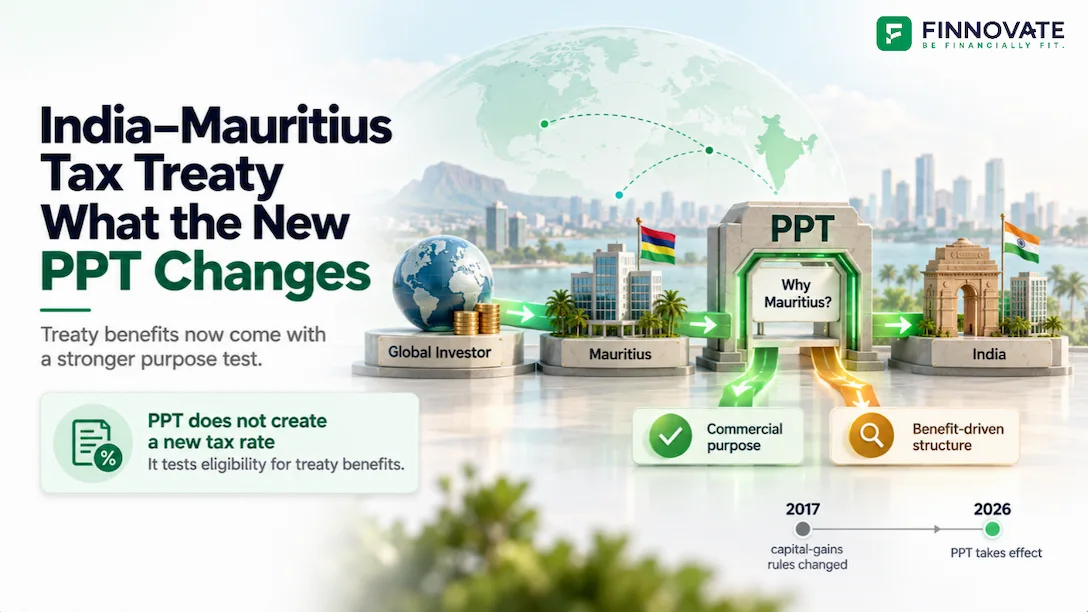
Understand the India–Mauritius tax treaty’s Principal Purpose Test, its August 2026 ef...

Explore India’s AI hardware opportunity through the proposed Adani–Jabil venture, from...
Popular now

Learn how to easily download your NSDL CAS Statement in PDF format with our step-by-step g...

Looking for the best financial freedom books? Here’s a handpicked 2026 reading list with...
Learn what SIF investment means in India, SEBI rules, Rs 10 lakh minimum investment, avail...
Clear guide to mutual fund taxation in India for FY 2025–26 after July 2024 changes: equ...