

Top Small-Cap Stocks in August 2026: Why Small Caps Outperformed
Nifty Smallcap 100 rose 3.16% in August 2026. See which small-cap stocks led, what drove t...
08 September 2026
Last reviewed: May 2026
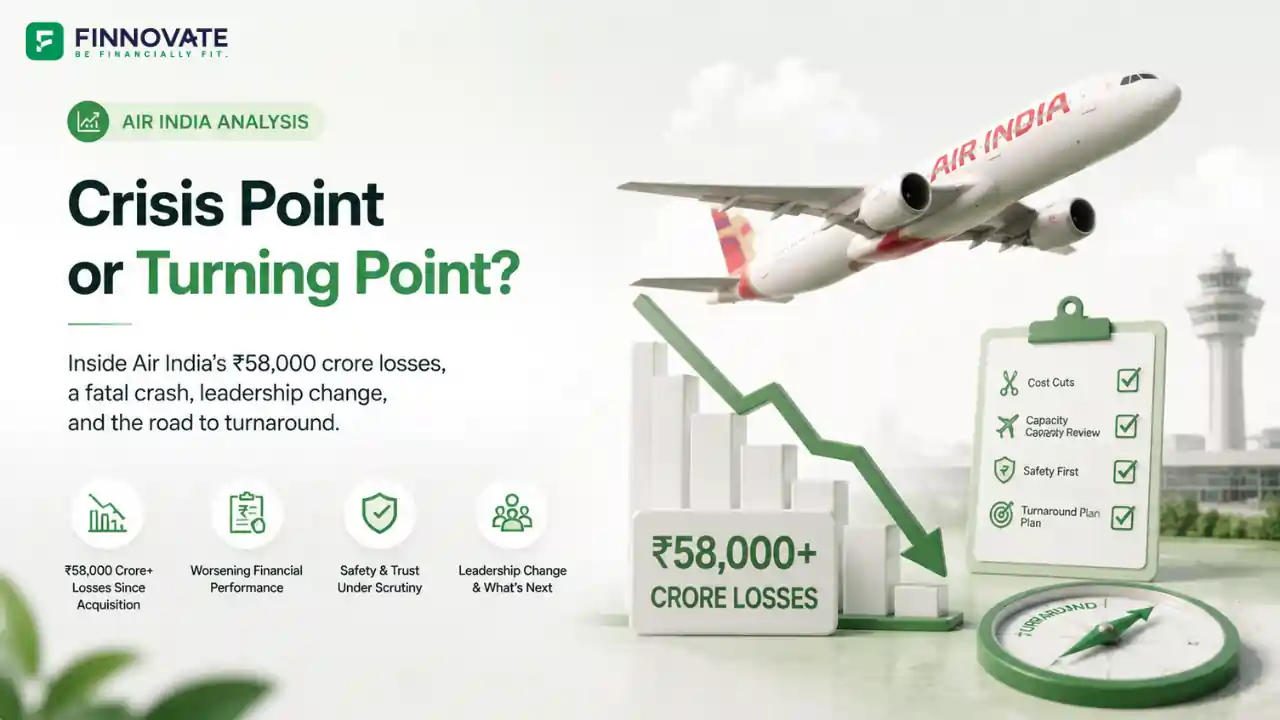
Air India's FY26 loss has come in at over ₹22,000 crore, more than double FY25's ₹10,859 crore, and significantly above the airline's own internal estimate of ₹15,300 crore. The number lands at a moment of compounding pressure: CEO Campbell Wilson has confirmed his resignation, a committee is searching for a successor, Singapore Airlines CEO visited Bombay House to discuss the financial crisis, and the board has begun discussing capacity cuts of over 20%, bonus freezes, and furloughs.
Tata Group took over Air India in January 2022 with a mandate to transform India's flag carrier from a chronically loss-making government airline into a competitive global carrier. Four full financial years later, the accumulated losses since the acquisition exceed ₹58,000 crore. Even for a group with the depth of the Tatas, this trajectory is not sustainable.
This article examines what drove Air India to this point, what the cost-cutting measures under discussion can and cannot achieve, what the AI171 crash means for the airline's safety culture, and what a genuine turnaround requires under the next CEO.
| Financial Year | Net Loss (₹ Crore) | Key Driver |
|---|---|---|
| FY23 (Tata airlines combined) | ~15,532 | First year under Tatas; merger costs and fleet provisioning |
| FY24 | ~10,122 | Losses narrowed 35%; revenue grew 23% |
| FY25 | ~10,859 | Losses widened slightly; Vistara consolidation costs |
| FY26 | 22,000+ | Pakistan airspace closure, ATF spike, AI171 crash costs |
| Total since acquisition | ~58,500+ | Four full financial years since January 2022 |
Three compounding external shocks converged in FY26, each hitting the airline's cost structure directly and simultaneously.
When Pakistan closed its airspace to Indian carriers following the border situation in early 2025, every Air India flight to Europe and North America had to take a significantly longer route. Longer routes mean more fuel burned per passenger, more crew hours required, and more maintenance cycles consumed per flight. The unit economics of every long-haul international route deteriorated overnight. With fuel accounting for approximately 45% of airline operating costs, the impact was immediate and material.
Aviation Turbine Fuel prices rose sharply as the Middle East conflict escalated through FY26. For Air India, which operates a large wide-body international fleet, the fuel cost impact was amplified by the longer routes being flown due to the Pakistan airspace closure. The two headwinds reinforced each other, compressing margins on the international routes that form the backbone of Air India's revenue.
On June 12, 2025, Air India flight AI171, a Boeing 787-8 Dreamliner, crashed 32 seconds after takeoff from Ahmedabad. Of the 242 people on board, 241 were killed. Ground fatalities brought the total to over 260. It was the first fatal accident involving a Boeing 787 since the type entered service in 2011, and the deadliest aviation incident of the decade. The financial cost to Air India included direct compensation, insurance settlements, legal proceedings, and fleet inspection costs. The reputational cost was larger: years of brand rebuilding were set back significantly. The AAIB investigation is ongoing.
What this means: Air India's FY26 deterioration was not primarily a management failure. It was a confluence of external shocks. But the severity of the damage also reflects structural vulnerabilities, particularly on fuel cost exposure and safety culture, that need to be addressed regardless of external conditions.
The measures currently under board discussion reflect the severity of the situation. As of May 2026, the board has discussed:
These are emergency measures, not a structural fix. Cutting capacity by 20% reduces revenue alongside costs. Furloughing non-technical staff reduces overhead but does not address the airline's fundamental unit economics problem: too many seats, too much fuel cost per seat, on routes whose economics have been worsened by external shocks.
Takeaway: For now, Air India is focused on surviving to fight another day. Surviving and transforming are different goals, and the current measures address only the first.
Beyond the emergency measures, Air India faces three structural challenges that require strategic decisions, not just expense reduction.
Air India operates a full-service international model at a time when the incremental growth in Indian aviation is coming from price-sensitive domestic and short-haul travellers. The full-service model requires either premium yields from premium customers, or a very efficient operation that keeps costs low enough to justify the overhead. Air India has neither at present.
The path forward involves unbundling food, beverages, seat selection, lounge access, and ancillary services, and making many of them chargeable. Most globally successful full-service carriers generate 15 to 20% of revenue from ancillary services. Air India's ancillary revenue contribution has historically been minimal. The market for full-service travel in India exists, but it is significantly smaller than the market for affordable, reliable air travel.
Airlines make money when aircraft are in the air. Air India's aircraft utilisation rates have improved since the Tata acquisition but remain below the levels that international peer airlines achieve on comparable fleets. Every additional hour of utilisation per aircraft per day is revenue earned against a largely fixed cost base. This is an area where operational discipline, ground handling efficiency, and maintenance scheduling can produce measurable financial improvement without requiring external conditions to change.
ATF price exposure is the single largest uncontrolled cost variable for any airline. Fuel hedging, the practice of locking in future fuel prices at contracted rates to reduce exposure to price spikes, is standard practice among airlines with disciplined risk management functions. Qantas, Emirates, and Singapore Airlines all maintain active hedging programmes. Air India's hedging activity has historically been limited. In an environment where geopolitical events can cause rapid ATF price spikes, the absence of robust fuel hedging directly translates into immediate and unplanned cost increases of the kind Air India experienced in FY26.
Qantas has not had a major fatal accident since 1951. Southwest Airlines has been accident-free for over 55 years. Virgin Atlantic and Emirates have maintained clean safety records across their entire operating histories. These are not coincidences. They reflect the systematic embedding of safety protocols, crew resource management culture, and institutional intolerance for shortcuts.
The AI171 investigation remains ongoing. The preliminary AAIB findings on the fuel control switch sequence have raised questions that go beyond technical aircraft failure. Whatever the final investigation concludes, Air India's next CEO must treat safety management as the first priority, not a parallel workstream alongside financial restructuring.
The reputational dimension is direct: an airline that cannot demonstrate a credible safety management system will struggle to attract the premium international traveller regardless of how good its seats, food, or service become.
Campbell Wilson led the merger of four Tata group airlines into two, oversaw the fleet expansion and the Vistara integration, and navigated multiple external shocks. His departure at this moment adds leadership uncertainty to an already pressured situation. The successor search committee has a difficult brief.
Singapore Airlines, which holds a 25.1% stake in Air India and whose CEO visited Tata Sons in April 2026, has a direct financial interest in a successful turnaround. Its institutional knowledge of running a premium international carrier and managing a low-cost subsidiary through Scoot are assets the new Air India leadership should draw on more deeply in the restructuring process.
Air India is privately held under Tata Sons and not directly investable on Indian exchanges. The indirect exposure is through Tata Sons' portfolio companies. The losses at Air India are a drag on Tata Group's overall capital allocation capacity and have been a point of concern raised at board level.
Singapore Airlines and Tata Group are in discussions about a capital injection to support Air India through the current period. The amount under discussion may not fully meet the airline's requirements, meaning Air India may need to pursue additional financing options.
For Indian travellers, the capacity reduction of over 20% on Air India routes will have practical effects. Fewer seats available means higher fares, particularly on international routes where Air India competes with IndiGo, which has reported comparatively stronger financial results through the same period of market disruption.
What this means: The immediate effect of Air India's crisis for most Indians is not a portfolio question. It is a travel market question. Reduced Air India capacity on international routes means less competition and potentially higher fares on those routes in the near term.
Rising ATF prices, geopolitical disruptions, and sector-level stress are part of the broader economic environment that shapes portfolio returns. A financial plan built for your specific goals can help you navigate uncertainty without reactive decisions.
Book a free callAir India and the Tata group's airline entities have accumulated losses exceeding ₹58,000 crore across four financial years since the January 2022 acquisition. FY26 alone accounts for over ₹22,000 crore, the largest single-year loss since privatisation, and exceeded the airline's own internal estimate by a significant margin.
Three compounding factors: Pakistan's closure of airspace to Indian carriers forced longer, more fuel-intensive routes to Europe and North America. ATF prices rose sharply due to the Middle East conflict. And the AI171 crash in June 2025 added direct financial costs and damaged the airline's brand and pricing power. The combination pushed losses well above internal projections.
As of May 2026, the board has discussed furloughing non-technical employees, freezing and reducing bonuses, implementing pay cuts for VP-level and above, and reducing flight capacity by over 20% for at least three months. Mass layoffs are not currently planned. These are emergency measures designed to reduce the rate of loss, not to structurally fix the business model.
Flight AI171 was an Air India Boeing 787-8 that crashed 32 seconds after takeoff from Ahmedabad on June 12, 2025, killing 241 of the 242 people on board. It was the first fatal accident involving a Boeing 787 since the aircraft type entered service in 2011. The investigation is ongoing. The crash directly set back Air India's brand rebuilding effort and raises safety culture questions that the airline's next leadership must address as a first priority.
Singapore Airlines holds a 25.1% stake in Air India. Its CEO visited Tata Sons in April 2026 to discuss the financial crisis. Tata Group and SIA are in discussions about a capital injection, though the amount under discussion may not fully meet Air India's requirements. SIA's experience running a premium international carrier and a low-cost subsidiary could be a valuable resource for the restructuring under new leadership.
The structural components of a turnaround are identifiable: cost rationalisation, service unbundling, improved utilisation, fuel hedging, and a strengthened safety culture. Whether execution is achievable depends on leadership quality, external conditions stabilising, and shareholders' willingness to continue funding the transformation. This is not investment advice. Please consult a SEBI-registered investment adviser before making any decisions based on airline sector developments.
Disclaimer: This article is for general information and educational purposes only. It does not constitute investment advice, a recommendation, or an offer to buy or sell any securities or financial instruments. Financial data sourced from Tata Sons Annual Reports FY23-FY25, Bloomberg, Business Standard, and publicly available sources. AI171 crash data from AAIB preliminary report, Air India official statements, and verified news sources. FY26 loss figure is based on Bloomberg/Business Standard reporting and pending final audited results. Past performance and market behaviour are not indicative of future outcomes. No investment decision should be made based solely on the contents of this article. Please consult a SEBI-registered investment adviser or qualified financial professional before making any investment decision.
No spam. Only new posts, simple explainers, and practical money checklists for busy professionals.
Finnovate is a SEBI-registered financial planning firm that helps professionals bring structure and purpose to their money. Over 3,500+ families have trusted our disciplined process to plan their goals - safely, surely, and swiftly.
Our team constantly tracks market trends, policy changes, and investment opportunities like the ones featured in this Weekly Capsule - to help you make informed, confident financial decisions.
Learn more about our approach and how we work with you:
No comments yet. Start the conversation. What would you add?
No spam. Only new posts, simple explainers, and practical money checklists.
You may also like
Nifty Smallcap 100 rose 3.16% in August 2026. See which small-cap stocks led, what drove t...

Nifty Midcap 100 rose 2.15% in August 2026. See which mid-cap stocks led the rally, key se...

See the best-performing Nifty 50 stocks in August 2026, which sectors led the market, and ...

Nifty Midcap 100 gained 1.81% in July 2026 and moved near its yearly high. See the top mid...
Popular now

Learn how to easily download your NSDL CAS Statement in PDF format with our step-by-step g...

Looking for the best financial freedom books? Here’s a handpicked 2026 reading list with...
Learn what SIF investment means in India, SEBI rules, Rs 10 lakh minimum investment, avail...

Clear guide to mutual fund taxation in India for FY 2025–26 after July 2024 changes: equ...