
HDFC Bank: What Must Change to Win Back Investors?
Can HDFC Bank win back investors? Explore how deposit costs, profit margins, loan quality ...
12 October 2026
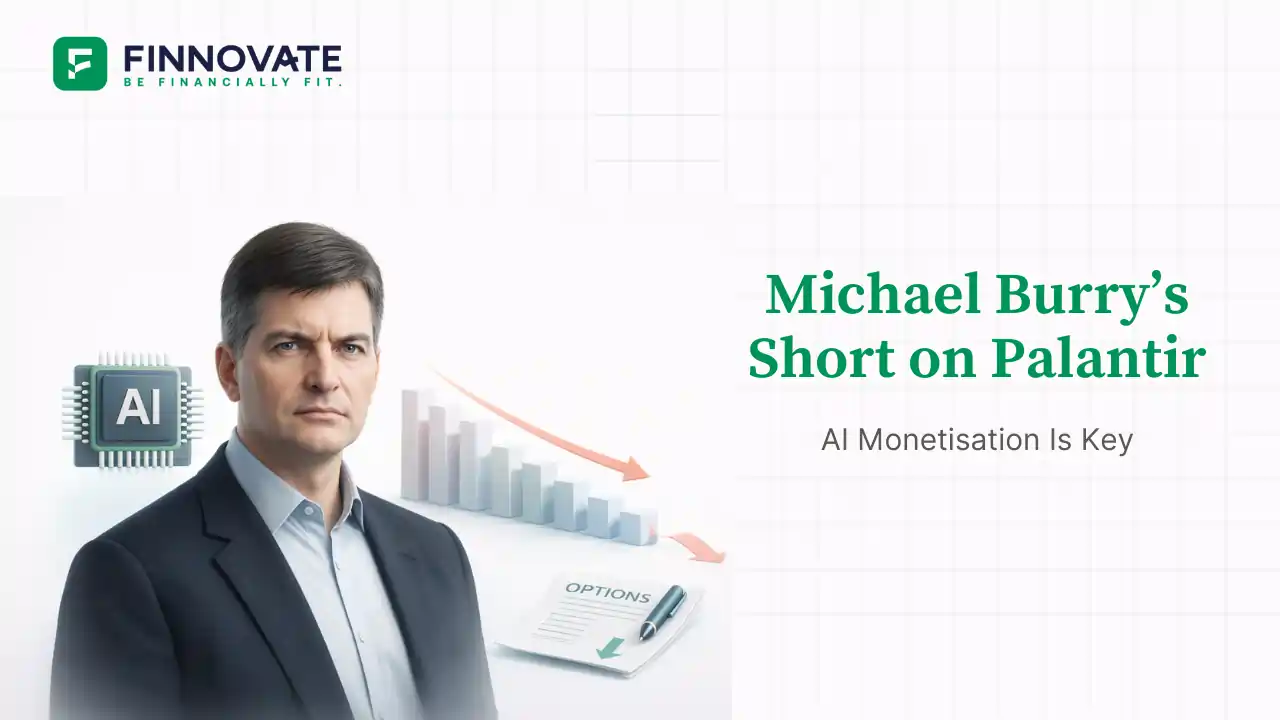
Michael Burry has a habit of showing up when markets feel most certain.
In 2006–08, he became famous for betting against sub-prime mortgages when most of Wall Street was still bullish. Today, he is again being watched for a contrarian call, this time around AI-led stocks, with Palantir at the centre of attention.
The headline sounds dramatic: Burry is “short” Palantir.
But the real question is simpler.
If this trade is to work, it will not be decided only by narratives around artificial intelligence. It will be decided by whether AI spending converts into measurable earnings, and whether the market remains willing to pay very high valuation multiples while waiting for that proof.
Burry was made famous by The Big Short story for one reason: he was early, he was unpopular, and he was right.
He identified that a large part of the sub-prime mortgage market had turned risky, and he built a position that would profit if those mortgage-linked securities collapsed. When the crisis hit, his trade paid off.
That history matters because it shapes how people interpret his current bets. When Burry takes a large bearish position, markets pay attention, even if:
In this case, the focus is on his bearish positioning in AI-related names, especially Palantir.
This is the most important part to understand.
Burry’s Palantir position is often described as a large “short”, but it is not the same as directly short-selling the stock. It is a bearish position expressed through put options.
The market often confuses notional value with money actually at risk.
A put option gives the buyer the right to sell a stock at a fixed price, known as the strike price. The buyer’s maximum loss is generally limited to the premium paid for the option.
So when headlines say “$912 million bet”, that figure refers to the notional exposure shown in the filing. It does not mean Burry directly put $912 million of capital at risk.
Based on later public clarification attributed to Burry, the premium paid was around $9.2 million. That still makes it a serious trade, but it is very different from saying he risked nearly a billion dollars.
This is why the position is bold in narrative terms, but not “all-in” in capital-at-risk terms.

A $50 strike price when the stock is trading around $141–$142 tells us something important.
This is not a trade positioned for a small correction. It is a trade that needs a major downside move to become deeply profitable.
At a roughly $140 stock price, a move toward the $50 strike zone would imply a fall of about 60% to 65%. That is a very large drawdown.
This also explains why the time horizon matters. If the options run into 2027, Burry is giving the thesis time to play out. He is not simply betting on one bad quarter. He is positioning for a larger re-rating in how the market values AI-led stocks.
Palantir is not a normal low-growth company trading at a moderate valuation. It is one of the market’s most closely watched AI-linked software names, and investors have been willing to pay a large premium for its growth story.
That premium is exactly where both the opportunity and the risk sit.
Depending on the metric used, Palantir’s valuation can look very different. Trailing earnings multiples have recently been quoted in the 200x-plus range by some market-data providers, while forward earnings multiples are materially lower but still elevated.
That distinction matters because valuation numbers can change depending on whether investors are looking at:
So instead of focusing on one exact P/E number, the bigger point is this:
High-multiple stocks do not always need bad business performance to fall. Sometimes, all they need is for expectations to become slightly more realistic.
This is where the Palantir story becomes bigger than Palantir.
Across big tech, enterprise software, data infrastructure, and cloud platforms, spending on AI has been massive. For some time, markets rewarded companies simply for being seen as AI winners.
But as the cycle matures, investors usually become more demanding.
The question changes from:
“Is this company linked to AI?”
to:
“Is AI creating real revenue, real margin expansion, and real cash flow?”
That is the heart of Burry’s trade.
It is not necessarily a bet that Palantir is a weak company. It is more likely a bet that the stock price may have moved too far ahead of the earnings power that AI can actually produce within a reasonable time.
In practical terms, the trade depends on whether:
If the market decides that “AI promise” needs to be priced more conservatively, high-multiple names can re-rate quickly.
To be fair, this is not a simple “bad company, expensive stock” story.
Palantir’s recent numbers have been strong. In its Q4 2025 update, the company reported 70% year-on-year revenue growth, with U.S. commercial revenue growing 137% year-on-year. It also guided for 61% year-on-year revenue growth for FY 2026.
That is why the stock remains controversial.
Bears are focused on valuation and the risk that AI excitement has gone too far. Bulls are focused on fast revenue growth, government demand, U.S. commercial traction, and the possibility that Palantir becomes one of the few software companies that can convert AI adoption into real operating leverage.
So the debate is not about whether Palantir has momentum. It clearly does.
The debate is about how much investors should pay for that momentum.
Burry’s trade can work if a combination of these things happens.
If Palantir continues to grow revenue but does not convert that growth into durable profit expansion, valuation support can weaken.
In high-growth stocks, investors do not only pay for revenue. They pay for the belief that today’s revenue will become tomorrow’s earnings and cash flows.
If that belief weakens, the stock can fall even if the company is still growing.
Even if Palantir executes reasonably well, the stock can still decline if the market decides it should no longer trade at such a high multiple.
This is one of the biggest risks in expensive stocks.
A company can report good numbers, but if the numbers are not good enough compared with market expectations, the stock can correct sharply.
AI requires heavy spending on people, computing power, infrastructure, security, and client implementation.
If investors start believing that AI costs are rising faster than AI profits, the market may become less willing to reward AI-linked stocks with premium valuations.
Markets often move before financial statements fully prove the point.
If sentiment around AI stocks cools, prices can fall first. The numbers may only confirm the slowdown later.
In short, the trade works if the market stops rewarding “AI potential” with extreme multiples and starts demanding clearer earnings outcomes.
There are also clear ways this trade can fail.
If AI-driven contracts scale, renew, and improve margins, Palantir may justify a premium valuation for longer than bears expect.
High valuations can stay high when growth keeps surprising on the upside.
Palantir’s U.S. commercial business has become a major part of the bullish case. If this segment keeps growing rapidly, it can support the argument that AI is not just a story, but a real business driver.
Palantir has meaningful government and defence-linked work. This can be different from purely discretionary enterprise software spending.
Government-linked contracts can be long-term, strategic, and difficult to replace quickly. That can give the business more durability than a typical software company.
Some analysts have remained positive on Palantir, with bullish price targets reflecting continued confidence in AI adoption, government demand, and U.S. commercial growth.
If earnings keep improving and bullish targets remain credible, the stock may stay supported. In that case, the puts may expire worthless, and the loss would be limited to the premium paid.
Indian investors may not own Palantir directly, but the lesson is still useful.
Every market cycle has a set of stocks that become almost untouchable in investor perception. These companies may have strong businesses, strong brands, and strong growth. But if the price already assumes perfection, the risk-reward can become uncomfortable.
This is not only true for U.S. AI stocks. It can apply to Indian themes too, such as:
The question should never be only:
“Is this a good company?”
The better question is:
“How much good news is already priced in?”
A good company can still become a bad investment if bought at an excessive valuation.
AI adoption is visible. Companies are talking about AI, testing AI, integrating AI, and spending on AI.
But adoption alone does not guarantee shareholder returns.
For investors, the real test is monetisation.
That means asking:
This is why Burry’s Palantir bet has become such a widely discussed trade. It is not only about one stock. It is a test of how much the market is willing to pay for the AI story before the earnings fully show up.
This trade will likely be decided by AI economics, not AI excitement.
Burry’s structure gives him:
But for him to make meaningful profits, Palantir’s stock needs to fall far enough before the options expire.
The core hinge is simple:
That is where this trade pays.
And that is also where the broader lesson sits for investors. Strong themes can create wealth, but only when the price paid still leaves room for reality.
Disclaimer: This article is for general information and educational purposes only. It is not investment advice, research advice, or a recommendation to buy, sell, or hold any security. Investing involves risk, including loss of capital. Please consult a qualified financial professional before making investment decisions.
No spam. Only new posts, simple explainers, and practical money checklists for busy professionals.
Finnovate is a SEBI-registered financial planning firm that helps professionals bring structure and purpose to their money. Over 3,500+ families have trusted our disciplined process to plan their goals - safely, surely, and swiftly.
Our team constantly tracks market trends, policy changes, and investment opportunities like the ones featured in this Weekly Capsule - to help you make informed, confident financial decisions.
Learn more about our approach and how we work with you:
No comments yet. Start the conversation. What would you add?
No spam. Only new posts, simple explainers, and practical money checklists.
You may also like
Can HDFC Bank win back investors? Explore how deposit costs, profit margins, loan quality ...
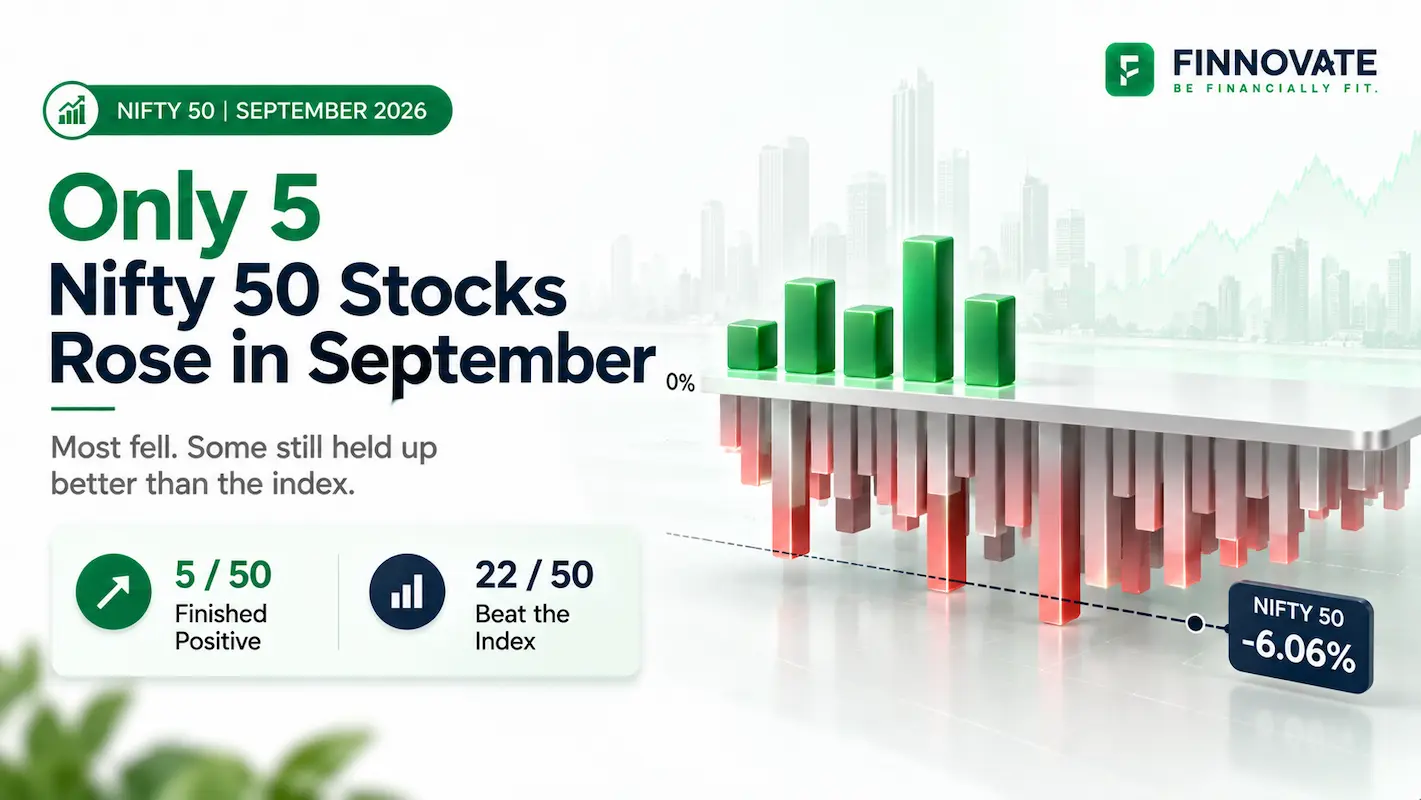
Only five Nifty 50 stocks rose in September 2026 as the index fell 6.06%. Compare monthly ...
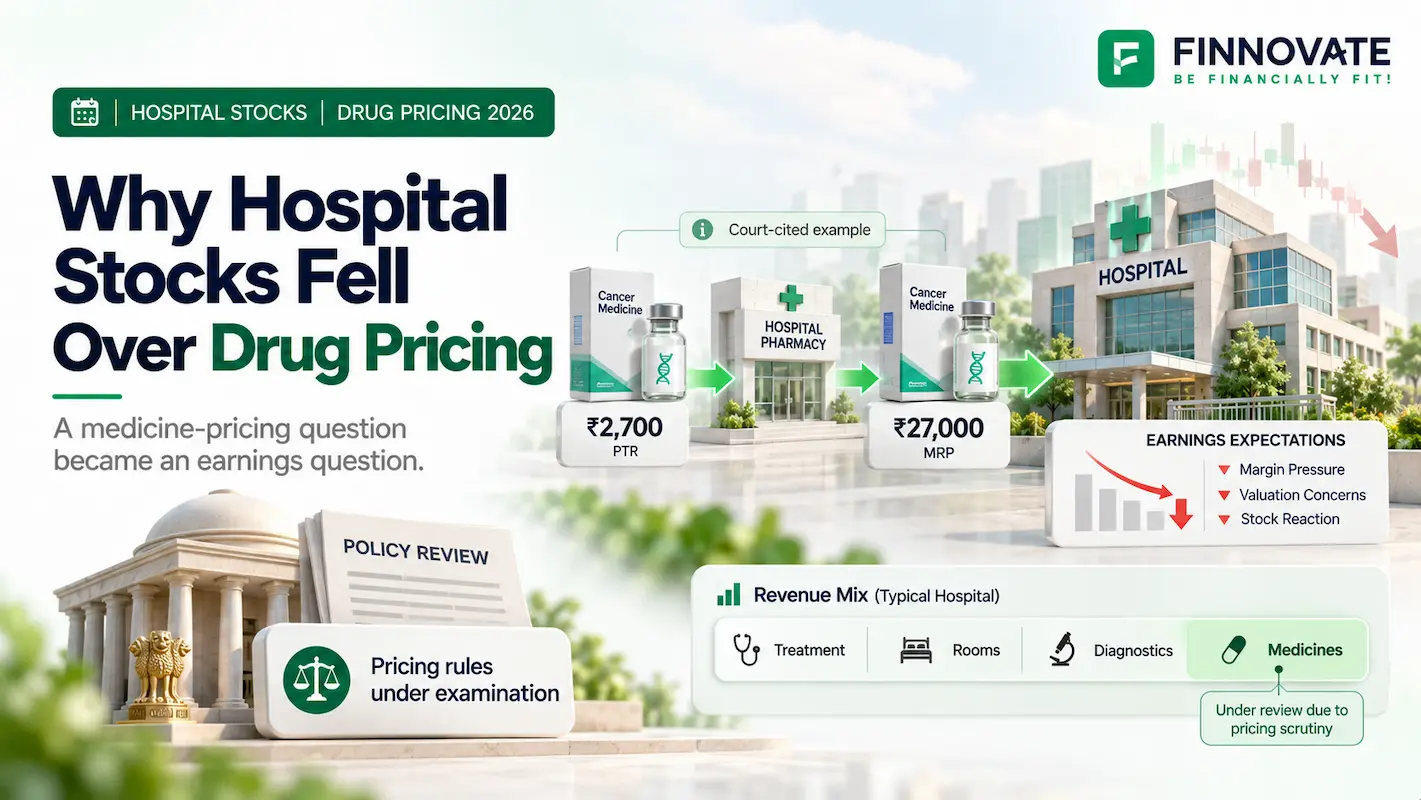
Why did hospital stocks fall after Supreme Court scrutiny of medicine prices? Understand d...
Nifty Smallcap 100 rose 3.16% in August 2026. See which small-cap stocks led, what drove t...
Popular now

Learn how to easily download your NSDL CAS Statement in PDF format with our step-by-step g...

Looking for the best financial freedom books? Here’s a handpicked 2026 reading list with...
Learn what SIF investment means in India, SEBI rules, Rs 10 lakh minimum investment, avail...

Clear guide to mutual fund taxation in India for FY 2025–26 after July 2024 changes: equ...