

The Great Economic Decoupling of 2026: Oil, AI & India
Rising oil prices and booming AI investment are shaping an uneven global economy in 2026. ...
24 October 2026
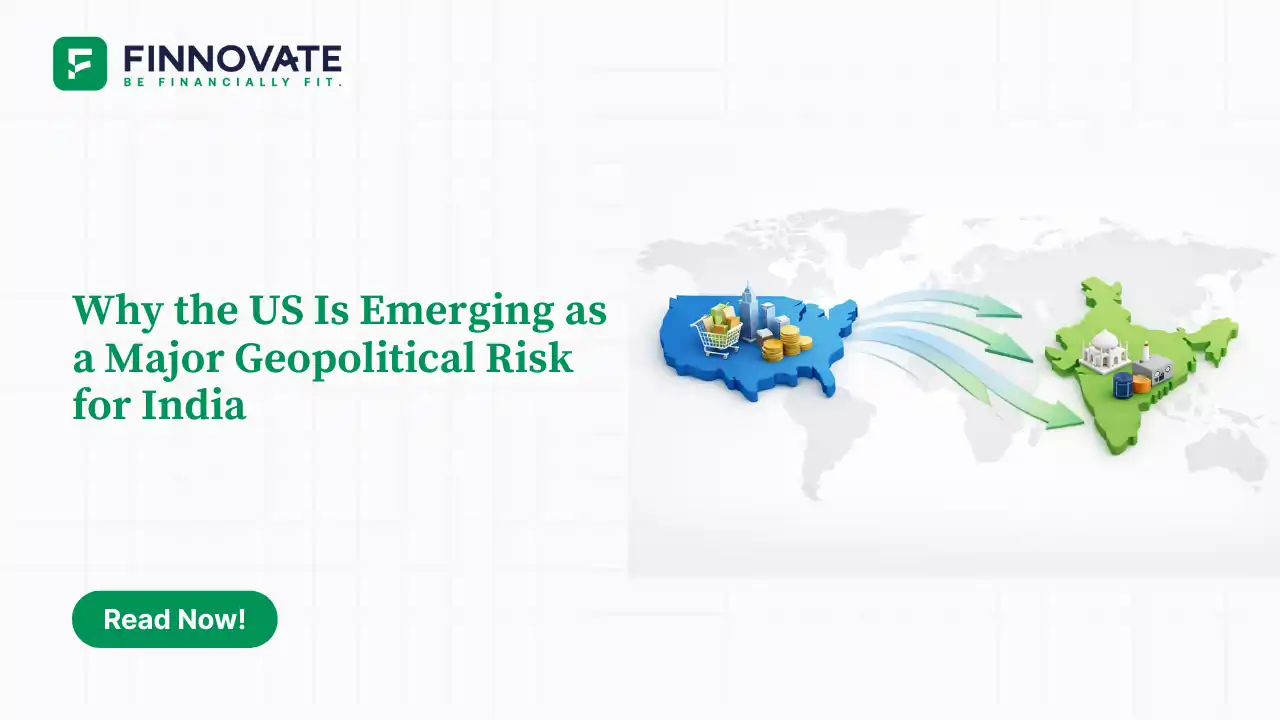
For a long time, geopolitical risk meant one thing.
Trouble in the Middle East.
Oil supply disruptions.
Wars that blocked trade routes.
Sanctions that slowed down global supply chains.
That definition no longer fits today’s world.
The biggest geopolitical risk today is not coming from supply chains.
It is coming from consumption, especially consumption in the world’s largest economy - the United States.
This shift matters deeply for India.
Earlier, geopolitical shocks were mostly about availability.
Countries and companies learned to manage this risk by:
But today’s risk is different.
The world is now facing a situation where access to the US consumer itself can be restricted, delayed, or weaponised. When the largest consumer market uses its buying power as leverage, traditional risk management stops working.
At first glance, this sounds counter-intuitive.
For decades, the US was seen as:
When global uncertainty rose, money flowed into the US, not away from it.
That perception has changed.
The US has increasingly used its economic and political strength to shape outcomes in its favour, even if it creates uncertainty for others. Tariffs, sanctions, visa controls, and unilateral actions are no longer exceptions. They are becoming tools of negotiation.
The shift is visible across multiple fronts.
The US has repeatedly used tariffs as pressure tools, often outside the traditional World Trade Organization framework. Countries without favourable trade deals face penalties, making multilateral trade rules less relevant.
Tightening of H1B visa norms and higher thresholds directly affect countries like India that export skilled services. Indian technology companies, in particular, have felt this impact.
Recent actions involving Venezuela highlight a deeper concern. The message is clear: access to resources can be overridden by state power, and global institutions may remain silent spectators.
International bodies often struggle to act when large powers take unilateral decisions. This weakens predictability and increases risk for emerging economies.
Together, these actions signal a new reality. Geopolitical risk can now be created deliberately, not just triggered by conflict.
India has been one of the countries most exposed to this shift.
The impact has come in layers:
When access to the US market becomes uncertain, India’s growth engines feel the pressure.
Over the last few years, companies globally adopted the China Plus One strategy to reduce supply chain risk.
This worked for manufacturing and sourcing.
But consumption risk is harder to fix.
You can move factories.
You cannot easily replace the world’s largest consumer market.
When the US restricts access to its consumption, diversification becomes far more complex. That is the structural challenge India and other export-oriented economies are now facing.
Despite these risks, India is not without protection.
One key factor stands out.
India’s economy is largely driven by domestic demand.
Roughly:
This means:
This does not eliminate risk, but it reduces vulnerability.
To handle this new form of geopolitical risk, India needs a clear long-term approach.
Some priorities stand out:
This is less about reacting and more about preparing.
The US will remain the world’s largest economy and a major global force.
But it is no longer a neutral anchor of stability.
Consumption itself has become a geopolitical lever.
Predictability has reduced.
Rules are more flexible for those with power.
India’s advantage lies in its scale, domestic demand, and long-term growth potential. Navigating this new world requires realism, diversification, and patience.
Disclaimer: This article is for general information and educational purposes only and should not be treated as financial, legal, tax, or investment advice.
No spam. Only new posts, simple explainers, and practical money checklists for busy professionals.
Finnovate is a SEBI-registered financial planning firm that helps professionals bring structure and purpose to their money. Over 3,500+ families have trusted our disciplined process to plan their goals - safely, surely, and swiftly.
Our team constantly tracks market trends, policy changes, and investment opportunities like the ones featured in this Weekly Capsule - to help you make informed, confident financial decisions.
Learn more about our approach and how we work with you:
No comments yet. Start the conversation. What would you add?
No spam. Only new posts, simple explainers, and practical money checklists.
You may also like
Rising oil prices and booming AI investment are shaping an uneven global economy in 2026. ...
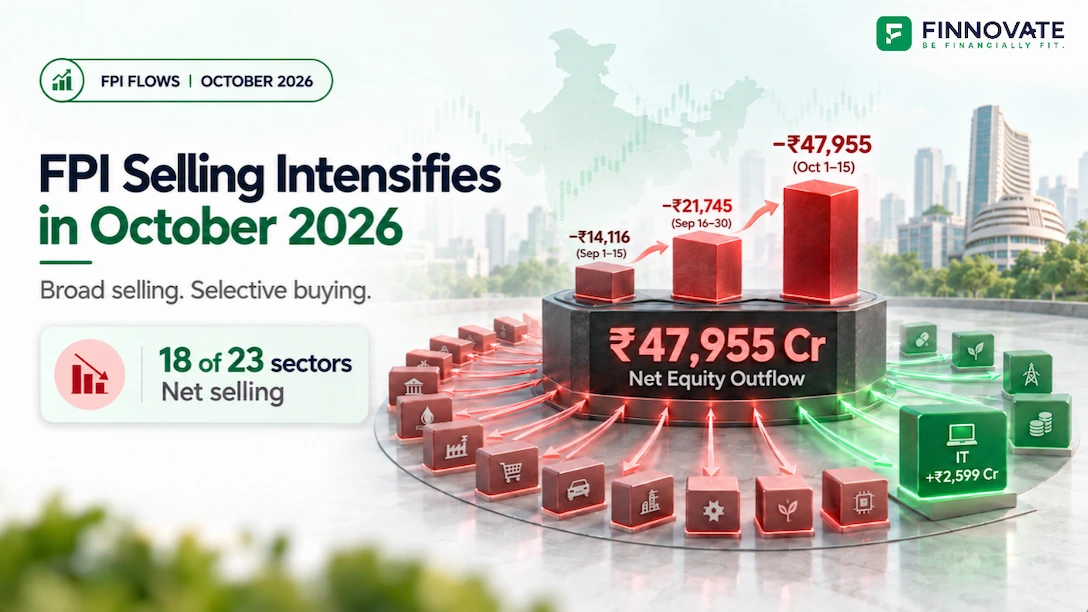
Explore FPI equity flows for October First Half, 2026: ₹47,955 crore in net outflows, th...
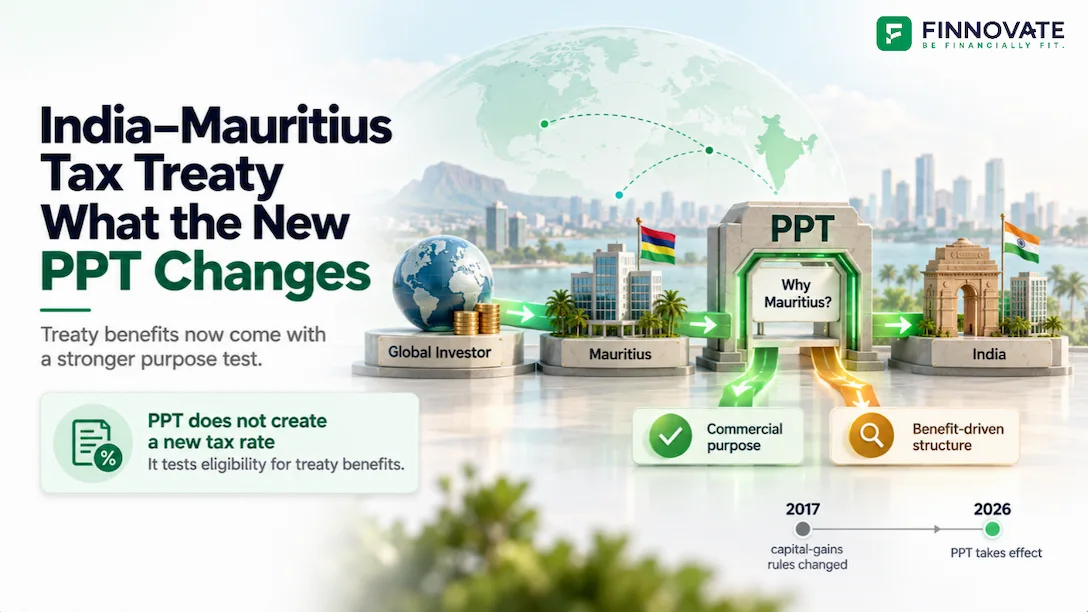
Understand the India–Mauritius tax treaty’s Principal Purpose Test, its August 2026 ef...

Explore India’s AI hardware opportunity through the proposed Adani–Jabil venture, from...
Popular now
Learn how to easily download your NSDL CAS Statement in PDF format with our step-by-step g...

Looking for the best financial freedom books? Here’s a handpicked 2026 reading list with...
Learn what SIF investment means in India, SEBI rules, Rs 10 lakh minimum investment, avail...
Clear guide to mutual fund taxation in India for FY 2025–26 after July 2024 changes: equ...