
India–Mauritius Tax Treaty: Principal Purpose Test Explained
Understand the India–Mauritius tax treaty’s Principal Purpose Test, its August 2026 ef...
22 October 2026
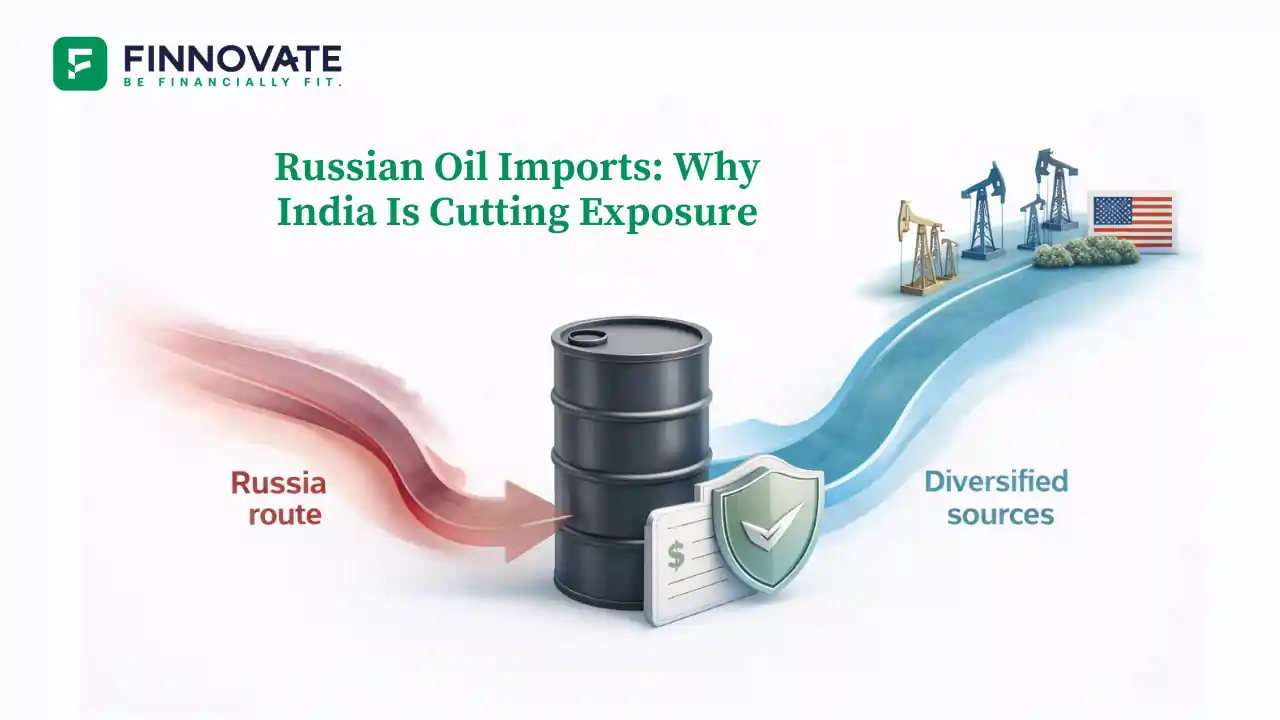
India’s crude oil strategy has always been a balancing act between price, reliability, and geopolitics. For nearly four years, discounted Russian crude helped Indian refiners manage costs and protect inflation in a high-volatility world. But the context has changed.
Under the evolving India–US trade understanding, India is under pressure to reduce Russian oil purchases, and the economic upside from Russian crude has also narrowed as discounts have shrunk. At this point, reducing dependence on Russia is not just about optics. It is increasingly becoming a practical decision for trade, payments, and long-term positioning.
What matters now is not whether India should cut Russian oil. The real question is how India cuts without creating a cost shock or weakening energy security.
Despite talk of “zero imports,” India cannot realistically eliminate Russian crude in one clean move.
In recent months, Russia has accounted for roughly 35% to 40% of India’s crude import basket at its peak levels, which is too large to replace instantly without disrupting refinery economics and supply chains.
But the direction is clear. Russia’s share has already started falling and Middle East barrels are rising again.
The bigger constraint is not only volume. It is the operating friction that comes with sanctioned supply chains.
Buying Russian crude is no longer just a “price decision.” It is a settlement decision.
Even when oil is available, transactions can get complicated because:
That is why India’s reductions in Russian crude are not only diplomatic signals. They are also risk management decisions for refiners, banks, insurers, and trading partners.
This is also consistent with recent reporting showing reduced Russian purchases and shifting crude sourcing patterns.
The practical trigger for faster adjustment is the India–US trade understanding that linked trade outcomes and punitive tariffs to India’s Russian oil purchases.
So the trade-off becomes clearer for India:
If the discount advantage is shrinking, then carrying high compliance and payment risk starts looking less attractive.

The realistic answer is: unlikely, at least in the near term.
The shift is more likely to look like this:
This “reduce, not eliminate” approach also preserves an important hedge: Russian barrels can sometimes be less exposed to Middle East supply disruptions, depending on shipping routes and geopolitical conditions.
Reducing Russian crude can raise India’s average crude import cost for two reasons.
Sourcing from farther geographies like the US can create:
India is actively working on lowering shipping dependence through domestic freight and tanker arrangements, which signals that logistics costs are now being treated as a strategic issue.
Brent has been trading around $71 per barrel in late February 2026, with markets pricing supply risks linked to geopolitics.
Even if Russia’s discount shrinks, having a diversified import mix matters most when the benchmark price is rising.
One reason India valued Russian crude in recent years is that it reduced dependence on a single geopolitical hotspot.
A fresh Middle East risk premium is visible again in oil markets due to US–Iran tensions, which has been noted as a key driver behind price strength.
There is also a broader strategic concern that any escalation in the region can threaten confidence in shipping lanes. Even when physical supply is not disrupted, markets often price fear quickly.
So India must be careful that “cutting Russia” does not unintentionally become “over-concentrating elsewhere.”
If you step back, the argument is not “Russia bad, US good.” The argument is more practical.
If Russian oil is no longer meaningfully cheaper, then the core reason to absorb payment and compliance friction fades.
India runs a strong trade relationship with the US, and the US remains a critical market for Indian goods and services. The reported tariff linkage to Russian oil purchases shows that this relationship can directly affect India’s exporters.
So even a partial shift of oil purchases toward the US can be seen as:
Even if Russia continues to supply oil, the surrounding ecosystem can remain constrained:
That friction compounds over time, and it shows up as hidden cost.
A common emotional argument is that India should continue buying Russian oil because Russia supported India historically.
But two points matter here:
Diplomacy runs on alignment, timing, and self-interest. Energy procurement is ultimately a national security decision, not a loyalty certificate.
The most realistic path for India looks like “controlled reduction.”
That means:
This approach avoids two extremes:
Disclaimer: This article is for general information and educational purposes only. It does not constitute legal, tax, or investment advice, and should not be treated as a recommendation to take any financial or trading decision.
No spam. Only new posts, simple explainers, and practical money checklists for busy professionals.
Finnovate is a SEBI-registered financial planning firm that helps professionals bring structure and purpose to their money. Over 3,500+ families have trusted our disciplined process to plan their goals - safely, surely, and swiftly.
Our team constantly tracks market trends, policy changes, and investment opportunities like the ones featured in this Weekly Capsule - to help you make informed, confident financial decisions.
Learn more about our approach and how we work with you:
No comments yet. Start the conversation. What would you add?
No spam. Only new posts, simple explainers, and practical money checklists.
You may also like
Understand the India–Mauritius tax treaty’s Principal Purpose Test, its August 2026 ef...

Explore India’s AI hardware opportunity through the proposed Adani–Jabil venture, from...
India’s CPI inflation rose to 5.54% in September 2026. Compare monthly trends, food pric...
The Shiller CAPE ratio is near its 1999 peak. Explore what it means for US stock valuation...
Popular now

Learn how to easily download your NSDL CAS Statement in PDF format with our step-by-step g...

Looking for the best financial freedom books? Here’s a handpicked 2026 reading list with...
Learn what SIF investment means in India, SEBI rules, Rs 10 lakh minimum investment, avail...
Clear guide to mutual fund taxation in India for FY 2025–26 after July 2024 changes: equ...