

The Great Economic Decoupling of 2026: Oil, AI & India
Rising oil prices and booming AI investment are shaping an uneven global economy in 2026. ...
24 October 2026
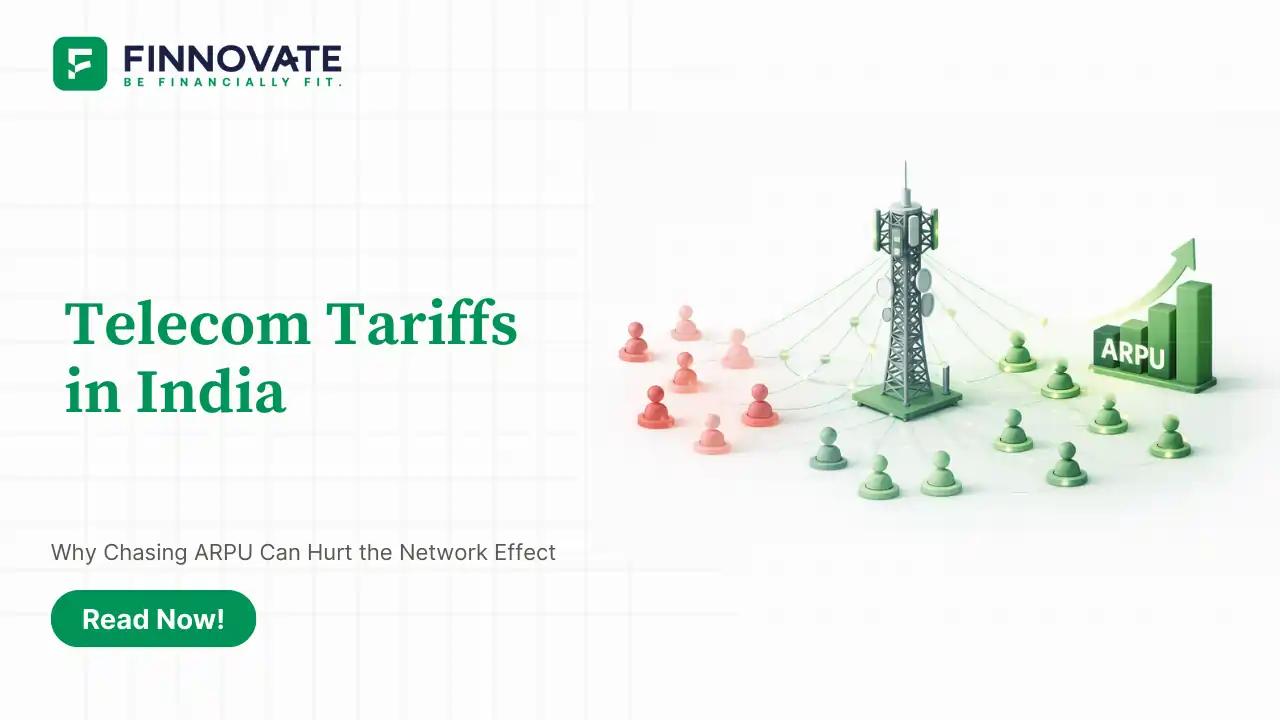
Telecom companies have one favourite metric right now: ARPU (Average Revenue Per User). Every tariff hike, every plan reshuffle, every “premiumisation” pitch eventually circles back to one thing: “ARPU is improving.”
But here’s the uncomfortable question: is maximising ARPU always the right strategy for a telecom business?
Because in India, the ARPU race has come with a hidden bill: 30–35 million customers dropped off. And in a network-effect business, losing users is not a small side effect. It can change the entire economics.
ARPU is simple: how much revenue a telecom company earns per active user in a given period.
Investors love ARPU because it signals:
Telecom is not a light business. Spectrum costs, towers, fiber backhaul, 4G/5G rollouts, maintenance, and customer support are ongoing costs. So yes, higher ARPU helps keep the machine running.
Let’s not romanticise it. Telecom companies are profit-driven businesses. They must cover capital costs and generate returns for shareholders. So an “ARPU-first” mindset can look perfectly logical.
But the problem starts when ARPU becomes the only metric that matters.
Because telecom doesn’t behave like a typical “sell more at higher price” business. It behaves like a network-effect business, where scale itself creates value.
In simple terms, network effect means: a service becomes more valuable as more people use it.
Think of it like:
Telecom works similarly. More users on a network means more calls, more messages, more data usage, more reach, and more relevance. Scale makes the ecosystem stronger.
This is also how telecom exploded in India. In the 1990s, mobile services were limited and high-end. Not because technology was “bad,” but because there weren’t enough people on the network for it to feel like a mass service.
Post-2000, telecom turned into a mass product as adoption surged. More people joined, usage increased, and networks became more valuable. That’s the network effect doing its job.
Here’s the trade-off that’s quietly playing out: to raise ARPU, companies often price out low-paying users or stop designing plans that work for them.
The result is visible: 30–35 million users lost by major telecom players because servicing them was seen as low value. The logic is tempting: these users contribute little revenue, so losing them doesn’t hurt much.
But telecom isn’t just about revenue per user. It’s also about how many active users stay connected to the network.
There’s an old idea often attributed to Dhirubhai Ambani: telecom pricing should be as cheap and accessible as a postcard. The point wasn’t literal pricing. The point was this: in network-effect businesses, accessibility drives adoption, and adoption drives long-term value.
And network effects are fragile. They take years to build and months to lose.
History is full of examples where networks lost relevance when they misunderstood participation. Postal and telegram systems were once powerful because everyone used them. Over time, as people shifted to faster communication networks, their value collapsed. Not because they were “bad,” but because the network moved away.

Many investors believe there’s no alternative to an ARPU focus. Without rising ARPU, telecom companies struggle to cover costs and fund upgrades. That’s true.
But it’s also true that telecom’s long-term strength comes from the network effect. So the smarter approach is not “ARPU vs users.” It is a two-metric strategy:
This means telecom companies need to keep quality services accessible to a large base at reasonable pricing, while still improving profitability through better plan design, smarter segmentation, and efficient costs.
Also, ARPU is volatile. A lot of the ARPU growth narrative since 2020 looks dramatic partly because ARPUs fell sharply after 2015. So “ARPU is up” can sometimes be a recovery story, not a pure growth story.
If you’re tracking telecom companies, ARPU is important. But it’s not the whole picture.
A business that grows ARPU while shrinking its active user base can look stronger in the short term, but it risks weakening its network effect over time. And in telecom, network effect is not a nice-to-have. It’s the core engine.
The bigger long-term question is simple: can the company grow profitability without losing the “more the merrier” advantage?
ARPU stands for Average Revenue Per User. It shows how much revenue a telecom company earns per active user over a period.
Network effect means a telecom network becomes more valuable as more people use it, because participation increases relevance, usage, and ecosystem strength.
To improve ARPU, fund network investments like 4G/5G upgrades, and protect profitability in a capital-heavy business.
It can if higher tariffs push out too many users, weakening the active user base and diluting the network effect over time.
Disclaimer: This article is for informational and educational purposes only and does not constitute investment advice.
No spam. Only new posts, simple explainers, and practical money checklists for busy professionals.
Finnovate is a SEBI-registered financial planning firm that helps professionals bring structure and purpose to their money. Over 3,500+ families have trusted our disciplined process to plan their goals - safely, surely, and swiftly.
Our team constantly tracks market trends, policy changes, and investment opportunities like the ones featured in this Weekly Capsule - to help you make informed, confident financial decisions.
Learn more about our approach and how we work with you:
No comments yet. Start the conversation. What would you add?
No spam. Only new posts, simple explainers, and practical money checklists.
You may also like
Rising oil prices and booming AI investment are shaping an uneven global economy in 2026. ...

Explore FPI equity flows for October First Half, 2026: ₹47,955 crore in net outflows, th...

Understand the India–Mauritius tax treaty’s Principal Purpose Test, its August 2026 ef...

Explore India’s AI hardware opportunity through the proposed Adani–Jabil venture, from...
Popular now

Learn how to easily download your NSDL CAS Statement in PDF format with our step-by-step g...

Looking for the best financial freedom books? Here’s a handpicked 2026 reading list with...

Learn what SIF investment means in India, SEBI rules, Rs 10 lakh minimum investment, avail...

Clear guide to mutual fund taxation in India for FY 2025–26 after July 2024 changes: equ...