

The Great Economic Decoupling of 2026: Oil, AI & India
Rising oil prices and booming AI investment are shaping an uneven global economy in 2026. ...
24 October 2026
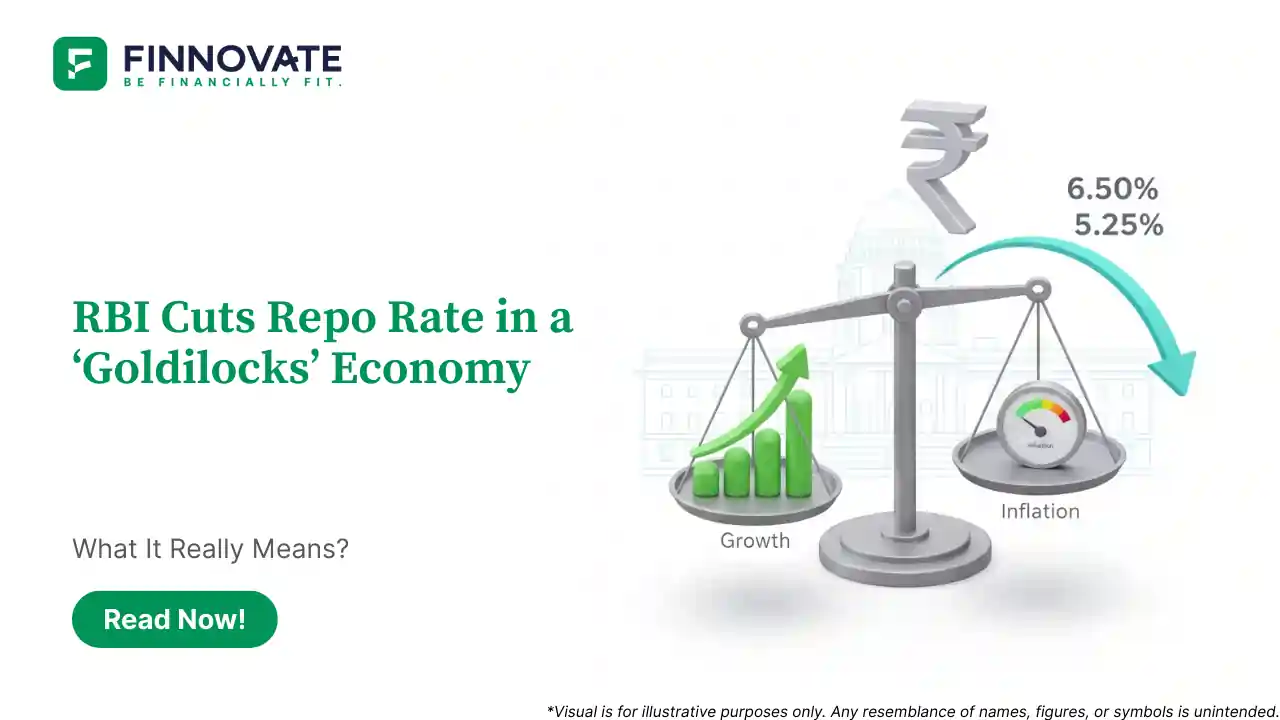
The Reserve Bank of India (RBI) has just cut the repo rate by 25 basis points, taking it from 5.50% to 5.25%. This is the key rate at which RBI lends to banks, and it anchors interest rates across the economy.
On the face of it, this looks like a standard “growth-support” move. But the context this time is very unusual. RBI is cutting rates not because growth is weak or inflation is too high, but because India is in what Governor Sanjay Malhotra called a "rare goldilocks period" – strong growth and very low inflation at the same time.
Let’s understand what happened, why RBI felt comfortable cutting, and what you should watch next.
Along with the rate cut, RBI also announced big liquidity support:
Both moves are designed to inject durable liquidity into the banking system and make sure lower rates actually flow into the economy.
In simple, a goldilocks economy is one where:
That’s the core logic behind the cut – strong growth + very low inflation = space to reduce interest rates.
RBI had expected inflation to cool, but the fall has been faster and sharper than its earlier forecasts, largely due to:
With inflation hovering near the bottom of the 2–6% band, staying too tight on rates would risk:
So, RBI is using this window to bring rates closer to a "neutral" level – not too tight, not too loose.
India’s growth picture looks healthy:
But RBI is clearly aware of external risks:
Cutting rates by 25 bps is RBI’s way of:
It’s a pre-emptive, not a panic move.
A rate cut on paper is not enough if banking system liquidity is tight.
That’s why RBI coupled the repo cut with:
Think of this as RBI saying:
“We’re not just announcing a lower rate. We’re also making sure there is enough money in the pipes so banks can actually lend at lower rates.”

Many past rate cuts came when:
This time, the starting point is different:
So RBI is not using rate cuts as a fire-fighting tool. It is fine-tuning:
That’s why the “goldilocks” phrase matters. It signals that RBI sees this window as an opportunity to gently shift policy towards growth-support without damaging macro stability.
Broadly positive: home, car and business loans linked to repo or external benchmarks should see lower rates over time. The actual benefit depends on how quickly your bank passes on the cut.
FD and other deposit rates are more likely to drift lower in the coming months, not higher. If you rely heavily on fixed income, this is a reminder to review your mix of bank FDs, debt funds and other low-risk options.
Rate cuts plus extra liquidity are supportive for bonds and equities, especially rate-sensitive sectors like banks, NBFCs, autos and real estate. The rupee may stay a bit under pressure, but RBI has clearly signalled that it is comfortable with some currency weakness as long as it remains orderly.
We are already in an easing cycle – 125 bps of cuts in 2025 confirms that.
Whether RBI cuts more from here depends on three things:
So, think of today’s move as:
“A clear shift towards easier conditions, but with the flexibility to pause if the global picture worsens.”
Over the next few months, key things to track are:
Your own decisions for 2026 – loan choices, FD locking, debt vs equity allocation – will be easier if you keep an eye on these three moving parts.
Disclaimer: This article is for information and education only. It is not a recommendation, research report, or investment opinion. Please consult a qualified financial professional before making any loan, investment, or asset allocation decisions.
No spam. Only new posts, simple explainers, and practical money checklists for busy professionals.
Finnovate is a SEBI-registered financial planning firm that helps professionals bring structure and purpose to their money. Over 3,500+ families have trusted our disciplined process to plan their goals - safely, surely, and swiftly.
Our team constantly tracks market trends, policy changes, and investment opportunities like the ones featured in this Weekly Capsule - to help you make informed, confident financial decisions.
Learn more about our approach and how we work with you:
Finnovate is a SEBI-registered financial planning firm that helps professionals bring structure and purpose to their money. Over 3,500+ families have trusted our disciplined process to plan their goals - safely, surely, and swiftly.
Our team constantly tracks market trends, policy changes, and investment opportunities like the ones featured in this Weekly Capsule - to help you make informed, confident financial decisions.
Learn more about our approach and how we work with you:
No comments yet. Start the conversation. What would you add?
No spam. Only new posts, simple explainers, and practical money checklists.
You may also like
Rising oil prices and booming AI investment are shaping an uneven global economy in 2026. ...

Explore FPI equity flows for October First Half, 2026: ₹47,955 crore in net outflows, th...

Understand the India–Mauritius tax treaty’s Principal Purpose Test, its August 2026 ef...

Explore India’s AI hardware opportunity through the proposed Adani–Jabil venture, from...
Popular now

Learn how to easily download your NSDL CAS Statement in PDF format with our step-by-step g...

Looking for the best financial freedom books? Here’s a handpicked 2026 reading list with...

Learn what SIF investment means in India, SEBI rules, Rs 10 lakh minimum investment, avail...

Clear guide to mutual fund taxation in India for FY 2025–26 after July 2024 changes: equ...