

The Great Economic Decoupling of 2026: Oil, AI & India
Rising oil prices and booming AI investment are shaping an uneven global economy in 2026. ...
24 October 2026

India’s quick commerce story still looks strong on the surface. Demand is intact. Usage is rising. Urban consumers continue to value speed and convenience. Yet beneath this growth story, the business finds itself at a critical crossroads.
The challenge is no longer about whether people want 10-minute deliveries. The challenge is whether quick commerce can survive a pricing battle especially with deep-pocketed players like Amazon and Flipkart entering the space.
Blinkit, Instamart, and Zepto continue to see rapid growth. Blinkit reported a 155% year-on-year revenue growth in the first quarter of FY26, with revenues touching ₹2,400 crore. Yet, despite this scale, it posted operating losses of ₹162 crore.
Instamart tells a similar story. With roughly 25% market share compared to Blinkit’s 52%, Instamart grew revenues by 113% to ₹859 crore in Q1 FY26. But its operating losses widened sharply to ₹896 crore.
In short, growth is happening - but profitability is not following.
The biggest challenge for quick commerce today is not customer adoption. It is unit economics.
Dark stores, last-mile delivery, inventory duplication, and hyper-local logistics make quick commerce an expensive model to run. Scale helps, but it does not eliminate these costs. As a result, even rapid revenue growth is failing to translate into operating leverage.
While global private equity and sovereign funds have shown strong interest in backing quick commerce, this capital comes with expectations. Investors are now demanding clearer visibility on profitability - not just expansion.
Over the past few months, Blinkit and Instamart have quietly raised prices and added extra charges. Heavy discounting was never sustainable, and that phase is clearly ending.
So far, the impact on demand has been limited. In large cities, consumers use quick commerce for speed, not for bargains. Paying a little extra for instant delivery has been acceptable.
But this pricing flexibility has limits. As competition intensifies, especially with new entrants willing to undercut prices, maintaining higher charges without losing customers will become harder.
The big question is whether Amazon is late to the quick commerce game. Strategically, the answer may be no.
Amazon has spent years focusing on traditional ecommerce and scaling its AWS business, which has benefited from the AI boom. But quick commerce has always been on its radar. It has now entered the segment selectively in major cities - and at significantly lower price points.
Amazon’s India business alone generates over ₹25,000 crore annually. That scale allows it to run a loss-leader strategy without pressure from private equity or sovereign funds. Reports suggest Amazon is willing to price products 15–20% cheaper than Blinkit and Instamart.
This fundamentally alters the competitive landscape.
Amazon brings several advantages to the table - deep balance sheets, a massive customer base, and a strong presence beyond large cities. Non-urban markets remain price-sensitive, an area where Amazon already has reach.
That said, incumbent quick commerce players are not without strengths. In dense urban markets, speed still matters more than price. Delivery infrastructure, dark store density, and operational experience give Blinkit, Zepto, and Instamart an edge - for now.
The real challenge is not survival. It is whether these platforms can deliver fast, stay competitive on pricing, and still move towards profitability.
Pricing wars rarely end well. If competition forces prices down sharply, margins will suffer across the board.
For quick commerce to remain viable, players will need to focus on operational efficiency, smarter delivery routing, selective pricing, and tighter cost control. Growth alone will no longer be enough.
Most importantly, the industry still lacks a clear, credible path to profitability. Until that emerges, pricing will remain the biggest strategic risk.
Disclaimer: This article is for informational and educational purposes only and does not constitute investment advice.
No spam. Only new posts, simple explainers, and practical money checklists for busy professionals.
Finnovate is a SEBI-registered financial planning firm that helps professionals bring structure and purpose to their money. Over 3,500+ families have trusted our disciplined process to plan their goals - safely, surely, and swiftly.
Our team constantly tracks market trends, policy changes, and investment opportunities like the ones featured in this Weekly Capsule - to help you make informed, confident financial decisions.
Learn more about our approach and how we work with you:
No comments yet. Start the conversation. What would you add?
No spam. Only new posts, simple explainers, and practical money checklists.
You may also like
Rising oil prices and booming AI investment are shaping an uneven global economy in 2026. ...

Explore FPI equity flows for October First Half, 2026: ₹47,955 crore in net outflows, th...
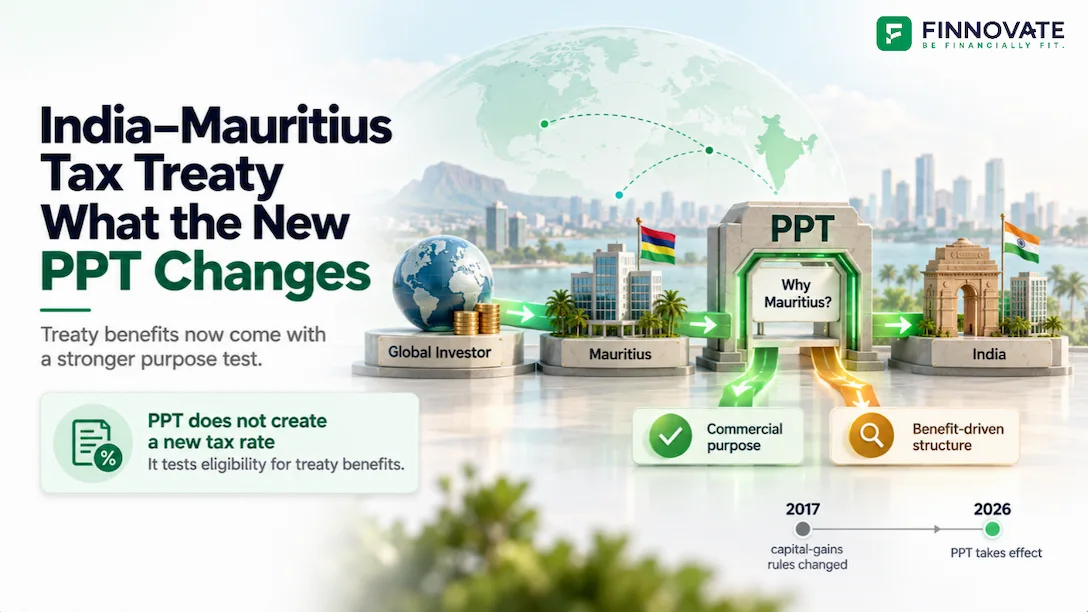
Understand the India–Mauritius tax treaty’s Principal Purpose Test, its August 2026 ef...

Explore India’s AI hardware opportunity through the proposed Adani–Jabil venture, from...
Popular now

Learn how to easily download your NSDL CAS Statement in PDF format with our step-by-step g...

Looking for the best financial freedom books? Here’s a handpicked 2026 reading list with...
Learn what SIF investment means in India, SEBI rules, Rs 10 lakh minimum investment, avail...

Clear guide to mutual fund taxation in India for FY 2025–26 after July 2024 changes: equ...