

The Great Economic Decoupling of 2026: Oil, AI & India
Rising oil prices and booming AI investment are shaping an uneven global economy in 2026. ...
24 October 2026

The government’s recent decision to bar quick commerce companies like Blinkit, Instamart, and Zepto from advertising the 10-minute delivery promise has sent ripples through the industry. While the companies involved are adapting their operations, the change marks a significant shift in how quick commerce is marketed to consumers. The 10-minute delivery claim has long been at the core of the quick commerce business, built on the pillars of speed, churn, and the use of dark stores. But with the government now intervening, how will this regulation impact the industry, and will it change anything about the future of quick commerce?
The 10-minute delivery claim was a hallmark of quick commerce companies when they began in the aftermath of the pandemic. Companies like Blinkit, Instamart, and Zepto argued that back-end logistics, dark stores, and an inventory-based model allowed them to provide lightning-fast delivery. However, this promise has come under scrutiny after gig workers went on strike last year, calling for better pay, social security, and better working conditions, including the pressure created by the unrealistic 10-minute delivery window.
The government’s decision to intervene and ban the 10-minute claim has hit at the heart of the quick commerce business model. Even though companies like Zepto and Blinkit continue to deliver quickly (in an average of 15-20 minutes), the 10-minute marketing claim is no longer permitted. This regulatory move was partly in response to the mounting public and worker pushback, and it certainly changes the dynamic for companies that have relied on speed as their key differentiator.
When quick commerce first launched, the idea of ultra-fast delivery led to a surge in customer satisfaction, which in turn resulted in repeat orders. As consumers were offered the ability to get groceries, daily essentials, and even more complex items at lightning speeds, quick commerce saw a sharp increase in gross order value (GOV).
The 10-minute promise became a significant marketing tool, making the service seem uniquely valuable compared to traditional e-commerce platforms with longer delivery times. However, as the quick commerce model evolved, the promise of a strict 10-minute delivery became more of a marketing tool than a guarantee.
While the 10-minute claim has now been banned from public advertising, it is important to note that the average delivery time in quick commerce has already shifted to about 15-20 minutes. Despite this, many consumers are still satisfied as long as the delivery remains significantly faster than traditional options.
So, will this regulatory change significantly affect sales? It’s unlikely. The speed and convenience remain embedded in the customer’s mind, even if the marketing around the 10-minute claim has to change. The quick commerce business is built on the foundation of a faster-than-usual delivery experience, and as long as that core value remains intact, the brand loyalty and repeat business will continue.
One of the underlying factors that quick commerce companies have leveraged in their growth is the use of aggressive discounting. Discounts were used to attract consumers, incentivizing them to make purchases despite the higher price points for the convenience of speed.
However, as many of these companies face cash burn and operating losses, the prospect of hefty discounts to attract consumers has become a risk that companies are less likely to take. In the early days of quick commerce, heavy discounts were effective in bringing in new customers, but as these companies scale up, sustaining such discounts becomes financially unsustainable.
Quick commerce companies like Blinkit and Zepto are focused on justifying their heavy investments in dark stores and logistics infrastructure, which is more expensive than traditional e-commerce models. While they might offer selective discounts during peak periods (e.g., festivals), it is unlikely that they will engage in aggressive discounting strategies as a long-term model, given the already thin margins in the sector.
While the government’s intervention has restricted direct advertising of the 10-minute delivery claim, quick commerce companies may seek surrogate advertising as a workaround. Surrogate advertising has been a well-known strategy used by industries like alcohol and cigarettes in India, where brands cannot directly advertise their products due to regulatory restrictions.
Quick commerce companies might need to adopt a more subtle approach to continue emphasizing their speed of delivery without directly stating it. This could involve associating with events, sponsoring speed-based activities, or collaborating with brands that share similar values of efficiency and speed. For example, sponsoring fast-paced events like marathons, car races, or technology-driven competitions might help communicate the speed element while staying within the regulatory limits.
As restrictions increase, companies often find creative solutions to keep their core value propositions visible to consumers. In this case, quick commerce brands might engage in more strategic brand associations rather than directly advertising delivery speed.
The government’s decision to ban the 10-minute delivery claim has certainly impacted the marketing strategies of quick commerce companies, but it may not fundamentally alter their business models. The core value proposition of quick commerce - fast delivery and convenience - remains intact, even without the explicit 10-minute promise.
While sales are unlikely to be significantly impacted by the change in marketing, the move may spur companies to innovate in their approach, from competitive pricing to surrogate advertising. As the market matures, quick commerce players will need to balance speed and sustainability, ensuring their model remains competitive while managing profitability.
Disclaimer: This article is for general information and educational purposes only. It does not constitute investment advice, a recommendation, or an offer to buy or sell any securities or mutual fund schemes.
No spam. Only new posts, simple explainers, and practical money checklists for busy professionals.
Finnovate is a SEBI-registered financial planning firm that helps professionals bring structure and purpose to their money. Over 3,500+ families have trusted our disciplined process to plan their goals - safely, surely, and swiftly.
Our team constantly tracks market trends, policy changes, and investment opportunities like the ones featured in this Weekly Capsule - to help you make informed, confident financial decisions.
Learn more about our approach and how we work with you:
No comments yet. Start the conversation. What would you add?
No spam. Only new posts, simple explainers, and practical money checklists.
You may also like
Rising oil prices and booming AI investment are shaping an uneven global economy in 2026. ...

Explore FPI equity flows for October First Half, 2026: ₹47,955 crore in net outflows, th...
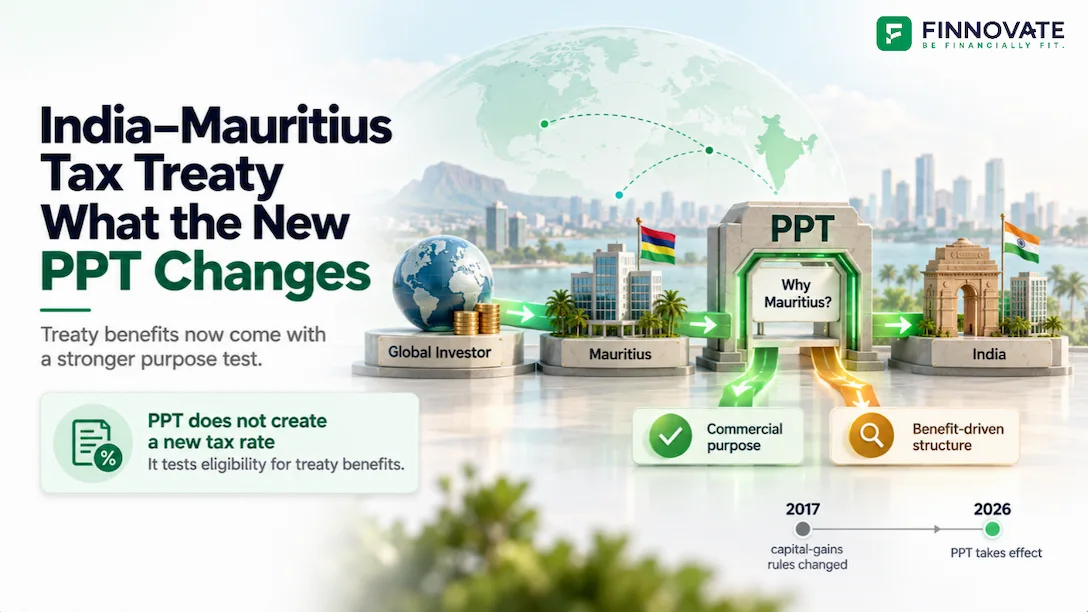
Understand the India–Mauritius tax treaty’s Principal Purpose Test, its August 2026 ef...

Explore India’s AI hardware opportunity through the proposed Adani–Jabil venture, from...
Popular now

Learn how to easily download your NSDL CAS Statement in PDF format with our step-by-step g...

Looking for the best financial freedom books? Here’s a handpicked 2026 reading list with...
Learn what SIF investment means in India, SEBI rules, Rs 10 lakh minimum investment, avail...

Clear guide to mutual fund taxation in India for FY 2025–26 after July 2024 changes: equ...