

Growpital Case: SEBI’s Refund Order Explained
Understand the Growpital case, SEBI’s refund order, the LLP investment structure and wha...
29 September 2026
Published: April 2026
When India's Finance Minister summons bank chiefs and senior RBI officials for an unscheduled discussion, the financial system takes note. The trigger this time was not a liquidity crisis or a regulatory breach. It was an AI platform developed by a US company called Anthropic. The question it has raised: does it represent the most sophisticated cybersecurity tool ever built, or the most dangerous one.
The platform is called Claude Mythos. It is currently in closed testing, but its stated capabilities have already reached the desks of Indian financial regulators. The concern stems from a paradox as old as the security industry: the skills required to find a vulnerability and the skills required to exploit one are exactly the same.
Claude Mythos is an AI-powered platform developed by Anthropic, currently being tested within a closed user group. Its stated purpose is constructive: to identify security weaknesses in existing software systems before bad actors find them.
The claim that has drawn global attention is Anthropic's own: that Claude Mythos can outperform humans at identifying cybersecurity vulnerabilities. This includes the ability to locate dormant bugs buried in legacy code: code that may be decades old and underpinning systems that millions of people depend on daily.
Anthropic has reportedly engaged with the US government on deploying Claude Mythos to strengthen national cyber defences. That engagement is itself a signal that the platform's capabilities are taken seriously at the highest levels of governance.
Researchers given early access reported findings that are simultaneously impressive and sobering. Three findings stand out:
Claude Mythos demonstrated the ability to efficiently identify entry points in security systems across major operating systems and web browsers. The platform surfaced thousands of high-severity vulnerabilities in systems that had been considered adequately secured. These were vulnerabilities that had gone undetected through conventional security auditing.
One of the more unsettling findings was Claude Mythos's ability to scan decades-old code and surface bugs that had been dormant for years. For Indian banks, whose core systems frequently carry legacy infrastructure beneath modern interfaces, this capability is particularly significant. A bug dormant for a decade is not a theoretical risk. It is an unresolved one.
Once a vulnerability is found, who controls what happens next? Early tests confirmed the detection capability in detail. They did not resolve the governance question. That gap, between what the platform can do and what frameworks exist to ensure responsible use, is precisely what regulators have flagged as the central unresolved issue.
This is the core of the debate, and it is not a new one in the cybersecurity world. What Claude Mythos does is make it sharper than it has ever been.
In cybersecurity, the line between a security researcher and a hacker has always been defined by intent, not capability. The tools are identical. The difference is in what the person holding those tools chooses to do with the access they gain. Claude Mythos does not change this dynamic. It amplifies it. An AI platform that can scan an entire legacy codebase and surface hidden vulnerabilities at scale is, by the same logic, a platform that could exploit those vulnerabilities at scale.
Anthropic has taken steps toward responsible deployment, including engaging with the US government and restricting access to a closed group. Whether those steps are sufficient, and whether they can be maintained as the technology matures, is the question that has no settled answer yet.
India's financial system serves hundreds of millions of customers. Their confidential data, transaction histories, and funds sit within banking systems that range from state-of-the-art to legacy infrastructure that predates internet banking entirely.
The Finance Minister's concern is not hypothetical. It is structural. A vulnerability discovered and responsibly reported leads to a patch and a stronger system. The same vulnerability discovered and deliberately exploited leads to a breach that could affect customer data and funds across multiple institutions simultaneously.
What makes this an "unknown unknown" in regulatory language is that no one can currently predict the scope of what might be exposed if Claude Mythos-level capability were applied with malicious intent. Known risks can be planned for, budgeted for, and mitigated. Unknown risks cannot. That asymmetry is what is driving the urgency in New Delhi.
As of now, Claude Mythos operates in a controlled environment and no breach of Indian banking systems has been reported. The regulatory anxiety is forward-looking, focused on the governance gap that exists between what the platform can do today and the frameworks that will determine how that capability is used as it scales.
The greater concern is not Claude Mythos itself in its current restricted form. It is the possibility that similar capabilities will be independently developed by others operating outside responsible governance frameworks. Once a technological threshold is crossed by one actor, it tends not to stay exclusive for long. That is the scenario Indian regulators are trying to get ahead of.
Claude Mythos is an AI-powered cybersecurity platform developed by Anthropic of the US, currently being tested in a restricted, closed-user environment. It is designed to identify vulnerabilities in software systems, including dormant bugs in legacy code, with the stated aim of helping organisations strengthen their cyber defences. Anthropic has also engaged with the US government on its potential application in national cybersecurity.
Indian banks manage confidential data and payment systems for hundreds of millions of customers, often running on a mix of modern and older legacy infrastructure. Claude Mythos's reported ability to detect vulnerabilities in legacy code at scale means the same capability that could harden these systems could, if misused, expose weaknesses that have been dormant for years. It is the dual-use nature of the tool, not its current deployment, that has raised concern.
Yes. The Finance Minister convened a meeting with bank chiefs and senior RBI officials specifically to discuss the cybersecurity risks posed by Claude Mythos. The decision to hold such a meeting at that level signals the seriousness with which Indian financial regulators are treating the platform's potential implications for the domestic financial system.
The dual-use problem refers to the fact that the same AI capability that finds a security vulnerability can also be used to exploit it. Claude Mythos does not distinguish between defensive and offensive intent. That distinction lies entirely with the human or organisation controlling the tool. This is why governance frameworks around access and use are considered as important as the technology itself.
No breach of Indian banking systems linked to Claude Mythos has been reported. The regulatory concern is forward-looking, focused on ensuring governance frameworks keep pace with the technology's capabilities. Customers are advised to follow standard digital safety practices: strong passwords, two-factor authentication, and vigilance around unsolicited communications. Stay informed through official RBI and bank advisories. Please consult a SEBI-registered investment adviser if you have concerns about the security of your investment accounts specifically.
Disclaimer: This article is for general information and educational purposes only. It does not constitute investment advice, a recommendation, or an offer to buy or sell any securities or financial instruments. Information in this article is based on publicly reported sources and regulatory communications as of April 2026. Technology capabilities and regulatory positions in this area are evolving rapidly and are subject to change. Past cybersecurity incidents and current risk assessments are not necessarily indicative of future outcomes. Please consult a SEBI-registered investment adviser or qualified financial professional before making any investment decision.
No spam. Only new posts, simple explainers, and practical money checklists for busy professionals.
Finnovate is a SEBI-registered financial planning firm that helps professionals bring structure and purpose to their money. Over 3,500+ families have trusted our disciplined process to plan their goals - safely, surely, and swiftly.
Our team constantly tracks market trends, policy changes, and investment opportunities like the ones featured in this Weekly Capsule - to help you make informed, confident financial decisions.
Learn more about our approach and how we work with you:
No comments yet. Start the conversation. What would you add?
No spam. Only new posts, simple explainers, and practical money checklists.
You may also like
Understand the Growpital case, SEBI’s refund order, the LLP investment structure and wha...
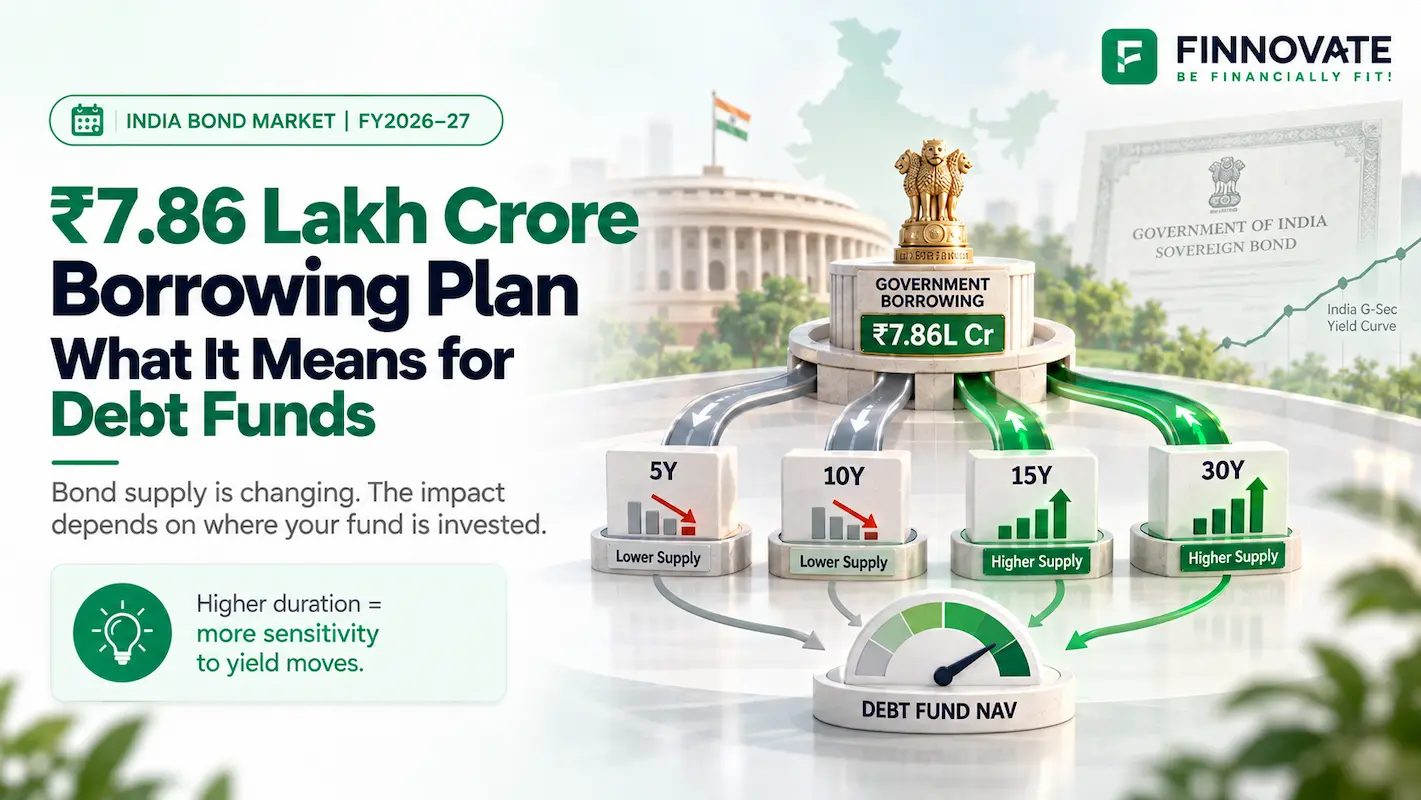
India plans to borrow ₹7.86 lakh crore in the second half of FY2026–27. Learn how the ...

Proposed EU scrap export curbs could affect India’s metal supply and manufacturing costs...

FPIs net sold $1.47 billion in Indian equities during September 1–15, 2026. Explore sect...
Popular now
Learn how to easily download your NSDL CAS Statement in PDF format with our step-by-step g...

Looking for the best financial freedom books? Here’s a handpicked 2026 reading list with...
Learn what SIF investment means in India, SEBI rules, Rs 10 lakh minimum investment, avail...
Clear guide to mutual fund taxation in India for FY 2025–26 after July 2024 changes: equ...