

The Great Economic Decoupling of 2026: Oil, AI & India
Rising oil prices and booming AI investment are shaping an uneven global economy in 2026. ...
24 October 2026
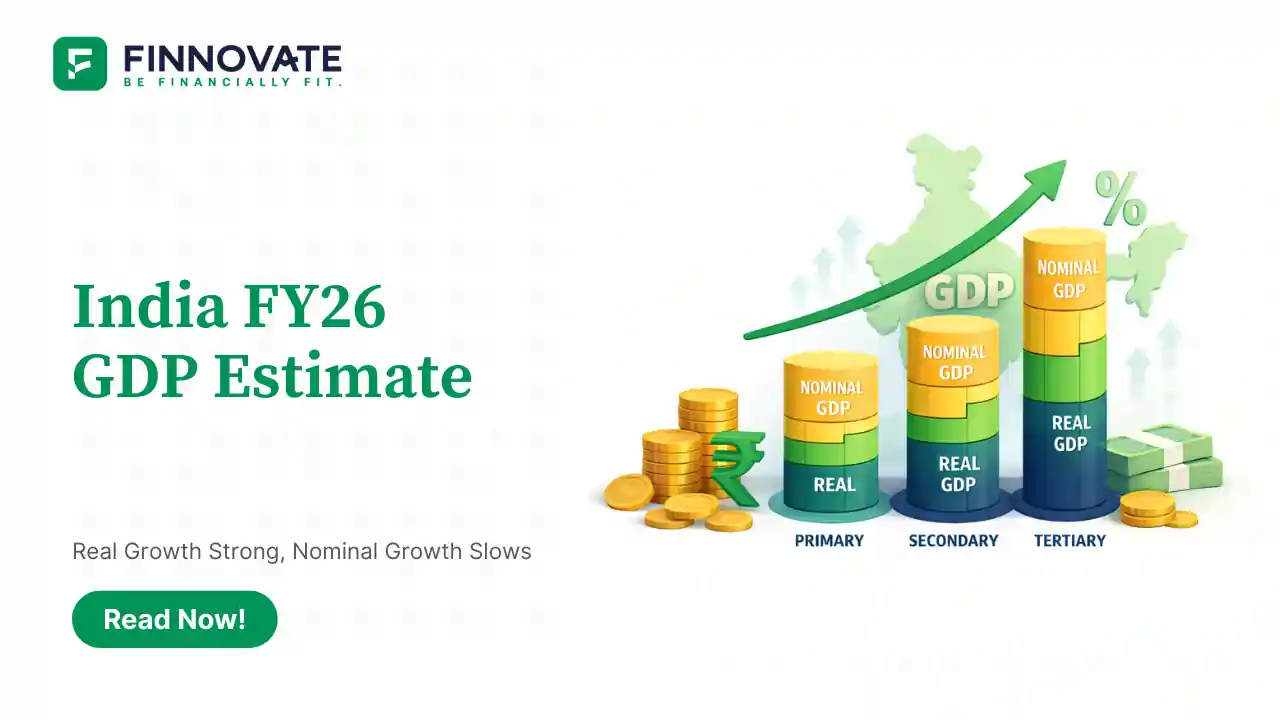
India’s first advance estimate (FAE) for FY26 GDP growth looks impressive on the surface, with a real GDP growth rate of 7.4% compared to 6.5% last year. However, while real growth has improved, nominal GDP growth - the unadjusted measure before inflation - has dropped significantly, raising concerns about the underlying health of the economy.
This contrast between real and nominal growth is a major talking point, as India’s overall economic performance seems at odds with what is happening in some key sectors. Let’s take a closer look at the numbers and break down the key takeaways.
To understand the GDP estimates, it’s important to differentiate between real GDP and nominal GDP.
In FY26, real GDP growth is estimated at 7.4%, but nominal GDP growth has decreased to just 8.0%, compared to 9.8% last year. This decline in nominal growth, despite strong real growth, indicates that inflation has been low, which is good for purchasing power but shows a slowdown in economic demand.
Looking at the performance of different sectors in FY26, the data reveals some interesting trends.
| Sector (Real GDP Growth) | FY24 | FY25 | FY26 (FAE) | FY25 (%) | FY26 (%) |
|---|---|---|---|---|---|
| Primary Sector | 26,97,294 | 28,15,689 | 28,90,621 | 4.4 | 2.7 |
| Agriculture, Livestock, Forestry | 23,67,287 | 24,76,805 | 25,54,071 | 4.6 | 3.1 |
| Mining & Quarrying | 3,30,007 | 3,38,884 | 3,36,550 | 2.7 | -0.7 |
| Secondary Sector | 46,46,499 | 49,31,228 | 52,57,858 | 6.1 | 6.6 |
| Manufacturing | 28,25,935 | 29,53,647 | 31,61,364 | 4.5 | 7.0 |
| Electricity, Gas, Utility Services | 3,82,776 | 4,05,296 | 4,13,702 | 5.9 | 2.1 |
| Construction | 14,37,788 | 15,72,285 | 16,82,792 | 9.4 | 7.0 |
| Tertiary Sector | 88,07,683 | 94,40,529 | 1,03,01,349 | 7.2 | 9.1 |
| Trade, Hotels, Transport | 29,94,536 | 31,76,830 | 34,15,552 | 6.1 | 7.5 |
| Financial, Realty | 38,14,586 | 40,88,072 | 44,94,341 | 7.2 | 9.9 |
| Public Administration, Defence | 19,98,561 | 21,75,628 | 23,91,455 | 8.9 | 9.9 |
| Real GVA | 1,61,51,477 | 1,71,87,446 | 1,84,49,828 | 6.4 | 7.3 |
| Real GDP | 1,76,50,591 | 1,87,96,955 | 2,01,89,919 | 6.5 | 7.4 |
Data Source: MOSPI (Figures are ₹ in Crore) – FAE is First Advance Estimates
The mixed bag of growth across sectors leads to an interesting observation: the real GDP growth for FY26 seems to be primarily driven by low inflation. In other words, while India’s economy is expanding, the growth is largely due to low price pressures rather than increased demand for goods and services.
Despite some challenges in key sectors, such as mining and construction, the strong performance of services has kept the overall economy in a positive trajectory.

There are some positive indicators for the coming quarters:
These green shoots indicate that nominal growth could see a rebound in the coming quarters, driven by strong capital spending and a possible recovery in consumer demand. The upcoming months will likely provide a better picture as inflation stays low and the government focuses on fiscal stimulus.
India’s $5 trillion GDP target remains out of reach for now, given the challenges with nominal growth. However, achieving a $4 trillion GDP is still very much within the realm of possibility, assuming the rupee remains stable and nominal growth picks up in the coming quarters.
The key question will be whether India can continue its growth momentum in the services sector, where a lot of potential lies, or if further challenges in manufacturing and agriculture will prevent India from reaching its ambitious targets.
In conclusion, while FY26 has begun on a positive note with 7.4% real GDP growth, the slower-than-expected nominal growth highlights that inflationary pressures remain under control, but demand-side recovery is crucial for long-term growth.
Disclaimer: This article is for informational purposes only and does not constitute financial, investment, or economic advice. The views expressed are based on available data and are subject to change based on future developments.
No spam. Only new posts, simple explainers, and practical money checklists for busy professionals.
Finnovate is a SEBI-registered financial planning firm that helps professionals bring structure and purpose to their money. Over 3,500+ families have trusted our disciplined process to plan their goals - safely, surely, and swiftly.
Our team constantly tracks market trends, policy changes, and investment opportunities like the ones featured in this Weekly Capsule - to help you make informed, confident financial decisions.
Learn more about our approach and how we work with you:
No comments yet. Start the conversation. What would you add?
No spam. Only new posts, simple explainers, and practical money checklists.
You may also like
Rising oil prices and booming AI investment are shaping an uneven global economy in 2026. ...

Explore FPI equity flows for October First Half, 2026: ₹47,955 crore in net outflows, th...

Understand the India–Mauritius tax treaty’s Principal Purpose Test, its August 2026 ef...

Explore India’s AI hardware opportunity through the proposed Adani–Jabil venture, from...
Popular now

Learn how to easily download your NSDL CAS Statement in PDF format with our step-by-step g...

Looking for the best financial freedom books? Here’s a handpicked 2026 reading list with...
Learn what SIF investment means in India, SEBI rules, Rs 10 lakh minimum investment, avail...

Clear guide to mutual fund taxation in India for FY 2025–26 after July 2024 changes: equ...