

The Great Economic Decoupling of 2026: Oil, AI & India
Rising oil prices and booming AI investment are shaping an uneven global economy in 2026. ...
24 October 2026

Indigo’s recent crisis may finally be cooling off. The DGCA has temporarily rolled back its new pilot-rest regulations, which had sharply reduced Indigo’s flying capability. The decision may not be ideal from a regulatory standpoint, but under the circumstances, it was necessary to prevent a system-wide collapse.
But behind the headlines lies a deeper question: Why did a single regulatory change trigger such widespread disruption? And what does that say about the state of India’s aviation industry?
For nearly two decades, Indigo has run one of the tightest and most efficient operations in global aviation. Its entire model is built on discipline: stretch every aircraft, every crew member, every slot, and every resource to maximize utilization and reduce unit costs.
This “lean, mean, and ruthless” operating model made Indigo incredibly profitable and allowed it to capture 67% of India’s domestic aviation market - nearly a monopoly-like position in a fiercely competitive industry.
But when the DGCA introduced new pilot rest rules, Indigo’s machine stalled. The regulation instantly cut its capacity by nearly 25%, because the airline simply didn’t have enough backup pilots to comply.
The result: cancellations, delays, chaos, and a nearly frozen system.
The DGCA’s intention wasn’t wrong - regulators must balance safety, competition, and consumer protection. But aviation economics in India are brutal:
In such an environment, the only way to remain profitable is to run a super-efficient, Indigo-style model. The DGCA underestimated how deeply Indigo’s scheduling and profitability depended on optimized pilot hours.
Good regulation protects markets without breaking them. In this case, implementation missed the practical realities - and the system buckled.
Critics can argue that Indigo’s model is too aggressive. But the truth is simpler: Indigo’s model works because nothing else does.
Indigo manages to deliver profits, reliability, and scale in a market where most airlines bleed money. Its efficiency is the only reason the Indian consumer enjoys competitive fares.
If anything, India needs more airlines that operate as efficiently as Indigo. That is what will create real competition and prevent one airline from dominating the skies. If competitors continue running bloated, unprofitable models, Indigo will naturally remain at 67–70% market share.
The problem isn’t Indigo’s strength - it’s the weakness of everyone else.

The recent flight disruptions inconvenienced thousands of passengers, no doubt. But the crisis began because the system was adjusted without strengthening the foundation.
India needs:
Without these, even the best airlines will struggle.
Indigo is only doing what the current environment requires: squeezing every resource to survive and stay profitable. Until India builds an ecosystem that supports stable, sustainable aviation economics, Indigo’s model will remain the only viable way to operate.
Disclaimer: This article is for informational and educational purposes only and does not constitute investment advice.
No spam. Only new posts, simple explainers, and practical money checklists for busy professionals.
Finnovate is a SEBI-registered financial planning firm that helps professionals bring structure and purpose to their money. Over 3,500+ families have trusted our disciplined process to plan their goals - safely, surely, and swiftly.
Our team constantly tracks market trends, policy changes, and investment opportunities like the ones featured in this Weekly Capsule - to help you make informed, confident financial decisions.
Learn more about our approach and how we work with you:
No comments yet. Start the conversation. What would you add?
No spam. Only new posts, simple explainers, and practical money checklists.
You may also like
Rising oil prices and booming AI investment are shaping an uneven global economy in 2026. ...

Explore FPI equity flows for October First Half, 2026: ₹47,955 crore in net outflows, th...
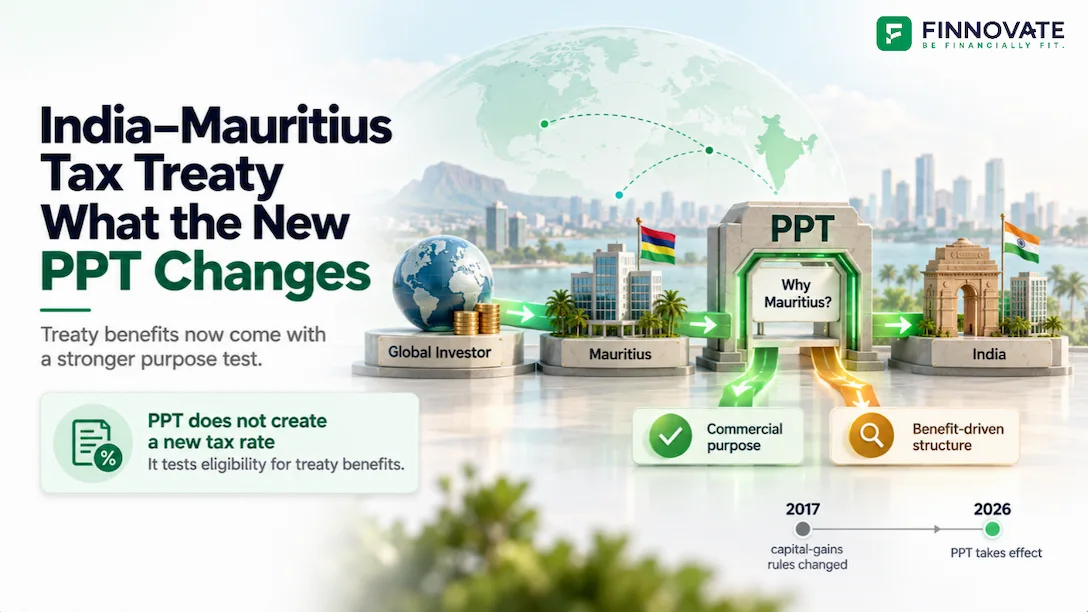
Understand the India–Mauritius tax treaty’s Principal Purpose Test, its August 2026 ef...

Explore India’s AI hardware opportunity through the proposed Adani–Jabil venture, from...
Popular now
Learn how to easily download your NSDL CAS Statement in PDF format with our step-by-step g...

Looking for the best financial freedom books? Here’s a handpicked 2026 reading list with...
Learn what SIF investment means in India, SEBI rules, Rs 10 lakh minimum investment, avail...

Clear guide to mutual fund taxation in India for FY 2025–26 after July 2024 changes: equ...